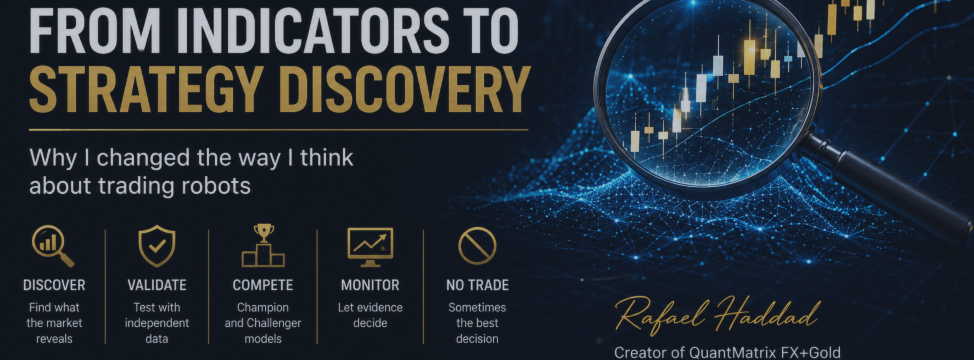
From Indicators to Strategy Discovery: Why I Changed the Way I Think About Trading Robots

For years, my approach to algorithmic trading followed a very familiar path. I would begin with an indicator, define a few parameters, create entry and exit rules, run a backtest, optimize the settings and, if the historical results looked promising, turn the strategy into an Expert Advisor.
It is a perfectly reasonable way to start. In fact, it is probably how most traders and developers first learn to build automated systems.
But after enough time working with this process, one uncomfortable question became impossible for me to ignore:
Was I really discovering something about the market, or was I simply becoming better at making historical data agree with an idea I had chosen beforehand?
That question changed the direction of my research.
The Indicator-First Problem
Most trading systems begin with a human hypothesis.
Perhaps RSI below 30 indicates oversold conditions.
Perhaps a moving-average crossover signals a trend.
Perhaps price breaking a Bollinger Band suggests momentum.
None of these ideas is inherently wrong. The problem appears when the research process becomes emotionally or structurally committed to proving one of them.
Once we decide that RSI, MACD, moving averages or any other indicator will be the foundation of the strategy, optimization can quietly become an exercise in historical persuasion.
We adjust the indicator period.
We change the threshold.
We modify the stop loss.
We move the take profit.
We add a filter.
We remove another filter.
Eventually, after enough experimentation, we often find a configuration that looks excellent.
The equity curve becomes smoother.
Profit Factor improves.
Drawdown falls.
The result looks convincing.
But there is a methodological trap hidden inside that success.
If thousands of configurations were tested, some of them were always going to look impressive simply by chance.
So the most important question is not:
“Did I find a profitable configuration?”
It is:
“Did I find a relationship that remains credible after I actively try to prove it wrong?”
That is a very different research objective.
Reversing the Direction of Research
I eventually became interested in reversing the traditional process.
Instead of:
Indicator → Parameters → Strategy → Market
I wanted to work from:
Market → Data → Discovery → Validation → Strategy
At first glance, this may sound like a minor conceptual adjustment. In practice, it changes the entire architecture of a trading system.
The researcher is no longer deciding in advance what the market must look like.
Instead, indicators and features become raw material.
They are measurements.
Possible descriptions.
Candidate representations.
The system is allowed to search among them, combine them, compare them and reject them.
The strategy should emerge from evidence rather than from loyalty to one indicator.
That distinction became fundamental to the way I think about quantitative trading.
Discovery Is Not Proof
There is another uncomfortable fact.
If we search enough combinations, we will eventually find something extraordinary.
This is not a philosophical statement. It is a statistical consequence of multiple testing.
Suppose an automated research system evaluates thousands of combinations of:
-
indicators,
-
thresholds,
-
timeframes,
-
holding periods,
-
stop distances,
-
profit targets,
-
volatility conditions,
-
regime filters.
Even if most candidate strategies contain no real market advantage, a few may produce spectacular historical results.
If we only look at the winners, those results can appear almost magical.
But the true statistical context is not one impressive strategy.
It is one impressive strategy selected from thousands of attempts.
This is why I stopped treating discovery as the end of the process.
Discovery is only the beginning.
Once a strategy looks interesting, the next job is to become hostile toward it.
We should try to break it.
Make the Strategy Survive
A candidate strategy should be exposed to data it did not use during development.
It should be tested across different historical periods.
It should survive realistic transaction costs.
It should contain enough trades to provide meaningful evidence.
Its performance should not depend entirely on one extraordinary operation.
It should remain coherent when market conditions change.
The objective gradually changes from:
“Find the strategy with the highest historical profit.”
to:
“Find the strategy that survives the greatest number of attempts to invalidate it.”
That is a much more demanding standard.
It also produces a much more interesting architecture.
Separate Discovery From Validation
One of the most important lessons in quantitative research is that the same data should not be allowed to answer every question.
If a dataset helped us discover the strategy, it has already influenced the model.
It should not then be treated as completely independent proof that the model works.
A more disciplined process separates the historical record into different roles.
The training period is where candidates can be discovered.
The validation period helps compare and filter them.
The test period provides another layer of evidence.
A final Holdout can remain untouched until the strategy has survived the earlier stages.
This structure does not eliminate overfitting, but it reduces one of its most common causes: repeatedly adapting a strategy to the same information and then treating the result as independent confirmation.
Walk Forward Through Time
Markets are temporal systems.
Tomorrow cannot be used to teach yesterday.
That sounds obvious, but many backtesting mistakes violate this principle indirectly.
Walk-Forward analysis helps by preserving chronology.
A strategy is discovered using an earlier historical window.
It is then evaluated on a later period.
The process moves forward and repeats.
This produces a much more realistic question:
Can information available at one point in time generate a strategy that remains useful afterward?
A model that only performs well when the entire historical dataset is visible at once deserves far more suspicion than one that repeatedly survives transitions from past to future.
Again, the goal is not certainty.
It is stronger evidence.
Strategy Competition
Another consequence follows naturally.
Why should one strategy remain responsible for trading forever?
Markets change.
Volatility changes.
Liquidity changes.
Trends disappear.
Ranges emerge.
Correlations evolve.
A model that works well in one environment may become mediocre in another.
This led me toward a Champion and Challenger architecture.
The strongest validated model can become the Champion.
Other qualified models remain available as Challengers.
Their performance continues to be monitored.
If evidence supporting the Champion begins to deteriorate, its position should not be permanent.
A Challenger may eventually deserve to replace it.
I find this idea particularly important because it removes a strange assumption from traditional trading systems: that once a strategy has been validated, the intellectual work is finished.
It is not.
Markets keep producing new evidence.
A trading system should be able to respond to that evidence.
Historical Success Is Not Permanent Authority
A model may have survived extensive testing and still deteriorate later.
That does not necessarily mean the original research was wrong.
Markets are not stationary machines.
What matters is whether the system can recognize when the evidence supporting a strategy is weakening.
A Champion might enter probation.
Risk may be reduced.
A Challenger may be promoted.
A strategy may be suspended.
The system should not continue allocating capital simply because a backtest from six months ago once looked impressive.
In other words:
Historical success grants an opportunity to trade. It should not grant permanent authority.
Sometimes the Correct Decision Is Nothing
There was one final idea that became increasingly important to me.
Many trading robots appear to be designed around the assumption that their purpose is to trade.
I think their purpose should be more selective.
A system should trade only when the available evidence justifies taking risk.
That means a quantitative system needs another perfectly legitimate output:
NO TRADE
No position.
No forced prediction.
No trade merely because another candle has appeared.
Sometimes the correct quantitative decision is to remain outside the market.
This may be less exciting than constant activity, but discipline is often less exciting than failure.
From Strategy to Ecosystem
These principles eventually became the foundation of the architecture I call QuantMatrix FX+Gold.
The objective was not to create one clever indicator strategy.
It was to build an environment in which strategies could be:
discovered → tested → challenged → ranked → executed → monitored → invalidated
That makes the system more interesting to me as an ecosystem than as a single trading model.
Some candidates never survive validation.
Some become qualified strategies.
Some become Champions.
Some deteriorate.
Some are replaced.
And sometimes none deserve capital.
That is not a flaw in the architecture.
It is the point.
A Different Question
Algorithmic trading often begins with:
“Which indicator should I use?”
I believe there is a more useful question:
“Which market relationships provide enough evidence to justify trust?”
That shift changes everything that comes afterward.
It changed the way I think about trading robots.
And it became the central principle behind my quantitative research:
Don't force reality to fit the model.
Force the model to prove that it fits reality.
Rafael Haddad
Creator of QuantMatrix FX+Gold
#QuantTrading #AlgorithmicTrading #MetaTrader5 #ExpertAdvisor #TradingSystems #QuantMatrix