Why Structure, Location, Timing and Market Context Must Be Evaluated Separately
Wait for structure. Keep control.
A strong candle breaks a previous high. The chart prints a clear Break of Structure. Momentum appears convincing, and the temptation to enter immediately is strong.
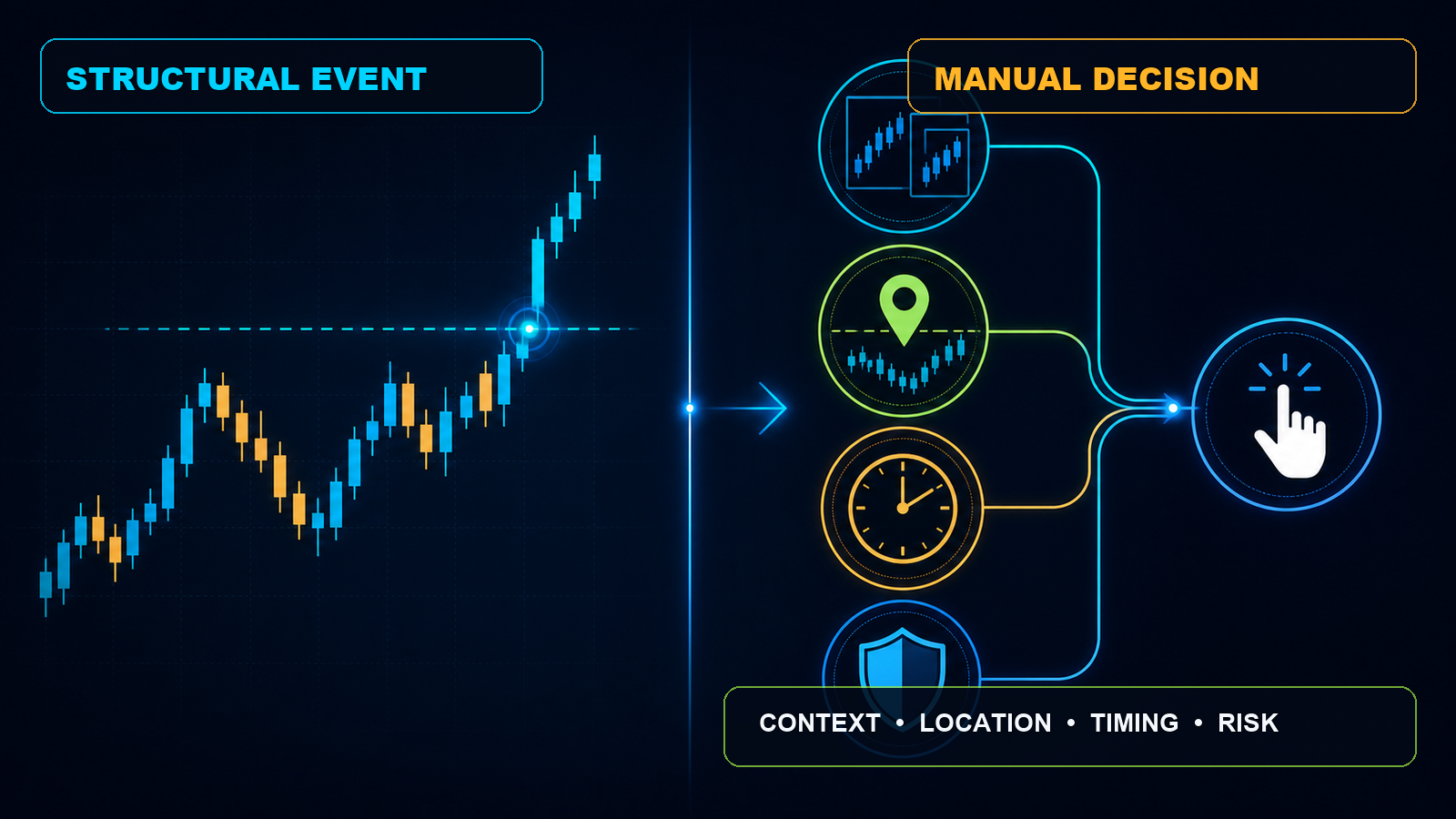
But a valid BOS answers only one question: has price moved beyond an important structural point?
It does not automatically answer whether the timing is suitable, whether the move is already extended, whether the broader market supports the direction, or whether the available risk is acceptable. A structural event can be real while the trade opportunity is poor.
This distinction is one of the most useful habits a developing discretionary trader can learn:
Structure describes what price has confirmed. A trade decision requires additional context.
BOS Is an Event, Not an Instruction
A Break of Structure is evidence that price has progressed beyond a relevant swing. In an established bullish environment, a break above a previous structural high may support a continuation reading. In a bearish environment, a break below a structural low may do the same in the opposite direction.
That information matters. It helps organize the chart and replaces vague impressions with a visible event.
However, the label itself is not a command to buy or sell. Treating every BOS as an entry signal creates a familiar problem: the trader often reacts after the most obvious part of the movement has already happened.
The more useful response is not “BOS means enter.” It is:
“The structure has changed or continued. What must happen next before this becomes actionable for my method?”
The Same BOS Can Mean Different Things on Different Timeframes
Market structure is always connected to timeframe.
An upward break on a five-minute chart may look decisive while the four-hour chart remains bearish. The lower-timeframe event may be the beginning of a reversal, but it may also be only a corrective rally inside a larger decline.
The opposite is equally possible. A bearish lower-timeframe break may appear alarming while the daily structure remains constructive. It could be an early warning, or simply a pullback within the broader trend.
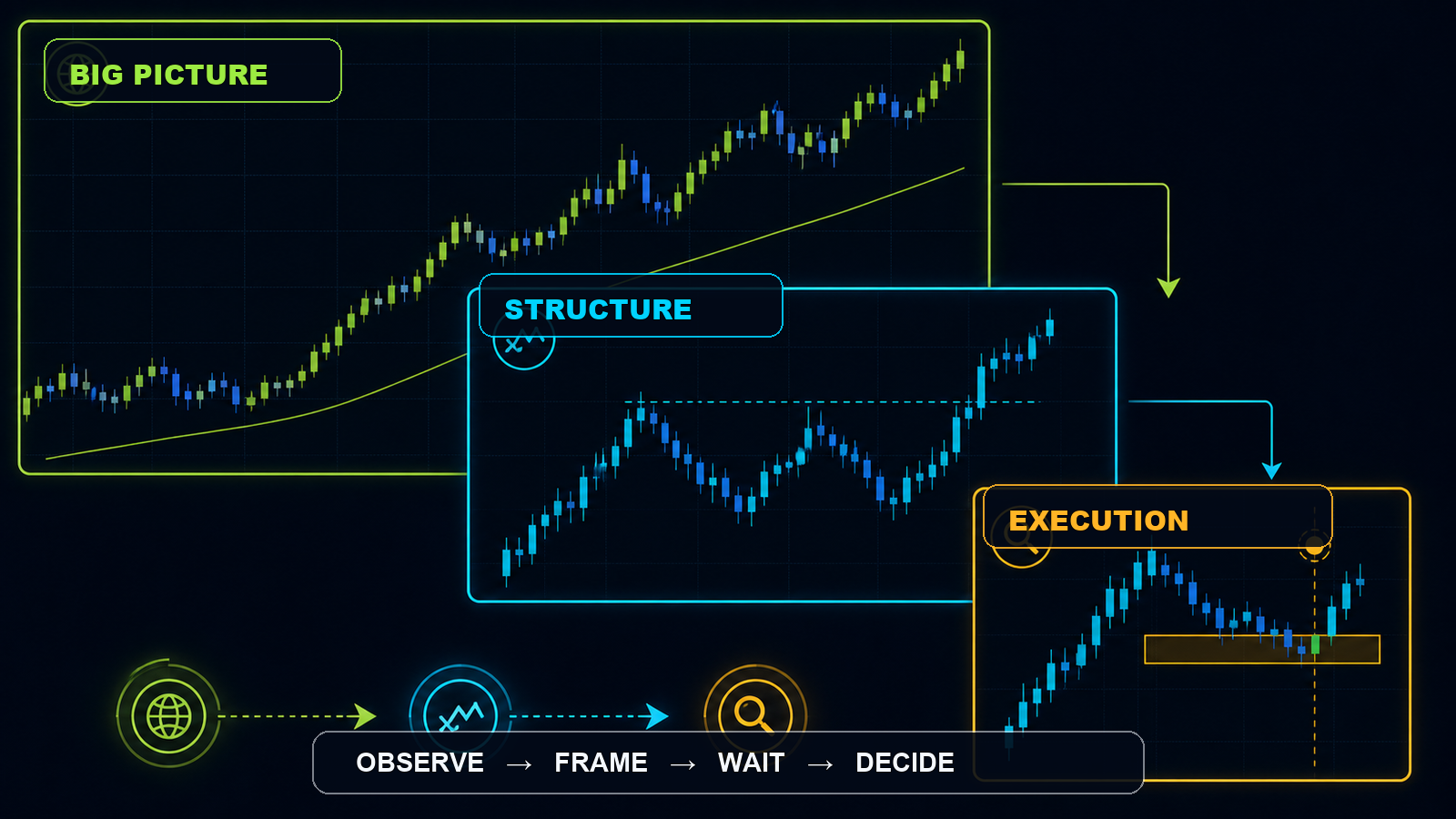
This is why a disciplined workflow separates three perspectives:
- Big Picture — the broader directional environment.
- Structure — the timeframe used to organize swings and structural events.
- Execution — the timeframe used to observe the manual entry process.
Agreement between these layers can create a clearer narrative. Conflict is not a failure of the analysis; it is useful information that may justify patience.
A Valid Break Can Still Be Too Extended
Imagine that price breaks a structural high after several large bullish candles. The BOS is valid, but price is now far from the area that defined the idea.
Entering simply because the break is visible may create poor trade geometry:
- the invalidation point may be too distant;
- the remaining path to the next reference area may be limited;
- volatility may already be elevated;
- late participants may be buying after the expansion rather than before it.
This does not mean that price must reverse. It means that directional correctness and entry quality are separate questions.
A market can continue higher after an extended bullish break. A trader can still be right about direction and wrong about timing.
Location Changes the Meaning of the Event
The same pattern is not equally useful everywhere on the chart.
A bullish BOS occurring directly beneath an important higher-timeframe high deserves a different interpretation from a bullish BOS emerging after a controlled pullback into a relevant area. A bearish break into a well-established support region is different from a bearish break with open space below.
Useful location questions include:
- Is price near a previous daily or weekly reference area?
- Is the break occurring into obvious opposing structure?
- Has the current session already travelled an unusually large distance?
- Is price returning to an area, or escaping from it?
- Where would the idea become invalid?
These questions do not predict the future. They prevent a single label from replacing a complete chart reading.
A Retest Can Improve Clarity, but It Does Not Stay Valid Forever
After a BOS, many traders wait for price to revisit the broken area. A retest may help show whether the level is still relevant and whether buyers or sellers are willing to defend the new side of structure.
But “wait for a retest” should not become another automatic rule.
A return that occurs soon after the break is not identical to a return much later, after new swings and new structural events have developed. Market information has a lifecycle. As time passes, the original event may lose relevance or be replaced by a more recent one.
The right question is not only:
“Did price touch the old BOS level?”
It is also:
“Does this level still belong to the current market story?”
Freshness, intervening price action and the current higher-timeframe state all matter. The exact interpretation belongs to the trader’s tested method.
Timing and Market Conditions Still Matter
Even when direction, structure and location appear aligned, execution conditions may be unsuitable.
Spread can widen. Volatility can be unusually low or unusually high. A market can be inactive, or it can already have completed most of its normal daily movement. A session transition can change participation quickly.
These conditions do not make a structural label false. They influence whether the trader should act on it now.
This is another useful separation:
- Structural validity: did the event happen?
- Context quality: does the broader picture support it?
- Execution quality: are the current conditions suitable for the trader’s plan?
- Risk acceptability: is the invalidation logical and affordable?
Keeping these questions separate makes the final decision easier to explain and review.
A Practical Observation Discipline
Instead of turning every BOS into a trade, use four deliberate actions:
Observe
Identify what price has actually confirmed. Avoid predicting the next candle before the current structure is clear.
Frame
Place the event inside its higher-timeframe, location, volatility and session context.
Wait
Allow price to show whether the structural area remains relevant. Do not treat the first dramatic move as an obligation to participate.
Decide
Make a separate manual decision about entry, invalidation, targets and risk. The structural event is evidence for the decision, not the decision itself.
Observe. Frame. Wait. Decide.
A Workspace for Manual Decision Support
Trading Lab Structure Navigator was created around this philosophy for MetaTrader 5. It organizes multi-timeframe context, visible swing structure and relevant state changes in one manual observation workspace.
It can help a trader distinguish between waiting, watching and invalidated conditions. It never opens, modifies or closes orders. Its internal evaluation and proposal logic remain part of the product rather than a public trading recipe.
You can examine the workflow through the Free Demo on the Trading Lab Structure Navigator product page.
Final Thought
A BOS can be completely valid and still not offer a good trade at that moment.
The purpose of structure is not to eliminate uncertainty. It is to organize it—so that direction, location, timing and risk can be considered before the trader acts.
Wait for structure. Keep control.
Trading Lab Structure Navigator is an analytical and educational utility for manual decision support. It does not guarantee outcomes, provide automated execution or replace independent analysis and risk assessment.