
A profitable backtest is persuasive.
Sometimes, dangerously persuasive.
You see a clean equity curve, a respectable Profit Factor, manageable drawdown and a sequence of trades that seems to confirm everything you hoped the strategy would do. After weeks or months of development, there is a natural temptation to treat that result as the end of the research process.
But in quantitative trading, it should probably be the beginning.
One of the most important changes in the way I started thinking about trading systems was this:
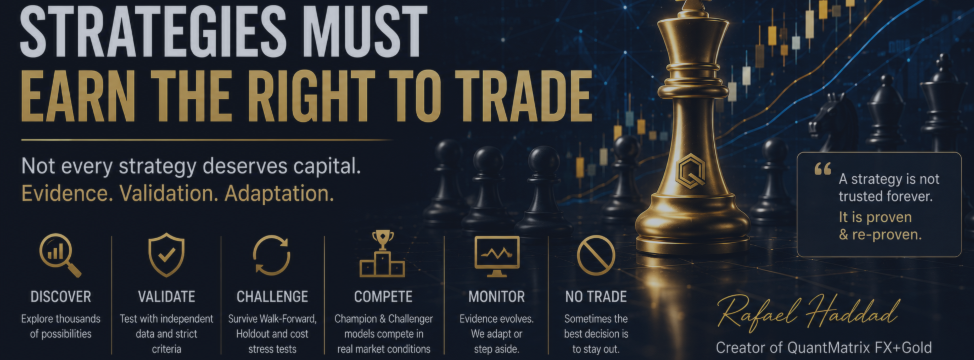
A strategy should not be allowed to trade simply because it performed well in the past.
It should have to earn that right.
The Problem With Historical Winners
Suppose we generate hundreds or even thousands of candidate strategies.
Different indicators.
Different thresholds.
Different timeframes.
Different holding periods.
Different stop-loss and take-profit structures.
Different combinations of market conditions.
Eventually, some models will produce excellent historical results.
That is not surprising.
In fact, it is statistically inevitable.
The more alternatives we test, the greater the probability that a few of them will look exceptional simply because of chance.
The danger begins when we forget how many candidates were rejected before the winner appeared.
A strategy that looks extraordinary in isolation may look far less impressive when we remember that it emerged from thousands of attempts.
This is why the strongest backtest is not automatically the strongest strategy.
Sometimes it is simply the luckiest survivor.
Change the Objective
Once I became more aware of this problem, I started changing the question I was asking.
Instead of:
“Which strategy made the most money?”
I became more interested in:
“Which strategy survives the most attempts to prove that it is wrong?”
That change may sound subtle, but it affects almost every stage of development.
The goal is no longer to search for beauty.
The goal is to search for resilience.
A smooth historical equity curve is attractive.
A strategy that remains credible after being exposed to independent data, costs, different market periods and statistical uncertainty is much more interesting.
Discovery and Validation Must Be Separate
One of the easiest mistakes in algorithmic research is using the same information to both create and validate the strategy.
If historical data helped determine the strategy’s parameters, that data has already influenced the model.
It should not then be treated as completely independent evidence that the model works.
This is why separating historical data into different roles is so important.
A Train period can be used to discover or calibrate candidate strategies.
A Validation period can help compare and filter them.
A Test period provides another layer of independent evaluation.
A final Holdout can remain untouched until the surviving model has already passed the earlier stages.
The purpose of this structure is not to create certainty.
It is to reduce the number of ways in which we can accidentally deceive ourselves.
Walk Forward Through Time
Markets are not static datasets.
They evolve.
Volatility changes.
Correlations shift.
Liquidity conditions vary.
Economic regimes come and go.
A strategy that looks excellent when tested across one large historical block may simply be exploiting characteristics that were specific to part of that period.
Walk-Forward analysis introduces a more demanding question.
Can a model developed using information from the past continue to perform when moved into a later period?
The procedure is simple in concept.
Learn from an earlier window.
Test on the following period.
Move forward.
Repeat.
This respects chronology and better approximates the way a live trading system actually experiences the market.
The strategy never gets to use tomorrow to explain yesterday.
Holdout Data: Evidence We Intentionally Refuse to Touch
One of the most valuable forms of evidence in quantitative research is information we deliberately avoid using.
A Holdout dataset should remain invisible to the strategy discovery process.
No optimization.
No parameter changes.
No threshold adjustments.
No “just one more test” because the previous result was disappointing.
Only after a candidate has survived the earlier stages should it face this unseen data.
The logic is straightforward.
If we keep adjusting the strategy every time it fails on supposedly independent data, eventually that data is no longer independent.
We have simply expanded the optimization process without admitting it.
The Holdout is a defense against that behavior.
Sample Size Matters More Than It Looks
Consider two strategies.
One wins 8 of 10 trades.
The other wins 180 of 300.
The first has an 80% win rate.
The second has 60%.
If we look only at percentages, the first appears superior.
But ten trades provide very little evidence.
A small sample can produce extreme statistics surprisingly easily.
This is why minimum trade requirements matter.
A strategy should not gain confidence simply because it has not yet traded enough to reveal its weaknesses.
The number of observations is part of the result.
A performance statistic without its sample size is incomplete information.
Transaction Costs Are Not an Afterthought
A strategy does not trade in a frictionless universe.
There are spreads.
Commissions.
Slippage.
Execution restrictions.
Different broker conditions.
If a model only remains profitable when these frictions are ignored, then the edge may exist only inside the tester.
For this reason, realistic transaction costs should be part of the validation process.
I also like the idea of stress testing.
What happens if costs are worse than expected?
What happens if slippage increases?
What happens if spreads become wider?
A robust strategy should have some margin of safety.
If a tiny increase in friction destroys the entire edge, that fragility matters.
The Best Trade Can Hide a Weak Strategy
Average performance can also be misleading.
Imagine a strategy that produces +20R over a historical sample.
Now imagine that one single trade produced +15R.
Suddenly the result looks very different.
The strategy may still be legitimate.
Some systems naturally depend on rare, large winners.
But this concentration of performance needs to be understood.
A useful robustness test is to remove the best historical trade and recalculate the statistics.
What remains?
If the strategy still shows positive expectancy, the evidence becomes more convincing.
If the entire advantage disappears, the model deserves more skepticism.
This leads to a principle I consider essential:
A quantitative research system should actively search for reasons to reject a strategy.
The Champion and Challenger Problem
Eventually, some strategies survive.
They have enough trades.
They survive different data partitions.
They remain interesting after transaction costs.
They hold up in unseen data.
At this point, they may become eligible for live trading.
But another question appears:
Why should one strategy remain in control forever?
Markets change.
A model that works well in one regime may become weak in another.
This led me to the idea of a Champion and Challenger architecture.
The Champion is the currently strongest validated strategy.
Challengers are other qualified models waiting for stronger evidence.
The important point is that the hierarchy is not permanent.
A Champion can deteriorate.
A Challenger can improve.
The system should be allowed to change its mind.
Historical Success Is Not Permanent Authority
One of the most dangerous ideas in automated trading is that validation happens once.
A strategy is tested.
It passes.
It goes live.
And from that moment on, it is treated as trustworthy.
But new market data changes the evidence.
Every new trade is information.
A Champion may begin accumulating losses.
Its rolling expectancy may decline.
Its behavior may drift away from historical patterns.
This does not automatically mean the strategy is broken.
Variance exists.
Drawdowns are part of trading.
But deterioration should be monitored.
A strategy can enter probation.
Risk can be reduced.
A Challenger can be promoted.
The Champion can eventually be suspended.
This is not a rejection of the original research.
It is an acceptance of the fact that markets evolve.
Shadow Trading as a Middle Ground
There is also a useful space between historical testing and live capital.
A validated strategy can continue generating simulated trades without actually controlling money.
I think of these as Shadow Trades.
The strategy sees the live market.
It produces signals.
Its hypothetical entries and exits are recorded.
But no real position is required.
This creates another layer of evidence.
It helps answer a very practical question:
Does the relationship discovered in the past continue to appear after the research period has ended?
For new Challengers, this can be an important probationary stage.
Sometimes the Best Strategy Is NO TRADE
There is another consequence of this architecture.
If no strategy currently meets the required level of evidence, the system should not be forced to participate.
This sounds obvious, but many trading robots are built around constant activity.
The market is open.
Therefore, the robot must have an opinion.
I disagree with that assumption.
A quantitative system should be allowed to say:
I do not have enough evidence.
Low expectancy.
Weak confidence.
Unfavorable regime.
Poor execution conditions.
Excessive risk.
Conflicting models.
Any of these may justify staying out of the market.
NO TRADE is not the absence of a decision. It is the decision.
The Objective Is Elimination
The most important realization for me was that quantitative research is not only about finding strategies.
It is about eliminating them.
Generate many candidates.
Reject most of them.
Challenge the survivors.
Monitor the winners.
Remove the ones that deteriorate.
What remains should represent a progressively smaller group of models supported by stronger evidence.
That does not guarantee future profit.
Nothing does.
But it changes the research process from a search for attractive historical results into a search for models that are difficult to invalidate.
That is a much more demanding standard.
And, in my view, a much more useful one.
Final Thought
A strategy should never trade because we want it to work.
It should trade only while the evidence suggests that it deserves the risk.
That principle became one of the foundations behind QuantMatrix FX+Gold.
The system is not designed to trust strategies forever.
It is designed to question them continuously.
Because in quantitative trading, confidence should not be inherited from the past.
It should be earned again and again.
Rafael Haddad
Creator of QuantMatrix FX+Gold
#QuantTrading #AlgorithmicTrading #Backtesting #WalkForward #MetaTrader5 #ExpertAdvisor #QuantMatrix