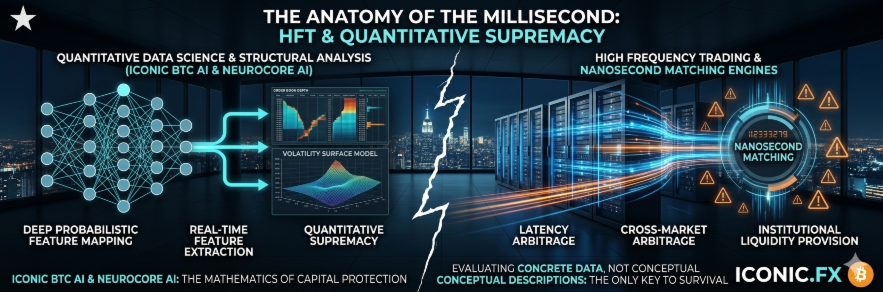
The Anatomy of the Millisecond: How High Frequency Trading and Algorithmic Scalping Dominate Modern Market Structure

The Anatomy of the Millisecond: How High Frequency Trading and Algorithmic Scalping Dominate Modern Market Structure
The architecture of global financial markets has undergone a radical and completely irreversible transformation over the past two decades. When most people think of asset trading, they still envision the classic and heavily romanticized image of turbulent trading floors filled with human beings coordinating orders through chaotic hand signals and shouting across a crowded room. That world no longer exists in reality. The modern marketplace is a fully digitalized, hyper liquified, and relentlessly fast ecosystem anchored deep within the complex server racks of international data centers located in places like Frankfurt, London, Chicago, and New York.
In this new digital reality, asset prices no longer move in leisurely daily steps or predictable hourly intervals. Instead, they shift at the breathtaking pace of nanoseconds and microseconds. Two fundamental trading disciplines divide this ultra high frequency territory between themselves today: High Frequency Trading on the institutional level and highly advanced algorithmic scalping on the quantitative side. Both of these approaches hunt the exact same phenomenon, which is the capture of minuscule price inefficiencies within extremely compressed time windows. Yet, they utilize completely different technological, structural, and financial levers to do so.
To achieve a sustainable statistical advantage or a true trading edge in today’s hyper efficient markets, whether you are operating in the highly volatile crypto space or within classic foreign exchange and commodity trading, you must understand the deep inner anatomy of this millisecond world. Every single order placed by a market participant inevitably interacts with the predatory algorithms of the high frequency elite. This comprehensive article decodes the hidden mechanisms behind institutional execution and short term scalping, analyzes the staggering technological arms race among market participants, and demonstrates why outdated manual retail approaches are mathematically guaranteed to fail in this environment.
1. The Foundation of High Frequency: What is the Real Difference Between HFT and Scalping?
Although these terms are frequently used interchangeably in financial literature and retail trading forums, a vast technological, financial, and regulatory chasm separates true institutional High Frequency Trading from professional algorithmic scalping. The only shared element between them is the extremely brief holding time of positions, which often lasts just a few seconds, milliseconds, or even small fractions of a single second. The method of market access, the depth of capital required, and the underlying mathematical logic could not be more distinct.
High Frequency Trading: The Institutional Infrastructure Elite
High Frequency Trading represents the absolute peak of the quantitative financial world and remains almost exclusively reserved for specialized hedge funds, massive proprietary trading firms, and top tier investment banks. A true high frequency algorithm does not operate based on classic visual patterns found on a standard candlestick chart. It does not look at moving averages or relative strength indicators. Instead, it feeds directly on raw market microstructure, global order flow data, and direct, unfiltered electronic data feeds provided directly by the exchange matching engines.
These firms act primarily as automated market makers. They permanently provide liquidity to the market by simultaneously placing passive buy orders and passive sell orders into the order book. Their profit is generated from the bid ask spread, which is the minor difference between the buy and sell price. They collect this tiny spread millions of times throughout a single trading day without directional bias. As an ironclad rule, these systems do not hold open positions overnight. This completely eliminates the systemic risk of overnight gaps or unexpected macroeconomic events occurring outside regular liquid trading hours.
Algorithmic Scalping: The Mathematical Pattern Hunt
Scalping, on the other hand, is a strictly directional trading strategy. While the institutional market maker passively waits for their orders to be filled on both sides of the order book, the algorithmic scalper actively searches for immediate, short term imbalances in the market to profit from an immediate, rapid price movement in a specific direction.
A modern algorithmic scalper employs highly complex statistical models to identify temporary market inefficiencies. These inefficiencies can include sudden liquidity shortages at prominent technical chart levels, temporary price correlation errors between tightly linked assets across different geographic locations, or the abrupt emergence of heavy institutional buying or selling pressure. The scalper enters the market instantly via automated systems, extracts a few quick pips or cents, and exits the position completely before the surrounding market environment even has time to react to the structural shift.
2. The Microstructure of the Order Book: Where the True Battle is Fought
To truly comprehend the inner functionality of high frequency systems, one must leave the classic candlestick chart behind and look deep into the heart of modern exchange architecture, which is the Limit Order Book. The order book is not a static directory of prices; it is a highly dynamic, multidimensional electronic battlefield where supply and demand collide every single microsecond of the day.
Limit Orders vs. Market Orders: The Hidden Dynamics of Liquidity
The order book essentially consists of two types of instructions that interact with one another:
-
Limit Orders (Passive Liquidity): These orders are entered into the book at a specific price and remain there as resting orders until they are either executed by another market participant or cancelled by the creator. They form the visible depth of the market.
-
Market Orders (Active Liquidity): These orders demand immediate execution at the next available market price. They instantly consume the limit orders resting in the book and serve as the actual catalyst for any price movement.
High frequency algorithms master the manipulation and reading of these order types with mathematical perfection. They use advanced models to calculate the exact toxicity of incoming order flow. If an institutional system recognizes that a massive, aggressive institutional buyer is pushing into the market using urgent market orders, it will cancel its passive limit sell orders within a fraction of a millisecond. This prevents the system from being run over at an unfavorable price by a much larger player.
The Hidden Layers of the Order Book: Level 1, Level 2, and Level 3 Data
Classic retail traders usually only look at Level 1 data, which displays the current best bid and ask price on their platform. Algorithmic systems, conversely, process Level 2 data, which shows the entire visible depth of the order book containing all available volumes across various price levels.
In the institutional sector, firms utilize Level 3 data. Level 3 data allows systems to view and track each individual order in the book by assigning it a specific queue ID. This enables high frequency systems to isolate the behavior of specific market participants, decode their hidden execution intentions, and launch highly specialized predatory trading strategies against them.
3. The Technological Arms Race: Hardware and Networks in the Institutional Sector
In the ultra fast world of high frequency execution, the speed of light is not just a theoretical value discussed in physics textbooks; it is a rigid, unforgiving economic boundary. Anyone who transmits data to the exchange matching engine even a single nanosecond slower than the competition loses their statistical edge and suffers systematic losses due to adverse selection, which is the unfavorable execution against better informed participants. For this reason, quantitative firms execute technological operations on a scale unmatched by almost any other industry on earth.
Co-Location: Physical Proximity to the Heart of the Market
The length of the fiber optic cable running from a trader's server to the exchange's core matching server plays a decisive role in profitability. Every additional meter of physical cable introduces unavoidable signal latency. For this reason, professional firms spend immense sums of money to rent server racks directly inside the very same data center facility where the exchange's matching engine resides.
This process is known as co-location. Exchange operators must meticulously ensure that the physical cables of all co-location clients are cut to the exact same centimeter length to artificially maintain absolute equality of opportunity within the facility.
From Fiber Optics to Microwaves: The Endless Chase for the Direct Path
When data must be transmitted between different financial hubs, such as between cryptocurrency exchanges or derivative markets located in different states or countries, fiber optic cables are simply no longer fast enough. Light travels roughly thirty percent slower through fiber optic glass than it does through a vacuum or open air.
Consequently, trading consortia have erected massive networks of microwave and millimeter wave antenna towers across continents and oceans. These line of sight wireless links transmit data along the absolute direct path with near cosmic velocity. Shaving off just two milliseconds on a route easily justifies infrastructure investments in the hundreds of millions of dollars because the first system to receive the data wins the entire pool of liquidity.
Hardware Acceleration: FPGAs Over Classic CPUs
Even the fastest network connection is completely wasted if data processing within the server takes too long. A classic operating system like Linux requires far too much time to pass an incoming data packet from the network card driver to a software application written in standard programming languages.
Modern high frequency infrastructures utilize FPGAs, which are Field Programmable Gate Arrays. These are microchips whose logical circuits are hardwired at the silicon level to execute a specific trading strategy. The incoming data packet is processed directly on the network interface card itself. Decisions to place, cancel, or modify an order are made within a matter of nanoseconds, bypassing the need for a traditional central processing unit entirely.
4. Anatomy of an Inefficiency: Successful Strategies in High Frequency Space
What mathematical and statistical anomalies do these highly armed systems chase all day long? These strategies can broadly be categorized into three fundamental institutional types.
Statistical Arbitrage and Cross Market Arbitrage
This represents the classic form of low risk exploitation of price discrepancies across different geographical locations or exchanges. If the price of an asset on an exchange in the United States sits at a certain value while it trades on a European platform at the exact same moment for a slightly higher equivalent value, an arbitrage algorithm buys instantly on the cheaper platform and sells simultaneously on the more expensive one.
While this sounds simple, its real world application requires immense speed. Because hundreds of arbitrage bots are hunting the exact same discrepancy, only the absolute fastest system wins the race. All trailing systems are left paying transaction fees or suffering bad fills because the liquidity has already vanished.
Market Making and Pricing Information Asymmetry
Market makers survive entirely on the spread. However, resting buy and sell orders inside the book introduces severe inventory risk. If the market abruptly breaks out in one direction, the market maker is continuously filled on the wrong side, buying in a crashing market or selling in a surging one.
To defend against this adverse selection, these systems deploy advanced stochastic control theories. The algorithm continuously adjusts its spreads and the directional skew of its orders in the order book based on the prevailing volatility index and real time order volume to keep its inventory risk completely neutral.
Predatory Momentum Ignition and Latency Arbitrage
A darker chapter of high frequency execution involves the intentional triggering of market momentum. Here, an algorithm fires a rapid cascade of spoof or aggressive orders to create the illusion of massive buying or selling pressure. Other, less advanced automated systems react to this perceived trend, pushing the price higher. The originating system then instantly flips its position at the absolute peak, profiting directly from the subsequent collapse of the engineered move.
5. Why Classic Retail Scalping Approaches Systematically Fail
Browsing public marketplaces or internet trading forums reveals thousands of commercial offers for high speed retail scalpers, latency arbitrage expert advisors, or tick scalpers. These commercial products promise regular retail traders that they can easily replicate institutional mechanisms on a standard retail account from home. In almost all cases, these attempts end in complete financial ruin. It is critical to understand the exact structural reasons for this failure.
The Illusion of the Broker Feed and the Severe Latency Deficit
A retail trader accesses their broker's server via a standard residential internet connection. The signal travels from the home computer through the local internet service provider to the broker's data center, which then passes the order along to its respective liquidity providers. This process takes, at best, between twenty and one hundred milliseconds.
In that exact window of time, a genuine institutional high frequency system has already scanned, processed, and restructured the market ten thousand times. By the time a retail scalper attempts to enter on a sudden price tick, the actual inefficiency has long been corrected by professionals. The retail trader permanently chases the move, suffering massive slippage and systematically buying the absolute top or selling the absolute bottom of the spike.
The Devastating Impact of Fees, Spreads, and Retail Commissions
Due to their titanic trading volumes, institutional firms pay virtually zero commissions. In fact, at many major exchanges, they receive a financial rebate for every limit order executed, meaning they actually get paid by the exchange to provide liquidity to the market.
The retail trader, by contrast, pays the full spread and a fixed commission per trade to their broker. Because scalping strategies aim to harvest tiny gains per trade, these transaction costs completely erode the mathematical expectancy of the strategy within a very short period. A system that looks flawless in a theoretical backtest without accounting for real world variable spreads and execution slippage degrades instantly into a fee generating machine for the broker, destroying the client's balance.
6. The Cognitive Control Center: The Institutional Approach of ICONIC.FX
At ICONIC.FX, we have thoroughly analyzed the technical nature of the modern high frequency market. We know with absolute certainty that it is structurally impossible for an external retail system to beat the institutional infrastructure elite in raw nanosecond level market making on a hardware layer. Anyone attempting that is building their entire financial foundation on sand.
Therefore, we pursue a fundamentally different and mathematically elegant approach. Instead of trying to fight unwinnable latency wars against multi million dollar microwave networks, we leverage the deep, pattern recognition power of artificial intelligence to read the structural footprints left behind by the high frequency elite within global order flow. Our entire ecosystem operates under an ironclad, non negotiable premise, which is an absolute risk framework and a strict no grid, no martingale philosophy.
We do not combat market chaos with blind execution, but rather through the mathematical symbiosis of two highly specialized neural models that work in harmony:
ICONIC BTC AI: Deep Structural Feature Extraction in the Crypto Space
Bitcoin trading is a uniquely hostile environment characterized by intense volatility, sudden unannounced trend expansions, and predatory liquidity sweeps. Volatility here is routinely exploited by algorithmic giants to engineer artificial price spikes and trap retail participants. The ICONIC BTC AI was designed from scratch to completely ignore this high frequency retail noise.
Rather than calculating lagging technical indicators like standard retail software, its deep neural layers continuously analyze raw market microstructure. The system searches for specific volume accumulation patterns and identifies the exact zones where institutional systems are clustering their liquidity blocks. By precisely extracting these structural features, the execution layer generates high probability, directional signals. Every single trade is protected by clean, uncompromising risk management without dangerous grid averaging, without doubling down, and without structural compromises.
ICONIC NEUROCORE AI: The Master Cognitive Control Layer
While the execution engine focuses on alpha extraction, the ICONIC NEUROCORE AI functions hierarchically above it as the cognitive brain of our entire infrastructure. Based on a sophisticated reinforcement learning framework, the Neurocore engine permanently monitors global market stability and active volatility surfaces across multiple asset classes.
The Neurocore AI functions as an intelligent, adaptive shield. It continuously computes the statistical energy of incoming market data streams. The moment the system registers that market structure is fundamentally altering, such as during a sudden liquidity vacuum, an impending flash crash, or unpredicted high frequency anomalies, it reacts proactively.
The engine does not wait for a rigid stop loss to get clipped in the market after the damage has occurred. It intervenes directly in the risk management layer, automatically compressing position sizes across trading models, tightening structural invalidation thresholds, or freezing trading operations entirely until the market environment stabilizes. This continuous, cognitive control loop ensures that the portfolio remains insulated from systemic risks before damage can manifest.
7. The Technological Workflow of the ICONIC Ecosystem
To guarantee maximum execution integrity and eliminate human error entirely, our entire ecosystem processes data through a strictly sequential, closed chain:
-
Data Injection: Raw microstructure data, order book depth, and rolling volatility metrics stream directly into the ICONIC NEUROCORE AI for real time processing.
-
Regime Analysis: The Neurocore engine calculates the statistical energy of the active market environment, screening the system for structural anomalies and shifts in liquidity.
-
Risk Distribution: The governance layer transmits dynamically calculated risk parameters and volatility limits to the execution layer in real time, adapting to current conditions.
-
Feature Extraction: The ICONIC BTC AI correlates these safety guardrails with active institutional order flow signatures to isolate precise market entries.
-
Precision Execution: Orders are routed directly to deep liquidity pools with optimized electronic latency, completely eliminating human execution risk and emotional interference.
8. Conclusion: The Era of Absolute Computational Supremacy
The evolution of financial markets has drawn an unmistakable line between the past and the future. Trying to survive in short term trading using traditional manual analysis, emotional inputs, or simple, rigidly coded retail bots is the equivalent of bringing a knife to a high tech drone battle.
High frequency trading and algorithmic scalping have pushed market efficiency to a level that forces your systems to adapt continuously or face rapid extinction. Sustainable success does not result from trying to be the absolute fastest player on the network, but from possessing the smartest mathematical models and the most robust risk management frameworks.
Through the technological symbiosis of the precise feature extraction of the ICONIC BTC AI and the forward looking, adaptive risk shield of the ICONIC NEUROCORE AI, we have delivered an infrastructure that bridges professional data science and automated asset management.
Stop relying on lagging indicators, manipulative promises from the retail industry, or emotional gut feelings. Welcome to the era of pure quantitative supremacy.