Temporal Inertia Law: Why Temporal Space Cannot Change Instantaneously

Temporal Inertia Law: Why Temporal Space Cannot Change Instantaneously
Abstract: Most forecasting models assume that market conditions may change abruptly from one minute to the next. The statistical analysis of the VISTmany Temporal Space demonstrates the opposite. The density field evolves continuously. Its internal structure possesses measurable inertia. Abrupt transitions are statistically suppressed. This paper introduces the Temporal Inertia Law, describing one of the fundamental dynamic properties of Temporal Space.
1. Introduction
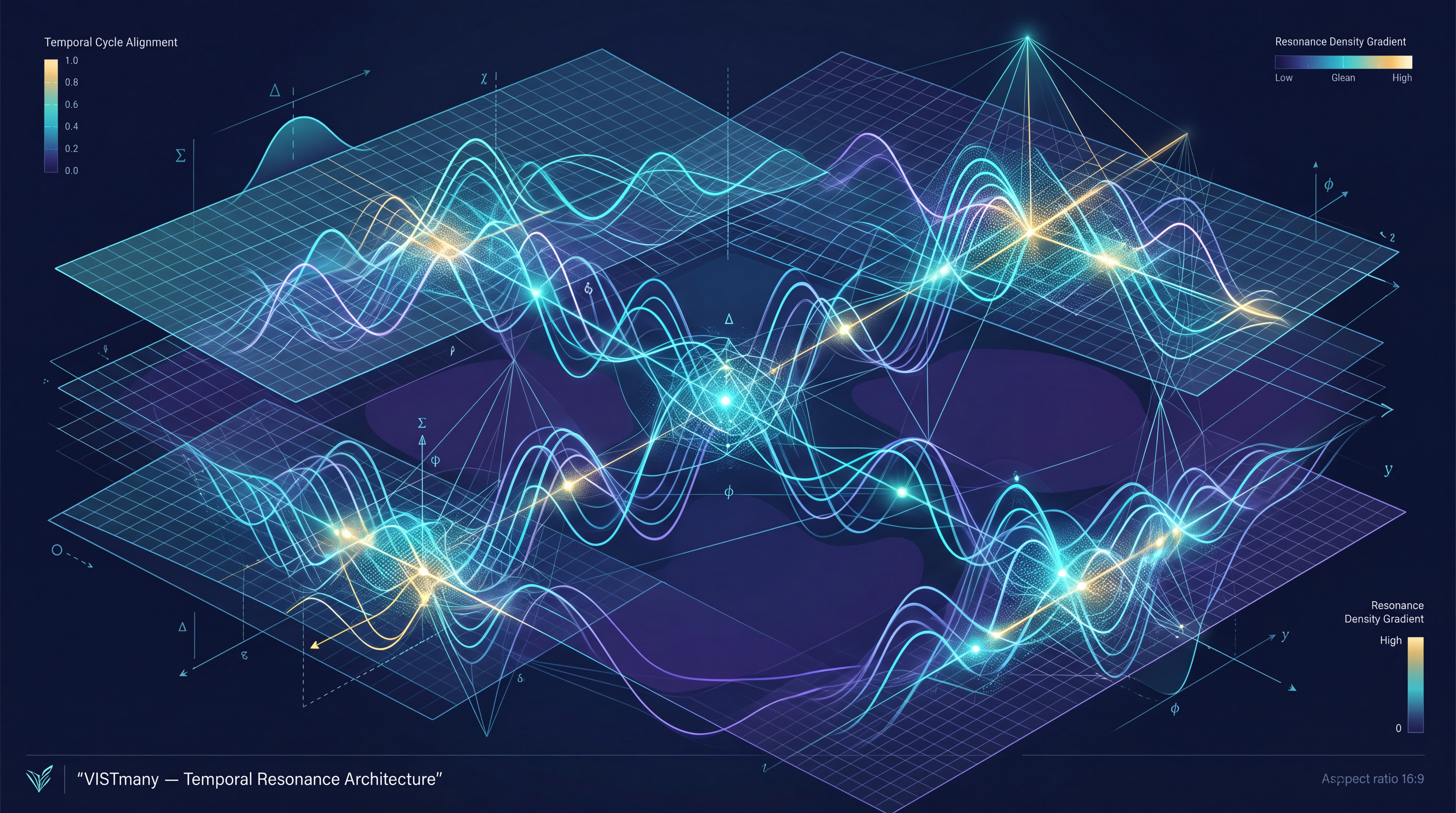
Temporal Space is not a collection of isolated timestamps. It behaves as a continuous field. Every temporal state is connected to neighboring states through measurable transition probabilities. This implies that Temporal Space cannot instantly reorganize itself. Instead, every structural change requires time.
2. Transition Matrix
The transition probability matrix reveals an unexpected property.
For all density states:
P(T→T)=0.73–0.92
Transitions to neighboring densities:
P(T→T±1)=0.07–0.14
Transitions larger than one density level:
P(T→T±2)<0.02
These probabilities form an almost perfectly tridiagonal matrix. Large structural jumps are practically absent.
4. Autocorrelation
Spatial me
mory confirms the same phenomenon.
Autocorrelation values:
- Lag 1: 0.981
- Lag 5: 0.940
- Lag 30: 0.815
- Lag 60: 0.721
- Lag 1440: ≈0
This means that neighboring temporal coordinates remain highly correlated. Only after approximately one day does the system completely lose memory of its previous configuration.
The full article can be read on our website in the Research Journal section:
All articles from the scientific journal VISTmany (Studying financial markets using time. Temporal space):
Exploring the architecture of Temporal Space in financial markets.