The Attention Market: Why News No Longer Moves Prices First

The Attention Market: Why News No Longer Moves Prices First
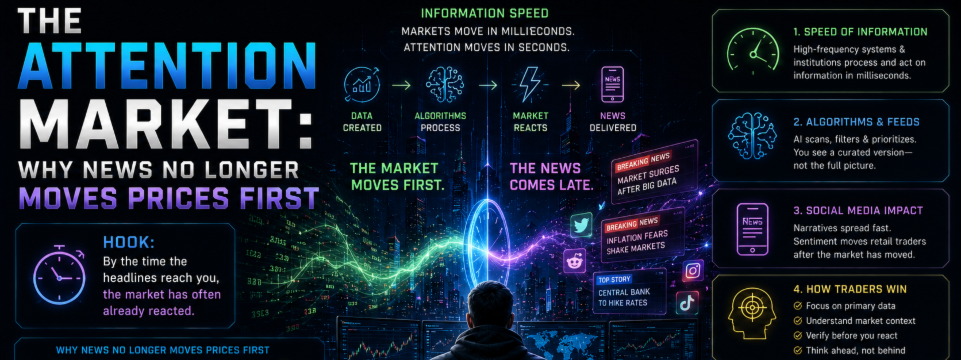
By the time the headline reaches you, the market has often already reacted. Read that sentence again, because it is not a clever hook designed to grab your attention for the next thirty seconds. It is the literal, structural reality of every modern financial market, and understanding it precisely is worth more than every trading course you have ever purchased combined. Most traders are still playing a game that stopped existing years ago, the game where reading the news first gave you an edge. That game is over. What replaced it is faster, more mechanical, and considerably more honest about who actually wins, and this article is going to show you exactly how it works, why chasing headlines is a losing strategy for almost everyone reading this, and what actually works instead.
Part One: The Information Cascade Nobody Ever Explains to You
News does not arrive at every market participant simultaneously. It cascades through a strict, measurable hierarchy of speed, and where you sit in that hierarchy determines almost everything about whether reacting to news can ever work for you. At the very top of the cascade sit raw exchange and data feed connections, where algorithmic systems receive information in fractions of a second, before any human anywhere has had the chance to read a single word. One layer down sit professional grade terminals, delivering information in low single digit seconds, still faster than almost any retail participant will ever experience. Below that sit wire services and financial news outlets, followed by social media distribution, followed finally by push notifications reaching a retail trading app. Only after all of that does a human being actually read the headline, and only after reading it does that human begin the genuinely slow, effortful process of comprehending what it means and deciding what to do about it, a process that takes seconds to minutes even for an experienced trader.
Here is the number that should genuinely unsettle you. By the time a human has finished reading and comprehending a piece of market moving news, multiple layers of faster participants have already acted on it, adjusted their positions, and, in many cases, already begun unwinding those positions as the initial reaction fades. You are not late to the party. You are arriving after the party has already ended and the venue has been cleaned for the next event.
Part Two: How Algorithms Actually Read the News Before You Ever See It
This is not speculation or a futuristic claim. Algorithmic news trading is real, established, and has been operating at scale for years. Systems built specifically for this purpose parse incoming headlines and press releases the instant they hit a data feed, extracting structured meaning, sentiment direction, keyword significance, numeric surprise relative to expectation, and translating that extraction directly into a trading decision within milliseconds. There is no human reading involved in this layer of the cascade at all. A press release announcing an economic figure does not need a person to understand what a better or worse than expected number means, a properly built system extracts that meaning and acts on it faster than the fastest human could physically move a mouse, let alone read and comprehend a full sentence. This is precisely why the sharpest, most violent portion of a news driven price move typically happens within the first few seconds after release, a window during which no retail trader reading a headline manually stands any realistic chance of participating on favorable terms.
Part Three: Social Media Has Become Faster Than the Wire Services That Used to Own This Entire Game
Here is a genuine structural shift worth understanding precisely. Traditional wire services built their authority on verification, an editorial process that, however brief, still took real time. Social media platforms carry no equivalent structural delay, information can be posted the instant someone witnesses it, with zero editorial review standing between observation and publication. This means breaking news frequently reaches public visibility through social platforms before official wire confirmation arrives, a genuine, measurable speed advantage over the traditional news industry that used to sit near the top of this cascade.
This speed advantage carries a real and important cost that deserves equal honesty. The same absence of editorial delay that creates the speed advantage also removes the verification step that historically caught errors before publication, meaning the fastest information in this specific channel is also, structurally, the least verified. Treating unconfirmed social media speed as equivalent to verified wire accuracy is a genuine trap, and understanding the tradeoff between these two channels, rather than blindly trusting whichever one is fastest, is real, practical information literacy.
Part Four: Why Chasing the Headline Is a Losing Game for Almost Everyone Reading This
Say this out loud if you need to, because it needs to be said plainly. If your strategy depends on reading a headline and acting on it faster than the market has already moved, you are not competing against other traders, you are competing against algorithmic systems operating in milliseconds, professional desks operating in low seconds, and an entire cascade of participants who were positioned before you finished reading the first sentence. This is not a fair fight, and it was never designed to be one. Pretending otherwise, continuing to trade as though reading news first is still a viable edge, is one of the most quietly expensive mistakes a retail trader can make, precisely because it feels productive, staying informed, watching the feeds, reacting quickly, while structurally guaranteeing you are always several layers too late to capture the move you think you are trading.
Part Five: The Actual Winning Strategy, Read the Reaction, Not the Headline
Here is the genuinely counterintuitive insight that changes everything once you internalize it properly. Since you are structurally never going to win the speed race against algorithmic and professional participants, stop trying to. The smarter, more honest strategy is reading how the market has already reacted, price action, volume, volatility expansion, rather than reacting to the raw headline yourself. The market's reaction is not noise standing between you and the real information. It is the real information, already aggregated, already processed, already encoding the collective judgment of every faster participant in the cascade who has already acted on what you are only now reading. A large, immediate volatility expansion following a release tells you, with far more reliability than the headline text itself, how the fastest and most sophisticated layer of the market has actually interpreted that release, information genuinely more valuable to you than the original words ever were in isolation.
Part Six: How to Actually Contextualize Information as a Retail Trader
This distinction matters enormously and deserves to be made explicit. Scheduled news, a known economic release at a known time, is fundamentally different from unscheduled, breaking news, and each demands a genuinely different response.
- For scheduled releases, you already know exactly when the cascade is about to fire. The correct response is not attempting to react faster than the algorithms once the release hits, an unwinnable fight, it is preparing your risk exposure in advance of a known volatility window, either standing aside deliberately or ensuring your risk framework is genuinely built to survive the sharp, mechanical volatility spike that a scheduled release reliably produces.
- For unscheduled, breaking news, you have already lost the speed race the moment it happens, full stop, and no amount of refreshing a feed changes that reality. The only honest, viable response is reading the market's already processed reaction, the price and volatility signature left behind by the faster layers of the cascade, rather than attempting to race a headline you were always going to read too late.
Part Seven: This Is Exactly Why Structurally Aware Automated Systems Win This Specific Game
This entire cascade problem is not an abstract inconvenience. It is precisely the structural disadvantage that a well engineered automated system is built to neutralize, because the entire contest described in this article is fundamentally about processing speed and disciplined, unemotional reaction, exactly the dimensions where a human being, however experienced, structurally cannot compete against the layers above them in the cascade. ICONIC TITAN AI was built directly for the scheduled half of this problem, applying a currency aware economic calendar filter that recognizes exactly which upcoming releases genuinely matter to a given instrument, with configurable blackout windows that respect the cascade timing described above instead of pretending a human can outrun it.
ICONIC BTC AI+ and ICONIC GOLD AI+ answer the unscheduled half of this problem directly, through ATR based dynamic stop and position sizing that responds to the market's actual, already processed volatility reaction rather than requiring any system, human or automated, to somehow win an unwinnable race against a raw headline. This is not a workaround. It is the structurally correct response to the exact cascade mechanics explained throughout this article, react to what the fastest layers have already revealed through price, not to the words a human tries and fails to read fast enough. The flagship ICONIC KYBERNETIC AI+ takes this further still, its continuous online learning stack keeping its own understanding of market reaction patterns genuinely current as the cascade itself keeps evolving, rather than trusting a single, aging calibration to remain accurate indefinitely.
Every single one of these mechanisms exists because the news cascade described in this article is real, it is measurable, and it is not going away. You can keep pretending you can outrun it with a faster refresh button, or you can deploy systems specifically engineered around the honest reality that you cannot, and never could.
Frequently Asked Questions
Why doesn't reading news first give traders an edge anymore? Information cascades through a strict hierarchy of speed, raw data feeds reaching algorithmic systems in milliseconds, professional terminals in low seconds, and only much later reaching a human who then needs additional time to comprehend it. By the time a human reads and processes a headline, faster layers of the cascade have already acted.
Do algorithms genuinely read and react to news automatically? Yes. Systems built for this purpose parse headlines and press releases the instant they arrive, extracting sentiment and significance and executing decisions within milliseconds, without any human reading involved at that layer of the cascade at all.
Is social media actually faster than traditional financial news outlets? Frequently, yes, since social platforms carry no equivalent editorial verification delay. This speed comes with a real accuracy tradeoff, since the same absence of review that creates the speed advantage also removes the verification step that historically caught errors before publication.
If chasing headlines does not work, what should a trader actually do instead? Read the market's already processed reaction, price action and volatility expansion, rather than the raw headline itself, since that reaction already encodes the aggregated judgment of every faster participant in the cascade who has already acted.
Should scheduled news and breaking news be handled the same way? No. Scheduled releases allow advance risk preparation before a known volatility window. Unscheduled breaking news has already been processed by faster participants by the time a human sees it, making reaction to the market's response the only viable approach.
Can retail traders realistically compete with algorithmic news trading systems? Not on raw speed, and pretending otherwise is a losing strategy. The realistic path is deploying systems built around the same structural principles, calendar awareness for scheduled events and volatility adaptive response for everything else, rather than attempting to manually outrun an unwinnable race.
Stop Racing a Contest You Were Never Going to Win
The market does not reward the trader who reads fastest. It rewards the trader, or the system, built to respect exactly how information actually cascades through modern markets, preparing for what can be anticipated and reading the market's own reaction for what cannot. Every minute you spend trying to beat algorithmic systems at raw news processing speed is a minute spent losing a fight that was decided before you ever opened the app.
Deploy systems specifically engineered around this exact reality instead. Explore ICONIC TITAN AI for calendar aware signal filtering, ICONIC BTC AI+ and ICONIC GOLD AI+ for volatility adaptive execution, and the flagship ICONIC KYBERNETIC AI+ for continuously learning, coordinated intelligence, at iconicfx.tech. The cascade is not going to slow down for you. Your trading approach has to be the part that finally catches up.
Risk Disclaimer. Trading foreign exchange, cryptocurrencies, commodities and other leveraged financial instruments carries a high level of risk and may not be suitable for all investors. The high degree of leverage can work against you as well as for you. Past performance is not indicative of future results. Automated trading systems, indicators and Expert Advisors do not guarantee profits and can produce losses. ICONIC.FX provides software tools only and does not provide investment advice, portfolio management or financial recommendations. You are solely responsible for your own trading decisions. Seek advice from an independent licensed financial advisor if you have any doubts.