ZigZag does not give signals — 3 errors that make it difficult to understand this

Most traders use ZigZag incorrectly — which is why they end up with false signals and lose money.
As a result, typical problems appear:
- entering against the trend
- constantly changing market bias
- the feeling that the indicator “repaints” and does not work
In reality, the problem is not ZigZag itself, but how it is used. Below are three key mistakes that make ZigZag work against you.
Mistake #1. Treating ZigZag as an entry signal.
One of the most common mistakes is using ZigZag as a source of trading signals.
The logic is usually simple:
- a peak appears — time to sell;
- a bottom appears — time to buy.

But ZigZag is not designed for this. It does not predict price movement and does not show entry points. It only reflects already formed segments of price movement.
As a result, entries come too late, without context, or with a high probability of error.
ZigZag does not answer the question “where to enter.” It answers the question “how the market has moved.” And if you use it as a signal tool — it will inevitably create a false sense of precision.
Mistake #2. Reacting to every ZigZag change
The next mistake is reacting to every ZigZag change as if it were a trend reversal.
Price pulls back slightly — ZigZag redraws → it seems like the trend has changed
Price moves again in the original direction — and again a “new trend”

As a result, it feels like the market is constantly changing, and you have to keep changing your decisions along with it.
The problem is that the classic ZigZag tracks many local fluctuations. It captures movements that do not always matter for the overall market structure.
As a result, the trader:
- keeps changing their bias
- enters trades without a clear logic
- loses track of direction
Not every price movement is a trend change. And not every ZigZag change is a structural shift. If you try to react to every fluctuation, the market will seem chaotic, even when it is moving in a consistent way.
Mistake #3. Ignoring the overall market structure
Another common mistake is focusing only on the last ZigZag point without considering the bigger picture.
Attention shifts to local highs and lows, while losing sight of:
- the overall direction of the market
- whether the current trend is still intact
- whether there are signs of a change

As a result, trades are often opened against the main direction.
For example:
price makes a small pullback down — and it is treated as a sell signal,
even though within the overall structure the market continues to move upward.
One of the reasons is analyzing only one timeframe.
If you look only at the current chart, it is easy to mistake a local move for a trend reversal. But on higher timeframes, the structure may remain unchanged.
As a result, on the lower timeframe it seems like the trend has changed, while on the higher timeframe it continues. And trades are opened against the main market direction.
ZigZag should be viewed not as a set of separate points, but as part of the overall structure that forms across multiple timeframes.
How to use ZigZag correctly?
ZigZag becomes a useful tool only when it is used as intended — to understand market structure and trend, not to find entry points.
The core logic goes from higher timeframe to lower timeframe.
First, determine the direction on a higher timeframe. This is where the main structure forms and sets the context.
- If the higher timeframe shows an uptrend structure — priority remains with buys.
- If the structure is downtrend — priority is given to sells.
After that, drop down to a lower timeframe and look for entry opportunities in the direction of the main move.

This approach allows you to avoid trading against the trend, ignore local fluctuations, and maintain a clear view of the overall market picture.
ZigZag is used here as a tool that helps you see this structure.
And only after the context is clear does it make sense to look for specific entry points.
To use ZigZag correctly, it is important that it highlights not every movement, but the overall sustained trend.
This is exactly the principle behind Valable ZigZag.
It builds a smoother and more consistent picture of movement, filtering out unnecessary pullbacks and minor fluctuations that are not true trend reversals.
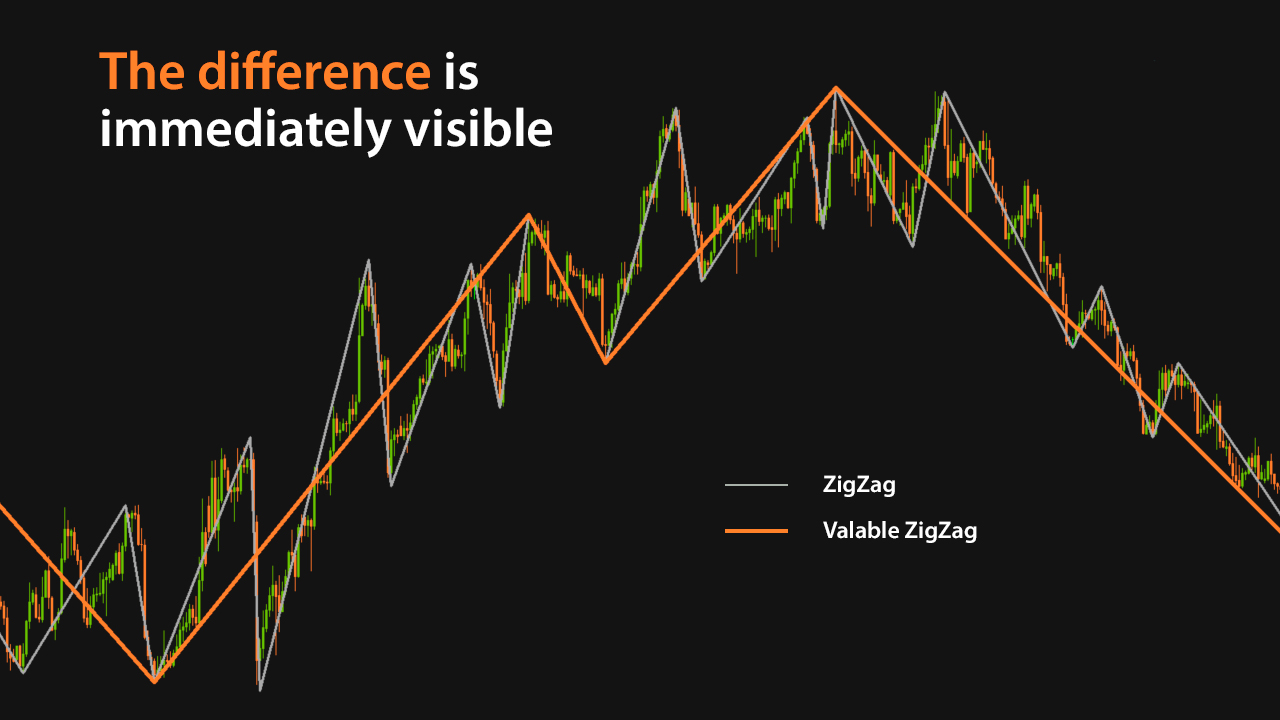
This allows you to:
- clearly see the direction on the current timeframe
- align it with higher timeframes
- avoid reacting to every local move
As a result, the trend is seen as a single movement rather than a set of random changes.
Where to find entry points?
Once the market direction is clear (including higher timeframes), the next question arises — where to enter a trade.
ZigZag, even in its improved form, is not designed for this. It provides context, but does not give specific entry, stop, or target levels.
At this stage, you don’t need just another tool — you need a system that allows you to move from analysis to execution.
Such a system is the Owl Smart Levels indicator.
It does not just add levels to the chart — it defines a clear trading logic:
- where to look for entries in the direction of the trend
- where to place the stop
- how to define targets (Stop Loss and Take Profit)
- under what conditions it is better to skip a trade

Indicator Owl Smart Levels MT5 | MT4 Version
The system includes a ready-made methodology, a detailed guide, a decision-making checklist, and the “Owl Helper” assistant advisor. This allows you not just to analyze the market, but to operate based on a clear algorithm without guesswork.
As a result, Valable ZigZag gives you an understanding of market structure, and Owl Smart Levels turns that understanding into concrete trading actions.
Valable ZigZag becomes useful only when used to understand the trend, but by itself does not give you executable decisions.
To move from analysis to trading, a system with clear rules is required. That system is Owl Smart Levels.