MQL5 Programming Articles

Study the MQL5 language for programming trading strategies in numerous published articles mostly written by you - the community members. The articles are grouped into categories to help you quicker find answers to any questions related to programming: Integration, Tester, Trading Strategies, etc.
Follow our new publications and discuss them on the Forum!
Add a new article

You are missing trading opportunities:
- Free trading apps
- Over 8,000 signals for copying
- Economic news for exploring financial markets
Registration
Log in
You agree to website policy and terms of use
If you do not have an account, please register


Better Programmer (Part 07): Notes on becoming a successful freelance developer
Do you wish to become a successful Freelance developer on MQL5? If the answer is yes, this article is right for you.

MQL for "Dummies": How to Design and Construct Object Classes
By creating a sample program of visual design, we demonstrate how to design and construct classes in MQL5. The article is written for beginner programmers, who are working on MT5 applications. We propose a simple and easy grasping technology for creating classes, without the need to deeply immerse into the theory of object-oriented programming.

MQL5 Wizard: New Version
The article contains descriptions of the new features available in the updated MQL5 Wizard. The modified architecture of signals allow creating trading robots based on the combination of various market patterns. The example contained in the article explains the procedure of interactive creation of an Expert Advisor.

A DLL-free solution to communicate between MetaTrader 5 terminals using Named Pipes
The article describes how to implement Interprocess Communication between MetaTrader 5 client terminals using named pipes. For the use of the named pipes, the CNamedPipes class is developed. For the test of its use and to measure the connection throughput, the tick indicator, the server and client scripts are presented. The use of named pipes is sufficient for real-time quotes.

Evaluation and selection of variables for machine learning models
This article focuses on specifics of choice, preconditioning and evaluation of the input variables (predictors) for use in machine learning models. New approaches and opportunities of deep predictor analysis and their influence on possible overfitting of models will be considered. The overall result of using models largely depends on the result of this stage. We will analyze two packages offering new and original approaches to the selection of predictors.

Using WinInet.dll for Data Exchange between Terminals via the Internet
This article describes the principles of working with the Internet via the use of HTTP requests, and data exchange between terminals, using an intermediate server. An MqlNet library class is presented for working with Internet resources in the MQL5 environment. Monitoring prices from different brokers, exchanging messages with other traders without exiting the terminal, searching for information on the Internet – these are just some examples, reviewed in this article.

Expert Advisor featuring GUI: Adding functionality (part II)
This is the second part of the article showing the development of a multi-symbol signal Expert Advisor for manual trading. We have already created the graphical interface. It is now time to connect it with the program's functionality.

Creating Multi-Expert Advisors on the basis of Trading Models
Using the object-oriented approach in MQL5 greatly simplifies the creation of multi-currency/multi-system /multi-time-frame Expert Advisors. Just imagine, your single EA trades on several dozens of trading strategies, on all of the available instruments, and on all of the possible time frames! In addition, the EA is easily tested in the tester, and for all of the strategies, included in its composition, it has one or several working systems of money management.


Automating Trading Strategies in MQL5 (Part 6): Mastering Order Block Detection for Smart Money Trading
In this article, we automate order block detection in MQL5 using pure price action analysis. We define order blocks, implement their detection, and integrate automated trade execution. Finally, we backtest the strategy to evaluate its performance.

Price velocity measurement methods
There are multiple different approaches to market research and analysis. The main ones are technical and fundamental. In technical analysis, traders collect, process and analyze numerical data and parameters related to the market, including prices, volumes, etc. In fundamental analysis, traders analyze events and news affecting the markets directly or indirectly. The article deals with price velocity measurement methods and studies trading strategies based on that methods.

Library for easy and quick development of MetaTrader programs (part XV): Collection of symbol objects
In this article, we will consider creation of a symbol collection based on the abstract symbol object developed in the previous article. The abstract symbol descendants are to clarify a symbol data and define the availability of the basic symbol object properties in a program. Such symbol objects are to be distinguished by their affiliation with groups.


Bid/Ask spread analysis in MetaTrader 5
An indicator to report your brokers Bid/Ask spread levels. Now we can use MT5s tick data to analyze what the historic true average Bid/Ask spread actually have recently been. You shouldn't need to look at the current spread because that is available if you show both bid and ask price lines.

Thomas DeMark's Sequential (TD SEQUENTIAL) using artificial intelligence
In this article, I will tell you how to successfully trade by merging a very well-known strategy and a neural network. It will be about the Thomas DeMark's Sequential strategy with the use of an artificial intelligence system. Only the first part of the strategy will be applied, using the Setup and Intersection signals.

Martingale as the basis for a long-term trading strategy
In this article we will consider in detail the martingale system. We will review whether this system can be applied in trading and how to use it in order to minimize risks. The main disadvantage of this simple system is the probability of losing the entire deposit. This fact must be taken into account, if you decide to trade using the martingale technique.

Library for easy and quick development of MetaTrader programs (part I). Concept, data management and first results
While analyzing a huge number of trading strategies, orders for development of applications for MetaTrader 5 and MetaTrader 4 terminals and various MetaTrader websites, I came to the conclusion that all this diversity is based mostly on the same elementary functions, actions and values appearing regularly in different programs. This resulted in DoEasy cross-platform library for easy and quick development of МetaТrader 5 and МetaТrader 4 applications.

Testing patterns that arise when trading currency pair baskets. Part III
In this article, we finish testing the patterns that can be detected when trading currency pair baskets. Here we present the results of testing the patterns tracking the movement of pair's currencies relative to each other.

Strategy builder based on Merrill patterns
In the previous article, we considered application of Merrill patterns to various data, such as to a price value on a currency symbol chart and values of standard MetaTrader 5 indicators: ATR, WPR, CCI, RSI, among others. Now, let us try to create a strategy construction set based on Merrill patterns.

Exploring Trading Strategy Classes of the Standard Library - Customizing Strategies
In this article we are going to show how to explore the Standard Library of Trading Strategy Classes and how to add Custom Strategies and Filters/Signals using the Patterns-and-Models logic of the MQL5 Wizard. In the end you will be able easily add your own strategies using MetaTrader 5 standard indicators, and MQL5 Wizard will create a clean and powerful code and fully functional Expert Advisor.

How Long Is the Trend?
The article highlights several methods for trend identification aiming to determine the trend duration relative to the flat market. In theory, the trend to flat rate is considered to be 30% to 70%. This is what we'll be checking.

Developing a cross-platform grid EA: testing a multi-currency EA
Markets dropped down by more that 30% within one month. It seems to be the best time for testing grid- and martingale-based Expert Advisors. This article is an unplanned continuation of the series "Creating a Cross-Platform Grid EA". The current market provides an opportunity to arrange a stress rest for the grid EA. So, let's use this opportunity and test our Expert Advisor.

MQL5 Cookbook: Getting Position Properties
In this article, we will create a script that gets all position properties and displays them to the user in a dialog box. Upon running the script, you will be able to select out of two modes available in the drop-down list in the external parameters: to either view position properties only on the current symbol or to view position properties on all symbols.


Understanding order placement in MQL5
When creating any trading system, there is a task we need to deal with effectively. This task is order placement or to let the created trading system deal with orders automatically because it is crucial in any trading system. So, you will find in this article most of the topics that you need to understand about this task to create your trading system in terms of order placement effectively.

Simple Trading Systems Using Semaphore Indicators
If we thoroughly examine any complex trading system, we will see that it is based on a set of simple trading signals. Therefore, there is no need for novice developers to start writing complex algorithms immediately. This article provides an example of a trading system that uses semaphore indicators to perform deals.

3D Modeling in MQL5
A time series is a dynamic system, in which values of a random variable are received continuously or at successive equally spaced points in time. Transition from 2D to 3D market analysis provides a new look at complex processes and research objects. The article describes visualization methods providing 3D representation of two-dimensional data.

Universal Trend with the Graphical Interface
In this article a universal trend indicator is created based on a number of standard indicators. An additionally created graphical interface allows selecting the type of indicator and adjusting its parameter. The indicator is displayed in a separate window with rows of colored icons.

Change Expert Advisor Parameters From the User Panel "On the Fly"
This article provides a small example demonstrating the implementation of an Expert Advisor whose parameters can be controlled from the user panel. When changing the parameters "on the fly", the Expert Advisor writes the values obtained from the info panel to a file to further read them from the file and display accordingly on the panel. This article may be relevant to those who trade manually or in semi-automatic mode.

Application of the Eigen-Coordinates Method to Structural Analysis of Nonextensive Statistical Distributions
The major problem of applied statistics is the problem of accepting statistical hypotheses. It was long considered impossible to be solved. The situation has changed with the emergence of the eigen-coordinates method. It is a fine and powerful tool for a structural study of a signal allowing to see more than what is possible using methods of modern applied statistics. The article focuses on practical use of this method and sets forth programs in MQL5. It also deals with the problem of function identification using as an example the distribution introduced by Hilhorst and Schehr.

MQL5 Cookbook: Trading strategy stress testing using custom symbols
The article considers an approach to stress testing of a trading strategy using custom symbols. A custom symbol class is created for this purpose. This class is used to receive tick data from third-party sources, as well as to change symbol properties. Based on the results of the work done, we will consider several options for changing trading conditions, under which a trading strategy is being tested.

Graphics in DoEasy library (Part 88): Graphical object collection — two-dimensional dynamic array for storing dynamically changing object properties
In this article, I will create a dynamic multidimensional array class with the ability to change the amount of data in any dimension. Based on the created class, I will create a two-dimensional dynamic array to store some dynamically changed properties of graphical objects.

Timeseries in DoEasy library (part 42): Abstract indicator buffer object class
In this article, we start the development of the indicator buffer classes for the DoEasy library. We will create the base class of the abstract buffer which is to be used as a foundation for the development of different class types of indicator buffers.

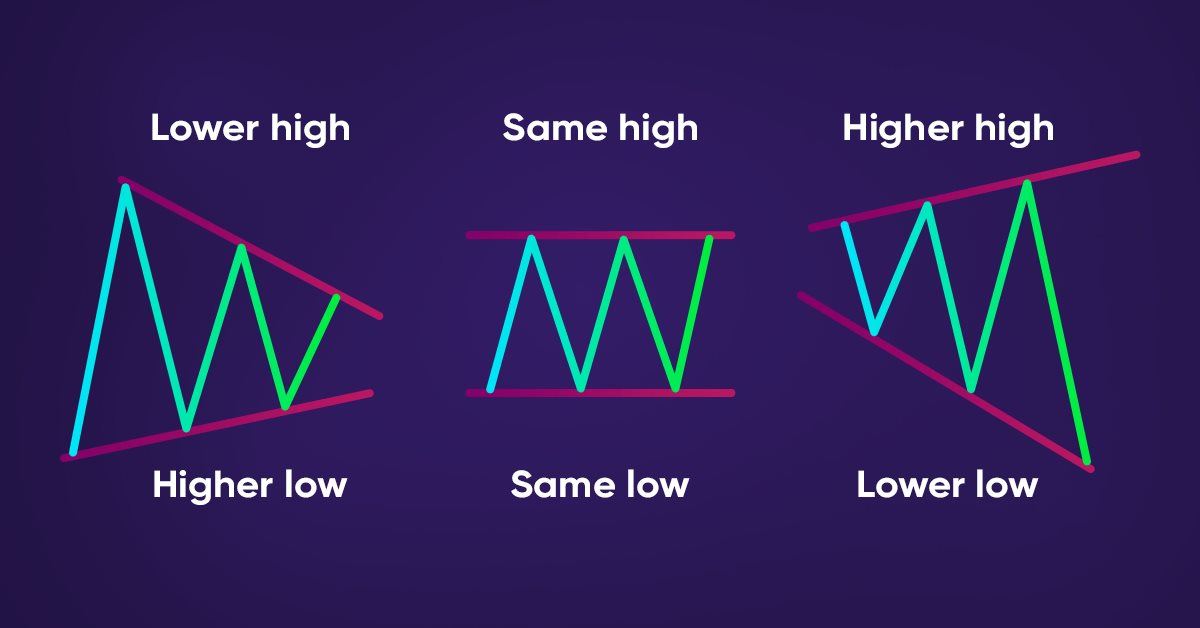
How to detect trends and chart patterns using MQL5
In this article, we will provide a method to detect price actions patterns automatically by MQL5, like trends (Uptrend, Downtrend, Sideways), Chart patterns (Double Tops, Double Bottoms).

The Indicators of the Micro, Middle and Main Trends
The aim of this article is to investigate the possibilities of trade automation and the analysis, on the basis of some ideas from a book by James Hyerczyk "Pattern, Price & Time: Using Gann Theory in Trading Systems" in the form of indicators and Expert Advisor. Without claiming to be exhaustive, here we investigate only the Model - the first part of the Gann theory.

Developing the oscillator-based ZigZag indicator. Example of executing a requirements specification
The article demonstrates the development of the ZigZag indicator in accordance with one of the sample specifications described in the article "How to prepare Requirements Specification when ordering an indicator". The indicator is built by extreme values defined using an oscillator. There is an ability to use one of five oscillators: WPR, CCI, Chaikin, RSI or Stochastic Oscillator.


Continuous Walk-Forward Optimization (Part 1): Working with Optimization Reports
The first article is devoted to the creation of a toolkit for working with optimization reports, for importing them from the terminal, as well as for filtering and sorting the obtained data. MetaTrader 5 allows downloading optimization results, however our purpose is to add our own data to the optimization report.

Creating MQL5 Expert Advisors in minutes using EA Tree: Part One
EA Tree is the first drag and drop MetaTrader MQL5 Expert Advisor builder. You can create complex MQL5 using a very easy to use graphical user interface. In EA Tree, Expert Advisors are created by connecting boxes together. Boxes may contain MQL5 functions, technical indicators, custom indicators, or values. Using the "tree of boxes", EA Tree generates the MQL5 code of the Expert Advisor.


Learn how to trade the Fair Value Gap (FVG)/Imbalances step-by-step: A Smart Money concept approach
A step-by-step guide to creating and implementing an automated trading algorithm in MQL5 based on the Fair Value Gap (FVG) trading strategy. A detailed tutorial on creating an expert advisor that can be useful for both beginners and experienced traders.

How to Write an Indicator on the Basis of Another Indicator
In MQL5 you can write an indicator both from a scratch and on the basis of another already existing indicator, in-built in the client terminal or a custom one. And here you also have two ways - to improve an indicator by adding new calculations and graphical styles to it , or to use an indicator in-built in the client terminal or a custom one via the iCustom() or IndicatorCreate() functions.

Library for easy and quick development of MetaTrader programs (part XX): Creating and storing program resources
The article deals with storing data in the program's source code and creating audio and graphical files out of them. When developing an application, we often need audio and images. The MQL language features several methods of using such data.

Analyzing Balance/Equity graphs by symbols and EAs' ORDER_MAGIC
With the introduction of hedging, MetaTrader 5 provides an excellent opportunity to trade several Expert Advisors on a single trading account simultaneously. When one strategy is profitable, while the second one is loss-making, the profit graph may hang around zero. In this case, it is useful to build the Balance and Equity graphs for each trading strategy separately.

Universal RSI indicator for working in two directions simultaneously
When developing trading algorithms, we often encounter a problem: how to determine where a trend/flat begins and ends? In this article, we try to create a universal indicator, in which we try to combine signals for different types of strategies. We will try to simplify the process of obtaining trade signals in an expert as much as possible. An example of combining several indicators in one will be given.