If You Removed Humans From Wall Street Tomorrow, Would Markets Still Work?

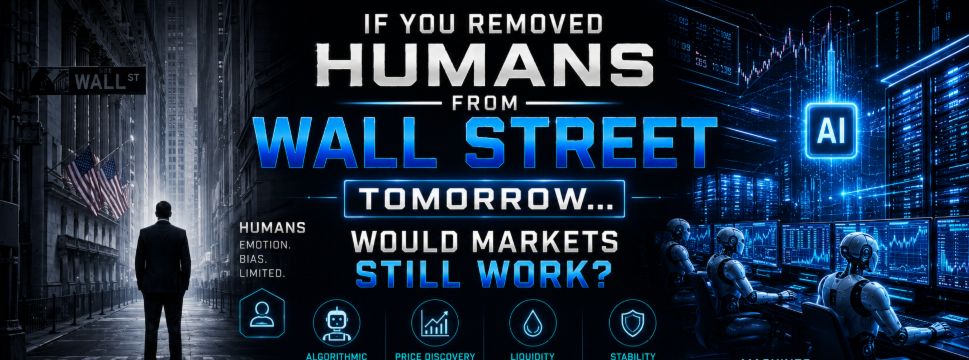
If You Removed Humans From Wall Street Tomorrow, Would Markets Still Work?
What if ninety nine percent of all trades were made by machines. It sounds like a distant hypothetical, the kind of provocative question designed purely to generate discussion rather than reflect anything close to current reality. It is worth stating plainly before going any further, current reality is already far closer to that number than most traders realize.
Part One: How Much of Trading Volume Is Already Algorithmic
Current estimates place algorithmic trading at roughly sixty to seventy five percent of total volume in major equity markets, and considerably higher still in foreign exchange, where electronic and algorithmic execution is estimated to account for somewhere between seventy and ninety percent of spot turnover. High frequency trading firms specifically are estimated to represent only a small single digit percentage of active trading firms while generating a majority share of overall equity trading volume on their own. The provocative hypothetical posed in this article's title is, in an important sense, less a hypothetical and more a modest extrapolation of a trend that has already traveled most of the distance toward its logical conclusion.
Part Two: What Role Do Humans Actually Still Play
Even inside a market this heavily automated, human contribution has not disappeared, it has concentrated into a smaller number of specific, genuinely difficult to automate roles.
- Strategy design and oversight. Every algorithm executing trades was designed, validated and continues to be monitored by a human or a human led team, even when the moment to moment execution itself involves no human decision at all.
- The generation of genuinely new information. This is the deepest and most important distinction in this entire discussion. Algorithms react to information, they do not, at least with current technology, originate the fundamentally new economic events markets ultimately price, a central bank policy decision, an actual corporate earnings result, a genuine geopolitical development. These originate from human institutions and human decisions, regardless of how automated the subsequent trading reaction to them becomes.
- Higher level capital allocation. Institutional decisions about overall portfolio strategy and allocation frequently remain genuinely human judgment calls, even when the specific execution beneath that strategic layer is fully automated.
- Regulatory and legal accountability. Oversight structures still require identifiable human responsibility, a dimension automation has not replaced and, under current frameworks, generally cannot replace.
Part Three: Could AI Alone Carry Price Discovery, Liquidity and Stability
This is the genuinely deep question hiding beneath the provocative framing, and it deserves careful, properly hedged treatment rather than a confident answer in either direction.
Price discovery fundamentally requires some mechanism for genuinely new information to enter the pricing process. If every participant were an algorithm reacting only to the behavior of other algorithms, with no channel for fundamentally new, human sourced information to enter the system at all, there is a real and largely unresolved theoretical question about where genuinely new information would even originate from in that scenario, since algorithms process and react to information rather than manufacturing the underlying economic events that information describes.
Liquidity raises a related but distinct concern. A market populated by many similarly programmed algorithms, rather than participants with genuinely diverse objectives, time horizons and information sets, risks a specific failure mode, correlated withdrawal, where many automated participants react to the same trigger in the same direction simultaneously, causing liquidity to evaporate exactly when it is needed most rather than remaining available. Genuine liquidity depth has historically benefited from participant diversity, and a monoculture of similarly behaving algorithms could quietly erode that diversity even while the raw number of active participants stays high.
Stability already has real, well documented historical precedent worth taking seriously. Extremely rapid, automation driven price dislocations have occurred before, extraordinarily fast, severe moves followed by equally rapid partial recovery, episodes widely studied specifically because they demonstrated how correlated automated behavior can amplify a shock far beyond what the underlying trigger alone would justify. These episodes are genuine, well documented market structure events, not speculation, and they offer real evidence about the specific risks a heavily automated market structure carries.
The honest, appropriately hedged conclusion is that raw execution volume can plausibly continue moving further toward full automation than it already has, but the deeper roles of genuine information generation and, to a meaningful extent, systemic stability anchoring appear considerably harder to fully automate away entirely, at least with currently available and near term foreseeable technology.
Part Four: A More Honest Framing Than Humans Versus Machines
The provocative humans versus machines framing, while genuinely useful for generating discussion, somewhat obscures a more accurate description of where things actually stand and where they plausibly continue heading. The real trajectory is not the wholesale disappearance of human involvement. It is the continued concentration of human contribution into design, oversight and the generation of genuinely new information, while an ever larger share of pure execution volume shifts toward automated systems built and supervised by those same humans.
What This Actually Means for You as an Individual Trader
In a market where the large majority of volume already moves through automated systems, a trader attempting purely manual execution is already competing inside a structure that does not particularly favor that approach, regardless of how this broader philosophical question eventually resolves. The practical response is not becoming a marginally faster manual trader inside an increasingly automated market. It is participating through genuinely well engineered automated systems of your own, built with the same discipline, adaptive intelligence and hard risk enforcement covered throughout this series, systems such as ICONIC BTC AI+, ICONIC GOLD AI+ and the flagship ICONIC KYBERNETIC AI+, rather than continuing to trade as though the market of decades past still exists.
Frequently Asked Questions
What percentage of trading is actually algorithmic today? Current estimates suggest roughly sixty to seventy five percent of major equity market volume and seventy to ninety percent of foreign exchange spot turnover is algorithmic or electronically executed, with high frequency trading firms alone, despite being a small share of active firms, generating a majority of equity volume.
What would humans still need to do if trading became almost entirely automated? Designing and overseeing the algorithms themselves, generating the genuinely new economic and geopolitical information markets ultimately price, making higher level capital allocation decisions, and carrying regulatory and legal accountability.
Could markets function with zero human participation at all? This remains a genuinely open and largely unresolved question. Price discovery appears to require some channel for genuinely new information to enter the system, and historical episodes of automation driven instability suggest liquidity and stability risks that a fully algorithmic, information isolated market structure has not yet convincingly solved.
Is humans versus machines the right way to frame this trend? Not entirely. A more accurate description is the continued concentration of human contribution into design, oversight and information generation, alongside an increasing share of pure execution shifting toward automated systems those same humans build and supervise.
The Real Question Was Never Humans or Machines
The market of today already sits far closer to the provocative hypothetical posed at the start of this article than most participants realize. The genuinely important question was never a binary choice between humans and machines. It is understanding precisely which roles concentrate where as this trend continues, and positioning yourself accordingly rather than assuming the market you are trading still resembles the one that existed when these tools did not yet exist.
Explore automated systems built for exactly this already largely automated market structure, including ICONIC BTC AI+, ICONIC GOLD AI+ and the flagship ICONIC KYBERNETIC AI+, at iconicfx.tech.
Risk Disclaimer. Trading foreign exchange, cryptocurrencies, commodities and other leveraged financial instruments carries a high level of risk and may not be suitable for all investors. The high degree of leverage can work against you as well as for you. Past performance is not indicative of future results. Automated trading systems, indicators and Expert Advisors do not guarantee profits and can produce losses. ICONIC.FX provides software tools only and does not provide investment advice, portfolio management or financial recommendations. You are solely responsible for your own trading decisions. Seek advice from an independent licensed financial advisor if you have any doubts.