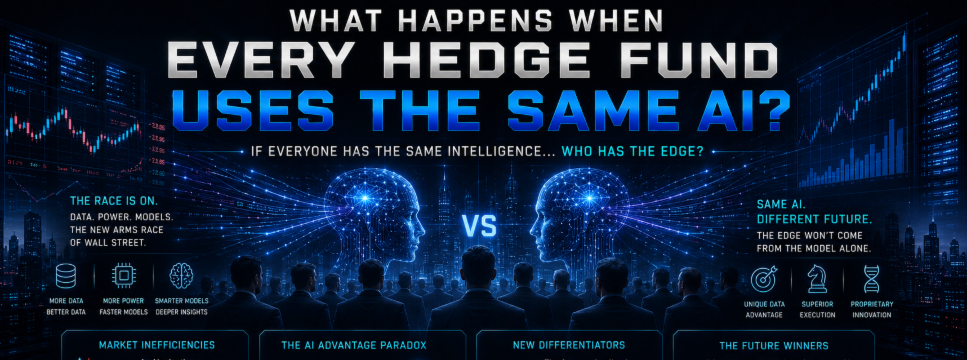

What Happens When Every Hedge Fund Uses the Same AI?
If everyone has the same intelligence, who actually has the edge. This is not a distant hypothetical, it is an increasingly real competitive dynamic as AI techniques that were once genuinely proprietary become standardized, widely published and commercially accessible across the industry. Understanding precisely what happens to competitive advantage as a once scarce capability becomes common is a real question in economics generally, not unique to trading, and working through it honestly explains exactly where edge relocates to rather than simply disappearing.
Part One: Why an Arms Race in Data, Compute and Models Emerges Naturally
When a genuinely valuable technique becomes widely accessible, whether through published research, commoditized cloud infrastructure, or increasingly capable off the shelf tooling, the remaining sources of differentiation shift naturally toward whatever inputs have not yet become similarly commoditized. This is a predictable, well understood economic pattern rather than speculation, competitive pressure flows toward scarcity, and once the underlying modeling technique itself stops being scarce, firms rationally redirect competitive effort toward proprietary or higher quality data, superior computational scale, or genuinely novel architectural approaches that have not yet become industry standard, precisely because the easy, now shared parts of the stack have stopped conferring any advantage on their own.
Part Two: The Effect on Market Inefficiencies When Many Similar Models Compete for the Same Ones
When many sophisticated participants apply similar AI approaches and consequently identify similar categories of inefficiency, the collective act of many participants simultaneously exploiting the same specific inefficiency tends to erode that inefficiency directly, a well documented dynamic in quantitative finance broadly. The genuinely interesting secondary effect is what this leaves behind. As widespread, sophisticated AI driven activity consistently corrects the more obvious, well known inefficiencies, the remaining opportunities left available become structurally different in character, either requiring meaningfully deeper sophistication to access at all, or concentrating in areas current AI approaches are collectively less equipped to handle, less liquid instruments, genuinely novel qualitative reasoning, or conditions poorly represented in the data most models were trained on.
Part Three: Does the AI Advantage Genuinely Shrink With Adoption
In one specific and important sense, yes. Being an early adopter of a technique that later becomes an industry standard provides a real but temporary advantage that predictably erodes as adoption spreads, a pattern well established in technology diffusion generally and not unique to trading at all. But the deeper, more useful answer is that the advantage does not simply vanish, it relocates. It shifts away from the binary question of whether a firm has access to AI at all, since that question increasingly answers itself as the baseline capability becomes common, toward a more specific set of differentiators that do not commoditize at the same pace.
Part Four: Where New Differentiation Actually Emerges
Several genuine, defensible candidates exist for where competitive edge relocates to as baseline AI capability becomes widely shared across the industry.
- Data quality and uniqueness. Once the modeling technique applied to data stops being differentiating on its own, the quality, breadth and genuine uniqueness of the underlying data being modeled becomes proportionally more valuable.
- Risk architecture and enforced discipline. This deserves particular emphasis because it is consistently underappreciated. If many participants have access to similarly capable decision engines, the genuine difference increasingly comes down to which of them pair that intelligence with hard, structurally enforced risk discipline versus which do not. A system with intelligence roughly equivalent to a competitor's, but paired with a categorical rejection of loss averaging techniques and code level, unbreakable risk boundaries, holds a real, durable edge over an equally intelligent system lacking that same discipline, an edge that does not depend on any modeling technique remaining proprietary at all.
- The speed and rigor of continuous adaptation. As baseline architectures converge toward similar capability, the rate at which a system genuinely notices and responds to real drift, rather than operating on a stale, infrequently updated calibration, becomes a meaningful differentiator even among otherwise comparable systems.
- Genuine architectural innovation beyond the now common baseline. Continuing to push into territory that has not yet become industry standard, causal reasoning rather than simple correlation, genuinely coordinated multi asset intelligence, remains a real source of durable differentiation precisely because it has not yet diffused as widely as more established techniques.
Part Five: What This Means for Evaluating Any AI Trading System Today
It is worth acknowledging honestly that neural networks and reinforcement learning broadly are increasingly common industry knowledge, not a secret proprietary edge simply by virtue of being labeled AI. Genuine differentiation, following the logic of this entire article, has to be evaluated in exactly the dimensions identified above rather than taken on faith from the AI label alone. The risk architecture inside ICONIC KYBERNETIC AI+, a hard, code level margin floor and a three tier portfolio drawdown framework, reflects precisely the discipline dimension this article argues remains a genuine differentiator even as baseline intelligence commoditizes. The continuous online learning stack across ICONIC BTC AI+, ICONIC GOLD AI+ and ICONIC KYBERNETIC AI+ addresses the adaptation speed dimension directly, and the causal, Transfer Entropy based coordination between Bitcoin and Gold inside the flagship system reflects the genuine architectural innovation dimension, territory that has not yet become a standard, widely commoditized baseline across the industry.
Frequently Asked Questions
Does AI stop providing any edge once every competitor has access to it? The raw technique itself provides less differentiation as adoption spreads, but genuine edge does not disappear, it relocates toward data quality, risk discipline, adaptation speed and architectural innovation that has not yet become similarly widespread.
Why does risk discipline matter more as AI becomes commoditized? If many participants have access to similarly capable decision engines, the difference between them increasingly comes down to which pair that intelligence with genuinely enforced risk discipline, an advantage that does not depend on the underlying model remaining proprietary.
What happens to market inefficiencies as more firms use similar AI? Widely shared, sophisticated AI activity tends to correct the more obvious inefficiencies it collectively detects, leaving remaining opportunities that are either structurally harder to access or concentrated in areas current AI approaches are collectively less equipped to handle.
Is it still worth evaluating a system's AI claims if the underlying techniques are increasingly common? Yes, but the evaluation should focus less on whether a system uses AI at all and more on the specific, less commoditized dimensions, data quality, enforced risk discipline, and genuine architectural innovation beyond an increasingly standard baseline.
The Edge Moves, It Does Not Disappear
When every sophisticated participant has access to broadly similar intelligence, the genuine differentiator was never simply having that intelligence in the first place. It is what surrounds it, the discipline to enforce hard risk boundaries regardless of how confident the model feels, the rigor to keep adapting rather than resting on a fixed calibration, and the willingness to keep pushing past whatever has already become standard across the rest of the industry.
Explore systems built around exactly these less commoditized differentiators, including ICONIC BTC AI+, ICONIC GOLD AI+ and the flagship ICONIC KYBERNETIC AI+, at iconicfx.tech.
Risk Disclaimer. Trading foreign exchange, cryptocurrencies, commodities and other leveraged financial instruments carries a high level of risk and may not be suitable for all investors. The high degree of leverage can work against you as well as for you. Past performance is not indicative of future results. Automated trading systems, indicators and Expert Advisors do not guarantee profits and can produce losses. ICONIC.FX provides software tools only and does not provide investment advice, portfolio management or financial recommendations. You are solely responsible for your own trading decisions. Seek advice from an independent licensed financial advisor if you have any doubts.