
The AI That Trained on Every Financial Crisis in History
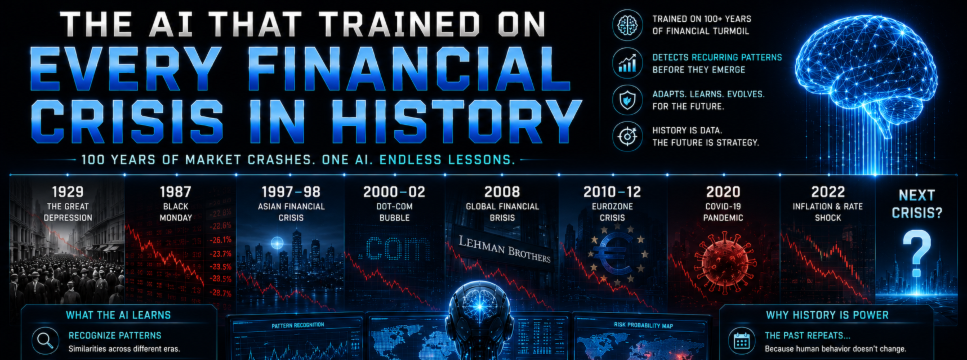
What if an AI could experience a century of market crashes in a single day. Picture such a system, trained deliberately across the Great Depression era crash, Black Monday, the global financial crisis and the pandemic driven crash, absorbing decades of collapse in a way no human researcher could ever personally live through. It is a genuinely compelling thought experiment, and working through it honestly, including its very real limitations, teaches more about how AI and history actually interact than any confident sounding marketing claim ever could.
Part One: What Data Actually Survives From Each Historical Crisis
A crucial and rarely discussed detail undermines the clean version of this thought experiment immediately. Data quality and resolution differ enormously across these four episodes, and that difference matters more than the dramatic framing suggests. The Great Depression era crash left behind extremely limited, low resolution records by modern standards, no tick level data, sparse daily figures, and a market structure built around physical trading floors that bears little functional resemblance to today's fully electronic markets. Black Monday offers somewhat richer daily data but still limited intraday granularity, occurring in a market still transitioning toward electronic execution. The global financial crisis provides genuinely rich, multi asset, credit market data reasonably close to modern structure. The pandemic driven crash offers the richest dataset of all, full electronic market microstructure data essentially structurally identical to markets today.
The honest conclusion is that training equally across all four is a far more limited exercise than the hook suggests, since data usefulness increases dramatically moving from the oldest episode to the most recent one, precisely because market structure itself, regulation, electronic trading, available instruments, has changed so fundamentally across this period that older data carries meaningfully less direct relevance to how a model would need to behave in today's market.
Part Two: Which Patterns Genuinely Repeat, and Which Do Not
Several structural, mechanism level patterns do appear to recur across genuinely different crises regardless of their specific trigger. Correlation between normally diversified assets tends to spike sharply toward one during systemic stress, a flight to safety dynamic overriding normal diversification. Liquidity tends to evaporate rapidly and simultaneously across multiple markets rather than gradually. Deleveraging cascades, forced selling triggering further forced selling, appear as a recurring mechanism across episodes with otherwise completely different origins.
What does not reliably repeat is the specific trigger itself. Each of these four episodes had a genuinely different proximate cause, speculative margin lending unwinding, a portfolio insurance feedback loop, subprime mortgage and credit derivative contagion, and an exogenous pandemic shock entirely unrelated to prior financial excess. A model that memorizes the specific trigger pattern of past crises is learning something highly unlikely to generalize to a structurally different future trigger, while a model that learns the underlying structural mechanisms, correlation spikes, liquidity evaporation, deleveraging cascades, is learning something with genuinely better odds of generalizing, precisely because these mechanisms have recurred across triggers that otherwise share almost nothing in common.
Part Three: Why History Helps, but Offers No Guarantee
History is genuinely useful for exactly the structural mechanisms identified above. It offers no guarantee precisely because the next crisis's specific trigger will, almost by definition, be something novel rather than a repeat of a prior one. A model overly reliant on the specific historical instances it was trained on, rather than the generalizable structural mechanism those instances happen to illustrate, risks being extremely well prepared for the last crisis and poorly prepared for a genuinely different next one. This is exactly why continuous adaptation and hard, structurally enforced risk boundaries, rather than confident reliance on historical pattern matching alone, remain the more defensible practical foundation, a conclusion this series has returned to from several different angles because the underlying truth does not change depending on which specific question raises it.
Part Four: What Traders Can Actually Learn From This
- Be skeptical of any system implying it has solved crisis prediction through historical training alone. The trigger of the next crisis is, by the nature of the problem, unlikely to closely resemble any specific historical instance a model was trained on.
- Value systems built around generalizable structural mechanisms over narrow historical memorization. Correlation breakdown, liquidity evaporation and deleveraging dynamics are a more durable vocabulary for recognizing crisis conditions than matching against a specific past event.
- Prioritize hard, structural risk enforcement that functions regardless of whether the next crisis resembles history at all. This is the one component of crisis preparation that does not depend on successfully predicting anything in advance.
- Treat historical study as vocabulary building, not fortune telling. Understanding how liquidity evaporation and correlation spikes have manifested before helps recognize the structural signature of a new crisis even when its specific trigger is genuinely unprecedented.
Part Five: How This Honest Philosophy Shows Up in Real Architecture
It would be dishonest to claim any current system was literally trained on granular data from the oldest of these historical episodes, given the data limitations discussed above, and no such claim is made here. What genuinely does show up in working architecture is the underlying philosophy this thought experiment points toward. The regime bucket learning and continuous online adaptation inside ICONIC KYBERNETIC AI+ reflects exactly the Part Three conclusion, a system built to keep learning from live, current evidence rather than freezing around any single historical memorization, however extensive. Its Physics Informed margin axiom and three tier drawdown framework embody the Part Four takeaway directly, hard risk enforcement that functions regardless of whether the next stress event resembles any specific historical episode.
The MAP Elites archive of specialist behavioral variants inside ICONIC BTC AI+ and ICONIC GOLD AI+ reflects the Part Two distinction structurally, maintaining multiple tuned responses for different genuine market conditions rather than a single memorized historical pattern, an architecture built around recognizing structural regime signatures rather than replaying one specific past instance.
Frequently Asked Questions
Could an AI genuinely be trained equally well on very old and very recent financial crises? Not equally well. Data resolution and market structure relevance increase dramatically moving from older episodes to more recent ones, meaning recent crisis data is generally far more directly useful for training a model intended to operate in today's market.
What actually repeats across different financial crises? Structural mechanisms tend to repeat, correlation spiking toward one across normally diversified assets, rapid simultaneous liquidity evaporation, and deleveraging cascades, even when the specific trigger differs completely between episodes.
Why doesn't studying historical crises guarantee predicting the next one? Because the specific trigger of the next crisis is, by the nature of the problem, unlikely to closely resemble any particular historical instance, meaning a model overly reliant on memorizing specific past events risks being well prepared for the last crisis rather than the next, genuinely different one.
What should traders actually take from studying financial crisis history? Treat it as vocabulary for recognizing structural crisis signatures such as correlation breakdown and liquidity evaporation, rather than as a tool for predicting exactly when or how the next crisis specifically arrives.
History as Vocabulary, Not Prophecy
The thought experiment of an AI trained on a century of crashes is genuinely useful, not because it produces a crystal ball, but because working through its honest limitations reveals exactly what history can and cannot offer. It can teach the structural language of crisis. It cannot hand over a reliable script for the next one, because the next one will very likely write its own.
Explore systems built around exactly this honest philosophy, structural adaptability paired with hard, unconditional risk enforcement, including ICONIC BTC AI+, ICONIC GOLD AI+ and the flagship ICONIC KYBERNETIC AI+, at iconicfx.tech.
Risk Disclaimer. Trading foreign exchange, cryptocurrencies, commodities and other leveraged financial instruments carries a high level of risk and may not be suitable for all investors. The high degree of leverage can work against you as well as for you. Past performance is not indicative of future results. Automated trading systems, indicators and Expert Advisors do not guarantee profits and can produce losses. No system can predict or guarantee protection against market crises or extreme events. ICONIC.FX provides software tools only and does not provide investment advice, portfolio management or financial recommendations. You are solely responsible for your own trading decisions. Seek advice from an independent licensed financial advisor if you have any doubts.