Gold Catalyst Evolution V6.11: Account Size, Fixed Lots, and Honest Risk Configuration

UPDATE NOTE — 8 October 2026
Hello traders,
This capital and sizing guide is aligned with Gold Catalyst Evolution V6.11. The current product uses two independent engines and manual static lot sizes. Capital guidance is an operating reference and must be assessed using the actual broker’s symbol specification and the selected engine profile.
Gold Catalyst Evolution V6.11 — official product description, current version and gallery
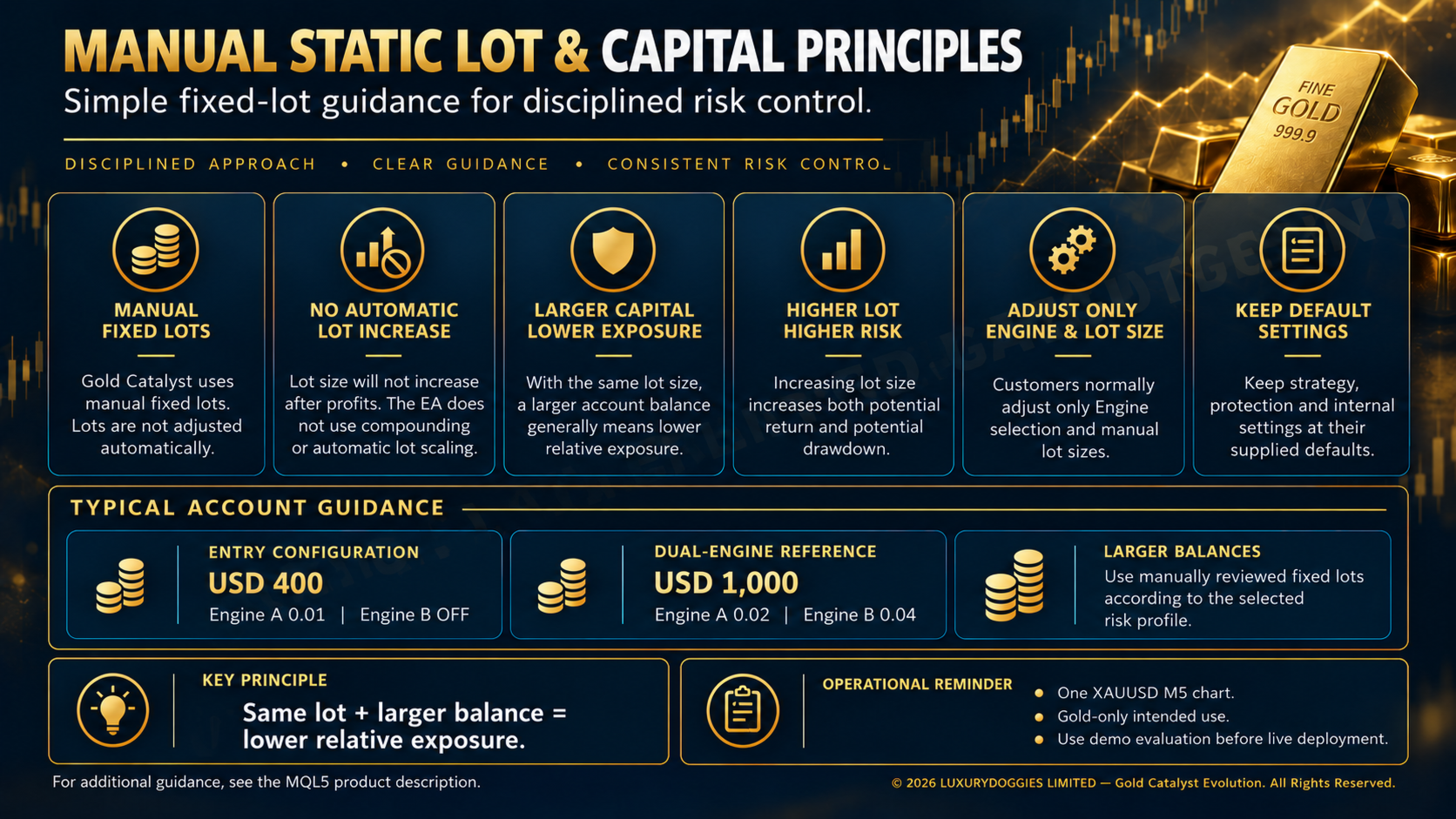 Manual static lots and capital principles — current product operating illustration; not a performance result.
 Capital and manual fixed lots in V6.11
- USD 400 minimum suggested entry configuration: Engine A enabled at 0.01 lot; Engine B disabled.
- USD 1,000 dual-engine reference: Engine A at 0.02 and Engine B at 0.04; both engines enabled for this reference.
- At USD 1,000 and above, Engine A only, Engine B only or both engines may be selected according to the reviewed capital and risk profile. Engine B may be reduced or disabled for a more conservative profile.
- Lots are set manually and remain static. There is no automatic balance/equity scaling or profit-based compounding.
- For non-USD accounts, convert account equity to its USD-equivalent value before applying USD-based guidance.
These are operating references, not safety guarantees. Increased lots increase potential gains and losses; each selected engine/lot combination needs evaluation under the operating broker’s conditions.
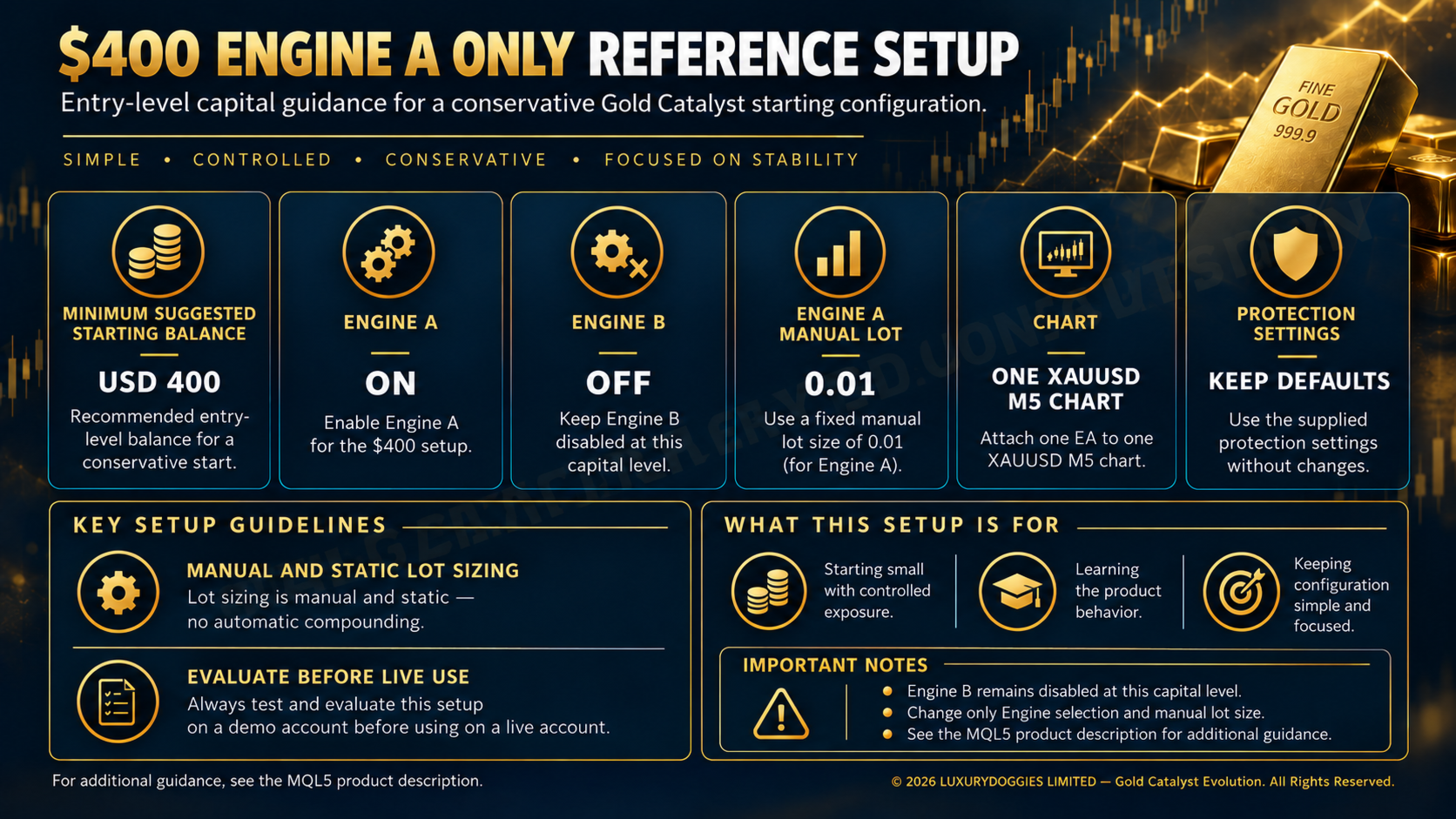 USD 400 Engine A only reference setup — current product operating illustration; not a performance result.
 Fixed lots and relative exposure
The EA does not automatically increase or decrease either engine’s lot size when balance or equity changes. More capital behind unchanged lots generally lowers percentage exposure, all else being equal. Raising either lot increases potential profit and potential loss and can increase drawdown.
The USD 400 starting configuration is Engine A only at 0.01. It is not the USD 1,000 dual-engine reference reduced to a USD 400 deposit. Running A=0.02 and B=0.04 on less capital materially increases relative exposure and does not inherit the reference setup’s risk profile.
For larger balances, select manually reviewed fixed lots according to the chosen profile. There is no universal balance-to-lot progression or automatic permission to increase lots after gains.
Engine selection is part of the risk profile
Engine A is a selective directional engine; Engine B is an independent market-participation engine. Each uses its own execution, fixed lot, magic number, protective levels and position management. At USD 1,000 and above, the description permits A only, B only or both according to reviewed capital and risk tolerance. Reducing or disabling Engine B may be used for a more conservative profile, but the selected configuration still needs its own evaluation.
On hedging accounts, both engines can manage their own simultaneous positions. Netting is supported through same-symbol serialization and should be assessed separately. Distinct magic numbers support attribution; both engines still share the account’s equity and margin.
Measure monetary risk from broker specifications
Lot size alone cannot establish dollar risk. Record the actual gold symbol’s contract size, tick size, tick value, digits, volume minimum/maximum/step and broker execution rules. Measure the price distance to accepted protective levels and include spread, commission, swap and realistic slippage.
Use one supported gold chart on M5. The reference leverage is 1:1000, but actual margin requirements depend on the broker. Leverage affects margin availability; it does not make the loss from a given price movement smaller. Confirm free margin before testing and operation.
A requested Stop Loss defines an intended exit. Gaps, slippage, liquidity, delays and broker rules can produce a different fill. No universal “dollars per stop” table should replace calculations from the operating broker’s actual contract and tick specification.
V6.11 protection and operating defaults
- Engine A Defense Mode: an additional protective state after a configured sequence of full-stop losses; internal recovery handling is automatic.
- Protection state persistence: retains protection state across terminal restarts where applicable.
- Weekend Protection: uses the broker’s session timing to block new entries near the weekly close, close protected EA positions before the weekend and resume after the market reopens.
- Engine B loss controls: daily-loss and consecutive-loss monitoring with cooldown behavior.
- Margin and execution checks: available margin and broker volume requirements are checked before orders are sent.
For normal customer operation, adjust engine selection and manual lots according to the evaluated capital and risk profile. Keep strategy, protection, sealed-profile, filter and diagnostic parameters at the supplied defaults. These controls do not guarantee recovery, exact Stop Loss fills, a maximum drawdown or any trading result.
Drawdown and historical evidence
V6.11 promises no fixed drawdown level. Read balance and equity drawdown separately and distinguish absolute, maximal and relative measures. Any performance observation belongs to its exact version, settings, broker, deposit, costs and date range.
The earlier pre-V6 Gold Catalyst archive reported roughly 40% peak-to-low decline. That historical demo record remains historical evidence; it is not V6.11 performance. Older development observations below a stated percentage are not a V6.11 cap or a guarantee for another engine/lot configuration. Operating screenshots explain setup; they do not establish future returns.
Evaluate the profile you actually intend to use
- Install the current V6.11 build through MQL5 Market.
- Record the exact broker, gold symbol, account currency, deposit, leverage, account mode, dates, selected engines and fixed lots.
- Retain supplied strategy, protection and internal defaults.
- Use relevant broker data in Strategy Tester, including real ticks where available.
- Evaluate engine-level results and combined equity drawdown, losing sequences, costs, protective exits and margin.
- Check Defense Mode, persistence, Weekend Protection and Engine B cooldown behavior in the evaluation environment.
- Forward-evaluate the selected licensed or rented configuration on demo before considering live use.
- Label any changed engine/lot combination separately and test it again.
Customer adjustments
For normal use, adjust engine switches and manual lots. Keep protective distances, sealed profiles, filter and diagnostic settings at the supplied defaults. Changing a Stop Loss or internal profile does more than alter one headline risk number: it can change trade management and strategy behavior. Any deliberate internal change requires independent evaluation.
Size from acceptable exposure and broker evidence, rather than a desired monthly return. Allow for worse outcomes than the observed sample. A configuration whose acceptability depends on believing drawdown cannot exceed a specific percentage is based on a guarantee the product does not provide.
Related guides: V6.11 FAQ · V6.11 installation · Risk across both engines
Risk notice: Trading leveraged gold involves substantial risk. Gold Catalyst Evolution V6.11 does not guarantee profit, fixed returns, stable income, recovery or a specific drawdown. Backtests and demo monitoring can differ from live execution because of spread, commission, swap, slippage, liquidity, delays, broker settings, contract size and data. Use only capital you can afford to lose. Past performance does not guarantee future results.