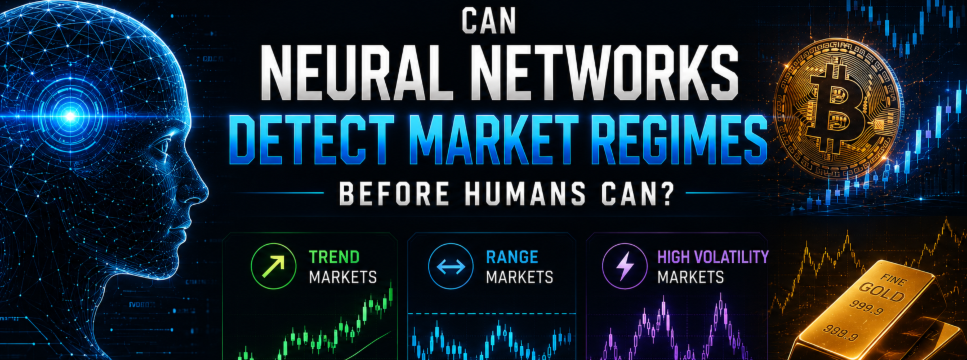

Can Neural Networks Detect Market Regimes Before Humans Can?
By the time a discretionary trader consciously admits to themselves that a market has genuinely shifted from ranging to trending, or from calm to violently volatile, a meaningful amount of the actual opportunity, or the actual danger, has usually already passed. The interesting question is not simply whether artificial intelligence can detect a market regime. It is whether it can do so with a genuine, measurable speed and resolution advantage over human perception, and whether that advantage actually matters more than the entry technique traders spend most of their effort perfecting.
This article examines exactly why humans are structurally slow at recognizing regime change, what a neural network genuinely extracts from a large historical dataset that a human observer cannot replicate at the same scale, why correctly identifying the regime often matters more than the entry rule applied within it, and how this plays out differently across Bitcoin, Gold and equity indices specifically.
Part One: Why Humans Are Structurally Slow at Recognizing Regime Change
Regime recognition is not a single observation, it requires synthesizing several signals simultaneously, price structure, volatility character, momentum persistence, and often the behavior of related instruments, sustained over an extended observation window before a person consciously updates their mental model of what kind of market they are actually trading. This process is further slowed by well documented cognitive biases. Confirmation bias leads traders to keep interpreting new price action through the lens of whatever regime they already believe is in effect, and recency bias anchors expectations to recent conditions even as those conditions are actively changing beneath them. The practical result is a lag between when a regime genuinely shifts and when a human consciously recognizes and acts on that shift, a lag during which a trader is often still applying a playbook that no longer fits the market actually in front of them.
Part Two: What a Neural Network Actually Extracts From a Large Historical Dataset
It is worth being precise about what training on a large historical sample genuinely means, since the phrase gets thrown around loosely. It does not mean a network consults millions of data points simultaneously to make a single decision. It means the statistical relationship between specific combinations of features, volatility measures, trend linearity statistics, momentum persistence, and often causal relationships to related instruments, and genuine regime transitions was learned from a historical sample far larger than any individual trader's consciously remembered set of analogous past situations. This gives a properly trained system's regime classification a statistically grounded basis that a human's necessarily smaller, memory limited sample of past experience cannot match in scale, even if a skilled discretionary trader can still bring genuine pattern intuition a model may lack entirely.
Concrete implementations make this real rather than abstract. ICONIC TITAN AI processes twenty two distinct features across seven timeframes in parallel through an ensemble of trained networks, a genuine feature extraction problem at a scale and simultaneity no human can consciously replicate while watching the same instrument. Trend linearity measurements, an R squared statistic quantifying how cleanly price has actually followed a directional path, and volatility comparisons through Average True Range give systems such as ICONIC BTC AI+ and ICONIC GOLD AI+ concrete, quantifiable regime features rather than a subjective visual impression of how a chart looks.
Part Three: Why Regime Detection Often Matters More Than the Entry Technique
Here is a point worth stating plainly because it runs against where most retail traders actually spend their effort. The identical entry technique can be either the single best or the single worst approach available, depending entirely on which regime is currently active. A breakout strategy applied during a genuine trend captures the majority of a sustained move. The exact same breakout strategy applied during a range produces little beyond a string of false signals and stop outs. This means the marginal value of a slightly refined entry rule, holding regime awareness constant, is small compared to the marginal value of correctly identifying whether the current regime justifies using that entry rule at all.
Regime classification functions closer to a multiplicative gate on a strategy's overall expectancy than an additive improvement layered on top of it. A merely adequate entry technique correctly gated to the appropriate regime will tend to outperform an excellent entry technique applied blindly regardless of regime. Most retail effort goes into refining the entry. The genuinely higher leverage effort goes into correctly answering the prior question, is this even the right regime to be using this technique in at all.
Part Four: Applying This Across Bitcoin, Gold and Indices
Bitcoin's regime transitions can occur extremely quickly and violently, meaning detection speed itself carries real weight, not merely detection accuracy. ICONIC BTC AI+ addresses this through continuous adaptation via differentiable plasticity alongside its trend linearity gate, allowing its assessment of current regime to update in near real time rather than lagging behind a rapidly shifting market the way a human's slower, bias affected recognition process tends to.
Gold's regime transitions are frequently triggered by discrete scheduled events rather than gradual technical exhaustion, meaning genuine regime detection for this specific market has to incorporate calendar awareness alongside pure price based structure. The integrated economic calendar filter inside ICONIC GOLD AI+ functions, in effect, as a form of anticipatory regime awareness, recognizing that a scheduled release is likely to trigger a genuine character shift before that shift has even fully materialized in price action itself.
Equity indices tend to exhibit somewhat more gradual regime transitions tied to broader macro cycles, earnings seasons and correlated risk sentiment shifts across underlying constituents, a genuinely different rhythm from crypto's often abrupt character changes. Worth stating honestly here, the current ICONIC.FX lineup does not include a dedicated index specialist, so this observation is offered as a general principle of index behavior rather than a claim about a specific product, and any system claiming genuine index regime detection deserves the same scrutiny toward asset specific engineering discussed throughout this article rather than an assumption that crypto or Gold tuned logic transfers automatically.
Part Five: Detection Speed as a Structural, Not Merely Incremental, Advantage
The regime bucket learning inside ICONIC KYBERNETIC AI+ illustrates the detection speed argument concretely. Rather than waiting for a human to notice, after the fact, that a particular trend strength condition has quietly become profitable or unprofitable, the system tracks a continuously updated reward estimate for each specific volatility bucket and adjusts its own threshold accordingly, in effect recognizing a genuine shift in that condition's real world profitability far closer to real time than a human review cycle, which typically happens weekly or monthly at best, ever could. This is not a minor convenience. It is a structural advantage in exactly the dimension this entire article has been examining, not merely whether a system can eventually recognize a regime shift, but how much real, tradeable time elapses before it does.
Frequently Asked Questions
Can AI genuinely detect market regime changes faster than a human trader? Well engineered systems can process many simultaneous features across multiple timeframes continuously and update their assessment in near real time, whereas human recognition is slowed by the need to consciously synthesize multiple signals and is further delayed by confirmation and recency bias.
What specific features do neural networks use to identify market regimes? Common features include trend linearity statistics, volatility measurements such as Average True Range, momentum persistence, and in advanced systems, causal relationships to related instruments, learned from a historical sample far larger than an individual trader's consciously remembered experience.
Is regime detection really more important than entry technique? Often, yes. The same entry technique can be either highly effective or largely worthless depending entirely on the active regime, making correct regime classification closer to a multiplicative gate on expectancy than the entry rule itself.
Does regime detection work the same way across Bitcoin, Gold and indices? No. Bitcoin demands detection speed for rapid, violent transitions, Gold requires calendar awareness for event driven shifts, and indices tend toward more gradual, macro cycle tied transitions, meaning genuine regime detection has to be tuned to each market's specific character rather than applied identically everywhere.
Understanding the Market Comes Before Trading It
A trading system that acts before it genuinely understands which regime is currently in play is gambling with extra steps, regardless of how sophisticated its entry logic sounds. The systems worth trusting are the ones built to answer the prior question first, correctly and quickly, before ever placing a trade.
Explore systems built with exactly this priority, from the parallel, multi timeframe awareness of ICONIC TITAN AI, through the regime adaptive execution of ICONIC BTC AI+ and ICONIC GOLD AI+, to the continuously self updating regime intelligence of the flagship ICONIC KYBERNETIC AI+, at iconicfx.tech.
Risk Disclaimer. Trading foreign exchange, cryptocurrencies, commodities and other leveraged financial instruments carries a high level of risk and may not be suitable for all investors. The high degree of leverage can work against you as well as for you. Past performance is not indicative of future results. Automated trading systems, indicators and Expert Advisors do not guarantee profits and can produce losses. ICONIC.FX provides software tools only and does not provide investment advice, portfolio management or financial recommendations. You are solely responsible for your own trading decisions. Seek advice from an independent licensed financial advisor if you have any doubts.


![[EURUSD]: Weekly Liquidity Activation Points (LAP), October 12-16, 2026](https://c.mql5.com/6/1035/splash-preview-777305.png "[EURUSD]: Weekly Liquidity Activation Points (LAP), October 12-16, 2026")
![[XAUUSD]: Weekly Liquidity Activation Points (LAP), October 12-16, 2026](https://c.mql5.com/6/1035/splash-preview-777299.png "[XAUUSD]: Weekly Liquidity Activation Points (LAP), October 12-16, 2026")
![[Nasdaq]: Weekly Liquidity Activation Points (LAP), October 12-16, 2026](https://c.mql5.com/6/1035/splash-preview-777311.png "[Nasdaq]: Weekly Liquidity Activation Points (LAP), October 12-16, 2026")