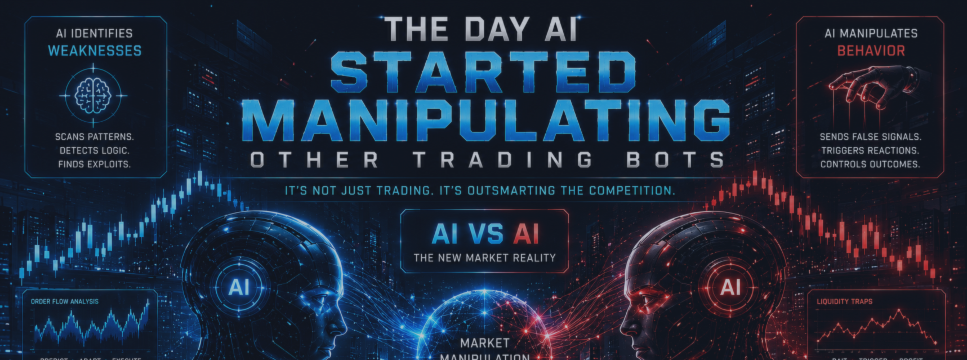
When AI Starts Trading Against AI: The Algorithm vs Algorithm Market Nobody Talks About

When AI Starts Trading Against AI: The Algorithm vs Algorithm Market Nobody Talks About
What happens when AI is no longer trading primarily against humans, but against other AI. This is not a single dramatic event with a clean, identifiable starting date, and any account claiming otherwise should be treated with immediate skepticism. It is a gradual, already well underway shift in market structure, and understanding it honestly changes how you should think about deploying any automated system today, including your own.
Part One: The Market Is Already a Competition Between Algorithms, Not Only Traders
A large and growing share of volume in major liquid markets is already driven by automated participants rather than discretionary human decisions. The practical consequence is direct, when your own system places an order, its most immediate counterparty on the other side of that trade is now frequently another automated system rather than a human reacting emotionally to a chart. This has been true and quietly building for years, it is simply rarely stated this plainly. The question worth asking is not whether this dynamic exists. It clearly does. The question is what it actually demands from the design of any system operating inside it.
Part Two: How Sophisticated Systems Recognize the Footprint of Other Algorithms
Automated activity leaves behind characteristic signatures that differ from organic, discretionary participation, unusually regular timing intervals, distinctive order sizing patterns, and repeated, mechanical defense or attack of the exact same price levels. Recognizing these signatures analytically, purely as contextual information feeding into a broader assessment of current conditions, is a genuinely emerging area of interest in sophisticated system design, understanding whether activity around a given level reflects programmatic, mechanical behavior versus organic conviction can meaningfully inform how much weight that level deserves.
It is worth being precise and honest here rather than overselling this capability. Reliably fingerprinting a specific counterparty algorithm in real time remains a genuinely difficult, actively developing problem, not a solved, universally available feature, and any product claiming to definitively identify and outmaneuver specific rival bots deserves informed skepticism. What is more realistically achievable, and already reflected in causal and regime aware architecture covered elsewhere in this series, is a broader contextual understanding of market structure and information flow, a related but meaningfully more modest and more honest capability than literal bot detection.
Part Three: Why Defensive Unpredictability Matters as Much as Predictive Accuracy
A system that behaves in a rigidly fixed, easily observable way, identical stop distance every time regardless of conditions, identical timing intervals for every action, becomes something other sophisticated participants can learn to anticipate and position against. In a market increasingly populated by other automated observers, genuine robustness requires more than raw predictive edge. It requires avoiding needlessly predictable, mechanically exploitable behavior in the first place.
This is where genuinely adaptive design offers a meaningful, if incidental, advantage over rigid rule based systems, not because it was explicitly engineered as a countermeasure against other algorithms, but because behavior that scales with real, current conditions is naturally less uniform and less trivially anticipated than a fixed, unchanging rule. Stop distances that move with real time volatility rather than sitting at one constant value, and pending order structures refreshed at intervals rather than left static indefinitely, both produce behavior that is harder to reduce to a single, exploitable constant, a natural byproduct of sound adaptive engineering rather than a dedicated anti detection feature layered on top of it.
Part Four: Is an AI Versus AI Ecosystem Really the Future, or Already the Present
Treated honestly, this is less a question of whether such an ecosystem will eventually arrive and more a question of how far an already substantially present dynamic continues to intensify. In many liquid markets, meaningful machine to machine interaction is not a future scenario, it is a description of current conditions. The genuinely open question, and one worth engaging with appropriate hedging rather than false confidence, is how much more adversarially sophisticated this multi agent dynamic becomes over time, and what that increasing sophistication will demand from individual system design as it continues to develop.
Part Five: What This Actually Means for Any System You Deploy
The practical takeaway is straightforward once stated plainly. In an increasingly algorithm dense market, the value of genuinely adaptive, continuously recalibrating architecture is heightened rather than diminished. A static, easily anticipated system faces a compounding vulnerability, exposure to genuine market drift over time, a problem covered extensively elsewhere in this series, and now potentially heightened exposure to sophisticated participants specifically recognizing and positioning against predictable, unchanging behavior.
The differentiable plasticity underlying ICONIC BTC AI+ and ICONIC GOLD AI+, continuously reshaping the network's own internal connections in response to live feedback, and the ATR adaptive stop and sizing logic scaling with real, current volatility rather than a fixed constant, both naturally produce behavior that is less trivially reducible to a single, static pattern than a rigid rule based script. The continuous online learning stack inside ICONIC KYBERNETIC AI+, its self calibrating confidence gate and continuously updated regime tracking, reflects the same underlying principle at a deeper architectural level, a system whose behavior genuinely evolves with real conditions rather than remaining fixed at whatever state it held on the day it was first deployed.
Frequently Asked Questions
Is trading really becoming an AI versus AI competition? A significant and growing share of volume in major markets is already automated, meaning an automated system's counterparty on any given trade is increasingly likely to be another automated system rather than a human. This is an already substantially present, gradually intensifying trend rather than a single future event.
Can trading systems genuinely detect and identify specific rival algorithms? Reliable, specific fingerprinting of individual counterparty algorithms in real time remains a genuinely difficult, actively developing problem rather than a solved capability, and claims of definitively identifying and outmaneuvering specific rival bots deserve informed skepticism.
Why does unpredictability matter for a trading system's design? A system with rigidly fixed, easily observable behavior can become something sophisticated participants learn to anticipate. Genuinely adaptive systems, whose behavior scales with real time conditions, are naturally less reducible to a single, exploitable pattern.
Does this mean I need a specialized anti detection trading system? Not specifically. Genuinely well engineered adaptive architecture, built primarily to track real market conditions honestly, naturally produces less predictable behavior as a byproduct of sound design, rather than requiring a dedicated, separate countermeasure layered on top.
The Market Nobody Announced, but Everybody Should Understand
There was no single dramatic day when AI started trading against AI, and any account claiming otherwise is telling you a story rather than a fact. What actually happened, and continues happening, is a gradual, already substantially advanced shift in who, or what, is genuinely on the other side of your trades. Understanding this honestly, without either dismissing it or dramatizing it beyond what current evidence supports, is what separates a genuinely informed operator from someone reacting to headlines.
Explore systems built on the kind of genuine, continuous adaptability this evolving market structure increasingly rewards, including ICONIC BTC AI+, ICONIC GOLD AI+ and the flagship ICONIC KYBERNETIC AI+, at iconicfx.tech.
Risk Disclaimer. Trading foreign exchange, cryptocurrencies, commodities and other leveraged financial instruments carries a high level of risk and may not be suitable for all investors. The high degree of leverage can work against you as well as for you. Past performance is not indicative of future results. Automated trading systems, indicators and Expert Advisors do not guarantee profits and can produce losses. ICONIC.FX provides software tools only and does not provide investment advice, portfolio management or financial recommendations. You are solely responsible for your own trading decisions. Seek advice from an independent licensed financial advisor if you have any doubts.