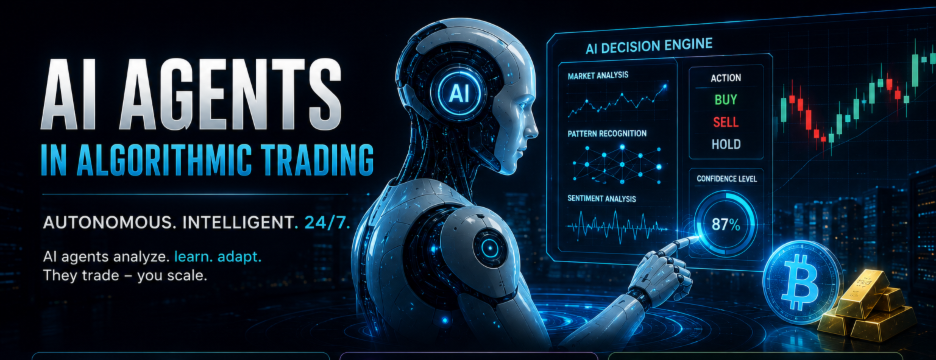
AI Agents in Algorithmic Trading: How Autonomous Systems Decide, Learn and Manage Risk

AI Agents in Algorithmic Trading: How Autonomous Systems Decide, Learn and Manage Risk
There is a quiet transition happening inside modern markets, and most retail traders have not noticed how far it has already gone. The dominant force moving through global markets today is no longer a person staring at a chart. It is an autonomous agent, a piece of software that perceives the market, decides, acts and learns, all without a human hand on the trigger. Understanding how these agents actually work is no longer optional knowledge for a serious trader. It is the baseline for competing in the environment that already exists.
This article breaks down exactly how autonomous AI agents make trading decisions, how reinforcement learning compares to the classical rule based strategies most traders grew up on, and what the genuine opportunities and risks of full automation look like, without hype and without vague marketing language. Along the way we will point to concrete, working examples from the ICONIC.FX ecosystem, because theory only matters once it becomes engineering you can actually deploy.
What Makes an AI Agent Different From a Simple Indicator
A traditional indicator measures something and displays it. A moving average, an oscillator, a volatility band. It has no memory of consequence and no capacity to act. An AI agent is a different category of software entirely. It perceives a state, the current condition of the market across whatever features it has been designed to read, evaluates that state through a trained model, selects an action, and then observes the outcome of that action to inform its future behavior. Perception, decision, action, consequence, repeat. That loop is what separates an agent from an indicator, and it is the loop every genuinely autonomous trading system is built around.
Inside the ICONIC.FX lineup, this distinction shows up clearly across two categories of product. Signal engines such as ICONIC TITAN AI and ICONIC HULLX AI perceive and score, delivering structured trade ideas while leaving the final action to you. Fully autonomous Expert Advisors such as ICONIC BTC AI+, ICONIC GOLD AI+, ICONIC NEUROCORE AI+ and the flagship ICONIC KYBERNETIC AI+ complete the full loop themselves, perceiving, deciding and executing without waiting for you at all.
How Autonomous Agents Actually Make Trading Decisions
The decision process inside a genuinely modern trading agent follows a consistent architecture, even though the specific mathematics differ from system to system. It generally proceeds through the following stages.
- State construction. The agent builds a representation of current conditions from price action, volatility, trend structure, momentum and often deeper statistical features such as trend linearity or long memory momentum channels. This is the agent's entire picture of reality at that instant, and the quality of this picture determines the ceiling of everything that follows.
- Policy evaluation. A trained model, whether a neural network, a reservoir architecture or a reinforcement learning policy, evaluates the state and produces a decision, typically expressed as a probability or confidence level for a given action rather than a rigid binary signal.
- Confidence gating. Serious agents do not act on every evaluation. A decision must clear defined thresholds, a minimum confidence level, a minimum probability of reaching a profit target, a maximum tolerated probability of hitting a stop, before it becomes an actual trade or alert. This gating is what separates a disciplined agent from a noisy one.
- Action and risk encoding. Once a decision clears its gates, it is translated into an actual market action, complete with position size, stop loss and target, all defined according to rules the agent cannot violate regardless of how confident it feels in the moment.
- Feedback and adaptation. The outcome of the action, win, loss, or partial result, is fed back into the system. In static systems this feedback changes nothing. In genuinely adaptive systems, it reshapes future behavior.
This is precisely the architecture behind ICONIC BTC AI+, where a plastic neural engine evaluates breakout setups at real structural levels, gates them through confidence thresholds, and can veto a structurally valid setup entirely if its learned judgment distrusts current conditions. It is also the architecture behind ICONIC TITAN AI, whose ensemble of networks scans every timeframe in parallel and only surfaces a signal once probability gates on both the target and the stop are simultaneously satisfied.
Reinforcement Learning Versus Classical Strategies
To appreciate why reinforcement learning represents such a significant shift, it helps to be honest about how classical strategies actually work. A classical rule based system is told exactly what to do. If a moving average crosses above another, buy. If price closes below a level, sell. The logic is fixed by the developer, and the system executes it faithfully forever, regardless of whether the market that logic was designed for still exists.
This is the central weakness of classical automation. Markets are non stationary, meaning their statistical character changes continuously. A rule set perfectly tuned to last year's conditions can become actively harmful the moment the regime shifts, because the system has no mechanism to recognize that its assumptions are no longer valid. It simply keeps executing the old rules with perfect, unthinking consistency, which is exactly as dangerous as it sounds.
Reinforcement learning approaches the problem from the opposite direction entirely. Instead of being told the rules, an agent learns optimal behavior through consequence. It takes actions, receives a reward signal based on the outcome, and gradually adjusts its policy to maximize long term reward rather than following a static instruction. Several concrete techniques make this possible in a trading context.
- Actor critic architectures use two cooperating components, one that selects actions and one that evaluates them, continuously sharpening each other's judgment through iteration.
- Eligibility traces and TD lambda learning allow an agent to correctly assign credit across a sequence of decisions, understanding which earlier action actually contributed to a later result rather than crediting only the most recent step.
- Boltzmann exploration balances confident action against controlled exploration, and in the most disciplined implementations, this exploration temperature is automatically reduced during drawdown, so the system becomes more conservative exactly when a human would be tempted to gamble harder.
- Online learning means the agent continues updating from live outcomes rather than being frozen after a single training run, so its behavior compounds in sophistication the longer it operates.
This is precisely the engine inside ICONIC KYBERNETIC AI+, whose actor critic reinforcement core uses TD lambda learning with eligibility traces to refine its decisions continuously from the consequences of its own actions across two coordinated markets. It is also visible in ICONIC NEUROCORE AI+, where Q learning with eligibility traces governs two isolated market brains under one coordinating risk authority. And it appears in a different, equally powerful form inside ICONIC BTC AI+ and ICONIC GOLD AI+, where differentiable plasticity and Hebbian neuromodulation let the network physically rewire the strength of its own connections as market conditions shift, an even more fundamental form of adaptation than adjusting a fixed policy alone.
The comparison, stated plainly. Classical strategies are photographs, frozen at the moment they were designed. Reinforcement learning agents are living processes, continuously reshaped by the market they actually face rather than the one their creator imagined.
The Genuine Opportunities of Full Automation
The advantages of fully autonomous systems extend well beyond convenience, and they are worth stating with precision rather than vague enthusiasm.
- Zero emotional interference. An autonomous agent does not feel the fear that closes winning trades early, the greed that holds losing trades too long, or the revenge impulse that follows a painful loss. These are the specific psychological failures that destroy the majority of discretionary trading accounts, and a well built agent is structurally immune to all of them.
- Continuous operation. Markets such as Bitcoin never close. An agent can monitor and act around the clock without fatigue, a genuine advantage that no human, no matter how disciplined, can physically match.
- Multi market coordination. Watching two volatile markets simultaneously, understanding how they genuinely influence each other and balancing risk between them mathematically, is a task that exceeds individual human capacity entirely. This is exactly what ICONIC NEUROCORE AI+ and ICONIC KYBERNETIC AI+ are engineered to perform, coordinating Bitcoin and Gold from a single core.
- Consistency at scale. An agent executes its ten thousandth decision with the exact same discipline as its first. Human consistency degrades with fatigue, stress and time of day. Machine consistency does not.
The Real Risks You Must Understand Before Automating Anything
Genuine opportunity does not exist without genuine risk, and any honest discussion of autonomous trading must confront these directly rather than glossing over them.
- The illusion of a smooth equity curve. Many automated systems on the market use grid or martingale techniques that produce a beautiful, steadily rising curve for months, then detonate the entire account in hours when a single sustained trend arrives. A smooth curve is not proof of quality. It is frequently the opposite, evidence of hidden, accumulating risk.
- Overfitting and curve fitting. A model trained too precisely on historical data can memorize noise rather than learning genuine structure, performing beautifully in backtest and collapsing the moment live conditions differ even slightly. This is the single most common reason ambitious automated systems fail in practice.
- Absence of hard risk enforcement. An agent without a hard stop loss on every single position, enforced at the code level rather than hoped for as a setting, is not a trading system. It is a delayed loss waiting for the right conditions to arrive.
- Blind trust without understanding. Deploying any autonomous system without understanding its underlying architecture, its risk rules and its behavior in adverse conditions is simply outsourcing risk you do not comprehend. Understanding precedes trust, always.
This is exactly why risk architecture across the entire ICONIC.FX lineup is treated as a non negotiable law rather than a configurable preference. Every system, from ICONIC BTC AI+ to the flagship ICONIC KYBERNETIC AI+, enforces a hard stop loss on every position, categorically rejects grid and martingale, and in the flagship's case embeds a hard free margin floor directly into the engine as a physics informed constraint the system is structurally incapable of violating.
How to Evaluate Any Autonomous Trading Agent Before Trusting It
Whether you are evaluating an ICONIC.FX system or anything else on the market, the same disciplined questions apply, and asking them separates an informed operator from someone gambling blind.
- Does the system set a hard stop loss on every single trade, enforced in code rather than optional?
- Does it categorically avoid grid and martingale, or any form of averaging into losing positions?
- Is the decision process adaptive, capable of genuinely learning from outcomes, or is it a frozen rule set optimized once on historical data?
- Is capital protection treated as a hard constraint the engine cannot violate, or merely as a suggested parameter?
- Does the provider's incentive align with yours, for instance through a performance based structure where the system earns only when you profit?
That final question matters more than most traders realize. A vendor who sells you a fixed price product and disappears has no stake in your outcome. A performance aligned structure, the no profit no fee model available through ICONIC.FX copytrading, binds the provider to the exact same result you are chasing, which is precisely the alignment you should demand before trusting anyone with your capital.
Frequently Asked Questions About AI Agents in Trading
What is the difference between an AI agent and a simple trading indicator? An indicator measures and displays information without memory of consequence. An AI agent perceives a state, decides, acts and learns from the outcome, continuously adapting its future behavior based on results.
Is reinforcement learning better than classical rule based trading? For adapting to changing market conditions, yes. Classical strategies apply fixed rules regardless of whether those rules still fit current conditions. Reinforcement learning agents adjust their behavior continuously based on live consequences, which is a structural advantage in non stationary markets.
Are fully autonomous trading systems safe? Safety depends entirely on risk architecture, not on the presence of AI itself. A system without a hard stop loss on every trade and without a rejection of grid and martingale carries serious risk regardless of how sophisticated its intelligence sounds.
Can I use both signal based and fully autonomous systems together? Yes, and many experienced traders do exactly this, using signal engines such as ICONIC TITAN AI or ICONIC HULLX AI for awareness and discretionary decisions, alongside autonomous Expert Advisors that compound in the background without requiring attention.
Do I need to understand the underlying AI architecture to use these systems? Not to operate them, since they run as ready tools on MetaTrader 5, but understanding the basic principles covered here allows you to evaluate any system with genuine confidence rather than blind trust.
The Agents Are Already Trading. The Only Question Is Whose Side You Are On
Autonomous AI agents are not a future development to prepare for. They are the dominant force already shaping modern markets, deciding, executing and adapting continuously while discretionary traders debate indicators on outdated timeframes. Understanding how these agents perceive, decide and learn is the baseline knowledge required to participate seriously in this environment, and understanding the difference between genuine adaptive intelligence and dangerous, risk hiding automation is what protects your capital while you do.
The complete ICONIC.FX lineup was built around exactly the principles covered in this article, adaptive reinforcement learning and neural intelligence at the core, hard code level risk enforcement as an unbreakable law, and a performance aligned copytrading model for those who want the intelligence without any technical setup. From the always on signal awareness of ICONIC TITAN AI and ICONIC HULLX AI, through the specialist autonomy of ICONIC BTC AI+ and ICONIC GOLD AI+, to the coordinated dual market intelligence of ICONIC NEUROCORE AI+ and the flagship ICONIC KYBERNETIC AI+, every layer of this guide has a working, deployable answer.
Explore the complete ICONIC.FX ecosystem at iconicfx.tech.
Risk Disclaimer. Trading foreign exchange, cryptocurrencies, commodities and other leveraged financial instruments carries a high level of risk and may not be suitable for all investors. The high degree of leverage can work against you as well as for you. Past performance is not indicative of future results. Automated trading systems, indicators and Expert Advisors do not guarantee profits and can produce losses. Backtests and simulated results have inherent limitations and do not represent actual trading. ICONIC.FX provides software tools only and does not provide investment advice, portfolio management or financial recommendations. You are solely responsible for your own trading decisions. Seek advice from an independent licensed financial advisor if you have any doubts.



![[EURUSD]: Weekly Liquidity Activation Points (LAP), October 12-16, 2026](https://c.mql5.com/6/1035/splash-preview-777305.png "[EURUSD]: Weekly Liquidity Activation Points (LAP), October 12-16, 2026")