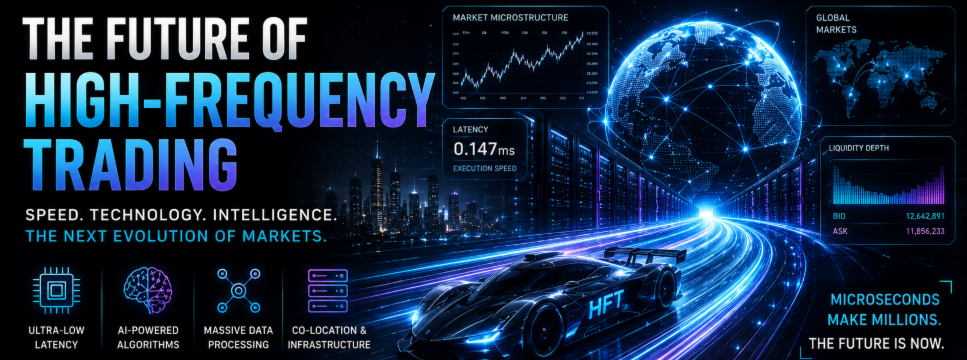
The Future of High Frequency Trading: How Artificial Intelligence Is Redefining the Speed War

The Future of High Frequency Trading: How Artificial Intelligence Is Redefining the Speed War
For three decades, the story of market speed was simple. Whoever had the fastest connection, the closest server, the shortest cable, won. High frequency trading turned this into a physical arms race, firms spending fortunes to shave microseconds off the distance between their servers and an exchange matching engine. That era is not over, but it is no longer the frontier. The next chapter of speed in markets is not being written in nanoseconds of latency. It is being written in the intelligence of the decision itself.
This article examines where high frequency trading is actually headed, why raw speed alone has stopped being a durable edge, how artificial intelligence and reinforcement learning are reshaping algorithmic execution at every level, and, honestly, what any of this genuinely means for an individual trader who will never own a data center next to an exchange.
What High Frequency Trading Actually Means Today
True high frequency trading refers to a narrow, capital intensive category of activity, firms colocating servers physically inside or adjacent to exchange data centers, consuming direct raw market data feeds, and executing thousands of orders per second through custom hardware built specifically to shave fractions of a microsecond off round trip latency. This world remains dominated by a small number of specialized firms, and it is not, and never has been, accessible to a retail trader running a platform on a home computer, regardless of internet connection quality.
It is important to state this plainly, because so much retail marketing blurs the line dishonestly. An Expert Advisor running on a retail broker connection, however sophisticated its intelligence, is not competing in the microsecond colocation arena, and no honest product claims otherwise. What is genuinely changing, and what matters enormously for every trader regardless of scale, is a parallel and increasingly dominant trend, the rise of intelligent, adaptive automated decision making that no longer depends on winning the physical speed war at all.
Why Raw Speed Stopped Being a Durable Edge
The pure latency arms race has, by its own economics, approached a point of diminishing returns. The physical distance between major exchange servers and the fastest possible network paths has been engineered down close to the limits of the speed of light itself. When multiple sophisticated firms all operate within nanoseconds of the theoretical minimum, being marginally faster than a competitor stops delivering the decisive edge it once did. The firms who continue to win are increasingly those who make better decisions with the speed they already have, not those chasing the last few nanoseconds of latency at exponentially rising cost.
This is the pivotal shift shaping the future of the entire field. Speed bought a seat at the table. Intelligence is what wins the hand now being played at that table.
From Colocation to Cognition: Where the Real Innovation Is Happening
The genuinely interesting frontier in modern algorithmic trading is not measured in microseconds anymore. It is measured in the sophistication of the decision engine sitting behind the execution layer. Several concrete shifts define this new frontier.
- Reinforcement learning driven execution. Rather than following static execution rules, modern systems increasingly use agents that learn optimal order placement and timing through live consequence, continuously refining behavior rather than executing a fixed playbook designed for yesterday's market conditions.
- Adaptive market perception. Techniques such as reservoir computing give systems a genuine memory of market sequence and rhythm, rather than treating every microsecond as an isolated, disconnected snapshot.
- Causal rather than correlative signals. Advanced systems increasingly measure the actual directed flow of influence between related markets, rather than assuming a fixed statistical relationship that can silently break down the moment conditions shift.
- Self modifying architectures. The most advanced systems now physically rewire the strength of their own internal connections as market character changes, an approach known as differentiable plasticity, allowing continuous adaptation rather than a single frozen calibration.
These are not incremental improvements bolted onto the old speed focused paradigm. They represent a genuinely different definition of edge, one based on understanding the market more deeply rather than merely reacting to it a few microseconds sooner than a rival.
The Democratization Trend Nobody Saw Coming
Here is the development that genuinely matters for every trader outside the institutional colocation world. As the frontier of edge shifted from raw speed to genuine intelligence, the barrier to entry shifted along with it. Building a faster physical connection to an exchange requires enormous capital that will never be available to an individual. Building genuinely intelligent, adaptive decision making requires sophisticated software architecture, which, unlike physical infrastructure, can be engineered once and deployed broadly.
This is precisely why the technology gap between institutional and retail trading has narrowed in the one dimension that actually matters for most traders. You will never colocate a server inside an exchange data center. But the same categories of intelligence driving the modern institutional edge, reinforcement learning, adaptive neural architectures, causal market analysis, are now available directly on a retail platform, running autonomously on your own account.
What This Means for the Individual Trader
The honest takeaway is not that retail traders can now compete in true high frequency trading. They cannot, and no credible product should claim otherwise. The honest and genuinely exciting takeaway is that the same intelligence categories reshaping the institutional speed war are directly accessible on a standard trading platform, applied at the timeframes and instruments retail traders actually operate in.
This is precisely the territory the ICONIC.FX ecosystem was built for. ICONIC BTC AI+ applies a plastic neural architecture built on differentiable plasticity, continuously rewiring its own internal connections as Bitcoin's volatile character shifts, the same self modifying principle driving the most advanced institutional research today. The flagship ICONIC KYBERNETIC AI+ applies causal intelligence through Transfer Entropy and a five hundred node reservoir architecture to coordinate Bitcoin and Gold simultaneously, alongside an actor critic reinforcement core learning continuously from its own decisions, the exact categories of intelligence described throughout this article. ICONIC NEUROCORE AI+ extends this same coordinated, learning based approach across two markets under one governing core.
For traders who want awareness rather than full automation, ICONIC TITAN AI brings a genuinely modern approach to information processing, scanning every timeframe in parallel through an ensemble of trained neural networks and surfacing only setups that clear strict, simultaneous probability gates, a direct application of the same intelligence first philosophy replacing pure speed as the defining edge across the entire industry.
The Risk of Chasing Speed Without Discipline
A word of caution belongs in any honest treatment of this topic. As automation accelerates across every level of trading, the temptation to equate faster execution with better outcomes grows stronger, and it is a trap. Speed without disciplined risk management simply allows mistakes to compound faster. An automated system executing flawed logic at machine speed does not become safer through velocity, it becomes more efficient at generating losses.
This is precisely why every system in the ICONIC.FX lineup pairs its adaptive intelligence with non negotiable, code level risk enforcement, a hard stop loss calculated before every single entry, a categorical rejection of grid and martingale techniques, and in the flagship system, a physics informed margin floor the engine is structurally incapable of violating. Intelligence and speed only become an edge when they operate inside a framework that treats capital protection as law rather than as an afterthought.
Frequently Asked Questions About the Future of High Frequency Trading
Can retail traders participate in true high frequency trading? No. True high frequency trading requires physical colocation inside exchange data centers and specialized infrastructure that remains the domain of large, well capitalized firms. What retail traders can access is the same category of artificial intelligence, reinforcement learning and adaptive architecture that is increasingly driving institutional edge beyond pure speed.
Is raw execution speed still important in modern trading? It remains relevant, but the pure latency arms race has approached diminishing returns as leading firms converge near physical limits. The differentiating edge has shifted toward the intelligence of the decision itself rather than marginal gains in microseconds.
What role does reinforcement learning play in the future of algorithmic trading? Reinforcement learning allows systems to continuously improve their decision making from live consequence rather than executing static, frozen rules, a capability increasingly central to both institutional and advanced retail systems.
How can an individual trader access this kind of intelligence today? Through purpose built systems that apply these architectures directly on retail trading platforms, without requiring any institutional infrastructure or technical expertise to operate.
The Edge of the Future Is Already Available
The future of high frequency trading is not a story about ever smaller fractions of a second. It is a story about intelligence finally overtaking raw speed as the defining edge in markets, and about that intelligence becoming available far beyond the walls of institutions that once held it exclusively. The traders who understand this shift early are positioning themselves on the correct side of an industry wide transformation, while others continue chasing an arms race that increasingly rewards a different kind of competitor altogether.
Explore the adaptive, intelligence first systems built for exactly this shift, including ICONIC BTC AI+, ICONIC KYBERNETIC AI+, ICONIC NEUROCORE AI+ and ICONIC TITAN AI, at iconicfx.tech.
Risk Disclaimer. Trading foreign exchange, cryptocurrencies, commodities and other leveraged financial instruments carries a high level of risk and may not be suitable for all investors. The high degree of leverage can work against you as well as for you. Past performance is not indicative of future results. Automated trading systems, indicators and Expert Advisors do not guarantee profits and can produce losses. Backtests and simulated results have inherent limitations and do not represent actual trading. ICONIC.FX provides software tools only and does not provide investment advice, portfolio management or financial recommendations. You are solely responsible for your own trading decisions. Seek advice from an independent licensed financial advisor if you have any doubts.



![[EURUSD]: Weekly Liquidity Activation Points (LAP), October 12-16, 2026](https://c.mql5.com/6/1035/splash-preview-777305.png "[EURUSD]: Weekly Liquidity Activation Points (LAP), October 12-16, 2026")