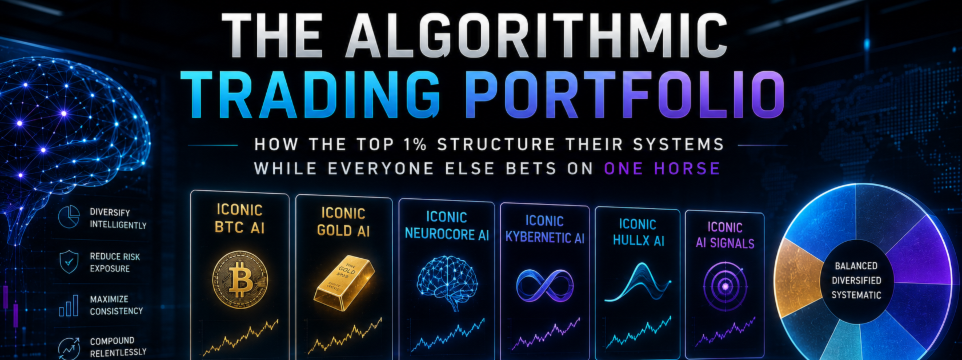
The Algorithmic Trading Portfolio: How the Top 1% Structure Their Systems While Everyone Else Bets on One Horse

The Algorithmic Trading Portfolio: How the Top 1% Structure Their Systems While Everyone Else Bets on One Horse
There is a mistake so common in automated trading that it has quietly ended more promising journeys than any market crash. It is not choosing a bad system. It is choosing only one. The trader finds a bot, funds it, and ties their entire outcome to a single strategy on a single market. When that strategy inevitably hits a rough patch, as every strategy on earth eventually does, they panic, abandon it at the bottom of its drawdown, and conclude that automated trading does not work. The system was never the problem. The structure was.
Professional trading operations have never worked this way. Inside every serious quantitative fund, capital is never staked on one strategy. It is spread across a coordinated portfolio of systems, each specialized for different markets, timeframes, and conditions, so that the weakness of one is offset by the strength of another. This is not a luxury of the rich. It is the fundamental architecture of survival, and it is the single most valuable structural lesson a retail trader can steal from the institutional world.
This guide teaches you exactly that. Over the next thirty minutes you will learn how to think about algorithmic systems the way a portfolio architect does, how to layer signal intelligence and autonomous execution, how to combine specialists and generalists across uncorrelated markets, and how to allocate capital so that no single system can ever sink you. Along the way we will use the complete ICONIC.FX ecosystem as the working example, because it was deliberately built as exactly such a portfolio, from signal engines to fully autonomous dual market intelligence. Take your time with this one. It is the closest thing to a blueprint you will find.
Part One: Why Single-System Trading Is Structurally Fragile
Begin with a truth that every quantitative professional accepts and almost every retail trader resists. Every strategy, no matter how sophisticated, has market conditions in which it underperforms. A breakout system starves in a tight range. A trend follower bleeds in chop. A volatility engine idles when the market sleeps. This is not a flaw to be engineered away. It is the mathematical nature of specialization. The very sharpness that makes a system deadly in its ideal conditions makes it ordinary outside of them.
Now consider what this means for the trader running a single system. Their equity curve is hostage to one strategy's relationship with current conditions. When the fit is good, they feel like a genius. When the fit degrades, they experience a drawdown with nothing to offset it, and this is where psychology takes over. Watching a lone system decline, with no counterweight, is emotionally unbearable for most people. They intervene, switch off, or abandon, almost always at the worst possible moment, converting a normal, recoverable drawdown into a permanent realized loss.
The portfolio approach dismantles this trap at the root. When capital is spread across systems with different specializations and different market exposures, the drawdown of one is cushioned by the performance of others. The combined equity curve is smoother not because any individual system changed, but because mathematics did its quiet work. This effect, the reduction of total volatility through combining imperfectly correlated return streams, is the closest thing to a free lunch that finance has ever discovered. Institutions have feasted on it for decades. It is time you did too.
Part One and a Half: The Mathematics of Not Losing, Made Concrete
Because this principle carries the entire guide, let us make it tangible with simple numbers rather than abstract assurances. Imagine two systems, each perfectly respectable on its own. System A returns a strong year but suffers a twenty percent drawdown along the way. System B performs similarly, with its own twenty percent drawdown. Held individually, either one subjects you to the full psychological weight of a twenty percent decline.
Now combine them, half your capital in each, and observe what happens to the drawdown. If their difficult periods arrive at exactly the same time, the combined drawdown remains twenty percent, and you have gained nothing. But if their rough patches only partially overlap, which is precisely what happens when systems trade different markets with different methods, the combined drawdown shrinks, often dramatically. One system's decline lands while the other is flat or advancing, and the portfolio dip might be twelve percent instead of twenty. Same components, same individual behavior, radically different experience for the person holding it.
This is the entire secret, and it is worth reading twice. The portfolio did not become safer because the systems improved. It became safer because their imperfections stopped arriving in unison. Correlation, the degree to which two return streams move together, is therefore the hidden variable that governs everything. Assets and strategies with low correlation to each other are the raw material of resilient portfolios, and this is why the pairing of Bitcoin and Gold, a modern risk asset and an ancient safe haven with structurally different drivers, appears again and again throughout the ICONIC.FX ecosystem. The diversification is not decorative. It is engineered into the very choice of markets.
One more consequence deserves emphasis, because it changes behavior. A smoother combined curve does not merely feel better. It compounds better. Deep drawdowns are mathematically punishing, since a fifty percent loss demands a one hundred percent gain merely to recover. By keeping the valleys shallower, a diversified structure protects the geometry of compounding itself, allowing the same underlying performance to accumulate into meaningfully more wealth over time. Structure is not cosmetic. Structure is return.
Part Two: The Two Layers of a Modern Algorithmic Stack
Before assembling a portfolio, you must understand that algorithmic tools fall into two fundamentally different layers, and a complete operation uses both.
The Signal Layer. These are systems that analyze the market and tell you what they see, delivering high quality trade ideas with defined entries, stops, and targets, while leaving the final execution decision in your hands. Think of them as an elite research desk working for you around the clock. They are ideal for traders who want to stay involved in the decision, learn from the machine's reasoning, or trade markets and accounts where full automation is not desired.
The Execution Layer. These are fully autonomous systems, Expert Advisors that analyze, decide, enter, manage, and exit entirely on their own. They are the layer that removes human emotion from the moment of action completely, and they are where the deepest AI architectures live, because autonomous execution demands the highest standard of risk engineering.
The amateur sees these as competing options. The architect sees them as complementary layers of one stack. The signal layer keeps you informed, sharpens your own judgment, and covers discretionary opportunities. The execution layer compounds relentlessly in the background, immune to your moods. A complete portfolio uses both, and we will now build one, layer by layer, product by product.
Part Three: The Signal Layer, Your Automated Research Desk
Every professional operation begins with superior information. In the ICONIC.FX ecosystem, two engines occupy this layer, each solving a different signal problem.
The multi timeframe scanner. One of the hardest problems in trading is that opportunity is scattered across timeframes. A setup forming on the hourly chart may be invisible on the daily, and vice versa. No human can genuinely monitor every timeframe on every symbol simultaneously. ICONIC TITAN AI was built for precisely this. Its neural signal engine scans every timeframe from one minute to daily in parallel, maintaining a live score matrix that shows, at a glance, where the highest probability conditions are forming across the entire time structure of a market.
What elevates ICONIC TITAN AI beyond a mere scanner is its quality gating. A signal is not issued simply because a pattern appears. The engine enforces a minimum AI score threshold and, on top of that, explicit probability gates, requiring a minimum estimated probability of reaching the first target and a maximum tolerated probability of hitting the stop. Signals that fail these gates never reach you. The result is a filtered stream of only the setups the engine itself considers statistically favorable, each delivered with defined structure. An integrated, currency aware economic calendar filter additionally suppresses signals around high impact news, protecting you from the most treacherous moments in the market.
The confluence specialist. Where the scanner covers breadth, the second signal engine delivers depth. ICONIC HULLX AI is a multi timeframe confluence indicator built around the adaptive Hull moving average suite, spanning its HMA, EHMA and THMA variants, fused with a volatility band squeeze engine that identifies moments when the market coils before expansion. Every potential signal must then pass through a five action Boltzmann AI meta gate, a reinforcement inspired filter that acts as the final intelligent judge of signal quality.
When ICONIC HULLX AI speaks, it speaks completely. Alerts arrive as push notifications containing the symbol, direction, entry, stop loss, and two take profit targets, a fully structured trade plan rather than a vague arrow on a chart. For the trader who wants to remain the final decision maker while outsourcing the analytical heavy lifting, this pair of engines forms a research desk that never sleeps, never gets bored, and never lowers its standards.
Part Four: The Execution Layer, The Specialists
Now we descend into the engine room, the fully autonomous layer where capital is deployed without human intervention. Portfolio construction at this layer begins with specialists, systems that concentrate their entire intelligence on mastering a single market. Specialization matters because markets have personalities. The statistical character of Bitcoin is nothing like the character of Gold, and a system tuned deeply to one will always outclass a generic system stretched across many.
The crypto specialist. Bitcoin is the most violent liquid market on earth, and it demands an architecture built for chaos. ICONIC BTC AI+ answers with a plastic neural engine founded on differentiable plasticity and Hebbian neuromodulation, meaning the system continuously rewires the strength of its own internal connections as market conditions shift. It maintains a MAP Elites archive of tuned behavioral variants, always holding a battle ready response for the regime it actually faces, and it learns even from imperfect trades through Hindsight Experience Replay, extracting signal from near misses the way an elite professional dissects every almost. Its momentum perception runs on Grünwald Letnikov fractional calculus, a mathematical method of measuring price acceleration with memory, and its discipline is absolute: daily and previous day breakout structure, confidence gated entries, ATR adaptive sizing, and a hard stop loss calculated before every single entry. No grid. No martingale. Ever.
The gold specialist. Gold moves to a different rhythm, driven by liquidity structure, macro flows, and scheduled news events that can whipsaw an unprepared system in seconds. ICONIC GOLD AI+ applies the same battle proven plastic cognitive kernel, differentiable plasticity, Hebbian learning, the behavioral archive, hindsight replay, to the specific liquidity personality of XAUUSD, trading daily and previous day high low breakouts filtered through its self adapting phenotypic brain. What distinguishes the gold engine further is its statistical hygiene and self awareness. Incoming features are normalized through Welford online statistics, reward shaping is driven by the Sortino ratio so the system optimizes against harmful downside volatility rather than all volatility, built in drift detection recognizes when market character has genuinely changed, and confidence calibration keeps its conviction estimates honest. Critically for gold, an integrated news filter built on the native economic calendar keeps the system out of the market during scheduled high impact events, sidestepping the single most dangerous moments in the gold market.
Notice what these two specialists give a portfolio when combined. Bitcoin and Gold are structurally different assets, a digital risk asset and an ancient safe haven, with meaningfully different behavior across market cycles. Running ICONIC BTC AI+ and ICONIC GOLD AI+ side by side is already genuine diversification, two deeply specialized return streams whose rough patches rarely align.
Part Five: The Execution Layer, The Coordinated Minds
Specialists are powerful, but the institutional frontier lies one level higher, in systems that trade multiple markets under a single coordinating intelligence. This is fundamentally harder than running two bots side by side, because true coordination requires the system to understand how its markets influence each other and to govern risk across both as one unified whole.
The dual asset intelligence. ICONIC NEUROCORE AI+ trades Bitcoin and Gold simultaneously from one coordinated core. Each market is handled by its own isolated brain, powered by Q learning with eligibility traces so that credit for outcomes is correctly assigned across sequences of decisions, while a central governance layer manages risk across both. Directed information flow between the two markets couples the brains intelligently, and capital exposure is disciplined through risk parity style allocation under a margin utilization governor. The five bugfix hardened allocation logic ensures neither market is starved of risk budget, keeping both brains genuinely active. For the trader stepping up from single market systems, ICONIC NEUROCORE AI+ is the gateway into coordinated multi asset intelligence.
The flagship. At the summit of the ecosystem stands ICONIC KYBERNETIC AI+, the fullest expression of everything modern trading AI has learned. Its OMNI NEXUS cybernetic core also commands Bitcoin and Gold from a single chart, but with the deepest architecture in the lineup. Causal understanding comes from Transfer Entropy within a directed graph model, measuring the real, directed flow of information between the two markets in real time rather than assuming correlation. Perception runs through a five hundred node Liquid State Machine, a massive echo state reservoir granting deep dynamic memory of market sequence. Decisions are refined by an actor critic reinforcement core using TD lambda learning with eligibility traces, improving continuously from the consequences of its own actions through relentless online updates.
And its protection is the sternest of all. The PINN Margin Axiom embeds a hard thirty five percent free margin floor into the engine as an unbreakable physical law. Three tiers of portfolio drawdown protection respond to stress in graduated stages, loss streak circuit breakers halt activity in hostile regimes, and capital allocation between the two markets is solved through stochastic tunneling toward a Nash Pareto equilibrium, a mathematical search for the optimally balanced distribution of risk. ICONIC KYBERNETIC AI+ is not an incremental upgrade over the rest of the lineup. It is the destination the entire ecosystem points toward, the system you graduate into as your capital and conviction grow.
Part Six: Assembling the Portfolio, The Architect's Principles
You now know the components. Here is how an architect combines them, using principles that apply whether you deploy two systems or all six.
Principle one: diversify across market personality, not just symbols. The point of holding multiple systems is that their difficult periods should not coincide. Combining a crypto specialist with a gold specialist achieves this naturally, because the two markets respond to different forces. Adding a coordinated dual asset system layers on a third return stream whose behavior differs from either specialist alone, since its cross market intelligence trades the relationship itself.
Principle two: layer signals over execution. Run the autonomous layer as your compounding core, and the signal layer as your awareness and opportunity engine. ICONIC TITAN AI and ICONIC HULLX AI keep you connected to the broader market and feed your discretionary side, while the EAs compound in the background untouched by your emotions. This structure satisfies the human need for involvement without letting that involvement contaminate the autonomous layer.
Principle three: budget risk, not hope. Decide in advance what fraction of total capital each system commands, and size those allocations so that even a worst case drawdown in any single system is survivable and emotionally tolerable. The professional asks one question of every allocation: if this system hits its maximum historical drawdown tomorrow, does my total portfolio remain comfortably intact? If the answer is no, the allocation is too large, regardless of how promising the system looks.
Principle four: judge the portfolio, not the parts. Once assembled, evaluate performance at the portfolio level over meaningful time horizons. Any individual system will have losing weeks. That is not failure, it is the statistical texture of trading. The architect resists the amateur reflex of yanking whichever system lost most recently, understanding that today's laggard is frequently tomorrow's leader as conditions rotate. The whole point of the structure is that you no longer need any single component to be perfect.
Principle five: scale in stages. A sensible progression exists within the ecosystem itself. Many traders begin with a single specialist such as ICONIC BTC AI+ or ICONIC GOLD AI+, add the second specialist for their first taste of genuine diversification, step up to ICONIC NEUROCORE AI+ for coordinated dual asset intelligence, and ultimately graduate to ICONIC KYBERNETIC AI+ as the flagship core of a mature portfolio, with the signal engines running throughout as the ever present research desk. Each stage builds on the last, and each is a complete, disciplined system in its own right.
Part Six and a Half: The Operator's Routine, What Overseeing a Portfolio Actually Looks Like
A frequent misconception deserves correction here. Running a portfolio of autonomous systems does not mean more work than running one. It means a different, far calmer kind of work, and remarkably little of it. Here is what a disciplined oversight routine actually looks like in practice, so you can see how light the operational burden truly is.
Daily, two minutes. A single glance confirms that all systems are connected and operating. You are not evaluating performance, you are confirming heartbeat. The signal engines may have delivered alerts worth reviewing for your discretionary side, and that review is optional, not obligatory. Then you close the terminal and live your day. The autonomous layer neither needs nor benefits from your continued attention.
Weekly, fifteen minutes. A calm review at the portfolio level. Total equity, current drawdown if any, and a brief look at whether each system is behaving within its normal statistical character. The key discipline is perspective: you are reading a chapter, not judging the whole book. Individual red weeks are expected texture, not emergencies. Nothing is switched off, resized, or overridden based on a single week.
Monthly, one hour. The only session with real decisions in it, and even here, the default decision is no change. You compare each system's behavior against its long term profile, confirm allocations still match your risk budget, and rebalance only if genuine drift has occurred, for instance if one system's growth has quietly made it a larger share of total capital than you designed. Deliberate, scheduled, unemotional adjustment is the professional rhythm. Impulsive midweek tinkering is the amateur one.
That is the entirety of the job. Perhaps three hours of attention per month to oversee a structure that watches the markets every second of every day. Compare that honestly against the life of the manual trader, chained to screens through every session, and the true luxury of the portfolio approach becomes obvious. It is not only mathematically superior. It hands you back your time, which was always the point.
Part Seven: The Five Portfolio Mistakes That Undo Everything
Mistake one: pseudo diversification. Running five systems that all trade the same market with the same style is not diversification, it is the same bet written five times. Diversification lives in the differences between systems, in market, method, and timeframe.
Mistake two: performance chasing. Pouring capital into whichever system performed best last month, and starving the rest, systematically buys high and sells low at the strategy level. Allocations should be set by design and adjusted deliberately, not chased emotionally.
Mistake three: intervention addiction. The trader who manually overrides their autonomous systems whenever they feel nervous has silently replaced the machine's discipline with their own emotions, recreating the exact problem automation exists to solve. Set the structure, then respect it.
Mistake four: ignoring the risk architecture of components. A portfolio is only as sound as its parts. A single grid or martingale system hiding in an otherwise disciplined portfolio is a bomb in the basement, capable of destroying the whole structure in one bad week. Every component must independently pass the hard test: a defined stop on every trade, and no loss averaging of any kind. Every system in the ICONIC.FX lineup is built to pass that test by design.
Mistake five: impatience with the mathematics. The smoothing power of a portfolio emerges over dozens and hundreds of trades, not days. The trader who dismantles the structure after two quiet weeks never gives the mathematics the runway it needs. Build it, fund it sensibly, and let time do what time does.
Frequently Asked Questions About Algorithmic Trading Portfolios
Why should I run multiple trading systems instead of one? Because every strategy has market conditions where it underperforms. Combining systems with different specializations smooths the total equity curve, reduces the psychological pressure of any single drawdown, and dramatically lowers the chance of abandoning a sound strategy at the worst moment.
What is the difference between a signal indicator and an Expert Advisor? A signal system like ICONIC TITAN AI or ICONIC HULLX AI analyzes the market and delivers structured trade ideas while you retain execution control. An Expert Advisor like ICONIC BTC AI+ or ICONIC KYBERNETIC AI+ executes fully autonomously. A complete portfolio typically uses both layers.
How much capital should I allocate to each system? Size every allocation so that the worst historical drawdown of that system would leave your total portfolio comfortably intact. There is no universal number, but the guiding rule is that no single system should ever be able to sink the whole structure.
Do I need all six systems to benefit from portfolio thinking? No. Even two genuinely different systems, such as a Bitcoin specialist and a Gold specialist, deliver meaningful diversification. The structure scales with you, and many traders build it in stages over time.
Can I combine these systems with copytrading? Yes. The autonomous systems are also available through performance based copytrading, where the model earns only when you profit, allowing you to hold a diversified algorithmic portfolio without any technical setup at all.
The Structure Is the Edge
Step back and see what you now hold. Most traders spend years hunting for the one perfect system, and the hunt itself is the trap, because no such system exists and never will. The professionals stopped hunting long ago. They build structures instead, portfolios of specialized intelligence whose combined behavior is stronger, smoother, and more survivable than any component alone. The edge was never a single algorithm. The edge is the architecture.
That architecture is now fully within your reach. Anchor your awareness with the always on research desk of ICONIC TITAN AI and ICONIC HULLX AI. Deploy the specialist firepower of ICONIC BTC AI+ and ICONIC GOLD AI+ across two structurally different markets. Step up to the coordinated dual asset mind of ICONIC NEUROCORE AI+, and crown the structure with the flagship intelligence of ICONIC KYBERNETIC AI+. Build it in stages or build it whole, deploy directly or mirror through performance aligned copytrading. Either way, stop betting on one horse. Start owning the stable. That is how the top one percent trade, and as of today, it is how you can too.
Visit on https://iconicfx.tech
Risk Disclaimer. Trading foreign exchange, cryptocurrencies, commodities and other leveraged financial instruments carries a high level of risk and may not be suitable for all investors. The high degree of leverage can work against you as well as for you. Before deciding to trade, you should carefully consider your investment objectives, level of experience and risk appetite. The possibility exists that you could sustain a loss of some or all of your initial investment and therefore you should not invest money that you cannot afford to lose. Past performance is not indicative of future results. Automated trading systems, indicators and Expert Advisors do not guarantee profits and can produce losses. Backtests and simulated results have inherent limitations and do not represent actual trading. Diversification does not guarantee profits or protect against losses. ICONIC.FX provides software tools only and does not provide investment advice, portfolio management or financial recommendations. You are solely responsible for your own trading decisions. Seek advice from an independent licensed financial advisor if you have any doubts.