Overfitting: The Invisible Killer That Destroys Trading Bots Nobody Saw Coming

Overfitting: The Invisible Killer That Destroys Trading Bots Nobody Saw Coming
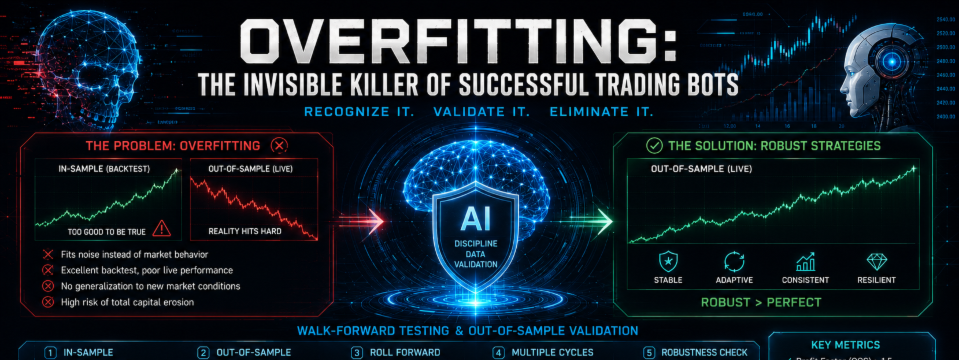
Somewhere right now, a developer is staring at a backtest so beautiful it looks almost fake. A near vertical equity curve, a profit factor that seems too good to question, barely a losing month across years of simulated history. It feels like discovery. It is very often something else entirely, a strategy that has quietly memorized the specific noise of historical data rather than learning any genuine, repeatable edge. The bot will be deployed live with total confidence, and within weeks, sometimes days, it will begin losing in ways the backtest never hinted at. This is overfitting, and it is responsible for more failed trading systems than any single flawed strategy idea could ever be.
This article explains precisely what overfitting is and why it is uniquely dangerous in a trading context, the concrete warning signs that reveal an overoptimized strategy before you ever risk real capital on it, how walk forward testing and out of sample validation actually work as genuine defenses, and why the goal of serious system design should always be robustness rather than the seductive illusion of a perfect backtest.
What Overfitting Actually Is and Why Trading Makes It Especially Dangerous
Overfitting occurs when a model or strategy becomes tuned so precisely to a specific historical dataset that it captures random noise alongside, or instead of, genuine underlying structure. In most machine learning applications, an overfit model simply performs poorly on new data, an annoying but survivable failure. In trading, the consequences are far more severe, because a strategy fitted to historical noise does not fail gracefully. It fails by placing real capital behind confident, precisely calibrated decisions that were never actually justified, and the market has no obligation to ever repeat the specific noise pattern the strategy secretly memorized.
The core problem is that financial markets are non stationary. Their statistical character shifts continuously, which means the exact historical sequence a strategy was optimized against will never occur again in precisely the same way. A strategy that only works because it was tuned to that unique historical sequence has no genuine edge at all, it has an elaborate coincidence dressed up as intelligence.
The Warning Signs of an Overoptimized Strategy
Several concrete red flags reveal an overfit system before you ever risk capital on it, and learning to recognize them is one of the highest value skills a trader can develop.
- Too many free parameters relative to the number of trades in the sample. A strategy with a dozen finely tuned inputs, calibrated against a few hundred historical trades, has enormous freedom to fit noise rather than signal. The more parameters relative to sample size, the more suspicious any impressive result should be.
- A suspiciously smooth equity curve with almost no drawdown. Genuine trading edges experience real drawdowns, because markets genuinely fluctuate. A curve that rises in an almost perfectly straight line across years of history is far more often evidence of overfitting, or of a hidden risk technique, than evidence of true skill.
- Extreme sensitivity to small changes in the test window. If shifting the backtest start or end date by even a few weeks dramatically changes the results, the strategy has likely been tuned to the specific historical sequence rather than to a genuine, durable pattern.
- Parameters with no logical or economic rationale. A rule that enters exactly after a specific, oddly precise number of bars, or a threshold with no relationship to any real market mechanism, is a strong signal that the parameter was chosen because it happened to fit historical data well, not because it reflects genuine market behavior.
- A strategy that has been repeatedly re optimized chasing the best historical fit. Every additional round of tuning against the same historical dataset increases the risk that the strategy is converging on noise rather than signal, even if each individual adjustment seemed reasonable at the time.
Walk Forward Testing: The Real Antidote to Curve Fitting
A single backtest, however impressive, only proves that a strategy fit a specific slice of history well. It proves nothing about whether that fit reflects genuine, repeatable structure. Walk forward testing addresses this directly. Rather than optimizing once against an entire historical dataset and calling the result proof, a walk forward process trains or calibrates a strategy on one window of historical data, then tests it strictly on the following window it never touched during calibration. The process then rolls forward repeatedly, continuously validating against genuinely unseen data rather than the same window the strategy was tuned against.
This is precisely the discipline built into ICONIC TITAN AI, whose neural networks are trained through a twelve month walk forward backfill process, continuously feeding hit rate statistics back into the model as it progresses, rather than relying on a single frozen calibration performed once against an entire historical dataset and never revisited. This distinction matters enormously. A system validated this way has demonstrated its behavior across a genuine sequence of unseen periods, not merely a single, potentially cherry picked historical window.
Out of Sample Validation and Why It Is Genuinely Non Negotiable
Out of sample validation is the broader principle underlying walk forward testing, and it deserves to be stated plainly. A strategy's true edge can only be measured by its performance on data it never influenced during its own design. Testing a strategy only on the data used to build it is not validation at all, it is simply confirming that the strategy fits the data it was fitted to, a circular and ultimately meaningless exercise no matter how impressive the resulting numbers look.
Any vendor unwilling or unable to describe how their system was validated on genuinely unseen data deserves informed skepticism rather than immediate trust, regardless of how compelling their marketing materials appear.
Building Robust Systems Instead of Chasing Perfect Backtests
The deepest lesson overfitting teaches is philosophical as much as technical. The goal of serious system design should never be the most impressive possible historical result. It should be genuine robustness, a system that performs reasonably across a wide range of conditions rather than spectacularly in one narrow historical window and disastrously everywhere else.
One of the most effective structural defenses against overfitting is requiring genuine accumulated evidence before a system trusts any of its own learned adjustments. ICONIC KYBERNETIC AI+ builds this principle directly into its architecture through explicit warmup gating across every learning component. Its regime filter requires a defined minimum number of trades in a specific volatility bucket before that bucket's learned verdict is ever allowed to override the original prior assumption. Its meta labeling position sizing model remains neutral until a meaningful number of trades have been observed, refusing to modulate size based on an undertrained estimate. Its smart bail out and adaptive trailing systems both enforce a defined warmup period of accumulated lessons before they are permitted to deviate from a fixed, conservative default, and even then, a Bayesian shrinkage mechanism pulls early estimates conservatively toward a neutral midpoint rather than trusting thin evidence at face value. This is precisely the kind of deliberate architectural discipline that separates a robust learning system from one quietly overfitting to whatever limited evidence it has accumulated so far.
A second genuine defense is continuous adaptation rather than a single frozen calibration. ICONIC BTC AI+ and ICONIC GOLD AI+ employ neural architectures built on differentiable plasticity, continuously rewiring the strength of their own internal connections in response to live market feedback rather than freezing after a single historical optimization. The self calibrating confidence gate inside ICONIC KYBERNETIC AI+, built on Adaptive Conformal Inference, regulates its own threshold online against a stated error rate target, meaning its calibration is continuously checked against live reality rather than trusted indefinitely from a single point in the past. A system designed to keep adapting against ongoing evidence is structurally far less vulnerable to being permanently anchored around one overfit historical snapshot.
How to Evaluate Any System's Backtest Honestly, Starting Today
Before trusting any trading system with real capital, apply a simple, disciplined checklist rather than being impressed by a single headline number.
- Ask specifically for out of sample or walk forward results, not merely total historical backtest profit, since the latter proves nothing about genuine generalization.
- Consider the number of tunable parameters relative to the number of trades in the sample, since more parameters relative to less data increases overfitting risk substantially.
- Check whether performance holds up across genuinely different market conditions and date ranges, rather than only the single window most favorable to the strategy.
- Be honestly skeptical of any equity curve with an unnaturally smooth appearance and minimal drawdown, since genuine trading edges experience real, visible volatility.
- Favor systems that describe explicit warmup periods, minimum sample requirements, or online recalibration mechanisms, since these represent deliberate architectural defenses against overfitting rather than an accident of good luck.
Frequently Asked Questions About Overfitting in Trading Bots
What is overfitting in the context of a trading strategy? It occurs when a strategy is tuned so precisely to historical data that it captures random noise alongside, or instead of, genuine repeatable market structure, producing impressive backtest results that fail to hold up in live trading.
What is the clearest warning sign of an overfit strategy? An equity curve that is unnaturally smooth with minimal drawdown, combined with a large number of finely tuned parameters relative to the number of historical trades used to calibrate them.
What is walk forward testing? A validation method where a strategy is calibrated on one window of historical data and tested strictly on the following window it never touched during calibration, with the process rolling forward repeatedly to validate against a genuine sequence of unseen periods.
Why is out of sample validation considered non negotiable? Because testing a strategy only on the data used to design it simply confirms it fits that data, proving nothing about genuine generalization to conditions the strategy has never encountered.
How can a trading system defend against overfitting architecturally? Through mechanisms such as warmup gating that require a minimum amount of accumulated evidence before trusting a learned adjustment, Bayesian shrinkage toward neutral estimates early on, and continuous online recalibration rather than a single frozen historical optimization.
Choose Robust Over Impressive, Every Time
The most dangerous trading system is rarely the one with a mediocre backtest. It is the one with a suspiciously perfect one, built on parameters fitted so precisely to the past that they carry no genuine information about the future. Genuine edge is rarely flawless in simulation. It is durable across conditions the strategy was never explicitly tuned for, validated honestly on data it never touched during its own design, and built with the architectural humility to require real evidence before trusting its own adjustments.
Explore systems engineered with exactly this discipline, from the walk forward validated signal engine of ICONIC TITAN AI, through the continuously adaptive architectures of ICONIC BTC AI+ and ICONIC GOLD AI+, to the warmup gated, self calibrating learning stack inside ICONIC KYBERNETIC AI+, at iconicfx.tech.
Risk Disclaimer. Trading foreign exchange, cryptocurrencies, commodities and other leveraged financial instruments carries a high level of risk and may not be suitable for all investors. The high degree of leverage can work against you as well as for you. Past performance is not indicative of future results. Automated trading systems, indicators and Expert Advisors do not guarantee profits and can produce losses. Backtests and simulated results have inherent limitations and do not represent actual trading. ICONIC.FX provides software tools only and does not provide investment advice, portfolio management or financial recommendations. You are solely responsible for your own trading decisions. Seek advice from an independent licensed financial advisor if you have any doubts.



![[EURUSD]: Weekly Liquidity Activation Points (LAP), October 12-16, 2026](https://c.mql5.com/6/1035/splash-preview-777305.png "[EURUSD]: Weekly Liquidity Activation Points (LAP), October 12-16, 2026")