Five Things Institutions Understand About Trading That Most Retail Traders Never Learn

Five Things Institutions Understand About Trading That Most Retail Traders Never Learn
There is a specific set of ideas that separates traders who survive for years from traders who blow up within months, and almost none of it is taught in the places retail traders actually learn from. It is rarely about which indicator to use. It is about how professionals actually structure information, measure success, handle volatility, borrow from institutional research, and avoid the quiet mistakes that destroy automated accounts long before anyone notices the danger.
This is a long, deliberately thorough piece, because each of these five ideas deserves real depth rather than a surface level mention. We will cover how multi timeframe artificial intelligence eliminates the guesswork behind precise entries and exits, why win rate is one of the most overrated numbers in all of trading, how news trading has been transformed by intelligent filtering rather than blind reaction, how professional hedge funds actually deploy machine learning behind their research desks, and finally, the specific mistakes that quietly sink the majority of automated trading accounts. Read this in full. It will change how you evaluate every system you ever look at again.
Part One: Multi Timeframe AI and the End of Guessing Which Chart to Open
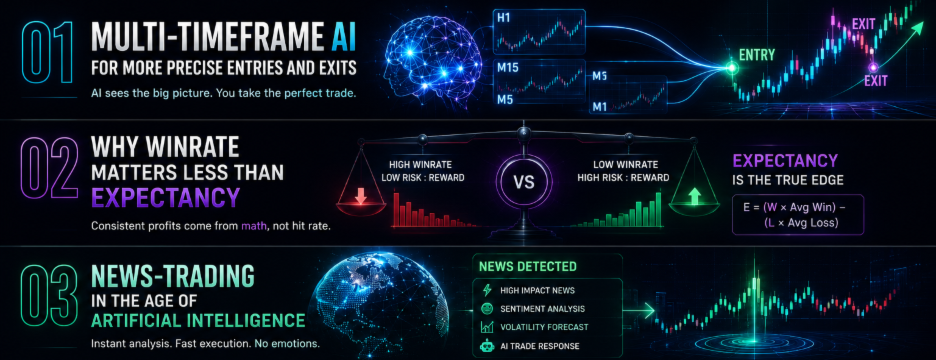
Every discretionary trader eventually faces the same silent limitation. A market moves across seven relevant timeframes simultaneously, from the smallest intraday structure through the daily trend, and no human being can genuinely track all of them at once with full attention. You watch one chart closely and lose the others. You switch between them and lose continuity. The result is not a lack of skill. It is a structural ceiling on how much information a single human attention span can process in real time.
The timeframe blind spot. This limitation is invisible until you understand it, and then you see it everywhere. A setup forming cleanly on the one hour chart can be completely contradicted by exhaustion on the four hour chart, or reinforced powerfully by alignment on the daily. Traders who only watch one or two timeframes are, whether they realize it or not, trading on a fraction of the available information, then wondering why their edge feels inconsistent.
How multi timeframe artificial intelligence actually solves this. Instead of forcing a choice, a genuinely modern signal engine scans every relevant timeframe in parallel, continuously, and scores what it observes on each one independently. ICONIC TITAN AI is built precisely around this principle, running an ensemble of trained neural networks across seven timeframes from the smallest intraday structure through the daily chart, maintaining a live score matrix so the highest quality conditions across the entire time structure of a symbol are visible at a glance rather than guessed at.
Why this produces genuinely more precise entries and exits. The precision does not come from a single clever formula. It comes from layered agreement. When multiple independent timeframes simultaneously score a setup favorably, the statistical case for that entry is substantially stronger than any single timeframe reading alone could ever justify. This is exactly why ICONIC TITAN AI gates its signals through multiple simultaneous probability thresholds, a minimum overall score, a minimum probability of reaching the first target, and a maximum tolerated probability of hitting the stop, so that only setups with genuine cross timeframe conviction ever surface as an alert.
Precision on the exit side matters just as much as the entry, and it is frequently ignored entirely by retail traders fixated only on getting in. A well engineered exit adapts to real volatility rather than sitting at an arbitrary fixed distance. This is the same philosophy behind the ATR based dynamic stops and structured take profit logic used across the autonomous execution layer of the ICONIC.FX lineup, where protective and profit taking levels scale with actual market conditions rather than a number chosen once and forgotten.
The confluence layer. For traders who want an additional lens focused specifically on trend structure rather than broad probability scanning, ICONIC HULLX AI brings a complementary multi timeframe confluence approach, built around an adaptive Hull moving average suite fused with a volatility band squeeze engine, filtered through a Boltzmann style meta gate before a fully structured alert, including entry, stop and two profit targets, ever reaches you. Running a broad probability scanner alongside a focused confluence engine gives a trader two genuinely different lenses on the same multi timeframe problem, which is precisely how a disciplined research desk operates rather than relying on a single opinion.
Part Two: Why Win Rate Is the Most Overrated Number in Trading
Ask a beginner what makes a good trading system and almost everyone answers the same way. High win rate. Ask a professional the same question and you get a completely different answer, one built on a concept most retail traders have never been properly taught. Expectancy.
The formula that actually matters. Expectancy is calculated by multiplying your win rate by your average win, then subtracting your loss rate multiplied by your average loss. This single number tells you what you can genuinely expect to earn, on average, per trade, over a large enough sample. And here is the part that surprises most traders the first time they see it laid out honestly.
- A system winning forty percent of the time, with an average win three times the size of the average loss, produces a strongly positive expectancy. Forty percent of trades return three units, sixty percent lose one unit, and the math still comes out clearly ahead over time.
- A system winning seventy percent of the time, with an average loss twice the size of the average win, can produce a negative expectancy despite the impressive sounding win rate. Seventy percent of trades return one unit, thirty percent lose two units, and the seemingly superior win rate quietly bleeds the account over a large enough sample.
This is precisely why a professional evaluating any trading system asks about the reward to risk ratio and the underlying expectancy before ever asking about win rate, and it is why marketing that leads with an impressive win rate percentage, without disclosing the size of losses relative to wins, should immediately raise suspicion rather than excitement.
Where this shows up in genuine system design. This principle is not theoretical. It directly shapes how a disciplined engine defines its targets. ICONIC TITAN AI deliberately calibrates its first take profit target around a specific, statistically favorable reward multiple of the risk taken, chosen precisely because it optimizes the probability weighted expectancy of the setup rather than chasing an unrealistic target purely to look impressive in marketing screenshots. The same philosophy underlies the defined reward to risk structure built into ICONIC BTC AI+ and ICONIC GOLD AI+, where take profit is set as a calculated multiple of the stop distance rather than an arbitrary number, ensuring every single trade carries a positive expectancy structure before it is ever placed.
The lesson to carry forward. Stop asking how often a system wins. Start asking what it actually expects to earn per trade once wins and losses are weighted honestly against each other. That single shift in thinking will change how you evaluate every product you ever look at again.
Part Three: News Trading in the Age of Artificial Intelligence
News trading has always carried a brutal reputation, and for good reason. A scheduled economic release can reprice a market violently in seconds, spreads widen dramatically at the exact moment liquidity thins, and a human trader manually reacting to a headline is almost always too slow, too emotional, or both. For years the professional advice was simple. Stay out of the market during major news, full stop.
Why blind avoidance was always an incomplete strategy. The problem with a blanket avoidance rule is that it treats every news event as equally dangerous and every symbol as equally exposed, which is simply not true. A currency pair is far more sensitive to a release tied to its own underlying economy than to an unrelated announcement, and treating every scheduled event as a universal blackout wastes opportunity while still leaving genuinely dangerous windows inadequately covered by a rule too crude to distinguish relevance.
How artificial intelligence has transformed this into a genuinely intelligent filtering problem. Modern systems no longer treat news as an emotional interruption to be feared blindly. They treat it as structured data to be filtered intelligently. ICONIC TITAN AI applies a symbol currency aware economic calendar filter, meaning it specifically understands which scheduled events are actually relevant to the instrument being traded, rather than blocking activity around every event indiscriminately. Configurable blackout windows before and after a release allow the filter to be tuned to high impact events only, or to both medium and high impact events, and an optional advance notification can even warn that a relevant release is approaching before the blackout window begins.
This same principle of intelligent rather than blind news handling runs through the autonomous execution layer. ICONIC GOLD AI+ integrates a news filter built on the native economic calendar specifically because Gold is exceptionally sensitive to scheduled macro releases, sidestepping the single most dangerous moments in that market without needing to be manually watched. ICONIC BTC AI+ respects its own news related lockouts while, critically, continuing to manage any already open position through that lockout, meaning protective trade management never simply stops the moment a news filter engages.
The genuine opportunity hiding inside modern news handling. The real advance is not simply avoiding news chaos, it is doing so with enough precision that legitimate opportunity outside the dangerous window is never sacrificed unnecessarily. A crude, universal news blackout throws away far more opportunity than it protects. An intelligent, currency aware, symbol specific filter protects capital during the moments that genuinely matter while leaving the rest of the trading day fully available, which is precisely the balance a professional operation demands and a blunt retail rule can never achieve.
Part Four: How Professional Hedge Funds Actually Use Machine Learning
The phrase machine learning gets thrown around loosely in trading marketing, so it is worth being precise about what the most sophisticated funds on earth actually do with it, because the gap between marketing language and genuine engineering is enormous, and understanding the real categories is what lets you evaluate any retail product honestly.
- Alternative data ingestion. Elite funds feed models with far more than price, satellite imagery, shipping data, credit card transaction flows, sentiment extracted from vast text sources, searching for statistically meaningful signals in data most participants never touch.
- Reinforcement learning for execution and allocation. Rather than following static rules, agents are trained to optimize decisions through live consequence, refining position sizing, timing and allocation continuously as market feedback accumulates, precisely the actor critic and eligibility trace based methods used to assign credit correctly across sequences of decisions.
- Reservoir computing and deep sequence models. To capture the temporal rhythm of markets rather than isolated snapshots, sophisticated funds employ architectures with genuine memory of sequence, allowing perception of market flow rather than a single frozen moment.
- Causal inference over simple correlation. The most advanced quantitative research explicitly measures directed influence between related instruments rather than assuming a fixed statistical relationship that can silently collapse the moment conditions shift.
- Continuous online adaptation. Static models trained once and frozen are treated with deep suspicion internally, because markets are non stationary. The most respected quantitative shops build systems designed to keep learning from live outcomes rather than assuming a single historical calibration remains valid indefinitely.
Here is the honest and genuinely important point. These exact categories of intelligence, once the exclusive property of institutions with research budgets no individual could ever match, now power systems directly available on a retail trading platform. The flagship ICONIC KYBERNETIC AI+ applies causal inference through Transfer Entropy within a directed graph model to understand the genuine flow of influence between Bitcoin and Gold, perceives market sequence through a five hundred node reservoir architecture, and refines its decisions through an actor critic reinforcement core using eligibility trace based credit assignment, learning continuously online rather than freezing after a single calibration. ICONIC NEUROCORE AI+ extends this same coordinated, continuously learning approach across two isolated market brains under one governing core.
At the specialist level, ICONIC BTC AI+ and ICONIC GOLD AI+ apply differentiable plasticity, physically rewiring the strength of their own internal connections in response to live feedback, alongside a MAP Elites archive of specialist behavioral variants and Hindsight Experience Replay that extracts learning signal even from imperfect outcomes, the retail equivalent of the continuous adaptation philosophy the most respected quantitative desks insist upon internally. This is not a claim of institutional scale. It is a claim of institutional principle, engineered into a product an individual trader can actually run.
Part Five: The Biggest Mistakes Traders Make With Automated Systems
Understanding sophisticated architecture means nothing if the underlying operational discipline is absent. This final section is deliberately blunt, because these specific mistakes are responsible for the overwhelming majority of blown automated trading accounts, far more than any flaw in the strategies themselves.
- Trusting a smooth equity curve without asking why it is smooth. Grid and martingale techniques, averaging into losing positions or doubling size after a loss, reliably produce a beautiful, steadily rising curve for months, then erase the entire account in hours when a single sustained trend arrives. A flawless curve is frequently a warning sign of hidden risk rather than evidence of skill. Every system worth trusting sets a hard stop loss on every single position and categorically rejects both techniques, exactly the standard enforced across the entire ICONIC.FX lineup.
- Chasing win rate instead of expectancy. As covered in depth above, a high win rate with poor reward to risk asymmetry can quietly produce a negative expectancy. Traders who select systems purely on advertised win percentage, without understanding the underlying reward structure, are evaluating the wrong number entirely.
- Betting everything on a single system. Every strategy has market conditions where it underperforms, and a trader with capital staked entirely on one system experiences the full emotional weight of every drawdown with nothing to offset it. A genuinely resilient approach spreads capital across systems with different specializations, for instance pairing the crypto focus of ICONIC BTC AI+ with the structurally different Gold personality captured by ICONIC GOLD AI+, or stepping up to the coordinated dual asset intelligence of ICONIC NEUROCORE AI+ and the flagship ICONIC KYBERNETIC AI+, alongside the always on awareness layer of ICONIC TITAN AI and ICONIC HULLX AI.
- Overfitting to a backtest. A model tuned too precisely on historical data can memorize noise rather than genuine structure, performing beautifully in simulation and collapsing the moment live conditions differ even slightly. A backtest is a starting point for evaluation, never a guarantee, and any system whose marketing leans entirely on a single flawless historical curve deserves informed skepticism rather than immediate trust.
- Interfering emotionally with an autonomous system. A trader who manually overrides a disciplined engine whenever they feel nervous has quietly replaced the machine's structural discipline with the exact human emotion automation was meant to remove, recreating the original problem in a new disguise.
- Deploying a system without understanding its architecture. Running any automated product without understanding its risk rules, its behavior in adverse conditions, and its underlying decision process is simply outsourcing risk you do not comprehend. Understanding must always precede trust, regardless of how compelling the marketing sounds.
Frequently Asked Questions
What is multi timeframe AI in trading? It refers to systems that analyze several chart timeframes simultaneously rather than one at a time, scoring conditions on each independently and looking for genuine cross timeframe agreement before surfacing a signal, producing more statistically grounded entries and exits than single timeframe analysis alone.
Why is expectancy more important than win rate? Expectancy accounts for both how often a system wins and the relative size of wins versus losses. A high win rate with poor reward to risk asymmetry can still produce a negative expectancy, while a lower win rate with strong asymmetry can be reliably profitable over time.
Is it safe to trade during major news events with an automated system? It depends entirely on how intelligently the system handles news. A blunt, universal blackout wastes opportunity, while a currency aware, symbol specific filter with configurable windows protects capital during genuinely dangerous moments without sacrificing the rest of the trading session.
What kind of machine learning do professional hedge funds actually use? Categories including alternative data analysis, reinforcement learning for execution and allocation, reservoir computing for sequence memory, causal inference over simple correlation, and continuous online adaptation rather than static, frozen models.
What is the single biggest mistake in automated trading? Trusting a smooth, uninterrupted equity curve without questioning why it looks that way, since grid and martingale techniques reliably produce exactly this appearance right up until a catastrophic, account ending drawdown.
Bringing It All Together
Multi timeframe intelligence, honest expectancy math, disciplined news handling, institutional grade learning architecture, and the operational discipline to avoid the mistakes that quietly sink most automated accounts. These five ideas are not separate lessons. They are the connected foundation of every genuinely professional trading operation, and understanding all five simultaneously is what separates an informed operator from someone gambling with sophisticated looking software.
The complete ICONIC.FX ecosystem was engineered around exactly this foundation, from the always on multi timeframe awareness of ICONIC TITAN AI and ICONIC HULLX AI, through the specialist discipline of ICONIC BTC AI+ and ICONIC GOLD AI+, to the coordinated institutional grade intelligence of ICONIC NEUROCORE AI+ and the flagship ICONIC KYBERNETIC AI+.
Explore the complete ecosystem at iconicfx.tech.
Risk Disclaimer. Trading foreign exchange, cryptocurrencies, commodities and other leveraged financial instruments carries a high level of risk and may not be suitable for all investors. The high degree of leverage can work against you as well as for you. Past performance is not indicative of future results. Automated trading systems, indicators and Expert Advisors do not guarantee profits and can produce losses. Backtests and simulated results have inherent limitations and do not represent actual trading. Diversification does not guarantee profits or protect against losses. ICONIC.FX provides software tools only and does not provide investment advice, portfolio management or financial recommendations. You are solely responsible for your own trading decisions. Seek advice from an independent licensed financial advisor if you have any doubts.


![[iVISTscalp5]: XAUUSD. Forecast First. Market Reaction Afterwards](https://c.mql5.com/6/1035/splash-preview-777232.png "[iVISTscalp5]: XAUUSD. Forecast First. Market Reaction Afterwards")
