Cognitive and Adaptive Trading Systems: The New Frontier Separating Real Intelligence From Automation

Cognitive and Adaptive Trading Systems: The New Frontier Separating Real Intelligence From Automation
The word automated has lost most of its meaning in trading. Every product claims it. A simple if this then that script running on a chart is automated. So is an architecture that perceives market regime, calibrates its own confidence, learns from every trade it closes, and physically rewires itself in response to changing conditions. These two things have almost nothing in common, yet marketing language treats them as the same category. This article draws the line clearly, because understanding the difference between automation and genuine cognition is the single most valuable filter you can apply before trusting any system with real capital.
We are going to define exactly what makes a trading system cognitive rather than merely automated, break down the specific building blocks of genuine adaptive intelligence, explain why static systems are structurally doomed while cognitive systems endure, and show precisely how this architecture is engineered inside real, deployable systems rather than theoretical research papers.
What Actually Makes a Trading System Cognitive
A rule based automated system is given fixed instructions and executes them faithfully forever, regardless of whether the market that inspired those rules still exists. A cognitive system is fundamentally different. It perceives a state, evaluates that state through a model capable of genuine adaptation, acts, and then learns from the consequence of that action, continuously reshaping its own future behavior. This perception, decision, action, learning loop is the defining signature of cognition in a trading context, and it is the exact boundary separating a script from an intelligence.
The distinction matters enormously in practice. A rule based system trained on historical conditions becomes progressively less accurate as the market drifts away from those conditions, with no internal mechanism to notice or correct for the drift. A genuinely cognitive system is built specifically to notice that drift and respond to it, which is precisely why the architecture underneath matters more than any single strategy idea ever could.
The Building Blocks of Genuine Adaptive Intelligence
Several distinct technologies combine to produce real cognitive behavior in a trading system, and understanding each one lets you evaluate any product with genuine precision rather than accepting marketing claims at face value.
- Differentiable plasticity and Hebbian neuromodulation. Rather than applying a frozen set of trained weights, a plastic architecture continuously rewires the strength of its own internal connections in response to live market feedback. This is arguably the deepest form of adaptation available, since the network's very structure evolves rather than merely its output.
- Reservoir computing and echo state architectures. Genuine market perception requires memory of sequence, not just a frozen snapshot of the current moment. A reservoir grants a system dynamic memory of how price action has unfolded over time, letting it perceive momentum and rhythm rather than isolated data points.
- Causal inference over simple correlation. A cognitive system measures the actual directed flow of influence between related markets rather than assuming a fixed statistical relationship that can silently collapse the moment conditions shift, a distinction that separates rigorous engineering from convenient shortcuts.
- Reinforcement learning with proper credit assignment. Actor critic architectures paired with eligibility trace based learning allow a system to correctly attribute an outcome across the sequence of decisions that actually led to it, rather than crediting only the most recent step, a far more accurate form of learning than naive approaches.
- Self calibrating confidence gates. The most advanced systems do not trust a fixed confidence threshold set once during development. Adaptive conformal inference techniques let a system regulate its own gate online, continuously adjusting so its realised error rate converges toward an honest target, keeping the system calibrated against reality rather than assumption.
- Independent position sizing intelligence. A separate, purpose built model can estimate the probability that a given setup actually wins and modulate position size accordingly, without ever touching the direction of the trade, adding a layer of genuine risk intelligence beyond the primary decision engine.
No single component here is sufficient on its own. Genuine cognitive behavior emerges from the combination, which is exactly why building a system like this is extraordinarily difficult and why so few products in the retail space genuinely achieve it.
Why Static Systems Are Structurally Doomed
Markets are non stationary, meaning their statistical character changes continuously and permanently. A static system, however well designed at the moment of its creation, is calibrated to a specific historical regime. The moment that regime shifts, the static system has no internal mechanism to notice the change, and it continues executing its original logic with perfect, unthinking consistency, which is precisely as dangerous as it sounds. This is the deep structural reason why so many promising backtests fail to translate into durable live performance, a phenomenon frequently described as curve fitting or overfitting, where a model has memorized the specific noise of historical data rather than learning genuine, generalizable structure.
A genuinely cognitive system approaches the problem from the opposite direction entirely. Rather than assuming its original calibration remains valid forever, it is built with mechanisms specifically designed to detect when conditions have changed and adjust accordingly, which is the only durable answer to a market that never stops evolving.
Learning From Every Trade, Not Just the Backtest
One of the most sophisticated expressions of cognitive design is counterfactual learning applied directly to trade management decisions. Rather than relying purely on historical backtesting, an advanced engine can observe its own live decisions and ask, after the fact, whether an alternative choice would have produced a better outcome. This is precisely how the most advanced systems in the ICONIC.FX ecosystem approach the two hardest decisions in all of trading, whether to cut a losing position early and how tightly to trail a winning one.
Inside ICONIC KYBERNETIC AI+, a position moving into loss beyond a defined threshold has its full context snapshotted, and once the trade eventually closes, that snapshot receives an honest counterfactual label, asking whether holding from that exact point would genuinely have outperformed cutting there. A learned model absorbs these lessons over time and only begins acting on them after a meaningful warmup period, closing losing positions early only once it has genuine statistical evidence to justify doing so. The mirror image process governs trailing stops, learning specifically when a tight trail protects profit and when that same tight trail quietly kills a position that would have reached its full target.
A related but architecturally distinct approach appears in ICONIC BTC AI+ and ICONIC GOLD AI+, where Hindsight Experience Replay extracts usable learning signal even from trades that never reached their target, treating a near miss as genuine training data rather than a discarded failure, the same discipline a professional trader applies when reviewing every close call rather than only celebrating clean wins.
Regime Awareness: Systems That Know When Not to Trade
Perhaps the most underappreciated form of cognitive intelligence is knowing when to stay out of the market entirely. A genuinely adaptive system does not treat every moment as equally tradeable. ICONIC KYBERNETIC AI+ applies a hybrid regime filter combining a fixed trend strength prior, tuned differently for each symbol since different markets structurally trend at different volatility readings, with an online learning layer that tracks the actual profitability of trading within specific volatility buckets over time. A bucket originally assumed unfavorable can be reopened if it proves quietly profitable in practice, and a bucket originally assumed favorable can be closed if real results prove otherwise, with a small amount of deliberate exploration ensuring the system never stops questioning its own assumptions permanently.
The awareness layer extends into signal generation itself. ICONIC TITAN AI scans every relevant timeframe in parallel through an ensemble of trained neural networks, gating every potential signal through multiple simultaneous probability thresholds before it is ever surfaced, a minimum overall confidence score, a minimum probability of reaching target, and a maximum tolerated probability of hitting the stop, ensuring silence is treated as a legitimate, disciplined output rather than a failure to perform. ICONIC HULLX AI applies a complementary confluence layer, fusing an adaptive Hull moving average suite with a volatility squeeze engine, filtered through a Boltzmann style meta gate before a fully structured alert ever reaches you.
Cognitive Architecture Coordinating Multiple Markets at Once
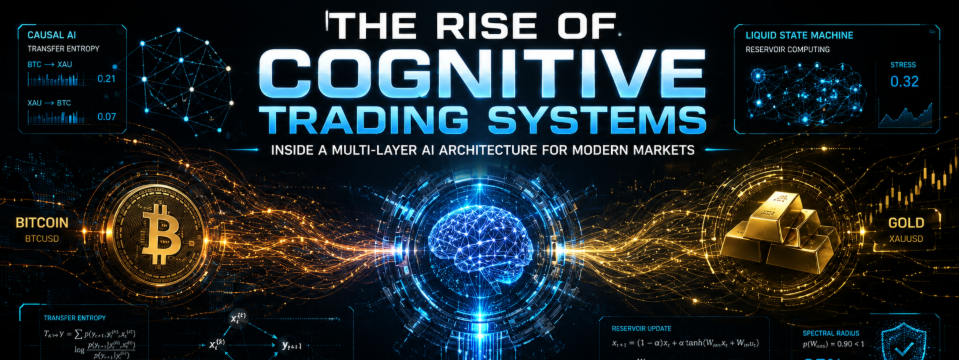
The deepest expression of this entire philosophy appears when a system must coordinate more than one market simultaneously, a task that genuinely exceeds what static or single symbol architectures can achieve. ICONIC KYBERNETIC AI+ governs Bitcoin and Gold through an OMNI NEXUS core built on a binned Transfer Entropy causal gate, measuring the real directed flow of influence between the two markets rather than assuming a fixed relationship, a Liquid State Machine reservoir with a recursive least squares readout kept regime adaptive through a forgetting factor rather than frozen, a Physics Informed margin axiom enforcing a hard, code level free margin floor the engine cannot violate, and Stochastic Tunneling optimization continuously searching for a genuinely balanced capital allocation between the two markets rather than a fixed, arbitrary split. ICONIC NEUROCORE AI+ applies a related coordinated approach, governing two isolated market brains under Q learning with eligibility trace based credit assignment beneath one unifying risk authority.
Risk as Non Negotiable Law, Not a Configurable Setting
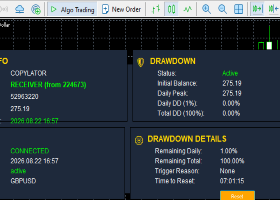
Cognitive sophistication means nothing without an equally rigorous risk framework underneath it. Every system across the entire ICONIC.FX lineup enforces a hard stop loss on every single position and categorically rejects grid and martingale techniques of any kind. In ICONIC KYBERNETIC AI+, portfolio level risk is further enforced through a three tier daily drawdown system, forcing a defensive posture at the first tier, blocking all new pending orders at the second tier, and triggering an emergency close of all positions with an enforced cooldown at the third and final tier. This is the piece of the architecture that separates a genuinely trustworthy cognitive system from an impressive sounding one, intelligence is only valuable when it operates inside boundaries the system is structurally incapable of crossing.
Frequently Asked Questions About Cognitive and Adaptive Trading Systems
What is the difference between an automated trading system and a cognitive one? An automated system executes fixed rules regardless of whether those rules still fit current conditions. A cognitive system perceives market state, adapts its behavior based on genuine learning mechanisms, and continuously recalibrates itself against live outcomes rather than a single historical training run.
Why do static, rule based trading systems eventually fail? Markets are non stationary, meaning their statistical character changes continuously. A static system calibrated to one historical regime has no internal mechanism to notice when that regime shifts, and continues executing outdated logic with unthinking consistency.
What technologies make a trading system genuinely adaptive? Key components include differentiable plasticity for self rewiring neural connections, reservoir computing for genuine sequence memory, causal inference for measuring real market relationships, reinforcement learning with proper credit assignment, and self calibrating confidence gates that keep the system honest about its own accuracy over time.
Can a trading system learn from trades that were not perfect wins or losses? Yes. Techniques such as counterfactual labeling and hindsight experience replay allow a system to extract genuine learning signal from near misses and partial outcomes, rather than only reinforcing clean wins.
Is more artificial intelligence always better in a trading system? No. Sophisticated intelligence only becomes valuable when paired with an uncompromising risk framework, including a hard stop loss on every trade and a categorical rejection of loss averaging techniques such as grid and martingale. Intelligence without enforced boundaries is simply risk hidden behind impressive language.
The Line Has Been Drawn
Automation and cognition are not the same category, and the gap between them is the single most important thing to understand before trusting any system with real capital. A script that executes fixed rules forever will eventually be broken by a market that refuses to stand still. A genuinely cognitive architecture, one that perceives, adapts, learns from its own consequences, and operates inside risk boundaries it cannot violate, is built for exactly the kind of market that actually exists.
Explore the complete cognitive architecture across the ICONIC.FX ecosystem, including ICONIC TITAN AI, ICONIC HULLX AI, ICONIC BTC AI+, ICONIC GOLD AI+, ICONIC NEUROCORE AI+ and the flagship ICONIC KYBERNETIC AI+, at iconicfx.tech.
Risk Disclaimer. Trading foreign exchange, cryptocurrencies, commodities and other leveraged financial instruments carries a high level of risk and may not be suitable for all investors. The high degree of leverage can work against you as well as for you. Past performance is not indicative of future results. Automated trading systems, indicators and Expert Advisors do not guarantee profits and can produce losses. Backtests and simulated results have inherent limitations and do not represent actual trading. ICONIC.FX provides software tools only and does not provide investment advice, portfolio management or financial recommendations. You are solely responsible for your own trading decisions. Seek advice from an independent licensed financial advisor if you have any doubts.