Explainable AI in Trading: Why Understanding the Why Matters as Much as the Result

Explainable AI in Trading: Why Understanding the Why Matters as Much as the Result
There is a specific fear that keeps otherwise capable traders from ever trusting an automated system with meaningful capital, and it rarely gets named directly. It is not a fear of losing money on a bad trade, every trader accepts that risk. It is the fear of losing money and never understanding why, of watching an opaque algorithm make a decision with no visibility into the reasoning behind it, leaving you unable to tell whether the system is working exactly as intended or quietly malfunctioning. This is the black box problem, and it deserves to be addressed honestly rather than glossed over with reassuring marketing language.
This article explains precisely why so many AI trading models genuinely are black boxes, what real, engineering grade methods exist to make AI decisions interpretable, why this distinction matters enormously for trust and risk management in a way it simply does not in most other AI applications, and, honestly, where the genuine limits of explainability still exist even in well engineered systems.
Why So Many AI Trading Models Are Genuinely Black Boxes
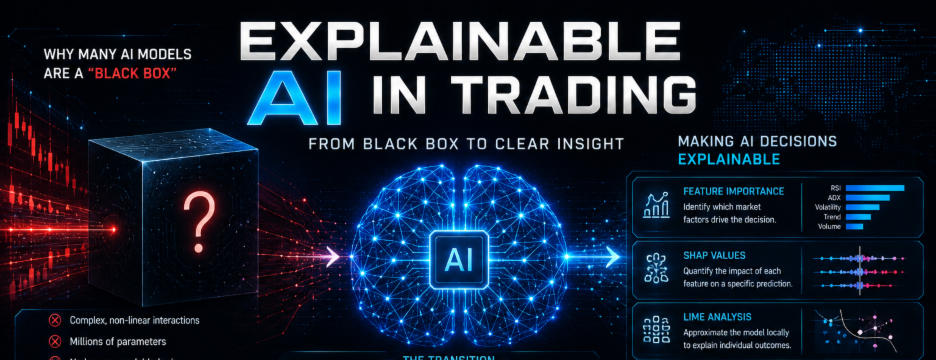
Modern deep neural networks can contain millions of internal parameters, and the mathematical relationship between any single input and the model's final output is distributed across so many interacting weights that no human, including the engineer who built the model, can trace a clean line from cause to decision. The model produces an output, a buy signal, a sell signal, a confidence score, but the specific reasoning behind that particular output at that particular moment remains genuinely opaque, even to its creator. This is not a marketing exaggeration. It is an accurate description of how many sophisticated machine learning architectures actually behave, and it applies broadly across the industry, not only to poorly built products.
Why This Problem Matters Far More in Trading Than in Most AI Applications
An opaque recommendation from a content algorithm costs you nothing more than a wasted few minutes if it gets something wrong. An opaque decision from a trading system costs real capital, and worse, it removes your ability to distinguish between two very different situations that look identical from the outside, a system correctly adapting to a genuine change in market conditions, or a system quietly malfunctioning due to a bug, a data problem, or a genuine failure of its underlying logic. Without any visibility into the reasoning, both situations present identically, as a losing trade you cannot explain, and the trader is left with nothing but blind trust or blind panic, neither of which constitutes real risk management.
Real Methods That Make AI Trading Decisions Genuinely Interpretable
Explainability is not a single feature that can be bolted onto any system. It is a set of deliberate architectural choices made specifically to preserve interpretability, often at some cost to raw predictive complexity. Several concrete methods exist and matter far more than vague promises of transparency.
- Probability outputs instead of binary signals. A system that expresses its conviction as a calibrated probability, the estimated likelihood of reaching a specific target or hitting a specific stop, gives you something genuinely inspectable. A binary arrow tells you nothing about confidence. An explicit probability tells you exactly how strongly the system believes in its own conclusion.
- Modular separation of direction and sizing decisions. Rather than one opaque model controlling everything, a system can use a separate, deliberately simple model, such as a logistic regression, purely to estimate the probability that a given setup wins and scale position size accordingly. Logistic regression coefficients are directly readable, unlike the internals of a deep network, which is precisely why placing this specific decision in a simpler model rather than folding it into a larger opaque one is a genuine explainability choice, not an accident.
- Explicit calibration targets. A system that regulates its own confidence threshold against a stated, numeric error rate target gives you a concrete, auditable number to check its behavior against, rather than an unstated internal assumption you have no way to verify.
- Human readable regime statistics. Tracking a running reward estimate for specific, named market conditions, rather than folding that information invisibly into a single opaque model, means you can literally inspect which conditions the system has found profitable and which it has not, in plain, readable numbers.
- Counterfactual labeling of trade management decisions. When a system explicitly records why it cut a losing trade early or widened a trailing stop, framed as an honest comparison against the alternative outcome, the reasoning behind that specific action becomes directly stateable in plain language, rather than buried inside an opaque decision function.
Where Genuine Explainability Actually Shows Up in Practice
It is worth being precise about where these principles are actually implemented rather than simply claimed. ICONIC TITAN AI expresses its conviction through explicit, simultaneous probability outputs, the estimated probability of reaching the first, second and third profit target, the probability of hitting the stop, and a regression estimate of expected favorable and adverse movement. A signal only surfaces once these stated probabilities clear defined thresholds, meaning the reasoning behind every alert is a concrete, inspectable number rather than an unexplained arrow on a chart.
Inside ICONIC KYBERNETIC AI+, the position sizing decision is deliberately handled by a separate, simple logistic regression model, distinct from the primary decision engine, specifically because a logistic model can estimate a win probability and modulate size in a way that remains directly readable rather than buried inside a more complex architecture. The system's own confidence gate uses Adaptive Conformal Inference, a technique that regulates itself against a stated, numeric target error rate, giving you a concrete figure to check its calibration against rather than an internal assumption you must simply trust. Its regime filter tracks a running, human readable reward estimate for each specific volatility bucket a trade was placed in, information you can literally inspect to understand which conditions the system has found genuinely favorable. Perhaps most directly, its bail out and trailing systems generate explicit counterfactual labels, this position was closed early because the estimated probability of genuine recovery had fallen below a stated threshold, or this trail was widened because continuation odds were assessed as favorable, reasoning that can be stated in plain language rather than extracted through guesswork.
Why Explainability Directly Strengthens Risk Management
The connection between explainability and genuine risk management is direct and practical, not philosophical. If a system can only produce an output with no visible reasoning, you have no way to distinguish healthy adaptation from quiet malfunction, and no way to audit whether a period of underperformance reflects a genuine, temporary regime mismatch or an actual failure in the underlying logic that demands intervention. A system that exposes its calibration targets, its probability estimates, and its regime specific statistics gives you the raw material to actually audit its behavior, checking whether its stated confidence has remained honest over time, whether its regime assessments match what you observe independently, and whether its trade management reasoning holds up to scrutiny rather than requiring blind faith.
This is also precisely why explainable systems earn trust more durably than impressive sounding black boxes. Trust built on visible, checkable reasoning survives a losing streak, because you can verify the system is still operating within its stated parameters. Trust built purely on past results collapses the moment those results turn negative, because there is nothing else underneath it to hold onto.
The Honest Limits of Explainability, Even in Well Engineered Systems
Intellectual honesty matters here more than anywhere else in this discussion. Perception layers built on deep neural architectures or reservoir computing, the components responsible for reading complex market patterns and temporal sequence, remain genuinely harder to fully interpret than a simple logistic model, and this is true across the entire industry, not a flaw unique to any single product. Full mechanistic interpretability of deep learning remains an open area of active research, and any product claiming complete, granular transparency into every internal neural computation should be treated with informed skepticism.
What a well engineered system can honestly claim is different and more modest, that its architecture deliberately separates genuinely interpretable decisions, such as position sizing, confidence calibration and trade management reasoning, into simpler, directly inspectable models, specifically so that the parts of the system most relevant to your risk exposure remain readable, even while the deeper perception layer retains some irreducible complexity. This is a meaningfully honest middle ground between a fully opaque black box and an unrealistic claim of total transparency, and it is the standard worth demanding from any system before trusting it with real capital.
Frequently Asked Questions About Explainable AI in Trading
What does black box mean in AI trading? It refers to a system whose internal decision making process cannot be meaningfully traced or understood, even by its own creators, typically because the model distributes its reasoning across a very large number of interacting parameters with no clean, inspectable path from input to output.
Why is explainability more important in trading than in other AI applications? Because incorrect or opaque decisions cost real capital directly, and without visibility into the reasoning, a trader cannot distinguish between a system correctly adapting to changing conditions and a system quietly malfunctioning, both of which look identical from the outside as an unexplained loss.
Can deep neural networks ever be fully explainable? Full mechanistic interpretability of deep learning remains an open area of active research, and complete transparency into every internal computation is not currently achievable for complex architectures. Genuine explainability in practice comes from deliberate architectural choices, such as isolating specific decisions into simpler, interpretable models.
What specific features make a trading system more explainable? Calibrated probability outputs instead of binary signals, modular separation of direction and sizing decisions into simpler models, explicit numeric calibration targets, human readable statistics tracked per market condition, and counterfactual labeling of trade management decisions.
How does explainability improve risk management specifically? It gives a trader concrete, checkable information, stated probabilities, calibration targets, and regime specific statistics, to audit whether a system is behaving as intended, rather than relying on blind trust that collapses the moment results turn unfavorable.
Trust Should Be Earned Through Visibility, Not Demanded Through Marketing
The future of serious algorithmic trading does not belong to whichever system claims the most impressive sounding intelligence. It belongs to systems willing to expose enough of their own reasoning that a trader can genuinely verify what is happening beneath the surface, rather than being asked to trust a black box purely because the marketing language sounds sophisticated. Explainability is not a limitation on intelligence. It is the discipline that makes intelligence trustworthy enough to actually deploy.
Explore systems built with genuine, inspectable reasoning at their core, including the calibrated probability gates of ICONIC TITAN AI and the modular, self calibrating architecture of ICONIC KYBERNETIC AI+, alongside ICONIC BTC AI+ and ICONIC GOLD AI+, at iconicfx.tech.
Risk Disclaimer. Trading foreign exchange, cryptocurrencies, commodities and other leveraged financial instruments carries a high level of risk and may not be suitable for all investors. The high degree of leverage can work against you as well as for you. Past performance is not indicative of future results. Automated trading systems, indicators and Expert Advisors do not guarantee profits and can produce losses. Backtests and simulated results have inherent limitations and do not represent actual trading. ICONIC.FX provides software tools only and does not provide investment advice, portfolio management or financial recommendations. You are solely responsible for your own trading decisions. Seek advice from an independent licensed financial advisor if you have any doubts.


