![[iVISTscalp5]: TSI — Timing Strength Index](https://c.mql5.com/6/1015/splash-772243.png "[iVISTscalp5]: TSI — Timing Strength Index")

TSI — Timing Strength Index
The Integrated Assessment of the Temporal Environment
Definition
-----------------------------------------------------------------------------------------
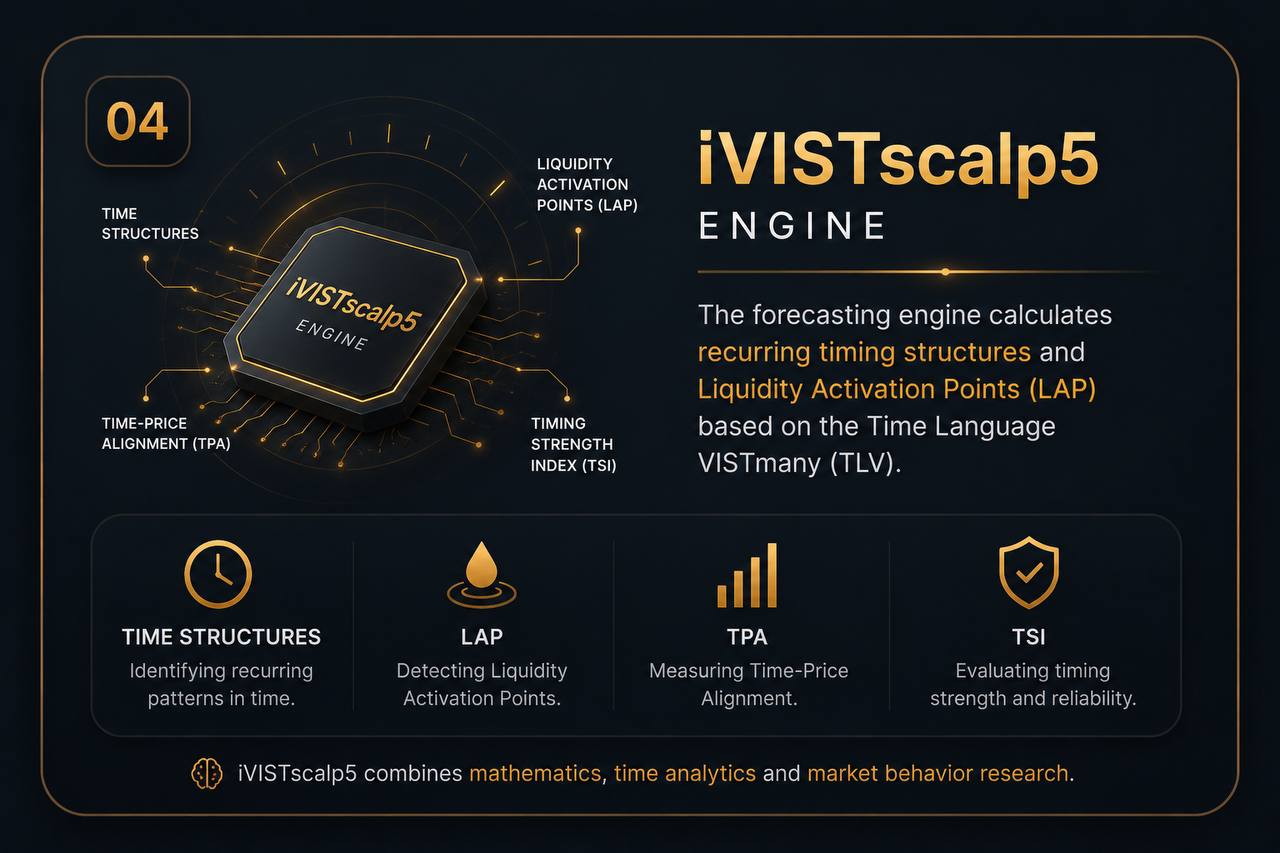
Timing Strength Index (TSI) is one of the core components of the VISTmany research methodology and the iVISTscalp5 framework. Unlike traditional indicators that primarily analyze price, TSI evaluates the concentration of timing events (LAPs) to identify periods when the probability of a strong market impulse significantly increases. TSI does not predict market direction—it measures the strength of the time structure, providing a foundation for further analysis of the interaction between time and price.
In the upcoming release of iVISTscalp5, the TSI module will become an integral part of the research framework, providing traders and researchers with a new approach to studying financial markets through time.

------------------------------------------------------------------------------------------
TSI (Timing Strength Index) is the integrated assessment of the strength, quality, and maturity of the current temporal environment.
TSI does not evaluate a single timing event.
TSI evaluates the complete temporal architecture surrounding that event.
Rather than measuring one signal, TSI measures the overall research quality of the market environment.
In other words,
TSI answers one question:
How favorable is the current temporal environment for meaningful market interaction?
The Philosophy of TSI
Traditional trading systems ask:
“Is there a buy signal?”
“Is there a sell signal?”
VISTmany asks a fundamentally different question:
How mature is the current temporal environment?
TSI exists to answer this question.
It is not a trading signal.
It is not a forecasting indicator.
It is an integrated research index.
What TSI Measures
TSI evaluates the entire temporal environment rather than an isolated event.
Its objective is to determine how many independent temporal factors support the importance of the current market moment.
Components of TSI
1. Liquidity Activation Points (LAP)
Every LAP possesses its own historical characteristics.
TSI evaluates:
• statistical reliability
• historical consistency
• behavioral quality
• timing characteristics
2. Momentum Clusters
A single LAP rarely defines market behavior.
TSI analyzes:
• timing density
• number of interacting LAPs
• temporal concentration
• cluster quality
The higher the temporal concentration,
the greater the research importance.
3. Timing Spectrum
TSI evaluates the position of every event inside the complete Timing Spectrum.
The same LAP may have completely different significance depending on its location within the weekly temporal architecture.
Timing Spectrum provides the global context for TSI.
4. Time Price Alignment (TPA)
Time alone is incomplete.
Price alone is incomplete.
TSI evaluates the quality of their interaction.
The stronger the Time–Price Alignment,
the stronger the temporal environment.
5. Market Structure
TSI evaluates:
• structural levels
• balance zones
• accumulation
• expansion
• historical reaction areas
Structure provides the spatial context.
6. Volatility
Temporal behavior changes under different volatility conditions.
TSI considers:
• current volatility
• expansion
• contraction
• market activity
7. Trading Sessions
Market behavior differs across sessions.
TSI analyzes:
• Asian Session
• London Session
• New York Session
• session transitions
8. Historical Research
Every market event contributes to future research.
TSI continuously learns from:
• historical reactions
• behavioral statistics
• recurring patterns
• research database
9. Temporal Response
Every completed market event becomes new scientific information.
TSI studies:
• impulse
• continuation
• retest
• reversal
• consolidation
• ignored timing
These observations continuously improve future TSI calculations.
What TSI Is NOT
TSI is not:
• a Buy signal
• a Sell signal
• an oscillator
• a forecasting tool
• a probability indicator
• a directional indicator
It never predicts price.
What TSI Represents
TSI represents the overall quality of the current temporal environment.
It estimates how favorable the current market conditions are for meaningful interaction between time and price.
High TSI does not guarantee market movement.High TSI indicates that the temporal environment deserves increased research attention.
Position Within TLV
The TLV research architecture consists of:
• LAP
• Momentum Cluster
• Timing Spectrum
• TPA
These concepts describe the market.
TSI evaluates them.
TSI is therefore not another analytical layer.
TSI is the integrated assessment of all analytical layers simultaneously.
It functions as the highest research index within the TLV framework.
Research Confidence Index
TSI can also be viewed as the Research Confidence Index.
It measures the confidence that the current temporal environment possesses sufficient quality to justify further analysis.
The decision to trade should never be based on TSI alone.
Trading decisions belong to the trader—or to the Trading Engine—which evaluates market reaction after temporal activation.
Role Inside iVISTscalp5
Within the iVISTscalp5 framework, TSI serves as the central quality assessment system.
Rather than highlighting every timing event equally, TSI helps identify those regions of the market where multiple independent temporal factors converge.
This enables traders and researchers to focus on high-quality temporal environments instead of isolated timing events.
Long-Term Vision
TSI is designed to become the central intelligence layer of the VISTmany ecosystem.
As research evolves, new analytical factors can be incorporated into TSI without changing its definition.
Its purpose is not to become more complex.
Its purpose is to become more comprehensive.
TSI transforms thousands of independent observations into a single integrated assessment of the market’s temporal environment.
In the VISTmany methodology,
research always comes first.
TSI measures the quality of that research.
Kind regards,
The VISTmany Team


![[iVISTscalp5]: XAUUSD. Forecast First. Market Reaction Afterwards](https://c.mql5.com/6/1035/splash-preview-777232.png "[iVISTscalp5]: XAUUSD. Forecast First. Market Reaction Afterwards")