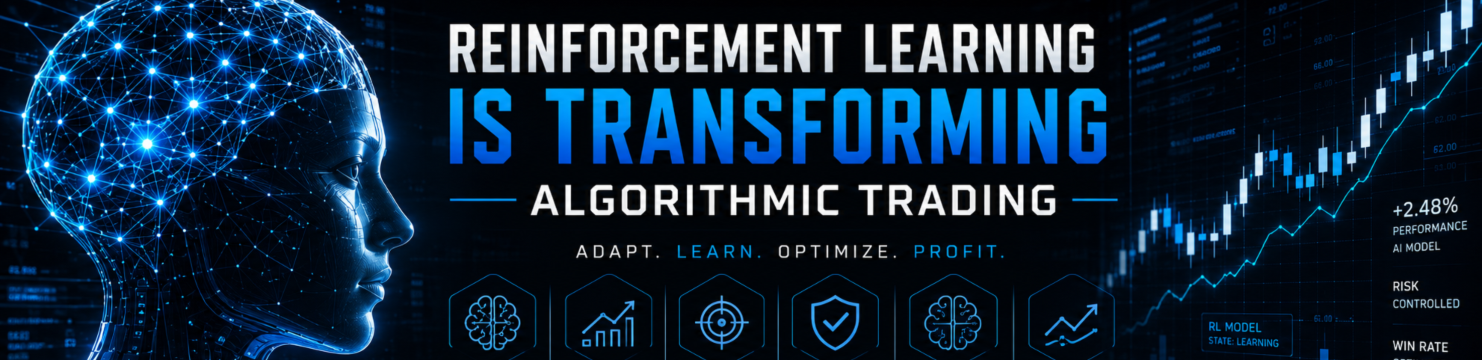

Artificial Intelligence is entering a new era. While traditional machine learning learns from historical examples, Reinforcement Learning (RL) enables AI systems to improve through continuous interaction with their environment. In quantitative finance, this creates exciting opportunities for adaptive algorithmic trading.
Modern AI-powered trading systems no longer rely solely on static indicators. Instead, they continuously evaluate market conditions, optimize decision-making and adapt to changing volatility, liquidity and trend structures. Learn more about advanced quantitative research at ICONICFX.tech.
What Is Reinforcement Learning?
Reinforcement Learning is a branch of Artificial Intelligence where an agent learns by interacting with an environment.
Instead of memorizing examples, the AI receives rewards or penalties based on its actions. Over time, it discovers which decisions maximize long-term performance.
Core Elements
- Agent
- Environment
- State
- Action
- Reward Function
- Policy Optimization
Why Reinforcement Learning Fits Financial Markets
Financial markets are dynamic systems that constantly evolve. Static trading rules often become less effective as market conditions change.
Reinforcement Learning offers a different approach by continuously optimizing decisions based on changing market environments rather than fixed assumptions.
- Adaptive market behavior
- Dynamic risk management
- Improved decision consistency
- Long-term optimization
- Continuous statistical learning
How an RL Trading Model Works
Every market situation represents a new state. The AI evaluates available information, executes an action and receives feedback based on the trading outcome.
Possible actions include:
- Open Long
- Open Short
- Hold Position
- Close Trade
- Reduce Exposure
- Increase Position Size
After thousands or millions of simulated market interactions, the model gradually develops increasingly effective trading policies.
Advantages Over Traditional Systems
- Less dependence on fixed indicators
- Continuous adaptation
- Probability-based decision making
- Reduced emotional bias
- Scalable across multiple assets
- Improved robustness in changing markets
Challenges
Professional Reinforcement Learning requires enormous computational resources, realistic simulations and extensive validation.
Without careful training, models may overfit historical data or develop strategies that fail in live markets. Walk-forward analysis, Monte Carlo testing and forward testing remain essential.
ICONIC KYBERNETIC AI+
ICONIC KYBERNETIC AI+ represents the next generation of quantitative trading technology by combining adaptive algorithms with sophisticated AI concepts.
Designed for MetaTrader 5, it focuses on systematic execution, intelligent market analysis and data-driven decision making.
Discover more about ICONIC KYBERNETIC AI+.
ICONIC BTC AI+
Highly volatile markets such as Bitcoin are ideal environments for intelligent algorithmic systems. ICONIC BTC AI+ applies quantitative analysis to identify statistical opportunities while maintaining disciplined execution.
Explore ICONIC BTC AI+.
Learn More About AI Trading
Visit ICONICFX.tech for educational resources covering Artificial Intelligence, algorithmic trading, quantitative finance and professional Expert Advisors for MetaTrader 5.
Conclusion
Reinforcement Learning represents one of the most promising developments in algorithmic trading. Rather than following rigid trading rules, adaptive AI systems continuously refine their decisions using statistical feedback. As computing power and quantitative research continue to evolve, reinforcement learning is expected to become an increasingly important component of professional trading technology.