
Polaris Edge
- Experts
- Version: 3.2
- Updated: 29 September 2026
- Activations: 10

UPDATE 29/09/2026 - VERSION 3.02 (POLARIS EDGE 3.0), WHERE CORE TRADING ENGINE HAS BEEN REBUILT
Polaris Edge 3.0 is not a routine update: it is a rebuild of the EA around a new trading engine. The direction announced with 2.4 is now complete. The core of the EA is three new, independent strategies - P5, P6 and P7 - and they are the only strategies enabled by default.
The four ML classifier slots (P1-P4) are still inside, unchanged from 2.4, but they now live in a separate "Legacy" section of the inputs and ship disabled. You can re-enable any of them, but they are no longer the focus of development.
If you are upgrading from 2.x, read this first:
- The P5 of version 2.x has been replaced. P5 in 3.0 is a different strategy with its own settings.
- The magic numbers have changed (now 563401-563407). 3.0 does not manage positions or pending orders opened by 2.x, so switch a chart to 3.0 only when 2.x has no open positions and no pending orders left.
- P5-P7 have new risk presets (see Position sizing). Legacy P1-P4 keep their 2.x sizing.
Suggested broker: TMGM - low spread and low round-trip latency to the trade server. With 3.0 this matters more than ever: most trades last from a few seconds to a few minutes, so execution speed has a direct impact on results (see the execution note in the backtest section).
Live signal, version 3.0 with Insane risk settings for stress testing: Polaris Edge 3.0 - live signal
What Polaris Edge 3.0 is
Polaris Edge 3.0 is an intraday EA built exclusively for XAUUSD. It runs three independent strategies, P5, P6 and P7, each on its own magic number and with its own stop loss and trailing stop. They share the same core engine, but each one reads the market on a different time horizon, so most of the time they trade different moves. When they agree, they can be in the market at the same time. Each strategy holds at most one position at a time.
The EA places and manages its own pending orders during all market hours, so it needs to run on an always-on terminal or VPS.
No martingale, no grid, no averaging down, no loss recovery. Every trade has a hard stop loss from the moment it is opened.
Stops and trailing
Stops are tight on purpose: $1 from the entry by default, which is about $1 of risk per 0.01 lot plus spread and commission. The trailing stop follows the price from the first tick in profit, at a $1 distance by default. Losing trades are small and frequent; the profit comes from the trades that keep running.
In the backtest below (50 ms execution delay, commission included), 95% of losing trades lost less than $1.32 per 0.01 lot and 99% less than $1.69. The largest single loss was $3.42 per 0.01 lot, a fill during a very fast move. Fills and stops can slip in fast markets, and that is the realistic worst case you should plan for.
The SL and trailing distance can be set separately for P5, P6 and P7. The defaults are the values everything was tested with, and I'd leave them there unless you have a specific reason to change them.
Built-in protection
- Performance guard. The EA keeps track of how its strategies have been doing recently. When results turn negative, it stops sending real orders and keeps following its signals virtually (paper trading) until results recover, then resumes real trading on its own. This is the main reason drawdowns stay contained in unfavourable periods. The virtual book is saved to a file, so a terminal restart or a VPS reboot does not reset it.
- US data window. Around the main US economic releases (8:28-8:45 New York time) the EA does not send real orders. The broker's time zone and the US daylight-saving changes are detected automatically, so there is nothing to configure.
- Session-break guard. Pending orders are cancelled a few minutes before the daily and weekend market breaks, so nothing gets filled on the reopening gap.
- Market-condition sizing. Based on internal market-condition scores, a single order can be sized from 0.25x to 3x the lot of your risk preset. It never depends on previous wins or losses (it is not martingale), and it always stays within the Max lot cap.
- Margin check. Before placing a pending order, the EA checks that the free margin can cover it, together with the orders the other strategies already have open. If it can't, the lot is reduced to fit, or the order is skipped. Pending orders that the free margin can no longer cover are removed before they trigger.
Position sizing
Each of P5, P6 and P7 recomputes its lot on every new order from the account balance, using the preset you choose:
- Low - 0.01 lot per $450 of balance
- Medium - 0.01 lot per $300
- High - 0.01 lot per $150 (the default)
- Insane - 0.01 lot per $120
- Fixed - the lot you set by hand, for backtesting or to stay on a fixed size
- Percent - the lot is sized so that hitting the strategy's hard stop costs the chosen % of the balance. Careful: because the stop is tight, even 1% means a large lot (about 0.10 lot per $1,000 with the default $1 stop), far more aggressive than Insane.
Base lot per strategy, before the market-condition sizing:
- $500: Low 0.01 / Medium 0.02 / High 0.03 / Insane 0.04
- $1,000: Low 0.02 / Medium 0.03 / High 0.07 / Insane 0.08
- $5,000: Low 0.11 / Medium 0.17 / High 0.33 / Insane 0.42
When the computed lot would fall below the broker's minimum (typically 0.01), the EA uses the minimum. Accounts smaller than the preset's step therefore trade at 0.01, which makes them effectively more aggressive than the preset. A hard cap (Max lot per order, default 1.0) limits every single order. Raise it only if your account is large enough to need it.
What drawdown to expect. Measured in the backtest below (January 2025 - September 2026, $500 start, same tick data, same trades for every preset):
- Low: max drawdown 10.8%
- Fixed 0.01 lot: max drawdown 10.8%
- Medium: max drawdown 17.5%
- High (default): max drawdown 25.2%
- Insane: max drawdown 28.3%
In every preset the deepest drawdown came in 2025, when gold was moving less and the account was still small. A higher preset scales profits and drawdowns together. In quieter, low-volatility markets the edge is much thinner and flat or losing stretches can last longer than anything in this test, so choose the preset for that case, not for 2026. If in doubt, start with Low or Fixed.
Backtest, the honest version
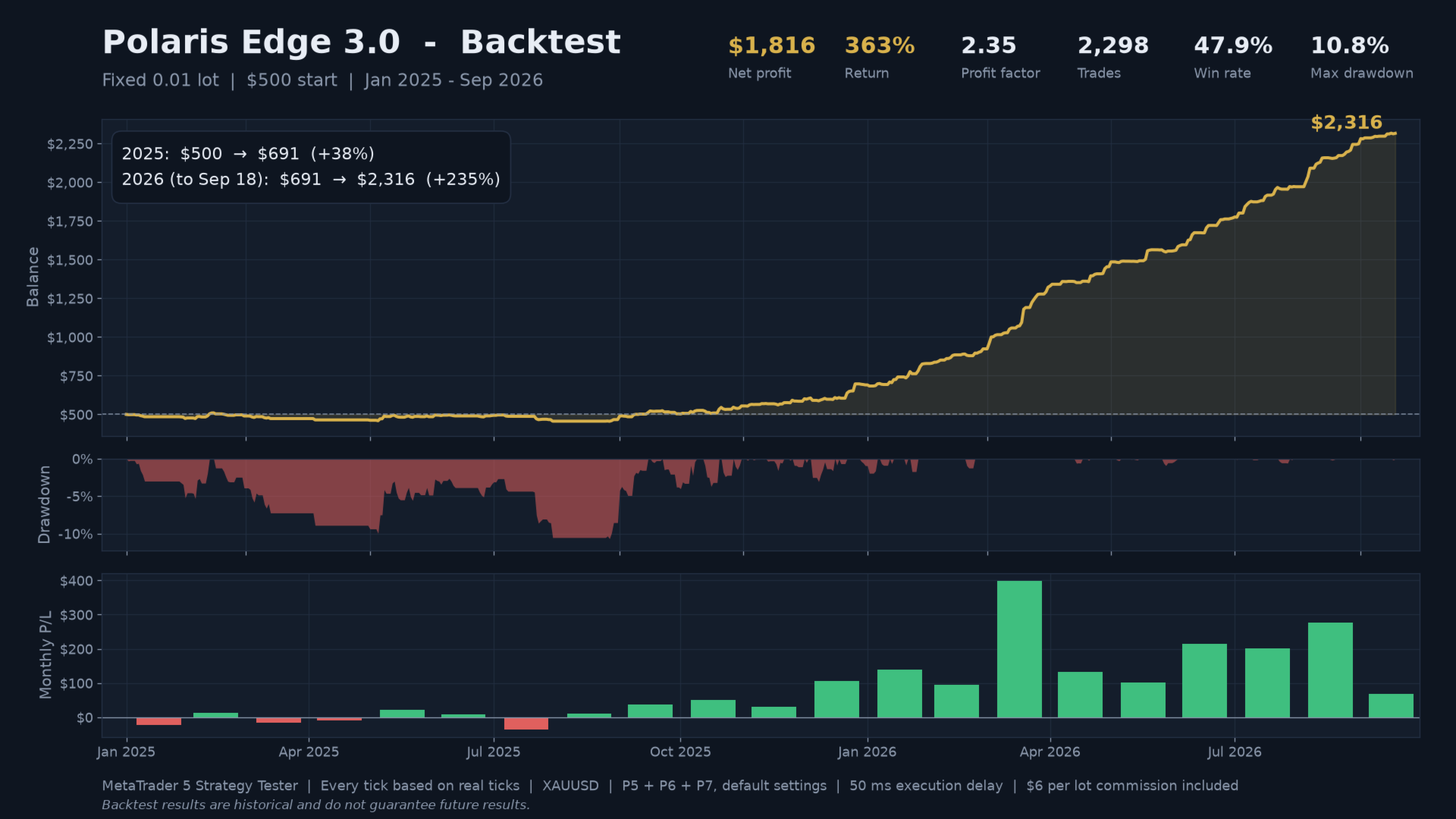
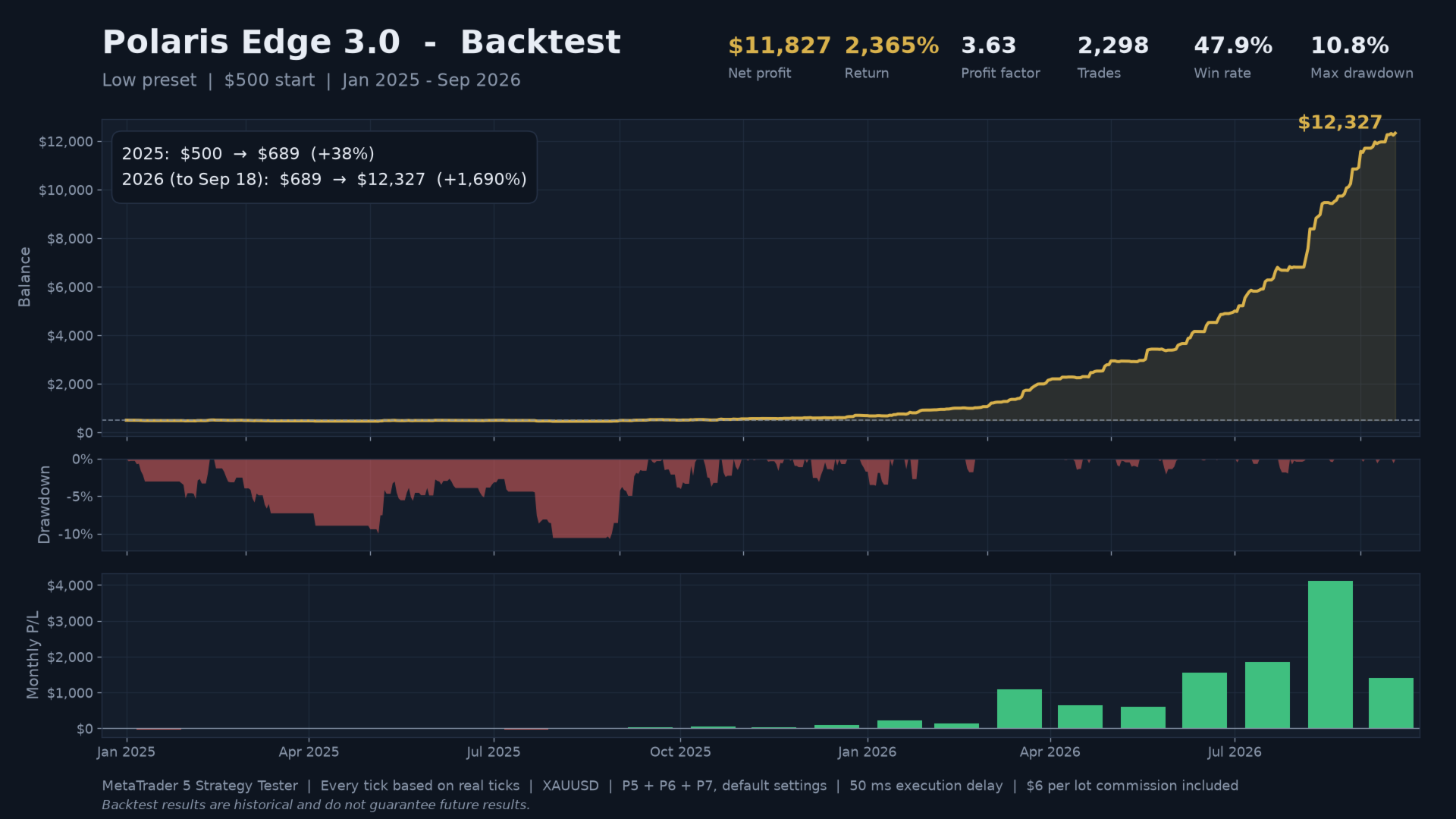
One continuous test in the MetaTrader 5 Strategy Tester, "Every tick based on real ticks", from January 1, 2025 to September 18, 2026: $500 start, Low preset and, separately, a fixed 0.01 lot, all other settings at their defaults (Max lot per order 1.0), 50 ms execution delay, $6 per lot commission. The screenshots show both tests.
The tick data (bid and ask) comes from an independent historical source, not from my broker, aligned to the broker's New York+7 clock. I did this on purpose: with $1 stops the results depend on the tick feed, and a second source is a harder test than the feed the engine was developed on. Note that 2025-2026 is also the period the engine was designed and tuned on (on my broker's ticks), so this is a check on independent data, not an out-of-sample period.
Low preset from $500, with compounding:
- 2025: $500 → $689 (+37.7%), 1,161 trades, profit factor 1.25, 8 of 12 months positive
- 2026 (Jan 1 - Sep 18): $689 → $12,327, 1,137 trades, profit factor 4.11, 9 of 9 months positive
- Whole period: 2,298 trades, win rate 47.9%, profit factor 3.63, max drawdown 10.8%
The same test with a fixed 0.01 lot (no compounding; the market-condition sizing still takes single orders to 0.02-0.03):
- 2025: +$191 (+38.1%), profit factor 1.26
- 2026 (Jan 1 - Sep 18): +$1,626, profit factor 3.70
- Whole period: +$1,816 on $500 (+363%), profit factor 2.35, max drawdown 10.8%
What the numbers say:
- 2025 was positive but choppy: roughly flat for the first nine months, with the 10.8% drawdown in the summer, and most of the gain in the last quarter.
- 2026 has been good. On Low, the $12,327 comes from compounding in a very strong year: the lot grows with the balance (up to 0.78 on single orders by September). The fixed 0.01 result for the same months is +$1,626.
- The settings are in fixed dollars and were calibrated with gold around $4,000: the engine needs gold to move in dollar terms. In a quiet, low-volatility market expect flat or losing stretches. The performance guard limits the damage; it doesn't make money in that market.
Execution: in tests with simulated delay, 50 ms gave practically the same result as zero delay, while 200-500 ms cut the results in the recent period and raised the drawdown, and irregular delays cut them heavily. Run the EA on a VPS close to your broker's server, under 50 ms round trip.
If you backtest it yourself:
- Use "Every tick based on real ticks". With $1 stops, the other modes give meaningless results.
- The quality of your broker's tick history matters a lot with stops this tight, so your numbers will differ from mine.
- The Strategy Tester does not expose the broker's real GMT offset, so in backtests the EA assumes the common New York+7 server clock (GMT+2 in winter, GMT+3 in summer) for the US data window. On live and demo accounts it detects the offset automatically.
The on-chart panel
There's a live dashboard in the top-left corner showing:
- the risk preset, balance, equity with percentage change, and margin used vs free;
- for each of P5, P6 and P7: status, current lot, open position, pending orders, today's P/L and total P/L;
- the performance-guard status (normal, or virtual mode with its virtual orders and positions) and the current market-condition lot multiplier;
- the US data window in your broker's server time, highlighted while it is active;
- open positions with colour-coded P/L;
- session stats (trades, win rate, profit), today's drawdown and the max drawdown of the run;
- the spread vs the configured maximum, and a countdown to the next H1 bar.
It updates once per second, and you can turn it off from the inputs if you prefer a clean chart.
What you need
- MetaTrader 5 build 3815 or higher.
- A hedging account.
- XAUUSD or your broker's gold symbol (XAUUSD.r, XAUUSD.m, GOLD, etc.), with a reasonable spread.
- Enough leverage, because the three strategies often trade at the same time: 1:500 recommended on High and Insane, at least 1:200 on Medium, at least 1:100 on Low. With gold around $4,000, 0.01 lot needs about $8 of margin at 1:500 and about $40 at 1:100.
- A VPS with low latency to your broker's server (under 50 ms).
Attach the EA to one XAUUSD chart, on any timeframe; the EA reads the timeframes it needs on its own (the Legacy P1-P4 need an M5 chart). Run one instance per account and symbol. If you run a second instance on the same account, change the Magic base.
I'd recommend starting on Low or Medium for the first two to four weeks on your broker, then stepping up once you've seen the EA behave on your actual fills and spreads.
Symbol scope
XAUUSD only. All the settings are in dollars of gold price and calibrated on gold. On EURUSD, indices or crypto it produces nonsense. Don't try it.
Legacy P1-P4
The four ML slots from version 2.x (six ONNX classifiers on M5) are still included, unchanged, in the "Legacy" input groups, all off by default. The models load only when at least one legacy slot is enabled, and those slots need the EA on an M5 chart. Their sizing, stops, trailing and thresholds work exactly as in 2.4.
Updates
P5-P7 are rule-based, so there are no models to retrain. Future updates will focus on execution and protection. I'll only ship a change after it has been confirmed in the MetaTrader 5 tester on real ticks over every test period, the same checks 3.0 went through. From 3.0 on, the magic numbers and the input layout stay backward-compatible, so existing chart attachments keep working through updates.
Risk warning
Trading FX and CFDs is risky, and you can lose all your capital. The numbers in this listing are historical and depend on broker conditions; your results will differ. I don't provide investment advice and I'm not liable for trading losses. Demo-test on your broker before going live, and never run the EA on capital you can't afford to lose.































First week of trading, all winners. High win rate with a hard coded stop loss.