The EA Specification Problem: Why Your Brief Costs More Than Your Strategy

The Pattern That Costs You Money
Most EA project overruns come from revision cycles, not from complex strategy logic. Specification quality predicts project cost more reliably than strategy complexity.
Here is a typical example. A brief says: "Entry when price crosses the level." The developer builds crossover detection — price was below the level on the previous tick, now it is above it. The client means something different: "When price touches the level for the first time." Crossover requires the price to be on the opposite side first. A first-touch entry fires the moment price reaches the level from any direction.
A four-word ambiguity like that can take three revision rounds to resolve. The developer is not wrong. The specification is.
Three Patterns of Bad Specifications
Bad specifications share three failure modes: missing edge cases, ambiguous trigger language, and unstated assumptions about execution behavior.
"Use a martingale system." The entire specification. No lot progression formula. No maximum drawdown limit. No stop condition. Does the lot double after every loss? Triple? Reset after a win or after reaching a target? What happens when margin runs out? Every unanswered question is a revision cycle.
"Close all trades when profit reaches target." Per-trade or per-basket? Floating profit or realized? If the EA has five positions open and combined floating profit reaches $100, does it close all five? Or each individually? Different code paths, different exit behaviors, different P&L outcomes.
"Same as my other EA but for gold." This assumes gold and forex pairs behave identically inside MetaTrader. They do not. XAUUSD uses different tick metrics than major forex pairs. If you have ever calculated position size on EURUSD and tried to reuse the formula on gold without adjustment, you have seen the problem:
The formula itself is correct. But SYMBOL_TRADE_TICK_SIZE and SYMBOL_TRADE_TICK_VALUE differ per instrument, so "same but for gold" is not a small change. It often requires reworking the entire risk management module.
The Walk-Through Scenario
A step-by-step scenario with specific prices eliminates more ambiguity than pages of general description. It forces you to think through your strategy concretely and exposes assumptions you did not realize you were making.
Compare these two specifications:
Vague: "EA should trail the stop loss."
Clear: "Price at 1.10500. Buy signal. EA opens buy at market, 0.10 lots. SL at 1.10200 (30 pips). TP at 1.11100 (60 pips). If price moves to 1.10800 (30 pips profit), move SL to 1.10500 (breakeven). After that, trail SL 20 pips behind for every 10-pip move up."
The clear version can be coded in hours. The vague version starts a clarification thread that adds days.
Seven Questions That Prevent Scope Explosions
Seven questions answered upfront cover most revision-causing ambiguities:
- Entry conditions — exact trigger with a walk-through scenario
- Exit conditions — SL, TP, trailing, time-based, signal-based
- Position sizing — formula with a numerical example
- Multiple positions — limit and behavior when limit is reached
- Symbol scope — which instruments and any per-symbol differences
- Timeframe dependencies — single or multi-timeframe data handling
- Error recovery — behavior on order failure (retry, alert, stop)
You do not need to be technical to answer them. Write in plain language. Use specific numbers.
The Cost Difference
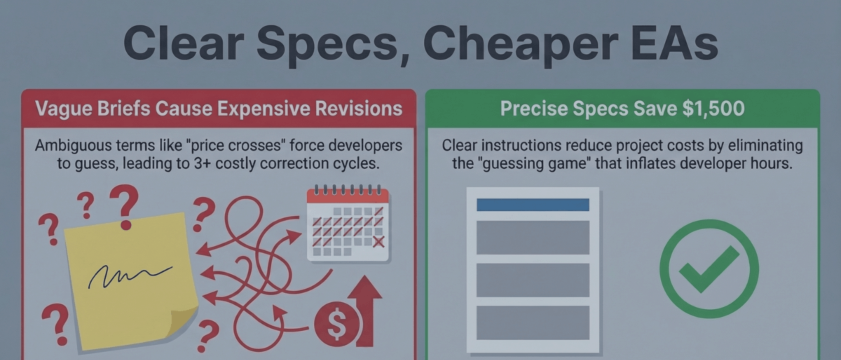
Walk-through scenarios cut revision rounds; vague specifications multiply them. At typical developer rates of $50–100 per hour, a few extra rounds can mean $500–$1,500 for the same end product. Thirty minutes writing a clear specification saves weeks and hundreds of dollars.