I Built an AAPL Trading Robot for MT5 — Here’s How NorthSlope Works

Apple is one of the most closely watched companies in the world.
Its stock can develop long, powerful trends, but trading those movements consistently is much harder than simply identifying that the price is rising. Pullbacks, sideways periods, sudden volatility, earnings reactions and overnight gaps can turn an apparently simple strategy into a difficult execution problem.
That challenge becomes even greater when the process is automated.
A trading system cannot rely on intuition, hesitation or interpretation. It needs predefined rules for deciding when conditions are favourable, how much capital to expose, when to stay out and when to accept that a trade has failed.
That is the idea behind NorthSlope.
NorthSlope is a long-only Expert Advisor developed for MetaTrader 5 and designed primarily around AAPL on the H1 timeframe. It follows a trend-based approach, waits for confirmation before entering and manages exposure through predefined risk rather than recovery techniques. It does not use grid trading, martingale or averaging down.
NorthSlope is available on MQL5 Market
View the complete product page and test the free demo in MetaTrader 5 Strategy Tester.
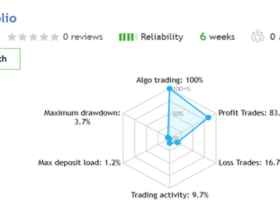
NorthSlope monitoring on Myfxbook
NorthSlope is also being tracked on a dedicated demo account where it operates independently from my other Expert Advisors. This makes it possible to review its trades, drawdown and performance without mixing results from other systems.
The account is a demo account and the monitoring is still developing. Results may differ from live execution and do not guarantee future performance.
The problem with automating AAPL
At first glance, Apple may seem like a natural candidate for a long-only trading system.
The company has historically attracted strong institutional interest, extensive analyst coverage and constant market attention. Its stock can produce extended bullish phases in which trend-following strategies have room to participate.
But those trends are rarely smooth.
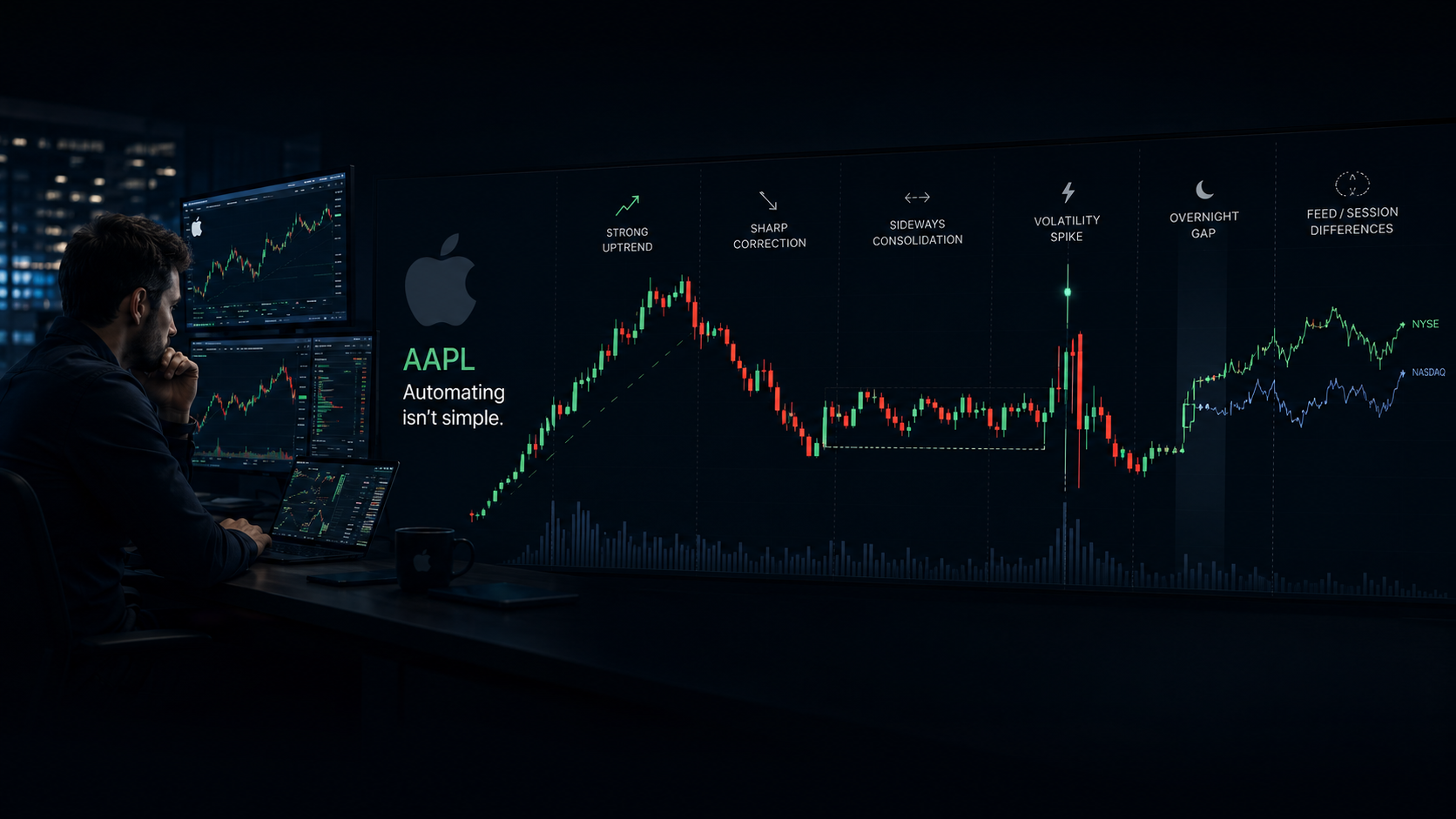
AAPL can move through several very different conditions:
- Strong directional advances.
- Sharp corrections.
- Long consolidation periods.
- Sudden volatility around earnings.
- Overnight gaps.
- Differences between broker feeds and trading sessions.
An automated strategy must deal with all of them without changing its behaviour emotionally.
That is one of the biggest differences between discretionary and systematic trading. A human trader may skip a signal because the market “does not feel right.” An EA cannot rely on that type of judgement. Its rules must already define what qualifies as a valid opportunity and what does not.
The real difficulty is not finding possible entries.
It is building a process disciplined enough to wait when the market is unclear.
Why NorthSlope follows trends
NorthSlope is not designed to predict the next movement in Apple stock.
It does not attempt to call exact bottoms, identify the perfect turning point or anticipate every breakout. Its role is more limited and more practical: participate when the market already shows a sufficiently favourable directional structure.
This is a trend-following philosophy.
Trend-following systems accept an important trade-off:
- They usually enter after a movement has already begun in exchange for avoiding many premature predictions.
That means NorthSlope will never capture every part of an upward move. It may enter after the lowest price has passed, and it may leave before the absolute top.
That is intentional.
The objective is not perfection. It is repeatability.
Instead of asking:
“Where will Apple go next?”
NorthSlope asks a more structured question:
“Are current conditions strong enough to justify controlled long exposure?”
The EA evaluates market direction and momentum using completed market data before considering an entry. The exact combination of rules remains part of the product’s internal logic, but the general process is based on alignment rather than prediction.
Why long-only?
NorthSlope only opens buy positions.
That decision is not based on the assumption that Apple must always rise. AAPL can fall sharply, remain bearish for extended periods or lose momentum for months.
The long-only approach exists because the system was built around one specific directional thesis rather than trying to solve every market condition with one EA.
There are several reasons for keeping the model focused.
A simpler trading hypothesis
A system that trades both directions has to distinguish between bullish and bearish behaviour, which may not be symmetrical.
A stock can rise gradually over months but fall violently in a much shorter period. Long and short trades can therefore require different assumptions, filters and risk controls.
NorthSlope avoids combining two potentially different strategies inside one product.
Fewer conflicting decisions
A long-only system has a clear choice:
- Conditions support long exposure.
- Conditions do not support long exposure.
There is no immediate reversal from buy to sell and no attempt to participate in every market phase.
Greater consistency
The strategy remains focused on a narrow task: identifying and managing favourable upward conditions in AAPL.
That does not make the strategy automatically safer or more profitable. It simply makes the behaviour easier to understand, test and evaluate.

Discipline before activity
Many automated systems are marketed through trade frequency.
More entries can make an EA appear active, but activity alone does not create an edge. In some market environments, the most disciplined decision is to do nothing.
NorthSlope is not designed to remain continuously exposed.
The general process is:
- Analyse the current market structure.
- Check whether directional conditions are aligned.
- Confirm that the setup is strong enough.
- Calculate exposure based on risk.
- Open a long position only when all conditions are met.
- Manage the trade until its exit condition or protection is reached.
This is deliberately selective.
The EA may remain inactive during:
- Bearish periods.
- Weak trends.
- Sideways markets.
- Conditions where risk cannot be calculated correctly.
- Situations in which a position is already active.
- Environments where broker restrictions prevent valid execution.
A period without trades is not necessarily a malfunction. It may simply mean that the system has not identified an acceptable opportunity.
Risk comes before the trade
A signal is only one part of an automated system.
Before opening a position, NorthSlope also considers how much exposure is appropriate for the configured risk and whether the broker can execute that position correctly.
The EA uses risk-based position sizing rather than increasing lots after losses. It calculates the trade size in relation to the protective distance and the account conditions. The resulting exposure can also be limited by broker volume and margin requirements.
This distinction is important.
NorthSlope is not built around the idea:
“The next trade must recover the previous loss.”
It follows the opposite principle:
“Every trade should stand on its own and carry predefined risk.”
That means losing trades are accepted as part of the strategy.
There is no attempt to hide them through progressively larger positions or layers of additional entries.
What NorthSlope does not use
One of the easiest ways for an EA to produce a visually smooth backtest is to postpone the recognition of losses.
That can be done through techniques such as:
- Opening more positions as price moves against the original trade.
- Increasing lot size after a loss.
- Building recovery baskets.
- Waiting indefinitely for the market to return.
- Averaging down without a clear exposure limit.
These techniques can create impressive curves for long periods, but they can also concentrate risk until a single market move causes significant damage.
NorthSlope does not use:
- Grid trading.
- Martingale.
- Averaging down.
- Loss-based lot progression.
- Recovery baskets.
- Multiple NorthSlope buy positions on the same symbol and identifier.
This does not mean NorthSlope cannot lose money.
It means losses are not managed by adding more exposure to the same failed idea.
One position, one decision
NorthSlope is designed to manage one matching buy position at a time for its symbol and internal identifier.
This keeps the exposure easier to interpret.
When a position is open, the strategy does not continue adding entries simply because the trend appears attractive. It waits until the active trade has been resolved before considering another one.
The advantage is not necessarily higher returns. The advantage is clarity.
At any moment, the user can understand:
- Whether the system is exposed.
- Which trade belongs to NorthSlope.
- What the intended risk was.
- Why the strategy is waiting.
- Whether the previous position has already been closed.
That transparency matters when evaluating an automated trading system.
Test NorthSlope with your own broker data
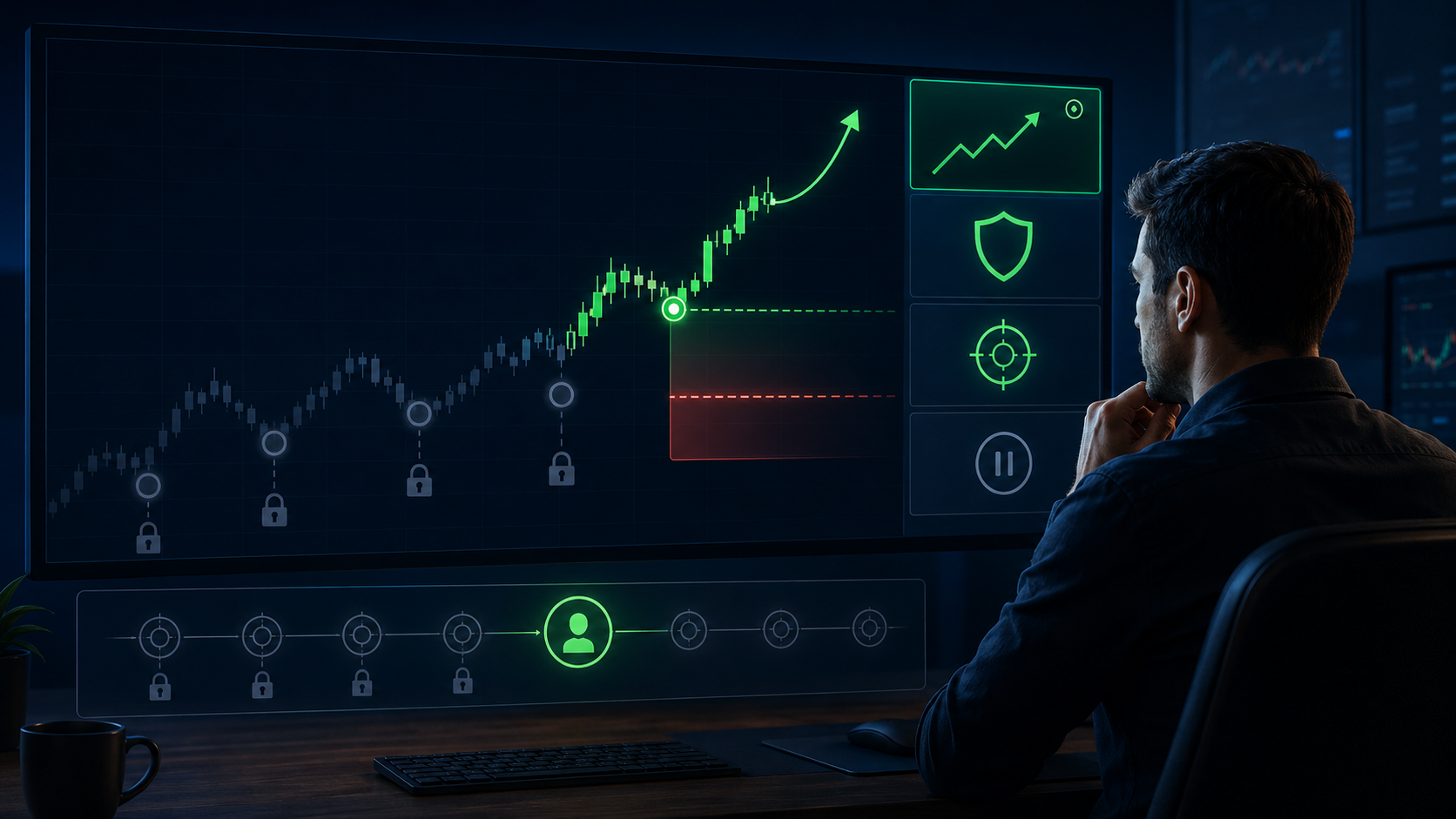
Use the free MQL5 Market demo in Strategy Tester to evaluate the EA with your broker’s AAPL history and contract conditions.
Protection from the beginning
NorthSlope opens its positions with initial protection based on current market volatility.
The exact calculation remains part of the EA’s internal configuration, but the principle is straightforward:
A more volatile market requires more room, while a quieter market may allow tighter protection.
This approach avoids using the same fixed price distance under every market condition.
However, no protective mechanism can guarantee an exact maximum loss.
Real execution can be affected by:
- Gaps.
- Slippage.
- Delayed fills.
- Minimum volume.
- Contract size.
- Commission.
- Currency conversion.
- Broker restrictions.
The configured risk is therefore a target based on the information available when the order is prepared, not a guarantee of the final result.
That difference should always be understood before using any EA in a live account.
Why simplicity matters
Automated trading systems often become more complicated over time.
A losing period leads to another filter. A missed trade leads to another exception. A disappointing result leads to a recovery mechanism. Eventually, the system can become so complex that it is difficult to understand why it trades at all.
NorthSlope was built around a narrower philosophy:
- Follow one directional idea.
- Wait for confirmation.
- Use controlled exposure.
- Avoid overlapping positions.
- Protect the trade from the start.
- Exit when the original conditions are no longer valid.
- Accept that some trades will lose.
This does not remove uncertainty.
It creates a framework for dealing with it consistently.
The limits of a rules-based system
No trading strategy works in every environment.
A trend-following system can struggle when:
- Price moves sideways for a long period.
- Trends reverse shortly after entry.
- Volatility changes suddenly.
- A gap bypasses the expected exit price.
- Broker data create different signals.
- The market produces many false directional moves.
NorthSlope can experience:
- Losing trades.
- Consecutive losses.
- Negative months.
- Extended periods without entries.
- Drawdowns.
- Different results between brokers.
- Different live and backtest execution.
These are not minor disclaimers. They are part of the system’s real behaviour.
An EA should not be evaluated only by its best period or its final net result. It should also be evaluated by:
- How losses occur.
- How exposure is controlled.
- Whether the logic remains consistent.
- Whether results can be reproduced.
- Whether unfavourable periods are disclosed.
A profitable backtest alone is not enough.
Backtesting is evidence, not proof
Historical testing can help answer useful questions:
- Does the strategy behave as intended?
- Are entries consistent with the design?
- Does position sizing remain controlled?
- How does it react to different market environments?
- Are results dependent on a small number of trades?
- How sensitive is it to broker data?
But a backtest cannot prove that the same outcome will happen again.
The quality of the result depends on:
- Historical data.
- Tick model.
- Trading costs.
- Broker sessions.
- Spread.
- Contract specifications.
- Corporate actions.
- Testing period.
- Parameter selection.
For that reason, NorthSlope should be tested using the user’s own broker data before any purchase or live deployment.
The free MQL5 Market demo allows users to examine the EA inside Strategy Tester and compare its behaviour under their intended conditions.
Who NorthSlope is designed for
NorthSlope may be relevant to traders who prefer:
- A rules-based process.
- Long-only trend participation.
- Controlled single-position exposure.
- Risk-based sizing.
- Fewer but more selective trades.
- Transparent limitations.
- No grid or martingale.
It is probably not suitable for someone who expects:
- Guaranteed monthly returns.
- Constant trading activity.
- Short-selling signals.
- Recovery after every loss.
- Zero drawdown.
- Identical results on every broker.
- A fully passive system requiring no supervision.
The EA is a tool, not a substitute for risk understanding.
The main idea behind NorthSlope
NorthSlope was not created to predict Apple stock perfectly.
It was created to automate a disciplined response to favourable market conditions.
Its philosophy can be reduced to five principles:
Trade with the trend
Participate when the market structure supports the long side.
Wait for confirmation
Avoid entering simply because the price has moved upward.
Control exposure
Calculate the position around predefined risk rather than expected profit.
Do not recover losses through additional risk
No grid, martingale or averaging down.
Accept uncertainty
Losing trades and unfavourable periods are part of systematic trading.
That is what NorthSlope is intended to represent: not a promise of easy returns, but a defined process for participating in AAPL trends with discipline.
Review the complete product information, examine its limitations and test the free demo before making a decision.
View and test NorthSlope on MQL5 Market
Risk warning: Trading financial instruments involves the risk of losing capital. Historical results, backtests and screenshots do not guarantee future performance. NorthSlope is automated trading software and does not provide personalised investment advice.