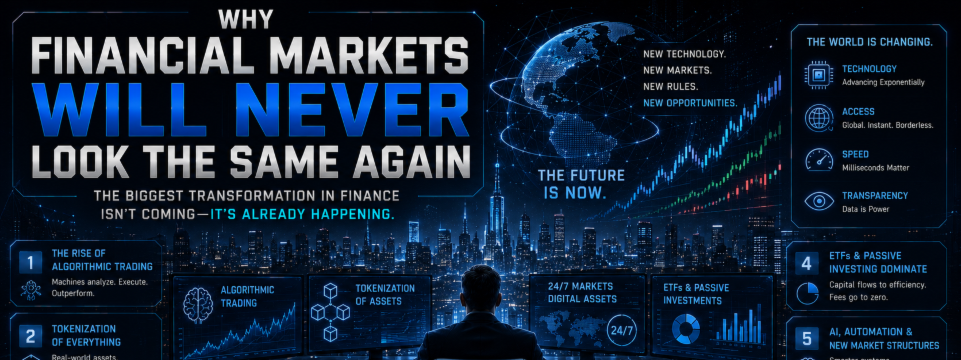

Why Financial Markets Will Never Look the Same Again
The biggest transformation in finance is not coming, it is already happening. Unlike a great deal of future of finance speculation, several of the trends covered in this article are not theoretical at all anymore. They are already moving through active regulatory approval and real infrastructure rollout at the largest exchanges in the world, right now. This article ties together six genuinely compounding shifts, briefly revisiting ground already covered in depth elsewhere in this series, and spending real time on the two developments that are moving fastest and deserve the most current attention.
Part One: The Rise of Algorithmic Trading, Briefly Revisited
This ground has been covered thoroughly elsewhere in this series, so only the essential summary belongs here. A large majority of volume in major equity markets is already algorithmic, and the figure runs even higher in foreign exchange, with high frequency firms specifically representing a small share of active participants while generating a disproportionately large share of total volume. This is foundational context for everything that follows, not a new claim in itself.
Part Two: Tokenization Is No Longer Theoretical, It Is Already Being Built
This is where the genuinely current news sits. Tokenization means converting ownership of a traditional asset, a stock, an exchange traded fund, a government bond, into a digital token recorded on blockchain infrastructure, tradeable and settleable through fundamentally different rails than the legacy systems that have run capital markets for decades. What separates this from earlier blockchain hype cycles is the identity of who is now building it. The exchange that has symbolized American capital markets for more than two centuries is developing a blockchain powered venue specifically designed for continuous, around the clock trading and near instant settlement of tokenized equities and funds, having already secured the regulatory clearance needed to proceed. A separate major exchange has received its own regulatory approval to enable tokenized trading of a major index of large companies and leading index funds, with tokenized and conventionally issued shares trading on the same order books and carrying identical investor rights. The central clearing and settlement hub processing the overwhelming majority of United States securities transactions has itself received clearance to begin handling tokenized transactions, moving from limited pilot activity toward broader commercial rollout. Tokenized government bonds specifically have grown at a genuinely remarkable pace, expanding roughly tenfold within a short span as institutional demand for programmable, yield bearing digital assets has accelerated.
The concrete benefits driving this are specific and compelling rather than vague. Settlement that traditionally takes a full business day or more can, on blockchain rails, complete in minutes. Fractional ownership becomes trivial to implement natively. Large trading firms gain the ability to move collateral between counterparties dramatically faster than traditional multi day settlement cycles allow, freeing up capital that would otherwise sit tied up in transit.
Part Three: Twenty Four Hour Trading Extends Beyond Crypto Into Traditional Markets
Continuous, around the clock trading used to be a defining characteristic exclusive to crypto markets. That exclusivity is ending. Crypto markets proved to traditional finance that continuous global trading was operationally possible and that investor appetite for it genuinely exists, and traditional exchanges are now actively following that proof of concept, extending weekday trading sessions dramatically longer than historical norms and, in the case of dedicated tokenized venues, targeting genuinely continuous, always on operation.
Honest treatment of this shift requires acknowledging the real friction points that remain unresolved rather than presenting a frictionless transition. Foreign exchange hedging markets and government bond markets, which underpin much of how large positions are hedged and collateralized, still largely operate on traditional business hours. When a tokenized equity trades continuously but the currency hedge or Treasury collateral behind it does not, genuine structural gaps open during the hours traditional markets remain closed, a real, currently unresolved engineering and market structure challenge the industry is actively working through rather than a settled, frictionless picture.
Part Four: The Growing Weight of ETFs and Passive Investment
This continues a multi decade shift toward index tracking and passive vehicles as the default entry point for the large majority of new investment capital, a trend that has already extended meaningfully into digital assets, covered in structural depth elsewhere in this series. The genuinely new development is tokenized ETFs themselves becoming part of the infrastructure shift described above, index funds increasingly available in the same blockchain native, continuously tradeable format as tokenized individual securities.
Part Five: AI, Automation and New Market Structures, Briefly Revisited
Also extensively covered elsewhere in this series, adaptive decision making architectures, continuous online learning, and code enforced risk boundaries already operate together in well engineered deployed systems today, not merely as future speculation. The relevant new point here is straightforward, a market structure moving toward continuous, always on trading across an ever wider range of asset types makes exactly this kind of always on, non stop automated oversight considerably more valuable than it already was, since a human simply cannot watch a genuinely continuous market indefinitely regardless of which asset class it happens to be.
Part Six: How the Role of the Human Trader Genuinely Continues to Change
The pattern already established elsewhere in this series, human contribution concentrating into design, oversight and the generation of genuinely new information rather than disappearing outright, applies with even more force as tokenization and continuous trading extend beyond crypto into the broader market. As more of the investable universe adopts an always on, continuously tradeable structure, the practical case for human traders directly monitoring markets around the clock weakens further, while the case for building and overseeing systems capable of doing so grows correspondingly stronger.
Part Seven: These Are Not Six Separate Trends, They Compound Each Other
The genuinely important insight is how directly these threads reinforce one another rather than developing in isolation. Tokenization enables continuous trading of assets that were historically bound to fixed sessions. Continuous trading increases the practical value of always on automated oversight. That oversight is increasingly AI driven rather than rule based. And each of these shifts further reshapes what a human trader's actual role becomes. Crypto markets, and Bitcoin specifically, have already been operating inside exactly this always on paradigm for years, well before traditional finance began actively building toward it, meaning systems engineered from the start for genuinely continuous, non stop market conditions carry a real, structural head start as the rest of the financial world now moves in the same direction. ICONIC BTC AI+ was built natively for exactly this continuous, never closing market reality, and the broader ICONIC.FX architecture, continuous online learning paired with hard, code level risk enforcement, reflects operating principles increasingly relevant to a financial system that is rapidly adopting the same always on structure crypto has run under from the beginning.
Frequently Asked Questions
Is asset tokenization actually happening, or is it still theoretical? It is actively moving through real regulatory approval and infrastructure development at major exchanges and central clearing institutions right now, with tokenized government bonds already growing rapidly and tokenized equity trading platforms receiving formal regulatory clearance to proceed.
Will traditional stock markets really trade twenty four hours a day? Major exchanges are actively extending trading sessions well beyond historical norms and building dedicated venues targeting genuinely continuous operation, though full, frictionless around the clock trading still faces real unresolved challenges around markets that remain closed on traditional hours, such as certain hedging and government bond markets.
What genuine problems does tokenization solve for traditional markets? Near instant settlement replacing multi day settlement cycles, native fractional ownership, and dramatically faster collateral mobility for large trading firms, freeing up capital currently tied up during traditional settlement delays.
How does this connect to automated trading and AI? As markets move toward genuinely continuous, always on operation across a wider range of assets, the practical value of always on automated oversight increases correspondingly, since continuous market conditions are structurally difficult for any human to monitor directly and indefinitely.
The Closing Bell Is Losing Its Grip
Markets built around a fixed opening and closing bell are giving way to a genuinely different structure, continuous, tokenized, increasingly automated, and less centered on any single trading session at all. This is not a distant scenario. It is already under active construction at the institutions that have defined market infrastructure for generations.
Explore systems already built for exactly this continuous, always on market reality, including ICONIC BTC AI+ and the flagship ICONIC KYBERNETIC AI+, at iconicfx.tech.
Risk Disclaimer. Trading foreign exchange, cryptocurrencies, commodities and other leveraged financial instruments carries a high level of risk and may not be suitable for all investors. The high degree of leverage can work against you as well as for you. Past performance is not indicative of future results. Automated trading systems, indicators and Expert Advisors do not guarantee profits and can produce losses. ICONIC.FX provides software tools only and does not provide investment advice, portfolio management or financial recommendations. You are solely responsible for your own trading decisions. Seek advice from an independent licensed financial advisor if you have any doubts.