
I have been trading for more than fifteen years. I am not here to sell you a holy grail — no indicator does that. What I can offer is a method I actually use, tested across trending markets, ranging markets, and the messy weeks in between.
This blog is the start of a longer series. I will share trading setups and scenarios I find worth discussing — not every signal on the chart deserves a click. MACD has earned its nickname as the "king" of retail indicators for a reason: it helps in trends, it helps in chop, and it is especially powerful when you learn to read divergence — but not every divergence is worth trading. That topic deserves its own posts. Today we begin with something simpler and more daily: how I read momentum when the histogram is painted in four colors instead of one.
Why I still use MACD every week
After fifteen years, I have retired more tools than I keep. MACD stayed.
-
In trends, it tells me whether push is still building or already fading.
-
In ranges, it helps me avoid buying the top of a subwindow spike that has no follow-through.
-
Around divergence, it is often the oscillator I compare against price — but only when context agrees. A divergence line without structure and timeframe bias is decoration, not an entry.
The default MT5 MACD histogram is fine. It is also easy to misread: one color, bars grow and shrink, and you guess whether momentum is strengthening or rolling over. I switched to a four-color read for the same DIF/DEF math — a clearer visual language, nothing mystical.
I published a free indicator for this on MQL5: BarionQuant Macd Histogram 4 Color. Use it or replicate the logic on any platform; the reading rules below are what matter.
The math (unchanged from classic MACD)
-
DIF = fast EMA(12) minus slow EMA(26) — the MACD line
-
DEF = smoothed signal of DIF
-
Energy = (DIF − DEF) × 2 — what the histogram plots
Most platforms use a single histogram color. You compare bar height bar-by-bar and hope you interpret it correctly.
Four colors, four states
Above zero (bullish energy):
-
Red — bar longer than the previous bullish bar → momentum building
-
Aqua — bar shorter than the previous bullish bar → momentum fading
Below zero (bearish energy):
-
Green — bar longer (more negative) than before → downside building
-
Gold — bar shorter than before → downside fading
You are not predicting the next candle. You are asking: relative to the last closed bar, is pressure increasing or decreasing?
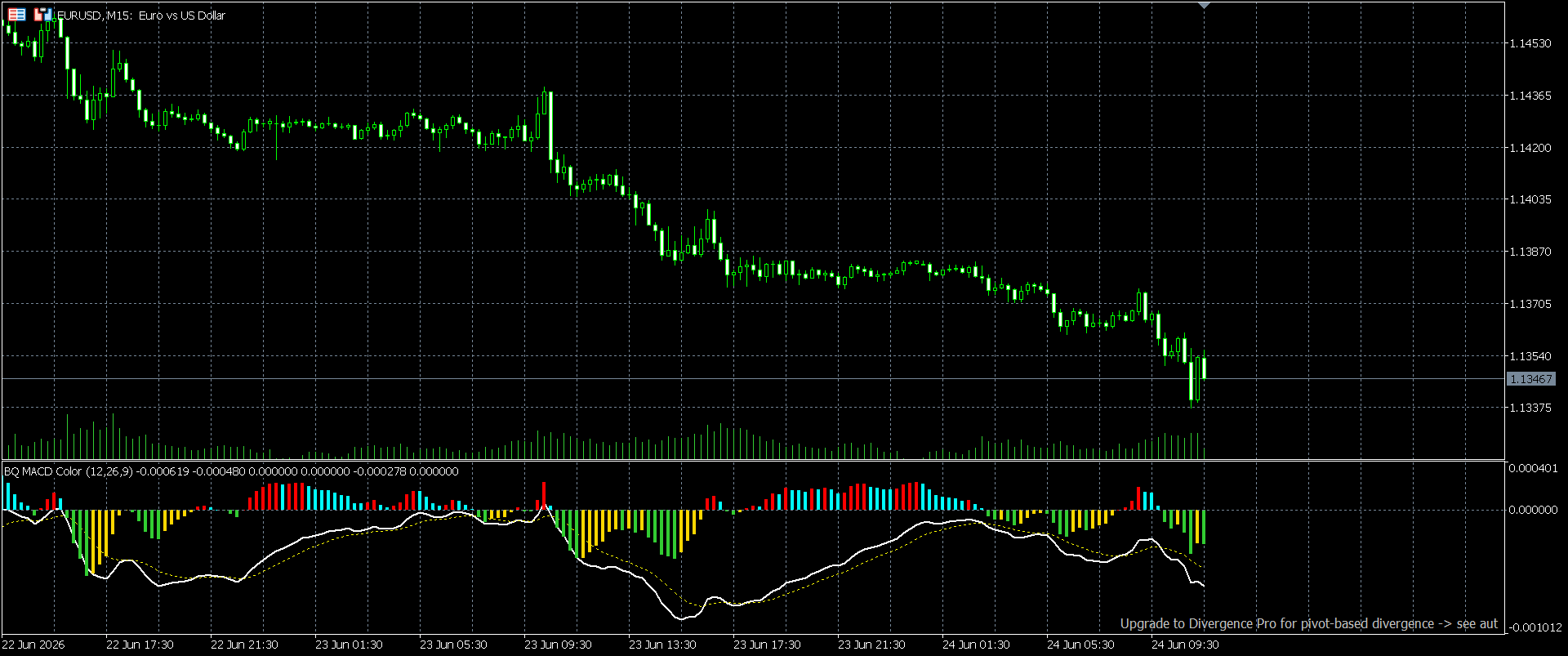
EURUSD M15 — red/green = building, aqua/gold = fading. White DIF line and dotted yellow DEF for context.
My five-minute routine (before I even think about divergence)
-
Higher-timeframe bias — Are we in a trend, a range, or mixed? I use a simple multi-timeframe rule (free MTF tool on my profile) so I do not fight H4 while M15 looks pretty.
-
Last 3–5 closed bars only — not the forming bar.
-
Building in my direction? — Long bias + red stacking → interest. Aqua after red → caution or skip.
-
Range day? — Four colors still flip in chop; I trade less, not more.
-
Journal one line — e.g. Skipped long — aqua fade after red, H1 flat.
This step alone filters a lot of "technically valid" MACD moments that would have lost money.
Divergence — preview for later posts
MACD divergence is where many traders first fell in love with the indicator — and where many accounts learned expensive lessons.
A bearish divergence (price higher high, MACD lower high) does not mean short immediately. A bullish divergence does not mean buy the dip. Context matters:
-
Is the higher timeframe aligned or fighting you?
-
Is momentum already fading (aqua/gold) before the divergence completes?
-
Is price at structure — support, resistance, or mid-range noise?
Not every divergence is worth trading. In upcoming posts I will walk through scenarios where I do take divergence seriously — and where I pass, even when the lines look perfect on a screenshot.
This free histogram tool does not draw divergence lines or alerts; that stays in my paid Divergence Pro work. The four-color read is the foundation: read momentum honestly first, then argue about divergence.
How this fits my free toolkit
| Tool | Question |
|---|---|
| MTF Confluence | Should I be looking long or short at all? |
| Macd Histogram 4 Color | Is momentum building or fading on this chart? |
| Fractal Risk Entry | How many lots for my risk % and stop? |
MACD color does not tell me when to trade. It tells me whether oscillator energy agrees with the story my timeframe bias already suggested.
Mistakes I still catch myself making
-
Watching the forming bar instead of the last close.
-
Ignoring aqua/gold after a strong red/green run — late entries often die there.
-
Treating any divergence as automatic permission — it is not.
What comes next in this series
I plan to publish follow-ups on:
-
MACD momentum + multi-timeframe bias (a simple combo I use daily)
-
When divergence is worth trading — and when it is a trap
-
Combining MACD reads with structure and risk sizing
If a topic would help you, leave a comment. I read them; this series is meant for discussion, not preaching.
Not financial advice. Personal notes from 15+ years of discretionary trading. Past results do not guarantee future performance. Test on demo first.