
Why Most Gold Traders Blow Up in the First 3 Months - And the Risk Framework That Stops It

I blew my second account on gold in 2017.
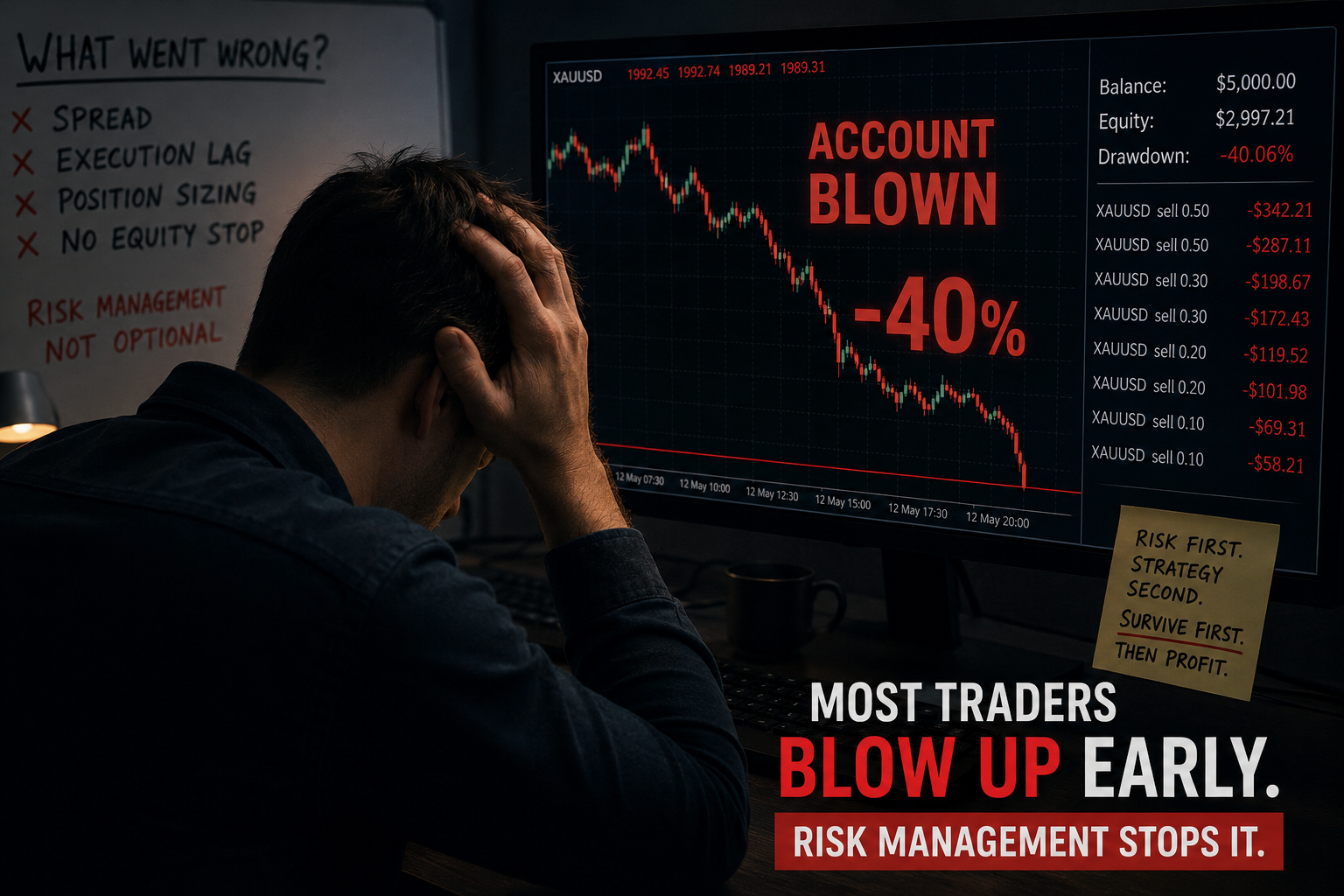
Not because I had no idea what I was doing. I had a system. Backtested it. Equity curve looked decent - nothing flashy, just consistent enough to feel believable. Then I went live with a broker that turned out to have a dealing desk. Week three, down 40%. Week six, it was over. I remember staring at the terminal and just... not closing it. Like keeping it open meant it hadn't fully happened yet.
What killed it wasn't the strategy logic. It was everything around it. Spread. Execution lag. Position sizing that seemed fine until gold dropped $18 in about 12 minutes on some surprise Fed comment and my stop was already gone before the order even processed.
Gold doesn't trade like a forex pair. It just doesn't. New traders know this in theory. Most don't actually adjust their risk setup for it. That gap is where accounts go.
🌟 Why Accounts Actually Blow Up
Everyone wants to blame psychology. Discipline. Emotional trading. Those matter. But when I look at the actual sequence of events on a blown account - mine or anyone else's - the root cause is almost always structural. Something wrong in the setup before the first trade was placed.
✅ Position sizing that treats gold like EUR/USD
Most people use a fixed lot, or some percentage-of-balance formula they copy-pasted from somewhere. The formula usually works fine for pairs with normal ranges. On gold it doesn't, because the average daily range is a different animal and your risk math has to reflect that.
A 1% risk rule with a 20-point stop is manageable on EUR/USD. On XAUUSD that same stop is a joke - during any real news event you'll get stopped out by spread before price even moves. I've watched traders set 15-point stops on gold going into NFP. There's not much to say about that. It doesn't end the way they hope.
✅ Ignoring spread entirely
During normal Asian hours, XAUUSD spread on a typical retail broker sits around 20 - 25 points. During a major US release I've seen it spike above 200. One broker I tested regularly went from 22 points to 190+ during CPI last year, and this was an account advertised as "raw spread ECN." They still widen. They all widen when it matters.
I spent weeks wondering why one of my EAs was consistently underperforming live versus demo. Eventually figured out the demo server had a fixed spread that had absolutely nothing to do with what live was actually getting during New York open. Took longer to find that than it should have.
✅ No hard equity stop anywhere in the system
This is what turns a bad week into an account that's gone. If nothing in your setup actually forces a stop when drawdown hits a certain level - not a plan, not an intention, something in the code that closes trades and stops the EA - a losing streak just compounds. Humans don't press the button when they're down 25% because they're convinced it'll recover. And EAs don't press it because nobody wrote that code.

🌟 What the Minimum Risk Layer Looks Like
I don't have a perfect framework. There isn't one. But there's a floor - a set of things that if you don't have them, you're probably not making it past month three regardless of how good your entry logic is.
✅ Know the actual dollar risk before you enter.
Not percentage-of-account in the abstract. Not points. Dollars. A real number.
On most standard retail XAUUSD accounts, 1 lot = $10 per point (0.1 price move) - though this varies by broker and contract specification, so verify yours. So 0.5 lots with a 30-point stop = $150 risk. Fine on a $5k account at 3%. Not fine if you also have two other open positions you didn't factor in.
In MQL5, lot sizing should be calculated, not guessed. And the calculation needs to go through actual broker volume constraints:
double CalcLotByRisk(double accountRisk, double stopPoints, double pointValue){ if(stopPoints <= 0 || pointValue <= 0) return 0; double balance = AccountInfoDouble(ACCOUNT_BALANCE); double riskAmount = balance * accountRisk / 100.0; double lotSize = riskAmount / (stopPoints * pointValue); double minLot = SymbolInfoDouble(_Symbol, SYMBOL_VOLUME_MIN); double maxLot = SymbolInfoDouble(_Symbol, SYMBOL_VOLUME_MAX); double lotStep = SymbolInfoDouble(_Symbol, SYMBOL_VOLUME_STEP); lotSize = MathFloor(lotSize / lotStep) * lotStep; lotSize = MathMax(minLot, MathMin(maxLot, lotSize)); return lotSize; }
SYMBOL_VOLUME_MIN not 0.01. Some brokers have non-standard minimums. Hardcode it and the EA will misbehave silently on certain accounts. I've debugged that exact issue more than once.
✅ Check spread before entering.
I know this is tedious. Most people skip it. Skip it and your EA will enter during a 190-point spread spike and be immediately underwater before the market moves a single point in your direction.
double currentSpread = SymbolInfoInteger(_Symbol, SYMBOL_SPREAD) * _Point;
if(currentSpread > MaxAllowedSpread * _Point)
    return;
I use around 30 - 40 points as the threshold for scalping entries on gold. For longer timeframe setups I let it go wider. The exact number is less important than having the check at all.
✅ Build the equity floor into the code.
Not into your head. Into the code. Mental rules don't run at 3am when your VPS drops and reconnects and the EA fires twice on the same signal.
double startEquity;  // captured in OnInit()

void CheckEquityFloor()
{
    double currentEquity = AccountInfoDouble(ACCOUNT_EQUITY);
    double drawdown = (startEquity - currentEquity) / startEquity * 100.0;

    if(drawdown >= MaxDrawdownPercent)
    {
        CloseAllPositions();
        ExpertRemove();
    }
}
ExpertRemove() detaches the EA completely. Some people prefer a flag that halts trading but keeps the EA attached so they can review state. Either works. What doesn't work is having nothing. Without this, a drawdown just keeps going.

🌟 What I Actually Run
At some point I got tired of copy-pasting the same risk logic into every new EA. Too much duplication, too many places to have the same bug in slightly different forms. So I pulled it all out into standalone utility tools. Built them because I needed them, not because I planned to sell anything.
🚀 Gold Risk Calculator MT5 - position sizing. Calculates lot size from risk percentage or fixed amount, handles gold's point value, shows me the real dollar exposure before I confirm the trade. Free. I keep it on every chart.
🚀 Gold Spread Monitor MT5 - tracks spread behavior over time on your specific broker and account type. Useful for figuring out which hours are genuinely problematic for your setup, not just following generic "avoid news" advice that may or may not apply to your execution environment. $30.
🚀 Gold Equity Protector - the hard floor. Monitors equity against daily and total drawdown limits, closes everything when triggered, can lock the EA out for the rest of the session. $39. I don't run live without this one.
Three tools, under $70 total. I've lost more than that in a single bad entry on a standard lot.
🌟 The Strategy Tester Problem
The MT5 tester is useful. I run it on everything. But it has a specific problem with gold that most people don't fully feel until they've deployed live and watched the numbers come in.
The historical spread data in the tester almost never matches what your broker actually served during those candles. Orders fill at the modeled price. Partial fills don't happen. The latency between signal and execution on a loaded VPS or a broker under server stress - anywhere from 100 to 300ms - none of that is in there.
I had a strategy show 40% annual returns in tester. Live it came out around 12%. The logic wasn't wrong. What actually happened:
- Slippage on entry, consistently a few points worse than modeled
- Some orders during news got partially filled or rejected
- Spread was wider than tester assumed on maybe 15 - 20% of entries
- VPS rebooted twice and missed signals both times
None of that shows in backtest. All of it affects real results every single month.
If your EA only works with a fixed 20-point spread and 0ms latency on a clean demo server, you don't have a trading strategy. You have a demo-bound illusion.
Add 10 - 15 points of slippage to every entry and rerun the test. If the results fall apart, the edge was thinner than you thought.
🌟 Session Timing
I'll keep this short because people either already know it or don't want to hear it.
Late Asian / early European overlap - roughly 01:00 to 05:00 server time - has thinner liquidity and moves that look like real breakouts but often have nothing behind them. I've stopped counting how many setups in that window looked perfect and then just reversed for no obvious reason. Probably still lose money on that session more than I should.
New York open is where volume shows up, but spread behavior gets unpredictable, especially 30 minutes either side of a major US release.
If your EA runs 24 hours with no time filter, it's treating 2am Asian the same as 14:30 New York. That's almost certainly not what you want.
🔥 Last Thing
Accounts don't blow up because traders are stupid. They blow up because the risk layer was incomplete, and gold's volatility eventually found the gap.
Most people build the entry logic first and think about risk after the account starts bleeding. That's the wrong order. The risk layer should exist before the first live trade, not after the first bad week.
And even then - actually check that it works. The number of times someone deploys an EA where the drawdown protection is in the code but the equity baseline was initialized wrong so it never fires... it happens more than it should. Run it on a demo account. Manually force it into drawdown. Watch it trigger. Then go live.
That's it, really.
🎁 New to Gold Algo Lab?
Start with the Gold Algo Lab Tool Map - a practical guide that organizes our MT5 tools into 6 connected stages: market context, setup selection, risk planning, trade execution, position management and account protection.
→ Gold Algo Lab Tool Map: Where to Actually Start With MT5 Tools for XAUUSD
https://www.mql5.com/en/blogs/post/771930
Do not choose a tool by its name alone. Start with the part of your trading process that needs the most control, then build your workflow one layer at a time.
Gold Algo Lab builds practical, risk-first MT5 tools for serious XAUUSD traders, shaped by 8 years of developing and trading real systems to help traders identify clearer setups, manage risk with greater confidence and execute with more discipline.