
Looking at the Chart: Easier Setups and Setups I Would Rather Skip with Prime ACE

Start Here
[Setup Guide]
Prime ACE Strategy Setup Guide - Trading Systems - 11 April 2026 - Traders' Blogs
[Introduction video]
https://www.youtube.com/watch?v=TMv4Zv7w5Zs
[Introduction video]
https://www.youtube.com/watch?v=TMv4Zv7w5Zs
Hello, and thank you for reading.
In the previous post, I explained that Prime ACE arrows are not something to enter automatically just because they appear.
They are candidates.
This time, I would like to continue from that idea and look at two simple chart examples:
an easier situation to consider,
and a situation I would rather skip or treat carefully.
Example 1: An Easier Situation to Consider
First, please look at this chart.
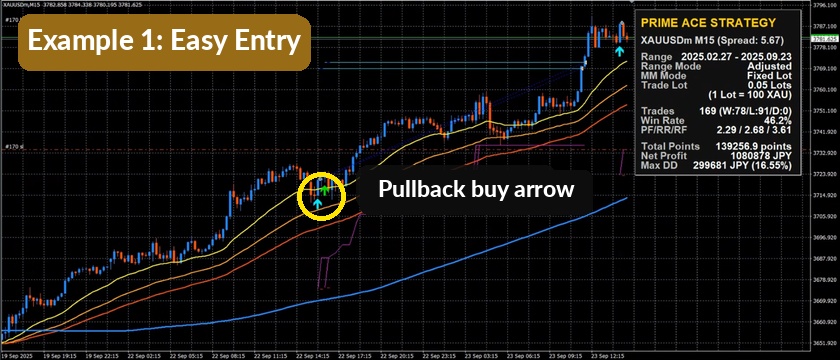
For me, this is a relatively easier type of buy setup to consider.
The reason is simple.
The market has been moving upward, and the buy arrow appears after a pullback.
In other words, the signal is not strongly going against the flow.
It appears in a situation where the trader can think of it as a possible continuation after a pullback.
Of course, there is no perfect setup in trading.
But among Prime ACE arrows, this kind of location is easier for me to accept.
The arrow appears after a pullback while the broader upward flow is still visible.
That is why I would consider this type of signal more positively.
Example 2: A Situation I Would Rather Be Careful With
Next, please look at this chart.
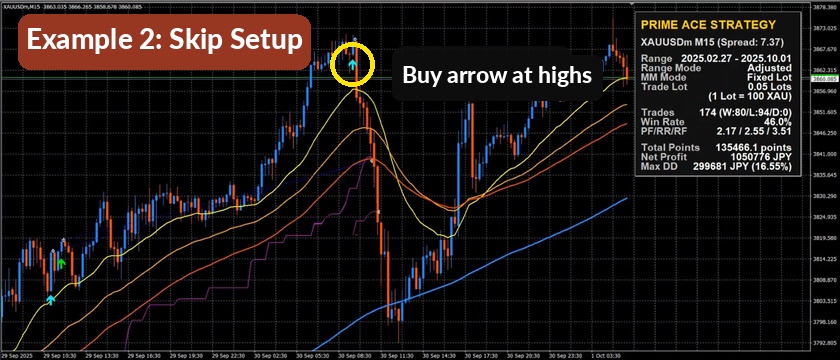
This chart also shows a buy arrow.
However, I would be much more careful with this type of situation.
The arrow appears near a high area after price has already moved upward.
After that, the market drops sharply.
The important point is this:
the arrow itself is also a buy arrow,
but the location is completely different.
When price has already risen a lot, it can be tempting to buy because the chart still looks strong.
But that is exactly the kind of situation where I want to slow down and think carefully.
The Location of the Arrow Matters
Prime ACE is not a tool for entering mechanically every time an arrow appears.
Rather, I see it as a tool for finding candidates and then choosing the better situations.
That is what I wanted to show with these two examples.
Even if both signals are buy arrows, they do not mean the same thing.
A buy arrow after a pullback in an upward flow is easier to consider.
On the other hand, a buy arrow near a high area may be something I would rather skip.
So I think the important question is not only:
did an arrow appear?
The more important question is:
where did the arrow appear?
Final Note
In this post, I focused on two simple examples.
Prime ACE arrows are non-repaint candidate signals, but they are not final answers.
After a candidate appears, I still want to check the chart location and decide whether the situation is worth taking.
That is the basic way I use Prime ACE.
If this approach makes sense to you, please take a look at the Market page below.