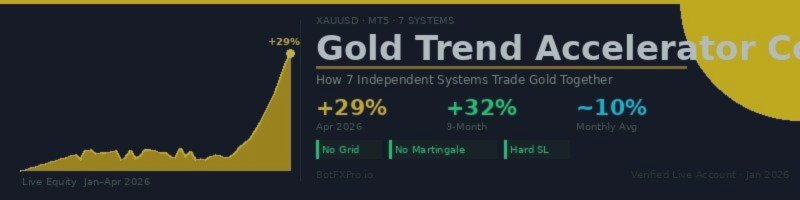
Gold Trend Accelerator Combo — How 7 Independent Systems Trade Gold Together (And Why April 2026 Proved the Concept)

Most gold EAs try to do one thing well — catch trends, fade reversals, or scalp momentum. The problem is that XAUUSD does not cooperate. Gold trends hard for weeks, then goes completely sideways. It spikes 2% in a session, then chops for a month. A system optimised for one market phase underperforms — or worse, loses — in the others.
Gold Trend Accelerator Combo was built around a different idea: instead of one strategy trying to work in all conditions, run seven independent strategies simultaneously, each designed for a specific market phase, and let the portfolio effect do the work.
This post explains how those seven systems are structured, what each one is doing at the logic level, and why the April 2026 live results reflect exactly the behaviour this architecture was designed to produce.
The architecture: two system families
The EA runs seven sub-systems on a single XAUUSD chart. Each system is fully independent — its own entry signals, its own Stop Loss and Take Profit distances, its own trailing stop logic, and its own maximum of one open position at a time. They share no state and cannot interfere with each other.
The seven systems split into two families:
Direct-Trend systems (T1, T2, T3, T4) — these systems enter in the direction of the EMA crossover signal. When the faster EMA crosses above the slower EMA, they look for long entries; below, short entries. They are designed to profit during sustained directional moves in gold.
Counter-Trend systems (R1, R2, R3) — these systems do the opposite. When the EMA signal suggests a trend, R-systems look for the market to revert. They are designed to profit when gold overextends, prints false breakouts, or consolidates after a move.
The practical effect: in a strongly trending market, the T-systems generate most of the profit while R-systems may scratch or take small losses. In a choppy, range-bound market, R-systems generate steady returns while T-systems produce small losses or flat results. The combined equity curve is structurally smoother than any individual system running alone.
How the entries work: EMA crossover + ATR
Every system uses Exponential Moving Average crossover as the entry trigger. Each system has its own fast EMA and slow EMA period, individually tuned for its timeframe and whether it is trend-following or counter-trend. The crossover alone determines signal direction — for T-systems it confirms the trend entry, for R-systems it triggers the opposite position.
Once a signal fires, the system does not use fixed pip distances for its Stop Loss or Take Profit. Both levels are calculated as multiples of the current ATR (Average True Range). This is the key to why the system adapts to gold's notorious volatility changes — during high-volatility sessions the SL and TP widen automatically; during quiet periods they compress. The EA never uses the same distance twice because the market is never identical twice.
Each system has its own ATR multipliers, giving the seven systems distinct risk profiles that collectively cover a wide range of market conditions.
Timeframe coverage: M30, H1, H4
The seven systems span three timeframes, all managed internally from a single chart attachment:
- M30 (30-minute): T1 and R1. Short to medium-term entries. T1 catches the early stages of intraday momentum. R1 fades the same moves when they overextend.
- H1 (1-hour): T2, T3, and R2. Three systems share this timeframe but with very different parameter sets. T2 targets shorter H1 momentum cycles. T3 targets the larger H1 trend structure with a fixed Take Profit rather than a trailing stop. R2 is the widest counter-trend system — it targets large mean-reversion swings with a substantial ATR-based TP.
- H4 (4-hour): T4 and R3. The highest timeframe in the portfolio. T4 enters on strong H4 trend signals with a fixed TP structure — fewer trades but based on major structural moves. R3 targets large structural reversals on the H4, using a trailing stop to ride the reversal as far as it will go.
This timeframe distribution means the portfolio is active across short, medium, and long gold cycles simultaneously. A trend on H4 runs T4 while T1 catches its intraday momentum sub-waves. When H4 consolidates, R3 takes over. The systems are not designed to cancel each other — they are designed to cover different phases of the same market.
Trailing stops: selective, not universal
A common misconception about automated gold systems is that all positions should use trailing stops to "let winners run." The reality is more nuanced. Gold's ATR-based moves can reverse sharply enough that a trailing stop on a counter-trend position — which by definition entered against the prevailing move — can cost more in slippage than it saves in captured profit.
Gold Trend Accelerator Combo applies trailing stops selectively based on each system's logic:
- T1, T2, and R3 use ATR-based trailing stops — these systems are designed to ride extended moves and benefit from locking in gains progressively.
- T3, T4, R1, and R2 use fixed Take Profit targets — these systems are optimised for defined risk-reward and do not chase the move beyond their calculated target.
This is not a compromise — it reflects a deliberate design choice for each system's role in the portfolio.
Risk management: one position per system, percent-based sizing
With seven systems running simultaneously, exposure management matters. The EA enforces a strict one-position-per-system rule. No system can open a second position while the first is still open. This prevents a scenario where a strong signal causes a system to pyramid into a losing position.
Lot size is calculated as a percentage of account balance based on the distance to the Stop Loss — not a fixed lot size. As the account grows, lot sizes grow proportionally. As the SL distance changes with volatility, the lot size adjusts to maintain consistent percentage risk per trade. Each of the seven systems has its own independently configurable risk percentage.
Every single trade, in every single system, has a hard Stop Loss sent to the broker server at the moment of entry. There is no scenario in which a trade is live without a Stop Loss in place.
The real-time dashboard
Because seven systems are running simultaneously, the EA displays a persistent on-chart dashboard showing the current status of each sub-system: its designation, timeframe, current signal state, open position direction, and live profit or loss. This makes the system's behaviour fully transparent at a glance — no guessing what it is doing or why.
What February and March actually tell us
February 2026 was flat (-0.01%). March 2026 produced a small loss (-3.78%). Looking at just those two months in isolation, the system appears to be underperforming.
But that reading misunderstands how the architecture works. In February and March, gold's directional moves were short-lived and frequently reversed. T-systems captured partial trend moves and gave some back when the trend failed to extend. R-systems partially offset the T-system losses but not completely, because the consolidation was not clean enough for strong reversal signals either.
This is not system failure. This is the system behaving exactly as designed during a period that did not suit any of its seven strategies particularly well. The portfolio absorbed the adverse conditions with contained, single-digit drawdown rather than catastrophic loss.
What April 2026 actually demonstrates
April 2026 saw sustained directional movement in gold. The T-systems — specifically those on H1 and H4 — captured the bulk of those moves. T3's fixed TP structure secured profits at predefined levels as each momentum wave completed. T1's trailing stop locked in gains as intraday trends extended. T4 on H4 positioned into the larger structural move.
The R-systems were quieter in April — fewer counter-trend entries triggered, and those that did were smaller contributors. This is correct behaviour. In a trending market, the counter-trend systems reduce activity rather than fighting the prevailing move.
The result was +29% in a single month on the live account — not from taking excessive risk, but from the T-systems firing consistently into favourable conditions while the R-systems stayed disciplined.
The live account started January 2026 with a $2,000 deposit. As of April 28, the balance stands at $2,645.55, a verified +32.28% absolute gain. Max drawdown across the entire period was 16.81%.
One installation, one chart
Despite seven independent systems running across three timeframes, the setup is a single chart attachment. Attach the EA to any XAUUSD chart in MetaTrader 5, configure your risk percentages for each system, and enable algorithmic trading. The EA handles all internal timeframe logic automatically — there is no need to open separate chart windows or manage multiple EA instances.
The on-chart dashboard confirms which systems are active, which are holding positions, and the live P&L of each. Everything is visible from a single terminal window.
Minimum balance requirements
Because the EA uses ATR-based Stop Loss distances rather than fixed pip targets, SL distances on XAUUSD can vary significantly across market conditions. The minimum recommended balance ensures that the mandatory 0.01 lot minimum remains within a safe percentage of account risk even at the widest typical SL distance:
- Standard account: $20,000 USD minimum recommended
- Micro or cent account: $2,000 USD equivalent (200,000 cent units) recommended
The live account above is running on a micro account with $2,000 deposit — the results shown are from the correct account type for the EA's design.
Closing thought
Most traders ask: "What is the win rate?" The more useful question for a multi-system EA is: "What happens to the portfolio when conditions are bad for one family of strategies?" The answer — and the real value proposition of this architecture — is that when T-systems struggle, R-systems are designed to compensate, and vice versa.
February and March demonstrated the downside of that design: contained, manageable drawdown during adverse conditions. April demonstrated the upside: efficient, compounding capture of favourable conditions when they arrive.
The system is available on the MQL5 Market. Live signal and verified track record are linked from the product page.