![[Special Comparison] More Trades or Better Selectivity? How Prime ACE Changes Character Through Parameter Settings](https://c.mql5.com/6/1000/splash-769017.png "[Special Comparison] More Trades or Better Selectivity? How Prime ACE Changes Character Through Parameter Settings")
[Special Comparison] More Trades or Better Selectivity? How Prime ACE Changes Character Through Parameter Settings

Start Here
[Setup Guide]
Prime ACE Strategy Setup Guide - Trading Systems - 11 April 2026 - Traders' Blogs
[Introduction video]
https://www.youtube.com/watch?v=TMv4Zv7w5Zs
[Introduction video]
https://www.youtube.com/watch?v=TMv4Zv7w5Zs
Hello, and thank you for reading.
In the previous posts, I explained that Prime ACE is designed to work in the following order:
-
first, use the parameters and the panel to find your tradable battlefield
-
then, treat the arrows as candidates
-
finally, narrow them down through discretion
This time, I would like to share a practical comparison.
As a special example, I want to show how changing the parameters can significantly change both the panel values and the overall character of the tool.
This Is Not About Finding a Single “Correct” Setting
Before going further, I want to make one point clear.
This comparison is not meant to say:
“this setting is the one absolute answer.”
Prime ACE is not a tool where you simply enter because an arrow appears.
It is a tool for exploring:
-
where to trade
-
how to trade
-
and which style suits your own battlefield better
In other words, the point of changing the settings is not to discover some magical perfect answer.
The real purpose is:
to find the tradable conditions that fit you better.
Comparison Conditions
In this comparison, all examples use the same base conditions:
-
JP225
-
M15
-
Initial Deposit: 1,000,000 JPY
-
Auto Risk: 1.0%
-
Test period: approximately the most recent two months
Only the parameters are changed.
A small note for international readers: JP225 may be less familiar in Europe or North America, but in Japan it is a major and widely followed trading instrument.
Example 1 — Default Parameters Focused on Opportunity Count
The first image shows the default settings, which are closer to a win-rate-oriented approach.
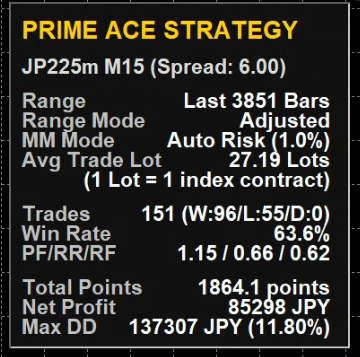
The results were:
-
Trades: 151
-
Win Rate: 63.6%
-
PF: 1.15
-
Net Profit: 85,298 JPY
-
Max Drawdown: 11.80%
The key feature of this setup is that it produces a solid number of candidates.
Prime ACE is designed on the assumption that arrows are candidates, and that the trader will then narrow them down through discretion.
From that point of view, the default settings are not just random initial values.
They are a meaningful starting point for exploring your battlefield while keeping a relatively broad set of opportunities visible.
Example 2 — Changing TP and SL Toward a Stronger Reward Structure
The second image changes the TP and SL structure toward a 2:1 reward-to-risk style.
This is where the character begins to change visibly.
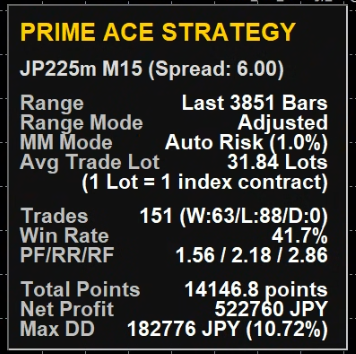
The results were:
-
Trades: 151
-
Win Rate: 41.7%
-
PF: 1.56
-
Net Profit: 522,760 JPY
-
Max Drawdown: 10.72%
Compared with the first setup, the trade count stayed the same.
However, the win rate dropped sharply from 63.6% to 41.7%.
At first glance, that may look uncomfortable.
But at the same time:
-
PF improved to 1.56
-
Net Profit increased significantly
-
Max Drawdown remained slightly lower than the first setup
What this shows is a shift in character:
from a win-rate-oriented profile to a reward-expansion-oriented profile.
If you only look at win rate, this setup may feel worse.
But trading is not decided by win rate alone.
It is also about:
-
how much you can limit losses
-
how much you can extend profits
And changing only the TP/SL structure can already change the entire “landscape” shown by the panel.
Example 3 — Adding a Stronger Trend Filter
The third image takes the second setup and raises the trend-strength filter by one step.
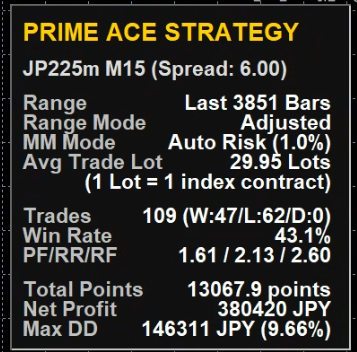
The results were:
-
Trades: 109
-
Win Rate: 43.1%
-
PF: 1.61
-
Net Profit: 380,420 JPY
-
Max Drawdown: 9.66%
Compared with the second setup:
-
Net Profit became somewhat smaller
-
but unnecessary trades were reduced
-
and drawdown became slightly lower
This is best understood as a move toward:
reward-oriented trading with less noise.
At this point, the choice becomes clearer:
-
do you want to keep a certain amount of trade frequency and stay more aggressive?
-
or do you want to filter more heavily and lean toward cleaner conditions?
This is where Prime ACE starts to show itself as more than a signal tool.
It becomes a tool for choosing your way of fighting.
What This Comparison Really Shows
The important point is not that one of these three settings is the only correct answer.
Each one has a different role.
The first, default setup offers:
-
more trade opportunities
-
more visible candidates
-
and a good foundation for discretionary selection
From there, adjustments such as:
-
changing TP and SL design
-
increasing the trend-strength filter
can shift the tool toward either:
-
more opportunity count
-
or more selectivity and quality
That is the real point.
Prime ACE is not a tool that gives you one fixed answer.
It is a tool whose character can be adjusted to fit your own trading style.
Why This Matters
You may prefer:
-
collecting a broader set of candidates and using discretion to filter them
-
focusing more on reward expansion
-
or tightening the filters to reduce noise and improve stability
All of those are possible directions.
That room for adjustment is one of the reasons Prime ACE can adapt to the market.
If you only look at the arrows, this strength does not fully appear.
The real flow is:
-
first, use the panel to find your tradable battlefield
-
then, treat the arrows as candidates and filter them through discretion
-
finally, if needed, use the bonus companion EA to make post-entry handling more consistent
That is the basic structure of Prime ACE.
Final Note
In this comparison, I wanted to show one important idea:
even under the same core logic, changing the settings can significantly change the way you trade.
If this helped clarify how Prime ACE works, please take a look at the Market page below.