How to Build an AI Trading Agent to Pass Prop Firm Challenges (Without Coding)

Passing a prop firm challenge is notoriously difficult. The problem most algorithmic traders face isn't finding a profitable entry; it's surviving the strict drawdown limits when the market regime shifts.
Static Expert Advisors (EAs) with hardcoded rules eventually break. When volatility spikes, a fixed lot size will inevitably blow right through a firm's risk limits.
I wanted a system that could adapt to the market and manage risk dynamically, but I didn't want to spend months learning complex Python machine learning code. So, I completely changed my architecture. I moved away from writing static MQL5 logic and built a local AI setup based on a simple philosophy: Build your own AI trading agent. No code. No PhD. Just describe your edge.
Here is a breakdown of the workflow I use to train and deploy adaptive agents specifically designed for prop firm evaluations.
1. Defining the Edge (In Plain English)
Instead of wrestling with programming syntax, the workflow starts with a built-in conversational assistant.
You simply describe your strategy in plain text. For example: "I want to buy when the trend is up, but only if the RSI shows it's oversold, and I want a tight stop loss based on ATR." The assistant evaluates the idea, asks clarifying questions, and automatically generates the exact entry and exit rules for you.
2. Training the Neural Networks
Once the rules are set, the standalone desktop engine downloads recent market data and trains three different AI agents (Core, Select, and Edge variants). The AI learns how to weight your entry and exit rules based on actual market features.
Let's be incredibly candid: AI is not a magic money printer. It usually takes several iterations to find a model that works. Some agents will overfit the backtest, and others will over-trade in ranging markets. The advantage here is that you can iterate, fail, and retrain new models in minutes instead of weeks.
3. The Prop Firm Secret: The 3% Equity Rule
This is the most critical part of passing a challenge. Your EA cannot just blindly open trades with fixed lots; it must calculate risk based on your current account balance.
Through extensive forward testing, I've found that these AI agents survive prop firm evaluations best when you configure them to use less than 3% of your account equity for any given trade.
Because the intelligence is handled by the local app, enforcing this rule is done dynamically per bar. The strategy configuration uses a specific margin_allocation_pct parameter. By setting this target, the engine calculates the exact lot size required so the used margin for a new position stays strictly under that 3% equity threshold. It automatically accounts for leverage, contract sizes, and account-currency conversions so you never accidentally over-leverage a trade.

4. Lightweight MT5 Execution
The MT5 Expert Advisor used in this setup is incredibly lightweight. It contains zero trading logic and simply acts as a terminal executor that polls the local app at exact candle boundaries.
When the EA polls the local server, the AI evaluates the closed bar and sends back a precise BUY , SELL , or EXIT signal, along with the dynamically calculated lot size to keep you under that 3% limit.
The Reality Check (Live Demo Evidence)
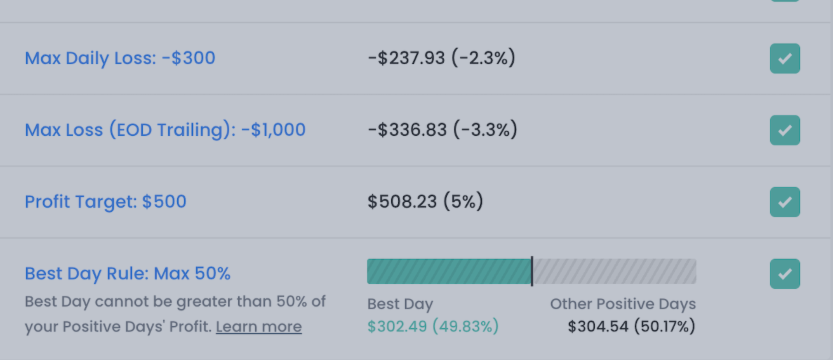
To be completely transparent: I recently used this exact setup to pass a demo prop firm challenge. I am forward-testing this architecture thoroughly before putting real funded capital on the line, which is exactly how every systematic trader should operate.
If you want to see how the AI actually performs in live market conditions, you can track the exact forward-testing signal I used to pass the evaluation here: View the Live Forward-Testing Signal
Conclusion
You don't need to be a data scientist to utilize machine learning in your trading. By keeping the MT5 EA "dumb" and shifting the intelligence to a local, no-code AI engine, you can rapidly test and deploy models that actually respect strict risk limits.
If you want to stop coding static EAs and see how this local AI architecture works, you can check out the platform I used to build it at corailabs.com .