

| PART | Section | Description | ||
|---|---|---|---|---|
| 1 | INTRODUCTION | Product introduction, what the product helps you with | ||
| 2 | INSTALLATION & SETUP | System requirements, step-by-step installation guide | ||
| Guide to Installing Free Indicators and EAs Included with the Mirage Trading System Purchase | ||||
| 3 | INTERFACE DISPLAY | Explanation of the components displayed on the chart | ||
| User Guide: Trading Lines & Signal Tracking System | The system automatically draws Entry, Stop Loss, and Take Profit lines (TP 1–4) on the chart, tracks price action for hits, records Win/Loss results, and displays real-time performance statistics. | |||
| User Guide : Visualization, Zone Fill, Signal Dashboard & Cancelled Signals | When you attach an indicator to a chart, the system renders the following visual components for each detected signal | |||
| User Guide: MTF SCAN & Dashboard User Guide | MTF SCAN automatically scans all Market Watch symbols across 8 timeframes (M1 to W1) and displays results on a Dashboard grid directly on your chart. | |||
| User Guide : Chart Theme User Guide | Chart Theme is a feature that changes the entire chart color scheme in MetaTrader 5 — including the background, candles, grid, text, and Bid/Ask lines — with a single click. | |||
| 4 | CORE CONCEPTS | Fundamental concepts that the system is built upon | ||
| User Guide: Market Structure Functionality in the Trading System | Identifies trend direction (Uptrend, Downtrend, Ranging) by analyzing swing highs/lows, and detects key events: BOS (trend continuation) and CHoCH (potential trend reversal). | |||
| User Guide : Signal Types, States, and Lifecycle | A signal is the system's notification when it detects a qualifying candlestick pattern on the chart. Each signal tells you the expected price direction and provides suggested entry, stop loss, and take profit levels. | |||
| 5 | SIGNAL FILTERS | Filters that refine and validate trading signals | ||
| User Guide: Trade Direction (Direction Filter) in the Trading System | Defines the allowed trading direction (Buy only, Sell only, both, or neither) as the first filter before searching for entry signals, based on current market trend. | |||
| User Guide: Signal Zone Filter in the Trading System | Eliminates signals not near important price zones, retaining only those connected to market structures (swing high/low, BOS, CHoCH) to reduce noise. | |||
| User Guide: StoplossHunt Filter User Guide — Filtering "SL Sweep" Signals | Identifies higher-probability signals by checking whether price "swept stoploss" before forming a pattern. | |||
| User Guide : Extreme Zone Filter | Extreme Zone Filter is a signal filtering feature that helps avoid entering trades when price is at the top or bottom of a Donchian price channel. | |||
| User Guide: Opposite Signal Filter | The Opposite Signal Filter is an automatic feature that prevents new signals from appearing when you already have an active trade running in the opposite direction.The principle is very simple: Don't buy when you're selling. Don't sell when you're buying. | |||
| User Guide : Quality Filter User Guide | Quality Filter is a feature that helps you receive only the best signals — price patterns formed clearly, with balanced proportions and high reliability — and reject weak signals, dull patterns, and those below standard. | |||
| 6 | TRADE MANAGEMENT | |||
| User Guide : Risk/Reward & SL Method User Guide | Risk/Reward (R:R) is the ratio between the amount of money you accept losing (Risk) and the amount of money you expect to gain (Reward) in a single trade. | |||
| User Guide: Trailing Stop Loss (TSL) User Guide | Regular Stop Loss (SL) stays fixed in one place. You set SL at 1990.00, and it stays there forever — even if price has risen to 2030.00.Trailing Stop Loss (TSL) is different. It automatically moves in your favor when price advances. As price moves up, TSL moves up with it. When price stalls or reverses, TSL holds the best position it reached. | |||
| 7 | CONFIGURATION PARAMETERS GUIDE | Detailed guide to each configuration parameter | ||
| SIGNAL SCANNING CONFIGURATION GUIDE - MIRAGE TRADING SYSTEM EA | Guide to mastering signal scanning settings within the Inputs tab, optimizing trade discovery on a single chart or across the entire market. | |||
| 8 | ALERTS & NOTIFICATIONS | |||
| User Guide: Alerts & Notifications User Guide | Configure push notifications, and on-screen popups when new signals are detected. | |||
| 9 | SYSTEM RISKS & LIMITATIONS | Notes on system risks and limitations |
1. INTRODUCTION
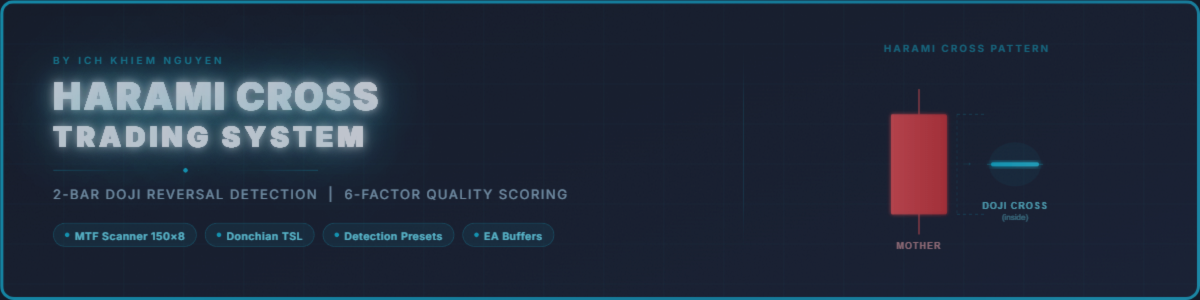
Harami Cross Trading System v1.002-Bar Doji Cross Reversal Detection with Quality Scoring
Author: Ich Khiem Nguyen | MQL5: https://www.mql5.com/en/users/khiemni/seller
What is Harami Cross Trading System?
Harami Cross Trading System helps you spot Harami Cross candlestick patterns on your MetaTrader 5 charts — automatically. The indicator scans every candle, filters out weak setups, and shows you only the best trading opportunities with clear entry points, stop losses, and profit targets already calculated. It works on any market and any timeframe, giving you more time to focus on your trading decisions instead of searching for patterns.
What Are HCR Patterns?
Harami Cross patterns are powerful reversal patterns where a large mother candle is followed by a Doji — a candle with a tiny body and long wicks stretching in both directions, shaped like a cross or plus sign. The Doji child sits completely inside the mother's body, signaling that the dominant trend has stalled and the market has entered a state of complete indecision. This structure is a stronger reversal signal than a standard Harami because a true Doji represents maximum uncertainty: buyers and sellers are perfectly balanced at the close.
The name "Harami" comes from the Japanese word for "pregnant" — the large mother candle contains the Doji cross child within its body, like a mother carrying a child. The cross shape of the Doji gives this pattern its distinctive name.
Bullish Harami Cross (Bullish Reversal)
After a sustained downtrend, a large bearish (red) candle appears, showing sellers are firmly in control. But on the very next bar, price opens inside the mother's body and forms a Doji — a candle where the open and close are nearly identical, leaving behind long upper and lower wicks of roughly equal length. This Doji cross sits entirely inside the mother's body. The message is clear: selling pressure has completely evaporated. Neither buyers nor sellers can dominate. The market is pausing before a potential upward reversal.
Bearish Harami Cross (Bearish Reversal)
After a sustained uptrend, a large bullish (green) candle appears, showing buyers are firmly in control. But on the very next bar, price forms a Doji cross sitting entirely inside the mother's body. Buying pressure has dried up completely. The market is perfectly balanced — a state of indecision that often precedes a downward reversal.
When you see these patterns forming near important support or resistance levels, they become even more reliable signals for potential trend reversals.
How the Indicator Finds Patterns
The indicator scans your charts in real-time and checks each potential pattern against multiple quality requirements:
- Checks that the first candle (mother) has a strong, decisive body with significant range relative to market volatility (ATR)
- Verifies the second candle is a genuine Doji — its body is tiny relative to its total range and relative to ATR, creating the characteristic cross shape
- Confirms the Doji forms entirely inside the mother's body with configurable tolerance — the key inside containment check
- Evaluates wick symmetry to reward Doji candles with balanced upper and lower wicks, confirming the cross shape quality
Only patterns that pass all these checks appear on your chart, so you don't waste time on weak or invalid setups.
Detection Preset System
The indicator includes three detection presets to match different trading styles and market conditions:
STANDARD Preset (Default — Recommended)
Relaxed thresholds designed to produce approximately 5% pattern pass rate. Best for most traders, especially on Forex and Gold. The Doji body can be up to 25% of the candle range (maxDojiBodyRatio=0.25) and up to 0.10x ATR (maxDojiBodyATR=0.10). This catches near-Doji candles that still carry reversal significance.
STRICT Preset
Original specification with tighter thresholds, approximately 1% pass rate. Requires very small Doji bodies (maxDojiBodyRatio=0.10, maxDojiBodyATR=0.05) and stronger mother candles. Use this when you want only textbook-perfect Doji crosses, accepting fewer but higher-conviction signals.
CUSTOM Preset
Advanced users can set each threshold individually using the [Custom] input fields. Select CUSTOM to override all six detection parameters with your own values. Useful for optimizing to a specific instrument or timeframe after backtesting.
Quality Score — How Good Is the Pattern?
Every pattern gets a quality score from 0.00 to 1.00. This helps you focus on the best trading opportunities.
What the Score Means
The indicator evaluates 6 weighted factors that together describe the quality of the Harami Cross structure. The dominant factor is Doji quality — a perfect Doji with a tiny body and long symmetric wicks scores highest. The scoring breakdown:
- isDoji (weight 0.23): How close the child is to a perfect Doji — the smaller the body relative to its range and ATR, the higher this score
- motherBodyATR (weight 0.18): The mother candle's body significance relative to market volatility — larger, more decisive mothers score higher
- isInsideBar (weight 0.18): How cleanly the child body fits inside the mother's body range — tight containment scores highest
- overlapRatio (weight 0.15): How much the child overlaps with the mother's body — high overlap means the Doji is well-centered inside the mother
- wickSymmetry (weight 0.13): Balance between upper and lower wicks on the Doji — symmetric wicks create the true cross shape and score highest
- directionChanged (weight 0.13): Whether the Doji's close direction reversed from the mother — a direction change adds reversal confirmation
Patterns with a near-perfect Doji (tiny body, balanced wicks) sitting cleanly inside a significant mother candle score highest.
- Grade A (0.80 - 1.00) — Excellent: Best signals, highest probability setups
- Grade B (0.60 - 0.79) — Good: Reliable setups worth trading
- Grade C (0.40 - 0.59) — Average: Needs additional confirmation
- Grade D (0.20 - 0.39) — Below Average: Risky, use with caution
- Grade F (0.00 - 0.19) — Poor: Avoid trading these signals
Quality Threshold Setting
By default, the indicator only shows patterns scoring 0.30 or higher. You can adjust this in the settings:
- Raise to 0.50 - 0.70: See only the best signals (fewer but higher quality)
- Lower to 0.15 - 0.25: See more signals (more frequent but mixed quality)
- Tip: Start with the default 0.30 and adjust based on your backtest results
What You See on the Chart
When the indicator detects a HCR pattern, it draws everything you need to know directly on the chart:
Signal Markers
- Arrow icons: Green up-arrow for Bullish Harami Cross, red down-arrow for Bearish Harami Cross, placed at the Doji cross candle
- Quality labels: Score displayed next to each signal (e.g., "0.68" or "B")
Trading Lines
- Entry line: Blue horizontal line at the entry price (Buy Stop above pattern high, Sell Stop below pattern low)
- Stop Loss line: Red line at the opposite pattern extreme plus ATR buffer
- Take Profit lines: Green lines at TP1 (1R), TP2 (2R), TP3 (3R), TP4 (4R) with R:R labels
Visual Zones
- Pattern highlight: Shaded rectangle covering the 2-bar Harami Cross area (mother + Doji)
- Tracking dots: Colored dots showing signal progress from pending through completion
Signal Lifecycle
Signals progress through different states, shown by changing colors and tracking dots:
- Pending: Pattern just detected, waiting for entry confirmation
- Triggered: Entry price reached, trade is active
- Target Hit: Price reached take profit level (signal turns green)
- Stop Hit: Price hit stop loss (signal turns red)
- Cancelled: Signal invalidated before entry (signal disappears or grays out)
You can watch your signals evolve in real-time without opening any menus or panels.
Settings You Can Adjust
Here are the main settings that control how the indicator finds and displays HCR patterns:
| Setting | What It Does | Default | When to Change It |
|---|---|---|---|
| ATR Period for volatility | Period for calculating Average True Range used in all ATR-normalized thresholds | 14 | Increase for smoother readings on volatile pairs |
| Detection Preset | Choose STANDARD (relaxed), STRICT (original spec), or CUSTOM (use values below) | STANDARD | Switch to STRICT for textbook-only Doji crosses; use CUSTOM after backtesting |
| [Custom] Min Mother Body/ATR (Std=0.12, Strict=0.15) | Minimum mother candle body size relative to ATR | 0.12 | Raise to 0.20 if getting too many weak, insignificant mothers |
| [Custom] Min Mother Range/ATR (Std=0.25, Strict=0.35) | Minimum mother candle total range relative to ATR | 0.25 | Raise to 0.40 for more significant mother candles only |
| [Custom] Max Child/Mother Body (Std=0.80, Strict=0.70) | Maximum child body as percentage of mother body | 0.80 | Lower to 0.60 for tighter inside containment requirement |
| [Custom] Inside Tolerance xATR (Std=0.05, Strict=0.03) | How much the child body can exceed mother body edges | 0.05 | Lower to 0.02 for strict inside-only patterns |
| [Custom] Max Doji Body/Range (Std=0.25, Strict=0.10) | Maximum Doji body as fraction of its total candle range | 0.25 | Lower to 0.10 for textbook Doji only; raise to 0.35 if signals too rare |
| [Custom] Max Doji Body/ATR (Std=0.10, Strict=0.05) | Maximum Doji body size relative to ATR | 0.10 | Lower to 0.05 for very small bodies only; raise to 0.15 on slow markets |
| Require Trend Bars Before Pattern (0=disable) | Number of same-direction bars required before the mother candle | 0 | Set to 2-3 if you want trend context confirmation before pattern |
| Min Quality (0.0-1.0, 0.30=relaxed) | Minimum quality score to show a signal | 0.30 | Raise to 0.50 for fewer, stronger signals |
| SL Buffer (xATR above/below pattern) | Extra distance added to stop loss beyond the pattern extreme | 0.10 | Increase for volatile markets, decrease for tighter stops |
Settings Tips
- Start with all default settings (STANDARD preset) and let the indicator run for a few days to see how it performs
- If you get too many signals, switch to STRICT preset or raise the Min Quality threshold
- If signals are too rare on your market, check that Max Doji Body/Range is not too tight (try 0.30) or lower Min Mother Body/ATR
- Always backtest any setting changes before using them on a live account
Best Timeframes and Markets
Recommended Timeframes
- M15 — Quality: Medium | Frequency: Very High | Best for: Scalpers who want quick Doji cross reversals on intraday swings
- H1 — Quality: High | Frequency: High | Best for: Day traders seeking clear intraday Harami Cross setups with good follow-through
- H4 — Quality: Very High | Frequency: Medium | Best for: Swing traders who want well-defined Doji crosses at session boundaries
- D1 — Quality: Excellent | Frequency: Low | Best for: Position traders looking for high-conviction daily reversal signals
Best Markets
- XAUUSD (Gold): Excellent Harami Cross clarity on H1 and H4 — gold's momentum reversals frequently produce clean Doji cross formations
- EURUSD, GBPUSD, USDJPY: Work well on all timeframes above M15 — major pairs provide reliable Doji structures with balanced wicks
- US30, NAS100: Best results on H4 and Daily — index volatility creates well-defined mother candles that frame the Doji clearly
- Cryptocurrency (BTCUSD): Use H4 or Daily timeframe for clearer inside containment and more defined cross shapes
The indicator works on any symbol and timeframe, but these combinations tend to produce the most reliable signals.
Getting Started — Quick Setup
Follow these steps to start using Harami Cross Trading System:
- Open MetaTrader 5 and load your chart (we recommend starting with XAUUSD on H1)
- In the Navigator panel (Ctrl+N), expand "Indicators" and find "Harami Cross Trading System"
- Drag the indicator onto your chart
- A settings window appears — click OK to use the default settings (STANDARD preset, recommended for first use)
- Watch for signals over the next few hours — green arrows for bullish Doji cross, red for bearish
- After seeing a few signals, adjust the Detection Preset or Quality Threshold if you want more or fewer signals
- To receive mobile alerts, enable "Allow notifications" in MT5 settings and turn on Push Alerts in the indicator inputs
That's it! The indicator is now scanning your charts automatically and will alert you when high-quality HCR patterns appear.
All Features at a Glance
- Automatic Harami Cross (Doji inside reversal) detection for both Bullish and Bearish variants
- 6-factor weighted quality scoring: isDoji (dominant), motherBodyATR, isInsideBar, overlapRatio, wickSymmetry, directionChanged
- Three detection presets: STANDARD (balanced, default), STRICT (textbook Doji only), CUSTOM (user-defined thresholds)
- Doji validation using both body/range ratio and body/ATR ratio for robust cross shape detection
- Wick symmetry scoring to identify true cross-shaped Doji candles with balanced upper and lower wicks
- ATR-normalized detection thresholds that adapt to any market volatility
- Signal states and lifecycle tracking (Pending → Active → Finished)
- Quality filter to reject weak patterns below threshold
- Extreme zone filter (overbought/oversold rejection)
- Stoploss hunt filter (liquidity sweep validation)
- Opposite signal filter (prevent conflicting signals)
- Risk/Reward with 3 stop loss methods (Donchian, ATR, Pattern)
- Up to 4 take profit levels (TP1-TP4)
- Donchian Channel trailing stop loss
- MTF Scanner (up to 150 symbols × 8 timeframes)
- Market structure analysis (BOS / CHOCH)
- 4-channel alert system (popup, sound, push, email)
- Signal statistics dashboard
- Professional chart themes (Dark, Light, Custom)
- EA signal buffers for automated trading
For detailed guides on each feature, see the MANUAL included with the indicator.
Common Questions
Q: What's the difference between Harami and Harami Cross?
A standard Harami only requires the child candle's body to be small relative to the mother — any small candle qualifies. A Harami Cross requires the child to be a genuine Doji: a candle where the open and close are nearly identical, leaving a very small body compared to its total range. The cross shape (tiny body + long wicks) represents maximum indecision and is considered a stronger reversal signal than a plain Harami. This indicator scores Doji quality as the dominant factor (0.23 weight) — a perfect cross scores significantly higher than a near-miss.
Q: What makes a good Doji cross shape?
A good Doji cross has three key characteristics: (1) a very small body — ideally less than 10% of the total candle range and less than 0.05x ATR; (2) long wicks on both the upper and lower side; (3) roughly equal wick lengths above and below the body, forming the symmetric cross or plus sign shape. The indicator's wickSymmetry factor specifically rewards this balance. A Doji with one very long wick and one very short wick scores lower than one with equal-length wicks, even if the body is equally small.
Q: Why does the stop loss seem wide sometimes?
The indicator calculates stop loss based on the pattern structure and recent volatility (ATR). The Harami Cross by nature has the Doji sitting inside the mother — the natural stop is beyond the mother candle's extreme, which can produce a wider stop than some traders expect. You can switch to ATR-based stop loss for a fixed-distance alternative, or adjust the SL Buffer to reduce extra padding. Donchian Channel stop loss (the default) typically gives the most balanced risk/reward by anchoring to recent market structure.
Q: How do I reduce the number of signals if I'm getting too many?
Three effective ways: (1) Switch from STANDARD to STRICT preset — this immediately tightens all Doji thresholds and reduces signals by roughly 80%. (2) Raise the Min Quality threshold from 0.30 to 0.50 or higher — keeps only the strongest Doji cross formations. (3) Lower the Max Doji Body/Range from 0.25 to 0.15 — requires a tighter, more precise cross shape.
Q: Can I use the STANDARD preset on all markets?
Yes — the STANDARD preset is designed as a universal starting point. It uses relaxed Doji thresholds (body up to 25% of range) to account for the fact that perfect textbook Doji candles are rare on continuous markets like Forex and Gold. If you are backtesting a specific instrument and finding quality scores are consistently low, try lowering the Max Doji Body/Range to 0.20 or using the CUSTOM preset to tune thresholds to that market's typical candle structure.
Q: Can I use this indicator with an Expert Advisor for automated trading?
Yes. The indicator provides 10 EA signal buffers accessible via iCustom(). Buffer 0 contains signal direction (1=Buy, -1=Sell), Buffer 1 the entry price, Buffer 2 the stop loss, and Buffers 3-6 the four take profit levels. Buffer 7 contains the quality score. Your EA can read these buffers to automatically place pending orders when Harami Cross signals appear.
What's New — Version 1.00
This is the v1.00 release of Harami Cross Trading System. Key features include:
- Automatic Harami Cross (Doji inside reversal) detection for Bullish and Bearish patterns
- Dual Doji validation: body/range ratio + body/ATR ratio for robust cross shape identification
- Wick symmetry scoring that rewards balanced upper/lower wicks (true cross shape)
- Three detection presets: STANDARD (default), STRICT (textbook), CUSTOM (user values)
- 6-factor weighted quality scoring with isDoji as the dominant factor
- 3 stop loss methods: Donchian Channel, ATR Multiplier, Pattern-specific
- 4 take profit levels with configurable R:R ratios (1R, 2R, 3R, 4R)
- Donchian Channel trailing stop with auto-activation
- Multi-timeframe scanner (150 symbols × 8 timeframes)
- Market structure analysis (BOS / CHOCH)
- 7-layer signal filtering system
- 4-channel alert system with anti-spam protection
- Professional chart themes (Dark, Dark Muted, Light, Custom)
- EA signal buffers for automated trading integration
Getting Help
If you have questions or need support:
- Documentation: Check the detailed user guides linked in the Features section above
- MQL5 Profile: https://www.mql5.com/en/users/khiemni/seller
- Direct Contact: Message me through MQL5 for technical support
I'm committed to helping you get the most out of this indicator.
Ready to Start?
Harami Cross Trading System is designed to save you time and help you find high-probability HCR patterns automatically. Attach the indicator to your chart and start with the default settings — you can fine-tune everything later as you get comfortable with how it works.
Happy trading!
Ich Khiem Nguyen
Harami Cross Trading System v1.00 — Created February 2026