Snare Structure
- Experts
-
Alex Amuyunzu Raymond
 I’m an experienced MQL5 developer and software engineer specializing in building robust, high-performance algorithmic trading systems for MetaTrader 5. My work goes beyond standard EA development — I design intelligent, scalable solutions that combine market logic, automation, and external
 - Version: 1.0
- Activations: 5
Snare Structure — Swing Break & AMD Confluence Expert Advisor for MT5
Snare Structure is a fully automated MetaTrader 5 Expert Advisor built around one core idea: price only becomes tradable once market structure confirms itself and liquidity has been engineered out of the way. The EA does not chase candles or fire on generic indicator crossovers. Instead, it maps swing structure in real time, waits for that structure to be broken with conviction, and cross-checks the break against the Accumulation, Manipulation, Distribution cycle before allowing an entry. The result is a system that behaves less like a signal generator and more like a disciplined structural trader sitting at the charts around the clock.
How It Reads the Market
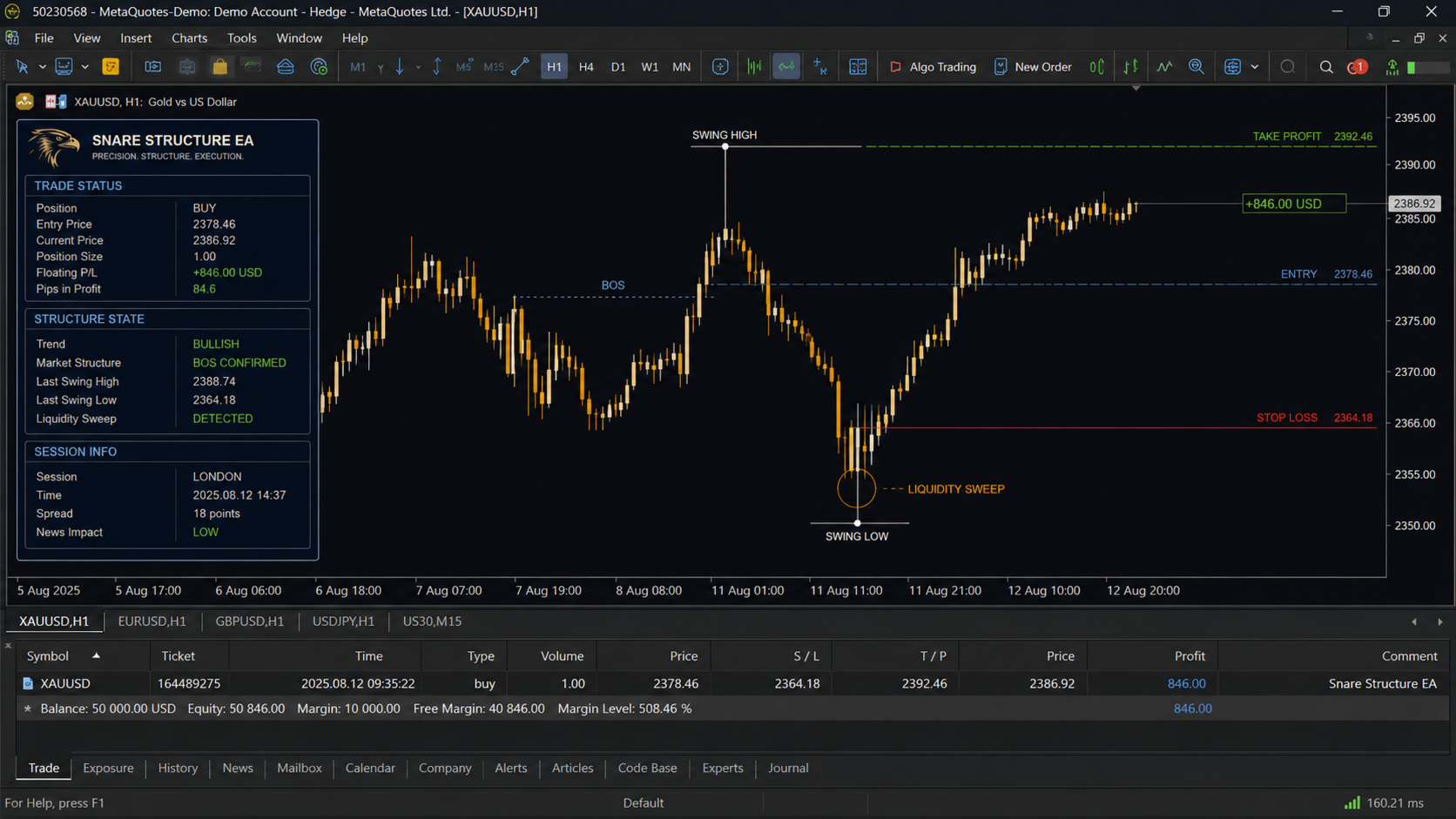
At the foundation of Snare Structure is a continuous swing-mapping engine. The EA tracks swing highs, swing lows, higher highs, higher lows, lower highs and lower lows as they form, building a live structural map of the instrument. When price takes out a meaningful swing level, that is treated as a potential shift in structure — not an automatic trade signal, but a trigger for deeper evaluation.
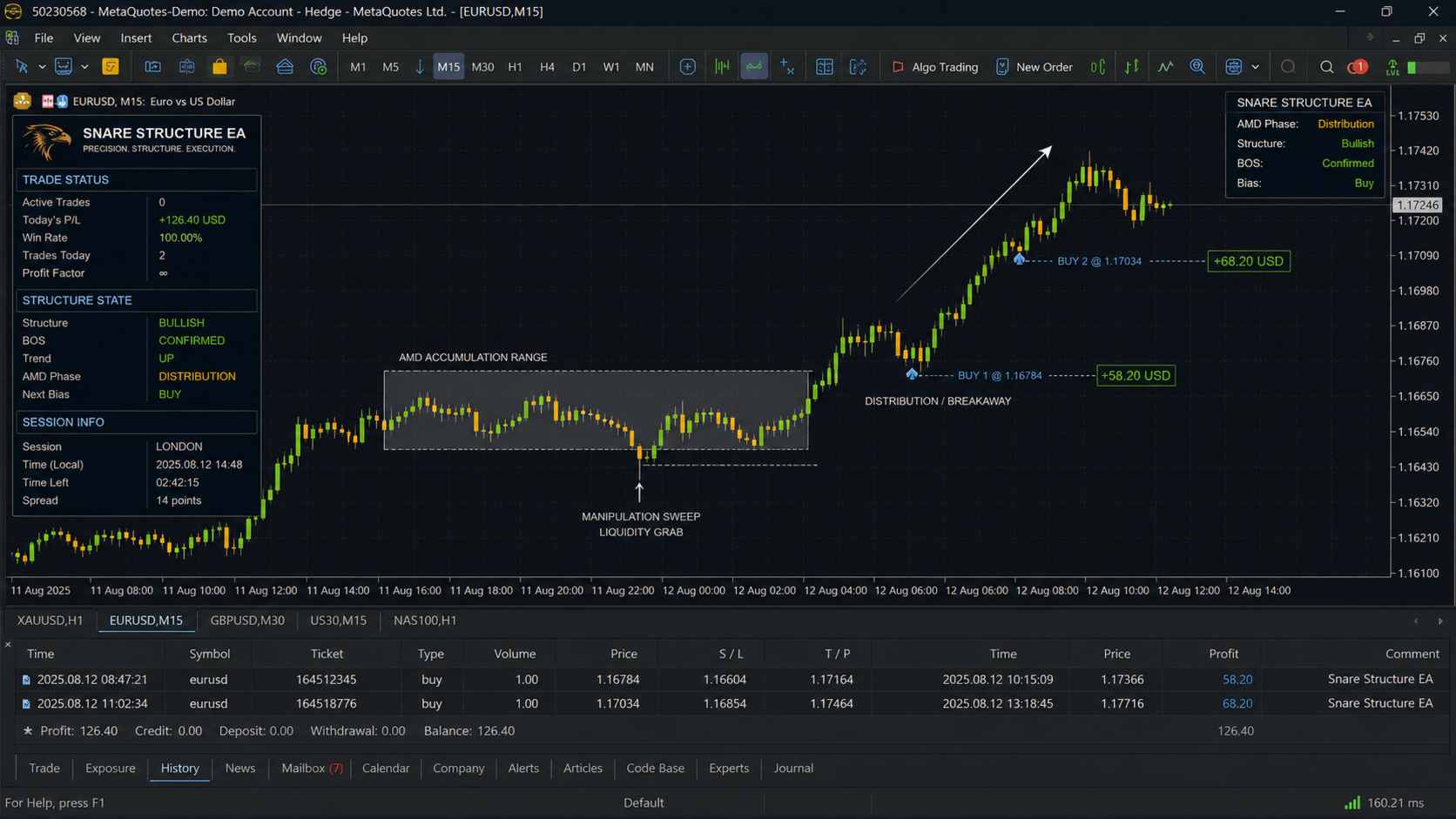
That evaluation runs through the AMD model. The EA looks for accumulation phases where price compresses and liquidity builds around a range. It then watches for manipulation — sweeps or false breaks beyond prior highs or lows designed to trap participants on the wrong side. Only after a sweep is identified does the EA consider the possibility of distribution: a genuine directional move away from the manipulated zone. This sequencing means a raw structure break during a random manipulation phase will not qualify as a trade on its own — the EA is specifically built to avoid being the retail participant that gets swept.
Entry Logic
A trade candidate only forms when several conditions line up together: a relevant swing structure must be identified, price must interact with that structural level, the break must be confirmed as valid rather than a wick-through, the surrounding price action must be consistent with AMD phasing, and directional bias must agree across the filters in play. Spread conditions, trading-session windows, and risk limits are all checked before a position is opened. Because entries require this confluence rather than a single trigger, Snare Structure is built to reduce the noise trades that come from trading every minor swing in isolation.
Multi-Timeframe Context
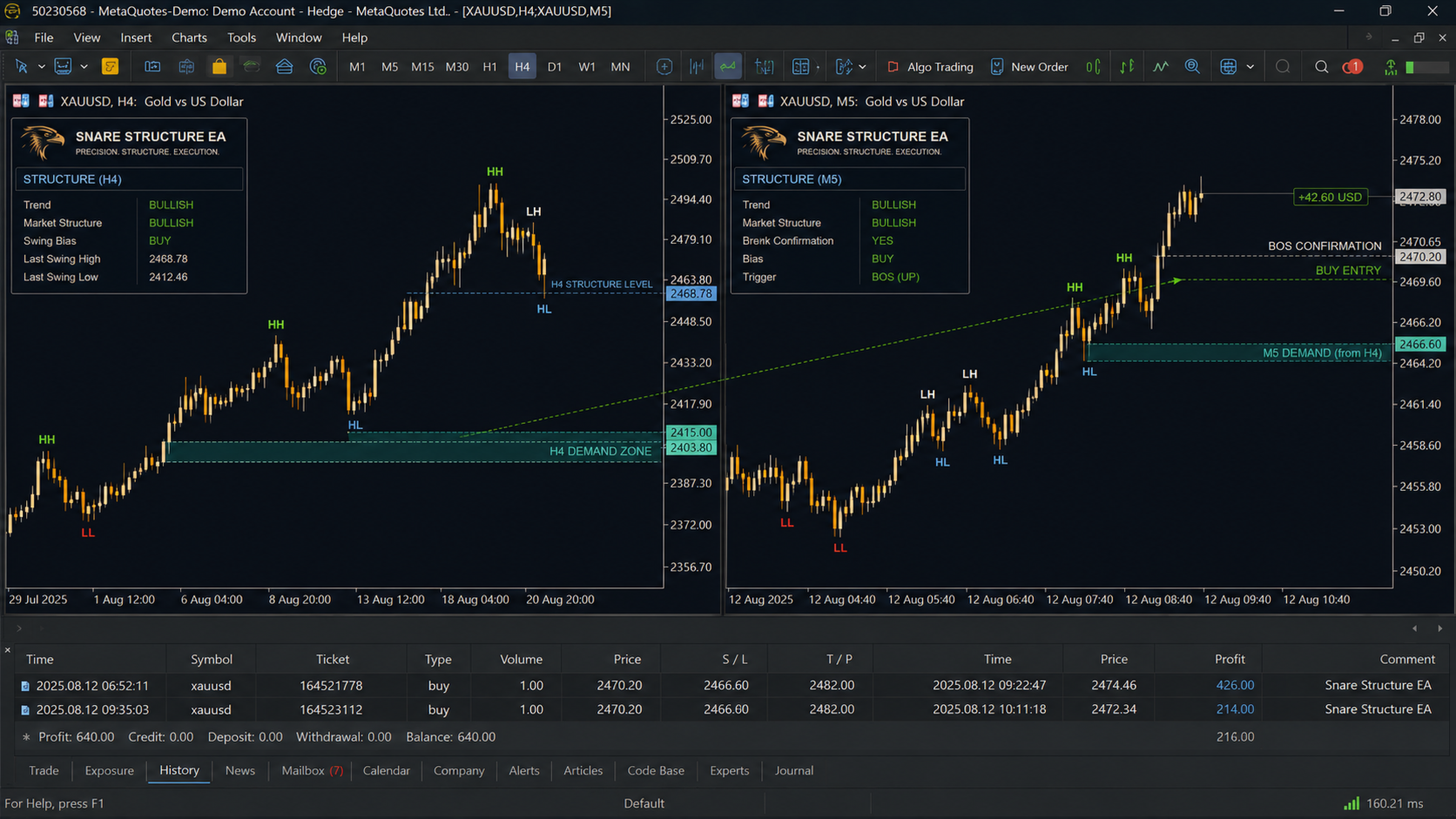
Snare Structure can reference a higher timeframe for broad directional bias and market context, while executing its structural break and entry logic on a lower timeframe. This separation lets the EA distinguish a meaningful structural shift from a minor intraday fluctuation, keeping trades aligned with the larger trend while still timing entries with precision on the execution timeframe.
Risk and Trade Management
Every position opened by Snare Structure is governed by a configurable risk framework. Users can choose fixed lot sizing or percentage-based risk sizing, set stop-loss and take-profit levels, define risk-to-reward requirements, and cap the number of simultaneous positions and daily trades. A maximum daily loss limit is available to stop trading once a defined threshold is hit, and spread filtering prevents entries during abnormal broker conditions.
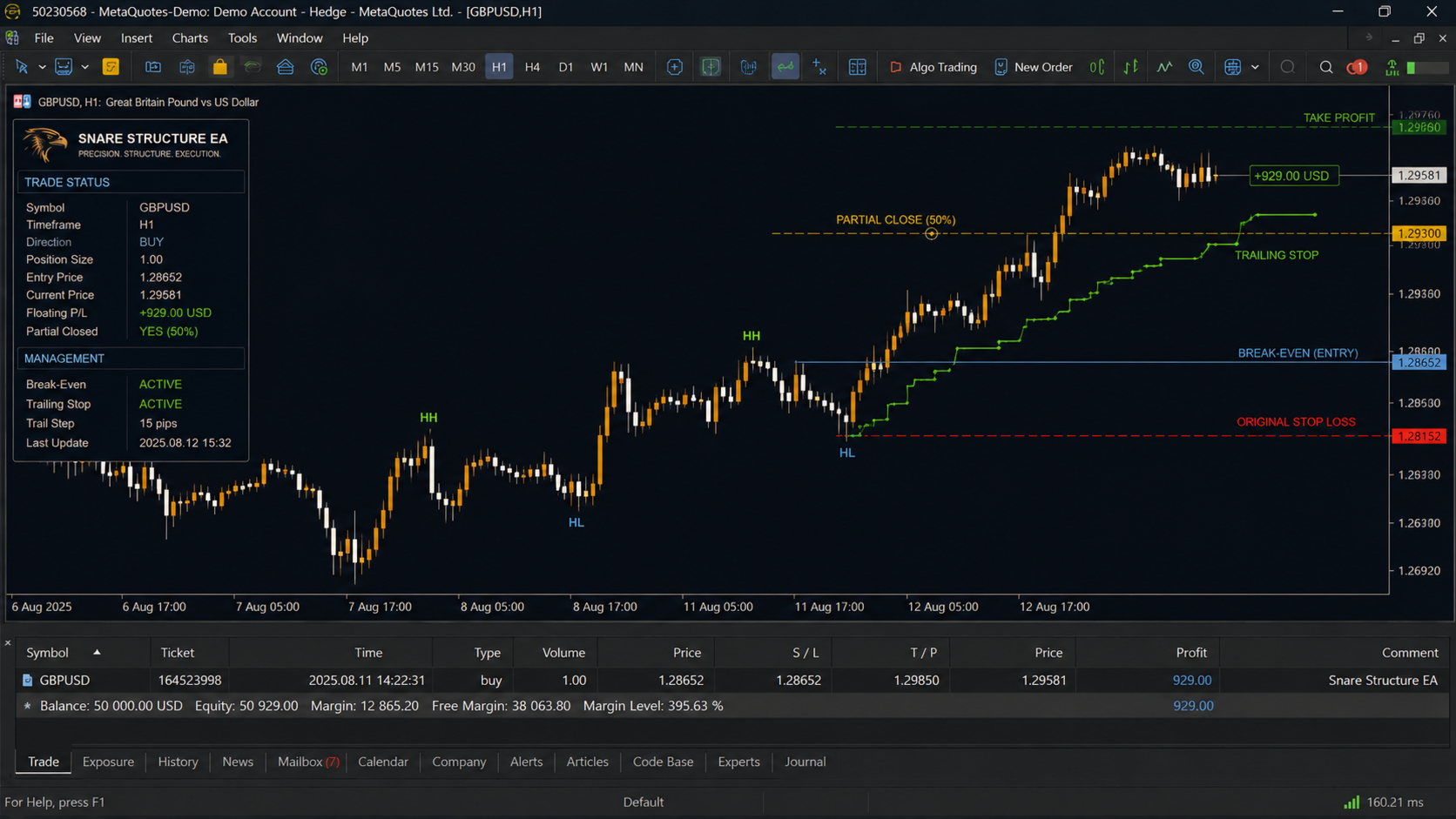
Once in a trade, Snare Structure can manage the position automatically: break-even activation once a defined profit threshold is reached, a trailing stop to lock in gains as the move develops, and partial position closure to bank profit while letting a portion of the position run. The EA can also monitor whether the structural setup that justified the trade remains valid, and exit if that structure breaks down.
Session and Market Filters
Snare Structure includes configurable session and day filters, allowing trading to be restricted to specific hours or sessions where the strategy is intended to perform. Maximum spread limits and minimum market movement thresholds add an additional layer of protection against trading during illiquid or erratic conditions.
Configuration
Nearly every part of the strategy is exposed as an input, including swing detection sensitivity, break confirmation method, AMD detection parameters, entry confirmation filters, stop-loss and take-profit methods, risk percentage or fixed lot size, risk-to-reward ratio, maximum trades, maximum spread, trading sessions, timeframes, break-even and trailing-stop settings, magic number, and slippage tolerance. This lets traders adapt Snare Structure to different instruments, volatility profiles, and personal risk tolerance rather than forcing a one-size-fits-all approach.
Built for MetaTrader 5
Snare Structure is developed natively in MQL5 for MetaTrader 5 and is suitable for backtesting and optimization against historical data before any live or demo deployment.
Risk Disclaimer
Snare Structure is a rules-based automated trading system and does not guarantee profit. Swing structure and AMD-style behavior can produce false signals, particularly during volatile, ranging, low-liquidity, or news-driven conditions. Thorough backtesting and forward testing on a demo account are strongly recommended before committing real capital, and past backtest performance does not guarantee future results.
Summary
Market Structure → Swing Identification → Liquidity and AMD Context → Break Confirmation → Entry → Risk Management → Automated Trade Management. Snare Structure turns a structural, liquidity-aware trading methodology into a systematic, repeatable, fully automated MT5 framework.