The entry is not the edge: three win rates, and the one that loses

Most people who start in trading look for the entry: the indicator, the pattern, the exact moment to buy. It is the part that gets sold the hardest. It is also the part that decides the least, and the arithmetic to see why fits on one line.
What an entry gives you
An entry rule decides when you try. Over many trades, that shows up as one number: how often the trade ends in profit, the win rate. It does not decide how much a winner makes or how much a loser costs. Those come from where the stop sits, where the exit sits, and how big the position is.
What a trade is worth on average needs all three:
worth per trade = share of wins x average win - share of losses x average loss
Three entries, side by side
An illustration, not three accounts. Each number is in units of money, the same unit for all three.
Entry A wins 80 trades in 100. Its average win is 1 unit and its average loss is 5. Per 100 trades: 80 x 1 - 20 x 5 = -20. It loses 0.20 a trade.
Entry B wins 55 in 100, with wins and losses both 1 unit. Per 100 trades: 55 - 45 = +10, or 0.10 a trade.
Entry C wins only 35 in 100, but its average win is 3 units against a loss of 1. Per 100 trades: 35 x 3 - 65 x 1 = +40, or 0.40 a trade.
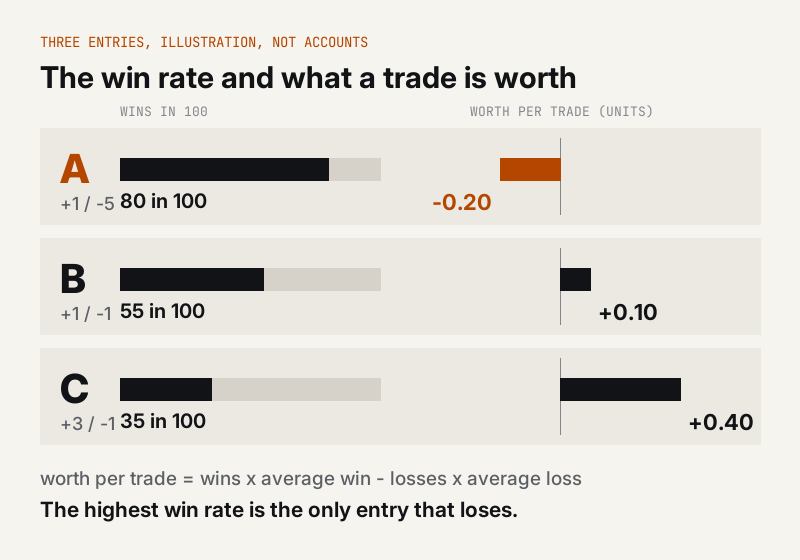
The entry anyone would buy on the win rate alone is A. It is the only one of the three that loses money. A needs to win 5 trades in 6 just to break even, C needs only 1 in 4. The win rate tells you how often. It cannot tell you how much.
Where the edge is built
Our third primer made this argument from the other side: the layers that decide a result sit after the entry. Position sizing decides how much each idea risks. Exits decide how long a winner runs and how quickly a loss is cut, which is exactly the average win and average loss above. Spreading across markets that do not move together smooths the ride without a better entry. And the discipline to take every signal matters, because the few large winners that carry a rule like C cannot be picked in advance.
The entry rule is the most fragile of these. It wears out first when markets change, and it is the easiest to make look good on a short history.
How to check any signal page in a minute
Every signal page on MQL5 carries the rows you need, under Statistics: Profit Trades and Loss Trades for the two shares, Average Profit and Average Loss for the two sizes, and Expected Payoff, which is the line above already worked out. Read them together. A high Profit Trades share next to an Average Loss several times the Average Profit is entry A, however good the curve looks so far.
Then ask the seller one question the page cannot answer: what decides the size of the average loss? If the answer is a stop placed with every trade, the number has a ceiling. If the answer is "the strategy rarely loses", the average loss has no ceiling yet, only a history.
The win rate is the most visible number on any page. Treat it as the start of the reading, not the result.
Our signals and products, with the losing rows left in: https://www.mql5.com/en/users/aller.techno