From Manual Signal Distribution to Automatic — COPYLATOR – MT5 Trade Copier

Product link:
https://www.mql5.com/en/ market/product/191385
Most signal providers do not start with a trade copier. They start with a spreadsheet, a phone, and a routine.
The routine is straightforward: open a trade on your own account, then open the same trade on each client account. Calculate the volume manually. Write down the details. Send a message explaining what you did so clients can verify it. Then repeat the process for the next client and the next trade.
This may work with a small number of clients. As the client base grows, however, the process becomes increasingly time-consuming and difficult to manage. Manual errors accumulate, and the provider spends more time distributing trades than managing the strategy.
This is a practical guide to replacing manual signal distribution with automatic copying, and to understanding what actually changes when you make the transition.
The Manual Method, Described Honestly
Before evaluating the switch, it is useful to understand what the manual process involves.
The provider first opens a trade on their own account. Then they open the same trade on each client account, one at a time. For every account, they calculate the appropriate lot size based on the client's balance, check the symbol name, place the order, and record the relevant details.
When the provider modifies the trade, the same sequence must be repeated. Stop-loss adjustments, take-profit changes, partial closes, and final exits all require additional manual operations.
The workload grows with the number of accounts and the number of actions performed on each trade.
For example, a provider with fifteen clients who performs three separate operations per client may need to carry out forty-five manual operations for a single trading cycle. This creates many opportunities for delays, inconsistencies, and mistakes.
The Five Failure Points of the Manual Method
Manual distribution tends to create problems in several predictable areas.
1. Lot-size calculation
The provider calculates each client's volume using the client's balance, the provider's balance, and the original trade volume. Rounding and broker volume-step requirements must also be considered. Repeating this calculation for many accounts increases the chance of an incorrect result.
2. Symbol names
Different brokers may use different names for the same instrument. The provider may trade XAUUSD while a client sees XAUUSDm or GOLD. Every symbol difference must be remembered and handled correctly.
3. Execution delay
The provider opens the trade first and then works through the client list. The last client may receive the trade later than the first, by which time the market price may have changed.
4. Missed modifications
A stop-loss may be updated on the provider's account and on most client accounts, while one or more accounts are accidentally overlooked. The problem can be especially difficult to detect when modifications happen quickly.
5. Incomplete records
The provider's spreadsheet may not match the actual account history. If a manual operation is missed or recorded incorrectly, it becomes difficult to determine which account reflects the intended trading activity.
Automation can reduce these repetitive failure points by replacing separate manual actions with a centralized copying process. It does not eliminate every possible execution or configuration problem, but it reduces dependence on the provider repeating the same task account by account.
What the Switch Actually Looks Like
The transition follows a straightforward structure.
The provider's trading account is configured as the Sender. COPYLATOR is installed on the provider's MT5 terminal, attached to a chart, and configured in Sender mode.
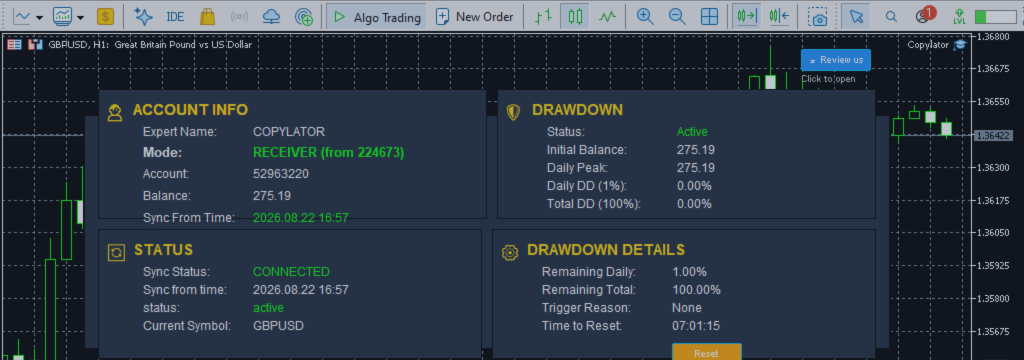
Each client account is configured as a Receiver. The client installs COPYLATOR on their own MT5 terminal, selects Receiver mode, and enters the provider's Sender account number.
The Sender publishes trading activity through the MT5 Common Folder, and the Receivers read that information and process the corresponding actions according to their individual settings.
The provider continues trading normally. The difference is that trades and supported management actions are distributed automatically instead of being manually repeated on every client account.
Lot Sizing No Longer Needs to Be Calculated Manually
One of the biggest changes in daily workload is the reduction of manual lot-size calculations.
Under the manual method, the provider calculates a separate volume for every client on every trade. The result must also comply with the client's broker volume step and minimum and maximum volume requirements.
With COPYLATOR, the Receiver can calculate copied volume using its own configured lot-sizing method. Available methods include fixed lot, multiplier, and balance-ratio sizing.
With balance-ratio sizing, the Receiver calculates volume using the relationship between its balance and the Sender's balance, subject to the configured settings and broker volume constraints.
For example, if a client's balance is 10% of the Sender's balance, the Receiver can calculate a copied volume approximately equal to 10% of the Sender's volume. A maximum lot cap can restrict the resulting volume.
The provider no longer needs to perform these calculations for every client. Each Receiver handles its own volume calculation according to its configuration.
Symbol Mapping No Longer Needs to Be Managed Account by Account
Another important improvement is the handling of different broker symbol names.
Under the manual method, the provider needs to remember which symbol corresponds to the instrument on each client's broker.
With COPYLATOR, automatic symbol mapping helps the Receiver identify the equivalent instrument on its broker. If automatic matching does not find the correct symbol, the client can configure a manual mapping on the Receiver side.
This means the provider does not need to maintain a separate symbol-name list for every client. The mapping is configured where the receiving instrument is available.
The Delay Is Reduced, but Execution Is Not Identical
Under manual distribution, the delay between the provider's trade and the last client's trade can be substantial because the provider must work through the accounts one by one.
With automatic copying, the Sender publishes the trading activity and the Receivers process it according to the copier's communication and polling behavior.
This can substantially reduce the manual distribution delay. However, it is important to distinguish between signal delivery and actual trade execution.
The total delay depends on the copier's communication cycle, terminal performance, the Receiver's processing, and the broker's execution time. Network conditions, liquidity, slippage, and market volatility can also affect the final entry price.
Therefore, automatic copying should not be understood as a guarantee that every client will receive exactly the provider's entry price or that all trades will execute within a fixed number of milliseconds.
Trade Modifications No Longer Depend on the Provider's Memory
Trade management is one of the most demanding parts of manual signal distribution.
When the provider moves a stop-loss, changes a take-profit, or partially closes a position, the corresponding action must be repeated on every client account.
COPYLATOR supports synchronization of stop-loss and take-profit changes, as well as Partial Close functionality.
These operations are distributed through the copying process, subject to the Receiver's configuration and broker execution conditions. The provider no longer needs to send a separate manual instruction for every supported modification.
Differences in entry prices, minimum stop distances, volume steps, and execution conditions can still affect the exact outcome on individual accounts.
What the Provider Gives Up
Automatic distribution has advantages, but it also changes the relationship between the provider and the client. The trade-offs should be understood clearly.
Less direct control over individual execution: Under manual distribution, the provider could decide to skip a particular client, delay a trade, or enter a different volume. With automatic copying, each Receiver processes the published activity according to its own settings.
Less manual interaction: Some clients may appreciate receiving a personal message for every trade. Automatic copying reduces the need for those routine messages, so providers may need other ways to maintain communication and explain strategy decisions.
Infrastructure monitoring: The Sender terminal must remain operational, and the communication process must function correctly. If the Sender goes offline, connected Receivers may stop receiving new trading activity until service is restored.
These responsibilities do not disappear when manual distribution is replaced. They simply become different responsibilities.
What the Client Gives Up
The client also needs to understand the change.
With manual distribution, a client could ask the provider to skip a trade, close early, or use a different volume before the provider placed the order.
With automatic copying, the Receiver processes the Sender's published activity according to the client's configured settings. The client can use available filters and risk controls, but these do not necessarily provide a way to approve or reject every individual trade manually.
The client retains control over their own account and can stop the Receiver or change its configuration. However, they should understand how their filters, lot-sizing settings, and drawdown protection affect the copying process before relying on it.
A useful division of responsibility is that the provider manages the strategy, while the client decides how to configure and supervise their own account.
Risk Limits Stay with the Client
Risk management remains an important part of the transition.
Each client can configure their own Receiver settings, including available daily and total drawdown limits, lot-sizing method, maximum lot cap, and supported trade filters.
COPYLATOR's drawdown protection can block further copying when a configured threshold is reached. Depending on the selected response, it can also close positions and delete pending orders.
The provider's own risk settings do not automatically become the client's risk settings. Each Receiver must be configured independently.
This is important because clients may have different account sizes, broker conditions, risk tolerances, and external trading restrictions.
Drawdown protection is a risk-management tool, not a guarantee against losses or broker stop-out. Slippage, gaps, execution delays, and existing positions can affect the final outcome.
The Transition Sequence
Switching every client at once may seem faster, but a gradual transition makes it easier to identify configuration problems.
- Configure the Sender. Install COPYLATOR on the provider's MT5 terminal and configure the account in Sender mode.
- Set up one Receiver. Choose one client account and configure its Receiver instance with the correct Sender account number.
- Review the settings. Check lot sizing, symbol mapping, filters, and risk controls on the Receiver.
- Run a controlled demo test. Confirm that trades, modifications, and closing actions are copied as expected before using live funds.
- Compare the results. Review volume, entry price, stop-loss, take-profit, and closing behavior. Investigate any differences.
- Expand gradually. Once the setup has been tested successfully, configure additional clients one at a time.
Running manual and automatic copying in parallel on live accounts can accidentally create duplicate positions. If a comparison is required, use demo accounts or another controlled testing arrangement that prevents duplicate execution on the same account.
The Ongoing Responsibility
Automatic distribution does not remove the provider's responsibility. It changes its nature.
The provider remains responsible for trading and managing the strategy. No copier can replace the provider's analysis or guarantee that the strategy will be profitable.
The provider must also monitor the Sender terminal and the copying infrastructure. Followers should monitor their own Receiver terminals and verify that their accounts are processing trades as expected.
Onboarding remains important. New clients need clear instructions about installation, configuration, lot sizing, symbol mapping, and risk settings.
Communication also remains part of the service. Clients may have questions about performance, drawdown, trade execution, or the strategy itself.
What automatic copying removes is the need to duplicate every trading operation manually across every client account.
Summary
Manual signal distribution can be manageable with a small number of clients, but its workload increases as the client base grows. Repeating trades, calculating lot sizes, remembering symbol differences, updating stops, and maintaining records all create additional work and opportunities for mistakes.
Automatic copying changes this process. The Sender publishes trading activity, and each Receiver processes it using its own configuration. Lot sizing and symbol mapping are handled on the client side, while supported trade modifications and closing actions are synchronized through the copier.
Risk settings remain independently configurable on each Receiver. The provider continues to manage the strategy, monitor the infrastructure, onboard clients, and maintain communication.
The transition requires careful setup and testing. Automatic copying does not guarantee identical execution or eliminate every operational risk, but it can make signal distribution more consistent and reduce the repetitive work that makes manual distribution difficult to scale.
Product link:
https://www.mql5.com/en/ market/product/191385