
Why Ninety Percent of Trading Education Is Useless
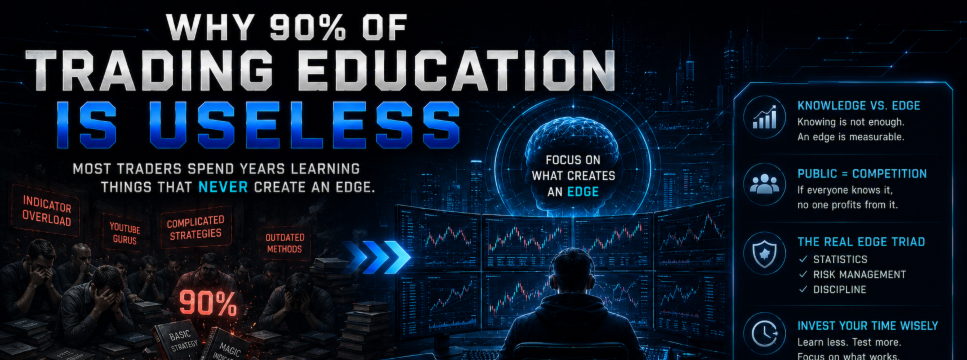
Most traders spend years learning things that never create an edge. This is not cynicism for its own sake. It is a specific, actionable diagnosis worth taking seriously, because understanding precisely why so much trading education fails to produce results is what actually lets you redirect your own learning time toward what genuinely matters.
Part One: Knowledge Is Not the Same Thing as a Demonstrable Edge
Being able to name a chart pattern, explain how an indicator is calculated, or recite market history is knowledge. It is not, by itself, an edge. A genuine edge is a specific, measurable behavior with demonstrated positive expectancy, validated with real rigor rather than simply understood conceptually. The overwhelming majority of trading education stops at transmitting the first kind of knowledge, here is what this pattern looks like, here is how this indicator is built, without ever crossing the far harder bar of demonstrating, with genuine validation, that acting on that knowledge actually produces positive expectancy in practice. Understanding what something is and having evidence that using it works are two entirely different achievements, and most curricula only ever deliver the first one.
Part Two: Why Publicly Popular Strategies Are Structurally Disadvantaged
Here is a genuinely counterintuitive point worth internalizing fully. If a strategy is popular enough to be taught widely across mass market courses, books and videos, it is, almost by definition, known simultaneously by an enormous number of market participants. A genuinely exploitable inefficiency that becomes this widely known tends to erode specifically because so many people are acting on it at once, the same crowding dynamic responsible for eroding any edge once broadly adopted. This means the most heavily marketed, most confidently branded proven strategies are, by the very fact of their popularity, frequently among the least likely to still carry genuine edge, precisely the opposite of what their marketing implies. This does not make every technical concept worthless. It does mean the specific patterns marketed hardest as secret, proven systems deserve the most skepticism, not the least, exactly because of how widely they have already spread.
Part Three: Why Statistics, Risk Management and Discipline Deserve Far More Curriculum Time Than They Get
Most trading education allocates the overwhelming majority of its time to entry technique and pattern recognition, and comparatively little to statistics, risk management and behavioral discipline, despite growing evidence that expectancy and risk management matter more for long run outcomes than marginal entry refinement. There is a structural reason for this imbalance worth understanding rather than simply lamenting. Entry technique is visually dramatic and easy to package into an exciting lesson, here is a chart, here is the pattern, here is the signal. Statistical discipline and risk management are considerably less visually compelling to teach, position sizing formulas and drawdown mathematics do not make for gripping course marketing, even though they matter substantially more to whether a trader actually survives long enough to benefit from any edge at all. Education gets built around what sells a course, not necessarily around what actually produces results, and these two things are not automatically the same.
Part Four: How to Actually Invest Learning Time More Effectively
- Prioritize expectancy mathematics and position sizing before additional entry variations. Understanding precisely how win rate, average win and average loss combine to determine genuine profitability matters more than learning yet another entry pattern.
- Prioritize learning to validate any strategy rigorously over learning more strategies. The discipline of genuine out of sample testing is a transferable skill applicable to everything you ever learn afterward, unlike any single specific pattern, which may already be eroded by the time you learn it.
- Prioritize behavioral discipline literature over additional technical content. Execution failure, deviating from your own rules under emotional pressure, destroys more accounts than any specific technique flaw, making this comparatively neglected area disproportionately valuable to study.
- Treat heavy marketing and popularity as a reason for scrutiny, not credibility. Given the crowding dynamic covered above, the strategies marketed hardest as proven secrets deserve closer, more skeptical examination precisely because of how widely they have spread, not automatic trust.
- Study genuine professional risk frameworks directly. Position sizing formulas, drawdown mathematics and portfolio construction principles are considerably more durable knowledge than any specific entry pattern, since they remain valid regardless of which specific strategy you eventually choose to apply them to.
Part Five: Applying This Framework to Everything You Evaluate Afterward
The genuinely useful outcome of this reframe extends beyond your own learning time. The same diagnostic applies directly to evaluating any trading education, product or automated system you encounter afterward. Does it lean on the crowded, heavily marketed technique category this article warns against, or does it genuinely prioritize validated expectancy, rigorous risk enforcement and honest statistical discipline over flashy, popular sounding claims. This exact standard, prioritizing hard risk discipline and honestly validated behavior over marketed technique, is precisely the philosophy the ICONIC.FX lineup, including ICONIC BTC AI+, ICONIC GOLD AI+ and the flagship ICONIC KYBERNETIC AI+, was built around from the start, hard, code level risk enforcement treated as law rather than a marketed feature, and continuous validation against live evidence rather than a single impressive sounding historical claim.
Frequently Asked Questions
Why doesn't knowing a lot about trading automatically produce results? Knowledge describes what a pattern or indicator is. A genuine edge requires demonstrated, validated evidence that acting on that knowledge produces positive expectancy, a considerably harder bar most trading education never actually crosses.
Why should widely popular trading strategies be viewed with more skepticism, not less? A strategy taught widely across mass market courses is known simultaneously by a large number of participants, and genuinely exploitable patterns tend to erode as more people act on them, meaning heavy popularity can be a warning sign about remaining edge rather than proof of one.
Why do most courses focus so heavily on entry technique instead of risk management? Entry technique is visually dramatic and easy to package into engaging lessons, while statistical discipline and position sizing are less compelling to market, even though they matter more to long run survival and results.
What is the single most effective way to reallocate trading education time? Prioritizing expectancy mathematics, rigorous validation discipline and behavioral execution consistency over accumulating additional entry patterns or technical variations.
Redirect Your Time Toward What Actually Compounds
Most trading education optimizes for what is exciting to teach, not what actually produces results, and the two are not automatically the same thing. Redirecting your own learning time toward expectancy, validation discipline and behavioral consistency, and applying the same skepticism toward popularity that this article argues for, is worth more than years spent accumulating additional patterns that were likely eroded by crowding long before you ever learned them.
Explore systems built around exactly this reprioritized philosophy, validated discipline over marketed technique, at iconicfx.tech.
Risk Disclaimer. Trading foreign exchange, cryptocurrencies, commodities and other leveraged financial instruments carries a high level of risk and may not be suitable for all investors. The high degree of leverage can work against you as well as for you. Past performance is not indicative of future results. Automated trading systems, indicators and Expert Advisors do not guarantee profits and can produce losses. ICONIC.FX provides software tools only and does not provide investment advice, portfolio management or financial recommendations. You are solely responsible for your own trading decisions. Seek advice from an independent licensed financial advisor if you have any doubts.