

One of the simplest numbers in MetaTrader 5 can also be one of the easiest to misinterpret: account balance.
Imagine a trading account that started with $5,000 and now shows a balance of $8,000.
Did the trader make $3,000?
Not necessarily.
Perhaps $2,000 was deposited during the period. Perhaps $500 was withdrawn. Perhaps there are open positions currently showing a floating loss. Perhaps part of the account growth came from trading and another part simply came from additional capital.
The balance is correct.
The interpretation may not be.
This distinction becomes increasingly important when an account is actively managed over time.
Capital and Performance Are Different Things
A trading account is an economic system affected by several independent components:
Deposits bring external capital into the account.
Withdrawals remove capital from the account.
Realized trading results represent profits and losses generated by closed trading activity.
Floating P/L represents the current economic effect of positions that remain open.
All of them affect the financial state of the account, but they do not mean the same thing.
A deposit increases the balance, but it is not trading profit.
A withdrawal decreases the balance, but it is not a trading loss.
An open loss reduces equity, even though it has not yet changed the balance.
This leads to an important principle:
Account growth and trading performance are not automatically the same thing.
A Simple Example
Consider an account with the following activity:
Initial capital: $5,000
Additional deposit: +$2,000
Realized trading profit: +$600
Withdrawal: -$300
Current floating P/L: -$100
The account may now contain substantially more money than it did initially.
But saying that the trader's performance equals the difference between the initial balance and the current balance would be misleading.
The economic picture contains several different components:
Capital contributed: $7,000
Capital withdrawn: $300
Realized trading result: +$600
Current floating exposure: -$100
Each number answers a different question.
That separation is what makes account analysis useful.
Balance vs Equity
Another distinction matters just as much.
Balance reflects the account after closed operations and account transactions.
Equity incorporates the current effect of open positions.
A trader can therefore have an apparently healthy balance while carrying a significant floating loss.
Conversely, profitable open positions can make current equity higher than balance.
For anyone evaluating the real state of a trading account, looking at only one of these values provides an incomplete picture.
The Problem Becomes Larger Over Time
For a new account with one initial deposit and no withdrawals, performance measurement can be relatively straightforward.
But real trading accounts evolve.
Capital may be added progressively.
Profits may be withdrawn periodically.
Several Expert Advisors may trade simultaneously.
Positions may remain open across sessions or month boundaries.
The trader may want to know not only whether the account is profitable, but also:
How much capital has actually been contributed?
How much has been withdrawn?
How much of the account change comes from trading?
What is happening during the current session?
What has happened during the current month?
How much open exposure exists right now?
How efficiently is trading volume converting into net result?
At that point, a simple balance figure is no longer enough.
Three Useful Accounting Levels
One practical way to organize account analysis is to separate it into three time horizons.
Session
The session view answers a short-term question:
What has happened since the current trading session began?
This can include realized results, current floating exposure, deposits or withdrawals occurring during the session and the resulting change in equity.
Month
The monthly view answers a broader question:
What has happened economically during the current month?
This becomes particularly useful for traders who make periodic contributions or withdrawals.
Without separating those capital movements, monthly account growth can easily be confused with monthly trading performance.
Account
The account-level view answers the longest-term question:
How has the complete economic structure of the account evolved?
Initial capital, subsequent contributions, withdrawals, accumulated trading results and current equity can then be examined as separate components of the same system.
Performance Is More Than Profit
Once capital movements are separated from trading results, another question becomes possible:
How efficiently was that result produced?
Final profit alone does not describe everything.
Two trading systems might generate the same net result while using very different trading volume, margin or gross profitability.
Useful complementary measurements can therefore include:
Net Profit per Lot — how much net trading result was produced relative to traded volume.
Equity-to-Margin Ratio — the relationship between current equity and margin currently being used.
Net-to-Gross Return Ratio — how much of gross positive trading performance remains after losses.
These measurements do not replace profit.
They provide context around it.
Why I Built TAM
This accounting problem was the reason I developed TAM Trading Account Manager.
I wanted a MetaTrader 5 utility that did not simply display another collection of trade statistics.
The objective was different:
Reconstruct the economic state of the trading account.
TAM separates capital movements from trading performance and organizes the information across account, month and session levels.
It monitors initial references, current equity, contributions, withdrawals, realized trading activity and floating exposure.
It also provides capital-efficiency measurements and a configurable profit-distribution view for traders who periodically separate distributable performance from capital retained in the account.
TAM does not generate signals.
It does not open trades.
It does not modify positions.
It does not attempt to tell the trader what to buy or sell.
Its purpose is simply to answer a different question:
What actually changed my trading account?
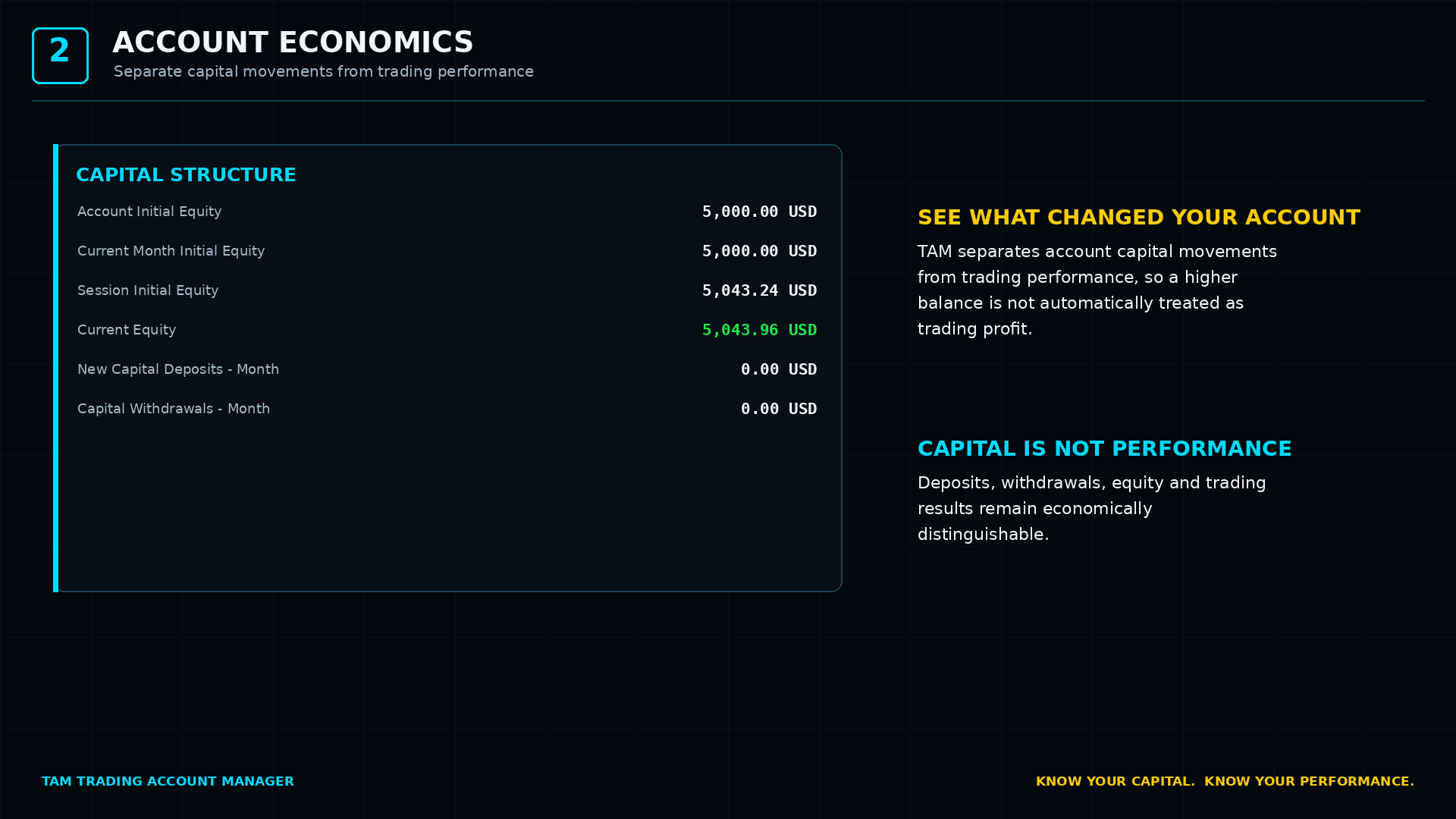
TAM Trading Account Manager is available for MetaTrader 5 in the MQL5 Market.
Better Information, Better Interpretation
MetaTrader 5 already provides the fundamental account data.
The challenge is interpreting that data economically when deposits, withdrawals, trading activity and open exposure coexist.
A balance tells you how much money is currently recorded in the account.
It does not necessarily tell you how that money got there.
Separating capital from performance provides a clearer framework for evaluating a trading account over time.
And sometimes the most useful improvement in trading is not another signal or another indicator.
It is simply understanding the numbers you already have.
Know your capital. Know your performance.