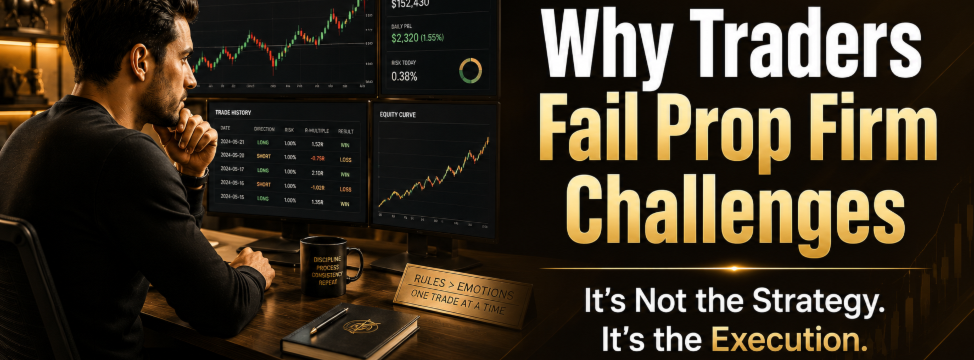
Why Most Traders Never Pass a Prop Firm Challenge (And Why the Problem Usually Isn't Their Strategy)

He understood market structure. He knew how to identify liquidity. He could explain support and resistance better than many traders on social media. His charts looked clean, and his analysis was often correct.
Yet somehow, he kept failing.
At first, he blamed the prop firms.
Then he blamed market conditions.
Then he blamed his strategy.
When we reviewed his trading history, the real problem became obvious.
The strategy wasn't failing.
He was.
That may sound harsh, but it's a pattern I've seen repeatedly over the years.
Many traders spend countless hours searching for the perfect entry model while completely ignoring the one thing that determines whether a strategy survives long enough to produce results: execution.
The Reality Nobody Likes Talking About
The trading industry has created an illusion.
Open YouTube, Instagram, TikTok, or almost any trading community, and you'll find endless discussions about "high-probability setups," "institutional concepts," and "secret strategies."
What you rarely see is a discussion about consistency.
Yet consistency is exactly what prop firms are looking for.
Think about it from their perspective.
If you were allocating a six-figure account to a trader, would you choose someone who can predict market direction occasionally, or someone who can follow a defined process every single day?
The answer is obvious.
Prop firms are not paying traders for being right.
They're paying traders for managing risk.
The Hidden Challenge Behind Every Challenge
Most traders think the evaluation process is a test of market knowledge.
In reality, it is often a test of discipline.
The rules appear simple.
Stay within the maximum drawdown.
Respect daily loss limits.
Reach the profit target.
Manage risk.
Sounds easy.
Then real money emotions begin to appear.
A trader takes a loss.
The next position becomes slightly larger.
Another loss follows.
Instead of waiting for the next valid setup, they begin looking for opportunities everywhere.
A market that looked clear in the morning suddenly becomes confusing in the afternoon.
The account starts moving in the wrong direction.
The challenge fails.
Not because the strategy stopped working.
Because emotions took control of execution.
Why Good Strategies Produce Bad Results
One of the biggest misconceptions in trading is that profitability comes entirely from strategy quality.
Of course, strategy matters.
A bad strategy will eventually fail.
But even a good strategy can produce terrible results when applied inconsistently.
Imagine two traders using exactly the same system.
The first trader follows every rule exactly as tested.
The second trader moves stop losses, skips valid trades, exits winners early, and increases risk after losses.
After 100 trades, the results will look completely different.
The strategy didn't change.
The trader did.
This is one reason why many experienced traders eventually become interested in systematic trading.
Not because they believe automation is magic.
But because they understand how difficult consistency can be when human emotions are involved.
The Shift Toward Rule-Based Trading
Over the past few years, algorithmic trading has become increasingly popular among both retail and professional traders.
The reason is not complicated.
Markets are emotional.
Algorithms are not.
An algorithm doesn't care about yesterday's loss.
It doesn't get excited after a winning streak.
It doesn't decide to double risk because a trade "looks good."
It simply follows instructions.
This doesn't guarantee profitability.
No system can do that.
But it does create something extremely valuable: consistency.
And consistency is often the missing ingredient for traders attempting to pass prop firm evaluations.
What I Learned Building Trading Systems
As someone who has spent years developing and testing Expert Advisors, one lesson became clear very early.
The hardest part of trading is rarely finding an entry.
The hardest part is following the same process over and over again without interference.
When developing automated systems, every rule must be defined.
There is no room for guessing.
No room for intuition.
No room for changing your mind halfway through a trade.
Either the conditions are met, or they are not.
That process forces you to think differently about trading.
Instead of asking:
"What do I feel about this trade?"
You begin asking:
"What does the data say?"
That shift alone can completely change how a trader approaches the market.
The Future of Trading in 2026
Trading is becoming increasingly data-driven.
Technology is improving.
Backtesting tools are becoming more advanced.
Execution is becoming faster.
At the same time, competition continues to increase.
In this environment, traders who rely entirely on emotions often find themselves at a disadvantage.
The traders who succeed tend to build systems.
Some of those systems are executed manually.
Others are semi-automated.
Others run through Expert Advisors.
But all of them share one characteristic.
They rely on rules instead of reactions.
Final Thoughts
If you've failed a prop firm challenge before, take a moment to review what actually happened.
Was the strategy truly the problem?
Or did execution slowly drift away from the original plan?
In many cases, the answer is uncomfortable.
The market wasn't the biggest obstacle.
We were.
The traders who eventually become consistent are usually not the ones constantly searching for new indicators or new strategies.
They're the ones who build processes they can trust.
They're the ones who focus on risk management.
They're the ones who understand that long-term success comes from repeating the same high-quality decisions again and again.
Whether that process is executed manually or through a carefully designed Expert Advisor, the principle remains exactly the same:
Consistency will always outperform emotion in the long run.
About Me
I specialize in developing rule-based Expert Advisors for MetaTrader 5, with a particular focus on breakout systems, structured risk management, and algorithmic execution. My work revolves around transforming trading concepts into measurable, testable systems that remove emotional decision-making and prioritize consistency above everything else.