
Why Your Biggest Enemy Is Not the Market - It Is Your Nervous System
I used to think the market was my enemy.
That was the easy story to believe. The market was too volatile. The spread was too wide. The news was too aggressive. Bitcoin moved too fast. Gold spiked too violently. Liquidity was dirty. The chart was manipulated. The setup was right, but the timing was wrong. The stop was hunted. The move happened without me. The reversal came too soon.
There was always a reason.
And sometimes, to be fair, those reasons were real. Markets are not clean. They are not polite. They do not move in straight lines just because your analysis is correct. BTC can move like it has no memory. Gold can respect structure beautifully for hours, then erase it in seconds around a macro event. Volatility expands when you least want it to. Liquidity disappears exactly when you need precision. News can turn a perfect technical setup into a battlefield.
But after enough trades, enough mistakes, enough sessions where I knew better and still acted worse, I had to admit something uncomfortable.
The market was not always the problem.
Sometimes the problem was what happened inside me after the market started moving.
The real enemy was not the candle. It was not the wick. It was not the spread, the broker, the news event, or the missed entry.
It was my nervous system.
It was the physical reaction that came before the logical decision. The pressure in the chest when a trade moved against me. The urgency when price started running without me. The impatience after sitting through slow price action for too long. The heat after a loss. The overconfidence after a win. The need to recover. The need to prove that my read was right.
That was the hidden layer of trading I underestimated for too long.
I was not only trading the market.
I was trading my own biology.
The Chart Does Not Just Show Price. It Shows You.
Every trader eventually meets this version of himself.
Not the calm version. Not the disciplined version who writes a trading plan on Sunday evening. Not the rational version who understands risk management perfectly when no position is open.
I mean the live version.
The version that appears when a trade is active, when the stop loss is getting close, when profit starts pulling back, when the market moves without you, when the last two trades were losses and the next setup appears.
That version of you is different.
He is faster. More emotional. More defensive. Less patient. More willing to negotiate. He sees meaning in every candle. He turns normal volatility into personal information. He starts treating market movement as if it is speaking directly to him.
This is where trading becomes dangerous.
Because the same setup can look completely different depending on your internal state. If you are calm, you may see a normal pullback. If you are afraid, you may see danger. If you just lost, you may see a chance to recover. If you missed a big move, you may see urgency. If you are up for the day, you may see an opportunity to push harder than planned.
The chart did not change.
You did.
That is why trading psychology is not a soft topic. It is not motivation. It is not a nice bonus for people who already have a strategy. It is part of execution quality. Your nervous system influences what you see, what you ignore, what you justify, and what you do next.
A trader can have good analysis and still make bad decisions because his body is in a state of threat.
That sounds dramatic until you have lived it.
Until you watch yourself move a stop you promised not to move.
Until you close a trade early, not because the setup invalidated, but because the discomfort became too loud.
Until you enter late because watching the move leave without you feels worse than following the rules.
Until you take the next trade too big because the previous loss still sits inside your chest.
That is not strategy.
That is biology wearing a trading mask.
Your Nervous System Was Not Built For Leveraged Markets
The human body was not designed to sit in front of a screen and make perfectly rational decisions while money fluctuates in real time.
Your nervous system was built to detect danger and respond quickly. It was built to survive threat, not to manage leveraged exposure with statistical patience. It wants safety. It wants relief. It wants control. When uncertainty rises, it does not calmly ask whether the trade still fits the plan. It asks how to reduce discomfort immediately.
That is why so many trading mistakes feel logical in the moment.
Moving a stop feels like avoiding pain.
Closing early feels like protecting profit.
Re-entering after a loss feels like restoring control.
Increasing size feels like accelerating recovery.
Chasing a breakout feels like avoiding regret.
None of these decisions feel irrational while they are happening. They feel necessary. They feel urgent. They feel justified.
But most of the time, they are not decisions made from strategy. They are decisions made from a nervous system trying to escape discomfort.
This was one of the hardest lessons for me to accept. I was not always breaking rules because I lacked knowledge. I was breaking rules because I wanted emotional relief.
I wanted the discomfort to stop.
The market would push against a position, and I would feel the need to do something. Not because the system demanded action, but because stillness felt unbearable. I would tell myself I was managing the trade actively. In reality, I was managing my emotional state through the trade.
That is a dangerous place to trade from.
Because once the purpose of action becomes emotional relief, the strategy is already compromised.
Revenge Trading Is Not Anger. It Is A Search For Relief.
Most people talk about revenge trading as if it is pure anger. Sometimes it is. But often, revenge trading is more subtle than that.
It is not always shouting at the screen or slamming the mouse. Sometimes it is quiet. Controlled. Almost professional.
You take a loss. You sit back. You tell yourself it is fine. Then another setup appears. Maybe it is not perfect, but it is close enough. You feel the need to get back in rhythm. You want to neutralize the emotional weight of the previous trade. You want to make the day feel normal again.
So you enter.
Not because the setup truly meets the standard.
Because the loss is still inside you.
That is revenge trading.
It is the attempt to repair an emotional state through market action.
The problem is that the market does not care what you need emotionally. It does not care that you want to recover. It does not care that you were right earlier but got stopped out. It does not care that you are close to breakeven for the day. It does not care that you want to finish the session green.
The market only responds to orders, liquidity, volatility, and structure.
Your need for relief is not an edge.
This is where many traders do the most damage. Not from one normal losing trade, but from the sequence that follows. The first loss is planned. The second trade is emotional. The third trade is desperate. By the fourth, the trader is no longer executing anything. He is trying to escape himself.
I have learned to respect this pattern because it is not a moral weakness. It is a structural risk.
And structural risks need structural solutions.
You do not beat revenge trading with motivational quotes. You beat it with limits. With cooldowns. With predefined rules. With systems that remove the option to negotiate when your nervous system is activated.
This is one of the strongest arguments for a professional Expert Advisor.
A well-built EA does not revenge trade because it has nothing to repair emotionally. It does not feel the previous loss. It does not enter the next setup to feel better. It follows the framework or it does nothing.
That silence after a loss can be worth more than the next trade.
Fear And FOMO Are Two Sides Of The Same System
Most traders think fear and greed are opposites. In practice, they often come from the same place: the body’s reaction to uncertainty.
Fear says, “Get out before it gets worse.”
FOMO says, “Get in before it leaves without you.”
Different direction. Same urgency.
Both are attempts to reduce uncertainty quickly.
Fear cannot tolerate open risk. FOMO cannot tolerate missed opportunity. Both push the trader toward action before the system has a reason to act. Both make the present moment feel more important than the larger process.
This is why BTC is such a dangerous psychological market for many traders. Bitcoin moves with speed. It creates urgency. A candle can expand quickly, and suddenly the trader feels late before he has even made a decision. That urgency can override the plan. The trader stops asking whether the setup is valid and starts asking whether he is about to miss something.
Gold has a different psychological trap. It can appear technical and controlled, then suddenly react violently to macro conditions, USD movement, or economic releases. A trader can be calm for hours, then one news-driven expansion can activate panic, hesitation, or impulsive re-entry.
Both markets expose the same weakness in different ways.
BTC attacks impatience.
Gold attacks emotional control around volatility and news.
This is why market-specific logic matters. A system trading BTC needs to respect volatility, sentiment-driven movement, and fast structural breaks. A system trading Gold needs to respect macro sensitivity, liquidity windows, news risk, and volatility spikes. Treating both markets the same is not discipline. It is laziness disguised as simplicity.
The trader’s nervous system reacts differently in each environment.
The system should be built to account for that.
The Lie Of Manual Control
Manual trading gives the illusion of control.
You can enter whenever you want. Exit whenever you want. Adjust the stop. Move the target. Add to the position. Reduce the position. Skip the next trade. Take one more. Override the rules. Adapt in real time.
That flexibility can be valuable in the hands of a truly disciplined professional. But for most traders, especially during emotional stress, flexibility becomes a weapon pointed inward.
Because the ability to change anything also means the ability to sabotage everything.
When you are calm, flexibility feels like freedom.
When you are activated, flexibility becomes danger.
The market pushes against you, and suddenly every rule has an exception. The plan is still there, but it becomes softer. More negotiable. You tell yourself you are reading the market. But often, you are reading your discomfort and calling it analysis.
This is where automated execution changes the game.
Not because it removes the trader’s intelligence, but because it removes the trader’s ability to emotionally rewrite the process midstream.
A serious Expert Advisor does not care how convincing your impulse feels. It does not care if you want one more trade. It does not care if you feel the move is obvious. It does not care if you are frustrated after a loss or excited after a win.
It follows the rules.
And that can feel restrictive until you realize that restriction is exactly what protects the process.
Discipline is not always about having more control.
Sometimes discipline is about removing the wrong controls from yourself.
Risk Management Is Emotional Protection
Most traders think risk management is about numbers.
It is. But it is also about psychology.
A properly defined risk model protects the account, but it also protects the trader from emotional overload. If the risk is too large, the nervous system becomes too loud. The trader cannot think clearly because the position size has turned normal market movement into a threat.
This is why overleveraging is not only a financial mistake. It is a psychological mistake.
Too much risk makes discipline harder. It makes every tick feel significant. It makes every pullback feel dangerous. It makes the trader more likely to interfere, because the emotional cost of letting the system work becomes too high.
Good risk management creates room to think.
It allows the trader to experience uncertainty without being dominated by it. It keeps losses inside a range that the system can absorb and the trader can psychologically survive. It prevents one trade from becoming an emotional event large enough to damage the next decision.
That is why features like daily limits, cooldowns, predefined risk per trade, volatility checks, spread filters, stop-loss rules, take-profit logic, break-even management, and trailing systems matter so much.
They are not just technical functions.
They are emotional stabilizers.
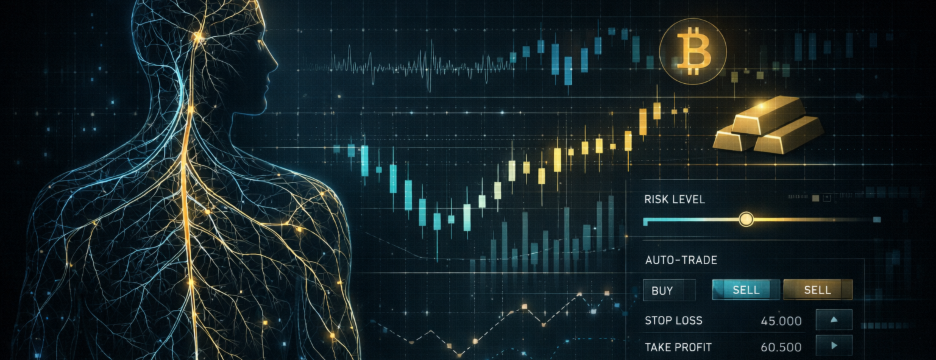
The ICONIC framework is built around this kind of protection. Risk settings, daily trading limits, cooldown mechanisms, market-condition validation, trailing-stop management, break-even behavior, and AI-supported confidence filtering all serve the same deeper purpose: keeping execution inside a controlled environment before the trader’s emotional state can distort the process.
This is not about avoiding all losses.
That is impossible.
It is about preventing losses from becoming psychological triggers that create more losses.
There is a difference.
The Trade After The Loss Is The Real Test
Anyone can follow a plan after a win.
The real test is the trade after a loss.
That is when the nervous system starts negotiating. It wants the pain to disappear. It wants evidence that the strategy still works. It wants control back. It wants the account curve repaired quickly.
This is when traders often abandon the very rules that were built to protect them.
The next setup appears, and they see it through the lens of the previous outcome. If the last trade lost, the next trade feels heavier. If the last stop was hit by a wick, the next stop feels suspicious. If the last move ran without them, the next entry feels urgent.
This is why a cooldown after losses is not a weakness. It is not fear. It is not lack of confidence.
It is intelligent system design.
A cooldown creates space between emotional activation and the next decision. It prevents the trader from using the market as a tool for emotional repair. It allows the system to reset instead of accelerating into lower-quality behavior.
A professional EA can enforce this without debate.
The trader may want to continue. The system does not care. If the rule says pause, it pauses.
That is the point.
Because the trader’s desire to continue after a loss is not always discipline. Sometimes it is the nervous system trying to regain safety through action.
And action taken from that state is rarely clean.
AI Confidence Is Not About Certainty. It Is About Restraint.
I do not trust AI in trading when it is marketed like a crystal ball.
That is not serious.
Markets are uncertain. Any system pretending to know the future should be questioned. But AI can have a serious role when it is used as a decision-quality filter rather than a prediction fantasy.
The value is not “AI knows where price will go.”
The value is that AI-supported logic can help evaluate whether the setup is worth taking under current conditions.
That matters because traders often feel confidence for the wrong reasons. A setup feels strong because the candle is large. It feels obvious because price is moving fast. It feels safe because the last similar trade worked. It feels urgent because the trader does not want to miss the move.
But emotional confidence is not the same as structured confidence.
Structured confidence comes from context. Trend alignment. Volatility. Market regime. Momentum. Spread. News risk. Higher-timeframe conditions. Risk state. Trade quality.
A system like ICONIC AI SIGNAL or the broader ICONIC NEUROCORE AI+ framework is built around the idea that decisions should be filtered, not blindly executed. AI-supported confidence, multi-timeframe context, market-condition validation, and risk controls create a buffer between raw market movement and actual exposure.
This is important because the nervous system loves urgency.
A system should love quality.
Those are not the same thing.
News Events Are Nervous System Traps
News does something strange to traders.
Even if they know a major event is coming, they often underestimate how quickly the environment can change. The chart may look clean. The setup may seem valid. The structure may be clear. Then the release hits, spread changes, volatility expands, and the trade is suddenly operating in a completely different market.
This is especially relevant for Gold, where macroeconomic releases can transform the session in seconds. It is also relevant for BTC, where broader risk sentiment, liquidity changes, and sudden market narratives can create violent shifts.
Trading through these conditions manually can be psychologically brutal. Price moves too fast. The body reacts before the mind finishes processing. The trader wants to close, reverse, re-enter, hedge, or do something simply because the movement feels threatening.
A news filter is not a luxury.
It is a recognition that not all market conditions deserve exposure.
A professional Expert Advisor can pause or reduce activity around dangerous windows. It does not need to prove bravery by trading through chaos. It does not confuse volatility with opportunity. It can respect the fact that some environments distort normal technical behavior.
That is discipline.
Not every move is meant to be traded.
Not every candle is an invitation.
Sometimes the most professional decision is to stand aside before the nervous system is even tested.
Why I Trust Systems More Than My Mood
I do not trust my mood in the market.
That does not mean I do not trust myself. It means I understand myself better than I used to.
I know that after a loss, I can become impatient. I know that after a win, I can become slightly too confident. I know that when BTC starts moving fast, I can feel urgency. I know that when Gold spikes around news, the body wants immediate control. I know that watching unrealized profit pull back can create pressure to intervene.
Knowing this does not make me weak.
It makes me honest.
A trader who does not understand his own patterns is dangerous. He will keep calling emotional reactions “market reads.” He will keep blaming external conditions while repeating the same internal mistakes. He will keep changing strategies when the real issue is execution stability.
This is why I trust systems more than mood.
A system does not replace responsibility. It does not remove the need for oversight. It does not eliminate risk. But it creates a structure that is not dependent on how I feel in a specific moment.
That matters.
Because feelings change.
Rules can hold.
From Trader To Operator
At some point, trading has to evolve.
You cannot stay forever in the emotional battlefield of every candle. You cannot build a serious process if every open position controls your nervous system. You cannot scale discipline if it depends entirely on willpower.
The trader has to become an operator.
An operator thinks differently. He is not asking whether the next candle makes him feel safe. He is asking whether the system is behaving according to design. He is not treating every loss as a personal failure. He is asking whether the loss was within expected parameters. He is not chasing every move. He is asking whether the setup met the required standard.
This is a cleaner identity.
Less dramatic. More professional.
The operator understands that his job is not to feel the market harder than everyone else. His job is to build or use a framework that can survive the market without being emotionally rewritten every day.
That is where automated systems become powerful.
Not because they make the trader disappear.
Because they move the trader into the correct role.
The trader designs. The trader monitors. The trader reviews. The trader improves. The system executes.
This is the foundation behind the ICONIC approach. ICONIC BTC AI+, ICONIC GOLD AI+, ICONIC AI SIGNAL, and ICONIC NEUROCORE AI+ are not just tools for action. They are part of a larger trading architecture built around market-specific logic, AI-supported filtering, risk control, news awareness, trade management, and portfolio-level thinking.
The goal is not to remove the human.
The goal is to remove the human from the part of trading where biology often performs worst.
The Market Is Not Personal. Your Reaction Is.
The market does not know you exist.
It does not know where your stop is because it hates you. It does not care that you need a win. It does not care that you are close to breakeven. It does not care that you missed the first move. It does not care how much time you spent analyzing.
The market is not personal.
But your reaction to it often is.
That is the problem.
A candle moves against you, and suddenly it feels like judgment. A setup fails, and it feels like incompetence. A winning trade reverses, and it feels like betrayal. A missed move creates regret. A drawdown creates doubt.
The market is simply moving.
The nervous system adds the story.
This is why trading requires more than strategy. It requires emotional architecture. It requires rules that exist before pressure begins. It requires risk limits that do not depend on confidence. It requires filters that stop the system from trading when the environment is poor. It requires cooldowns, news awareness, trade management, and structured execution.
It requires a process strong enough to protect the trader from himself.
That may sound harsh.
It is not.
It is honest.
And honesty is where professional trading begins.
Final Thought: The Best Traders Are Not Emotionless
The best traders are not emotionless.
They still feel pressure. They still feel frustration. They still feel discomfort during drawdowns. They still feel the pull of missed opportunity. They still have nervous systems.
The difference is that they do not let the nervous system become the execution engine.
That is the entire point.
You do not need to become a machine. You need to stop forcing a human body to do a machine’s job while capital is moving in real time. Execution should be structured. Risk should be predefined. News should be respected. Volatility should be measured. Trade management should be consistent. Confidence should be filtered. Emotional urgency should not be allowed to decide exposure.
That is what serious automation offers.
Not certainty.
Not fantasy.
Not guaranteed performance.
A professional distance between market pressure and human reaction.
That distance is where discipline lives.
That distance is where a trader can finally stop confusing emotional intensity with market insight.
And that distance is where the real evolution begins.
Move From Nervous Reaction To Structured Execution
If trading still feels like a fight against yourself, the answer may not be another indicator or another motivational rule.
It may be time to build distance between your nervous system and your execution.
ICONIC was built for traders who understand that modern markets require more than instinct. With AI-supported filtering, risk-controlled execution, news awareness, cooldown logic, trade management, and market-specific Expert Advisors for BTC and Gold, ICONIC helps turn emotional reaction into structured operation.Not as a shortcut.
Not as hype.
As architecture.