The Apex Trend Strategy: Trade Pullbacks and Reversals with Confidence

The problem with most trend trading
Every trader has heard "the trend is your friend." Yet most still lose on trends — not because the idea is wrong, but because execution is vague:
- They enter too early into a pullback that keeps falling.
- They exit too late because they have no objective stop.
- They hesitate at the exact moment a clean signal appears, then chase it 20 pips later.
- They trade against the higher timeframe without realizing it.
The fix isn't a magic indicator — it's a repeatable set of rules that answers three questions before every trade: What is the trend? Where is my risk? When do I act?
That is exactly what the Apex Trend Strategy below gives you.
The idea in one sentence
Trade in the direction of the higher-timeframe trend, enter on a volatility-confirmed signal, and let a volatility-based trailing stop manage the exit.
Three layers, three filters, zero guesswork:
- Direction — the higher timeframe decides whether you may go long or short.
- Trigger — an ATR volatility-stop flip on your trading timeframe times the entry.
- Risk — the volatility stop itself becomes your stop-loss and trailing exit.
The Volatility Apex Pro indicator was built to display all three on one chart, so you can execute this strategy mechanically.
[Insert screenshot: chart with dots, glow arrow, ZigZag and info panel]
The tools on your chart
| Element | What it tells you |
|---|---|
| Volatility Stop dots (teal / red) | Current trend + your dynamic stop-loss level |
| Buy / Sell glow arrows | The exact reversal candle — printed only on the closed bar (non-repaint) |
| ZigZag | Market structure: higher highs/lows or lower highs/lows |
| Info panel — HTF row | The higher-timeframe trend, so you always trade with the bigger picture |
Everything is derived from ATR (Average True Range), so the system automatically adapts to volatile and quiet markets alike.
The Apex Trend Strategy — exact rules
Setup (the filter)
Look at the info panel:
- Go long only when both Trend and HTF read UP.
- Go short only when both Trend and HTF read DOWN.
With the built-in Higher-Timeframe filter enabled, the indicator already hides counter-trend arrows for you — so if you see an arrow, the direction filter is passed.
Entry — two variants
A) Reversal entry (aggressive, catches new trends early)
- Wait for a Buy/Sell glow arrow on a closed candle.
- Enter at the open of the next candle.
B) Pullback entry (conservative, higher win rate)
- In an established uptrend, wait for price to pull back toward the teal dots without flipping them.
- Enter long when the next candle closes bullish (mirror for shorts).
Stop-loss
Place your stop just beyond the volatility-stop dots (or the opposite side of the signal candle — whichever is wider). This is a logical stop: if price closes past it, the trend has flipped and your reason for the trade is gone.
Take-profit & trade management
Choose one:
- Trail with the dots — move your stop to the dot level as it advances. Exit when an opposite arrow prints. Best for capturing big trends.
- Fixed target — aim for the previous ZigZag swing or a 1.5–2R target, then trail the remainder.
[Insert screenshot: a long trade — entry arrow, stop below dots, trailing to exit]
A worked example
On EURUSD H1, the panel flips to HTF: H4 UP. Minutes later a Buy arrow prints on the close. You enter long at the next open, stop below the teal dots (say 22 pips). Price trends for two sessions; you trail your stop up with the dots. When a Sell arrow finally appears, you exit — banking roughly 3× your initial risk. No prediction, no second-guessing — just the rules.
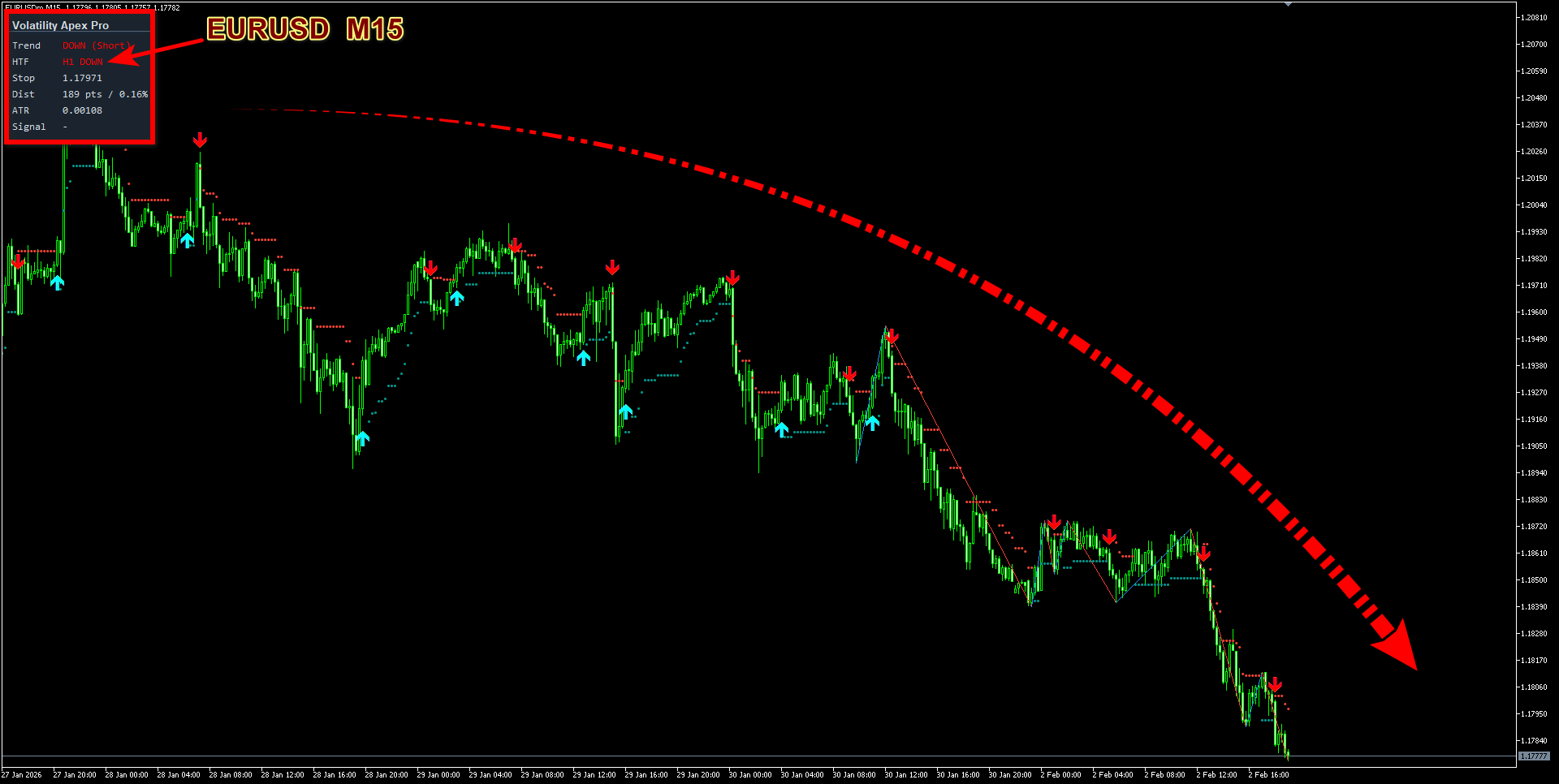
(Illustrative example, not a performance claim.)
Risk management (non-negotiable)
- Risk a fixed 0.5–1% of the account per trade.
- Size the position from the stop distance, not the other way around.
- Never widen the stop after entry.
- Skip trades into high-impact news — volatility spikes cause false flips.
- Aim for quality: one clean, filter-aligned setup beats five rushed ones.
No strategy or indicator wins every trade. The edge comes from consistency, alignment with the higher trend, and disciplined risk — not from being right every time.
Best markets & timeframes
| Style | Timeframe | Suggested symbols |
|---|---|---|
| Intraday trend | M15 – H1 | EURUSD, GBPUSD, USDJPY, AUDCAD |
| Swing trend | H4 – D1 | XAUUSD (Gold), GBPJPY, indices |
| Fast scalping | M5 – M15 | Low-spread majors (tighten the multiplier) |
Trends are cleanest on M15 and above. On lower frames, use a slightly higher ATR multiplier to filter noise.
Why this strategy works
- It removes hesitation — an arrow is a decision, not a suggestion.
- It keeps you on the right side — the HTF filter blocks counter-trend traps.
- It manages risk automatically — the volatility stop is your exit plan from the first candle.
- It's honest — signals are non-repaint, so your backtest reflects reality.
Get the indicator
The Volatility Apex Pro indicator draws every element of this strategy for you — trend dots, non-repaint glow arrows, ZigZag structure, the higher-timeframe filter, a live dashboard, and 4-channel alerts (popup / push / e-mail / sound).
- 🟢 MetaTrader 5: https://www.mql5.com/en/market/product/185588
- 🔵 MetaTrader 4: https://www.mql5.com/en/market/product/185676
Add it to a chart, set your inputs, and start trading the Apex Trend Strategy today. A free demo is available on the product page — test it in the Strategy Tester before you buy.
More tools by the author: https://www.mql5.com/en/users/tachiteam/seller
Risk disclaimer: Trading foreign exchange and CFDs carries a high level of risk. This article is for educational purposes only and is not financial advice. Past performance and backtests do not guarantee future results. Always test on a demo account and apply sound risk management.


