The Trillion Dollar Race for Bitcoin: Who Will Own the Future

The Trillion Dollar Race for Bitcoin: Who Will Own the Future
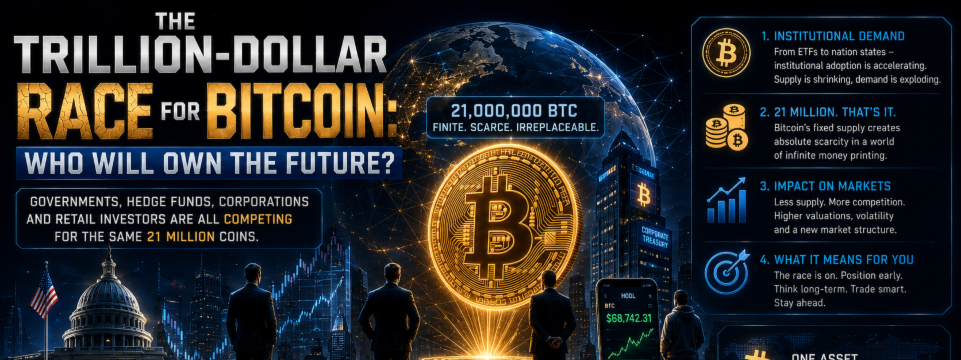
Governments, hedge funds, corporations and retail investors are all competing for the same twenty one million coins. It is a genuinely compelling framing, and the honest version of this story is considerably more interesting, and more nuanced, than the simple narrative of everyone racing in the same direction at once. This article breaks down the actual, current shape of that competition across four genuinely different participant categories, what fixed supply competing against growing demand structurally means, and what a trader should honestly take from all of it.
Part One: The Fixed Supply That Makes This Race Possible
Bitcoin's protocol enforces a maximum supply of twenty one million coins, a mathematically guaranteed ceiling rather than a policy that could change with a committee vote, unlike fiat currency, which can be issued without a fixed limit, or even gold, where new supply continues entering circulation through mining, albeit slowly. This creates a genuinely different scarcity dynamic than any prior reserve asset in history, total future supply is not merely currently limited, it is mathematically certain never to exceed a specific, known number. Worth noting honestly, a meaningful share of that twenty one million is permanently inaccessible, lost private keys and abandoned wallets, meaning genuinely circulating, accessible supply sits below the theoretical cap itself.
Part Two: The Four Genuinely Different Categories Competing for This Supply
Governments present a considerably more fragmented picture than headlines suggest. The largest known state holding currently consists entirely of coins obtained through criminal forfeiture and seizure, not open market purchases, and exists under an executive order rather than a passed law, with proposed legislation to formalize and expand acquisition still pending and unresolved. Other nations have taken genuinely different paths, one pioneered direct, deliberate purchases years ago as legal tender, another accumulates through state backed mining using domestic renewable energy, while several others hold meaningful stockpiles purely as a byproduct of law enforcement seizures rather than deliberate strategy. The honest summary, government interest in Bitcoin as a reserve asset is a genuinely growing policy conversation, but active, coordinated open market buying by states remains far more limited than the dramatic framing implies.
Corporations present an even more divided landscape than most coverage acknowledges. A meaningful cluster of public companies continue accumulating Bitcoin treasury positions, sometimes aggressively, while a separate group of similarly prominent public holders have been net sellers, actively reducing their positions during the same period. This is not a monolithic corporate rush in one direction, it is a genuinely split strategic landscape, with some firms treating Bitcoin as a permanent, digital gold style reserve and others actively rebalancing or trimming exposure based on shorter term considerations.
Institutional fund vehicles, regulated investment products offering exposure to Bitcoin through traditional brokerage accounts, represent a further distinct demand channel, one already covered in structural depth elsewhere, and continue to represent a meaningful and mechanically direct source of ongoing spot demand.
Retail investors remain a large, distributed demand source in their own right, continuing to accumulate through direct exchange purchases alongside the same fund vehicles institutions use, a demand category less concentrated but no less genuinely persistent than the others.
Part Three: What Competing Demand Against Fixed Supply Means Structurally
When multiple demand sources compete for a supply that cannot expand to meet that demand, unlike most assets where rising prices eventually incentivize more supply to enter the market, the structural tendency is for price itself to bear a larger share of the adjustment burden. This is straightforward, defensible economic reasoning applied to Bitcoin's specific fixed supply characteristic, not a specific price prediction or guarantee of any particular outcome. It is also worth remembering that concentrated holding by a smaller number of larger entities, rather than a vast number of small holders, can meaningfully affect how sensitive price becomes to the buying or selling decisions of any single large participant, a market structure dynamic worth taking seriously regardless of which specific direction current flows happen to point.
Part Four: What This Honestly Means for Long Term Investors and Traders
The fixed supply argument is a genuinely interesting long term structural thesis, but it is not, and should never be treated as, a guarantee of continuously rising price. No asset moves in one direction indefinitely, and the genuinely mixed, actively evolving behavior across governments and corporations documented above is itself proof that this narrative is far from a settled, one way certainty.
For traders specifically, the practical takeaway is less about picking a directional side in this competition and more about recognizing what this evolving structural backdrop does to volatility character, an asset with an increasingly diverse, sometimes conflicting set of large participants competing over a fixed supply is likely to continue exhibiting a genuinely different volatility profile than earlier, more purely retail driven market cycles, reinforcing rather than reducing the importance of volatility adaptive risk management covered throughout this series.
Part Five: How to Actually Position for a Genuinely Unresolved Story
Given how unsettled several major pieces of this competition genuinely still are, whether pending legislation ever passes, whether corporate treasury strategy continues splitting in different directions, the defensible response is not confidently betting on a single directional narrative resolving in any particular way. It is deploying systems built to handle whatever character this evolving structural backdrop actually produces, whichever direction it eventually leans. ICONIC BTC AI+ reflects exactly this philosophy, a continuously adaptive neural architecture paired with ATR based dynamic risk sizing and a hard stop loss on every single position, built to respond honestly to whatever volatility genuinely materializes rather than assuming any particular resolution of this still unfolding competition for supply.
Frequently Asked Questions
Are governments actively buying large amounts of Bitcoin on the open market? Currently, the largest known state holdings consist primarily of coins obtained through law enforcement seizures rather than open market purchases, and proposed legislation to formalize and expand deliberate acquisition remains pending rather than enacted in most major cases.
Are all major corporations accumulating Bitcoin treasury positions? No. The corporate landscape is genuinely divided, with some prominent public holders continuing to accumulate while others have been net sellers reducing their positions during the same period, rather than moving uniformly in one direction.
Why does Bitcoin's fixed supply matter for long term price structure? Unlike most assets, where rising prices can eventually incentivize more supply to enter the market, Bitcoin's supply is mathematically capped, meaning sustained demand growth structurally places more of the adjustment burden on price itself rather than being offset by expanding supply.
Does the fixed supply argument guarantee Bitcoin's price will keep rising? No. It is a genuine structural thesis, not a guarantee. The demonstrably mixed and evolving behavior across governments and corporations shows this remains an unresolved, actively developing story rather than a settled certainty.
A Race With No Confirmed Winner Yet
The honest version of this story is more interesting than the hype version. Governments are exploring rather than uniformly committing. Corporations are genuinely divided rather than moving in lockstep. What remains constant is the fixed, mathematically guaranteed ceiling on total supply, a structural fact worth understanding clearly, paired with the humility to recognize that how this genuinely unresolved competition plays out remains an open question best met with adaptive, disciplined risk management rather than confident prediction.
Explore systems built for exactly this kind of genuine uncertainty, including ICONIC BTC AI+ and the flagship ICONIC KYBERNETIC AI+, at iconicfx.tech.
Risk Disclaimer. Trading foreign exchange, cryptocurrencies, commodities and other leveraged financial instruments carries a high level of risk and may not be suitable for all investors. The high degree of leverage can work against you as well as for you. Past performance is not indicative of future results. Automated trading systems, indicators and Expert Advisors do not guarantee profits and can produce losses. ICONIC.FX provides software tools only and does not provide investment advice, portfolio management or financial recommendations. You are solely responsible for your own trading decisions. Seek advice from an independent licensed financial advisor if you have any doubts.