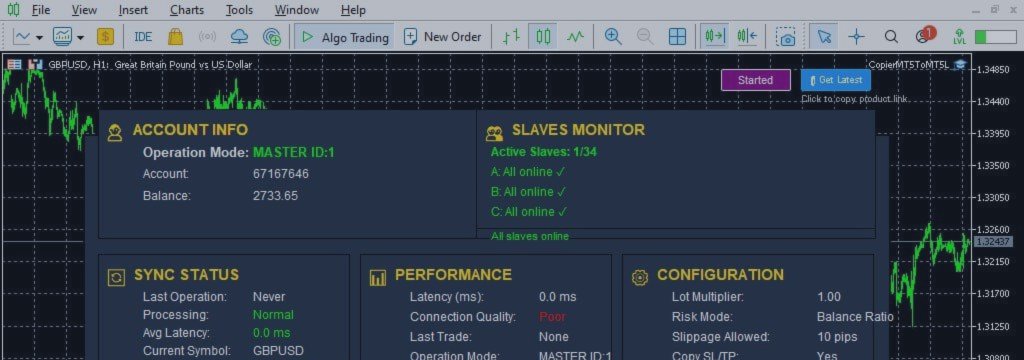

PRODUCT ACCESS LINK ON MQL5 MARKET:
- Copier MT5 To MT5
https://www.mql5.com/en/ market/product/191385 - Copier MT4 To MT4
https://www.mql5.com/en/market/product/150647
The Core Challenge in Trade Replication Systems
In any multi-account trade replication system, one question tends to cause more anxiety than any other:
It's a scenario every trader fears and surprisingly, many copying systems handle it poorly.
In an ideal world, every action on the Master account (opening, closing, modifying SL/TP) would replicate instantly to all connected Slaves. But real-world trading is far from ideal. Internet dropouts, broker latency, VPS failures, or even a simple platform restart can temporarily take a Slave offline.
When that happens, the way your copier handles the reconnection determines whether you walk away with a minor glitch or a major account mismatch.
How Basic Trade Copiers Behave During Disconnection
Simple trade copiers treat every trading action as an isolated event:
- Open order
- Close order
- Modify Stop Loss
- Modify Take Profit
If the Slave is offline when the Master closes a trade, the Close event never arrives. The result?
? Trade closed on Master
? Trade remains open on Slave
This creates account desynchronization the two accounts no longer mirror each other.
Why Desynchronization Is Dangerous
When accounts drift apart, several serious issues emerge:
| Consequence | Explanation |
|---|---|
| Uncontrolled open positions | Slave holds a trade that no longer exists in the Master's strategy |
| Increased unnecessary risk | Market moves after Master's exit can cause unexpected losses on Slave |
| Strategy deviation | Slave no longer follows the intended trading logic |
| P&L divergence | Performance metrics between accounts become incomparable |
Over time, even a single missed close can compound into significant performance gaps.
The Right Approach: State-Based Synchronization
Professional systems don't just copy events they continuously monitor account states.
When a Slave reconnects after being offline, the system doesn't blindly replay missed commands. Instead, it performs a full synchronization check:
- Analyze Master state Which trades are open? Which were recently closed? Any SL/TP changes?
- Analyze Slave state What positions are still open? Are there any orphaned trades?
- Compare both states Identify mismatches: trades closed on Master but open on Slave, volume differences, etc.
Intelligent Decision-Making After Reconnection
Not all disconnections are equal. Advanced systems adjust their behavior based on context:
?? Short Disconnection (seconds to minutes)
- Market conditions are assumed stable
- Missing actions are safely executed
- Accounts quickly resynchronize
?? Extended Disconnection (hours or more)
- Market may have moved significantly
- Executing an old "close" command could lock in a bad price
- The system may:
- Keep the Slave position open temporarily
- Close it based on current market conditions
- Apply a risk-managed exit instead of direct replication
This is where context-aware logic separates professional copiers from basic ones.
Event-Based vs. State-Based Copying A Critical Distinction
| Approach | Focus | Weakness |
|---|---|---|
| Event-Based | "What happened?" | Missed events break synchronization |
| State-Based | "What is the current situation?" | Can correct inconsistencies even after missed events |
State-based systems include a dedicated Synchronization Engine that constantly watches for mismatches and resolves them both during live trading and especially after reconnection.
A Real-World Example
Let's walk through a typical scenario:
- Master opens a BUY trade on EUR/USD
- Later, Master closes that trade
- At that exact moment, Slave goes offline
- Slave reconnects 30 minutes later
What happens next?
- System checks: Does the trade still exist on Master? ? No
- System checks: Is it still open on Slave? ? Yes
Now the system decides:
- If market is stable ? Closes the Slave trade immediately (simple sync)
- If price has moved significantly ? May delay closure, adjust exit price, or apply risk rules before acting
The goal is not mechanical replication it's intelligent alignment.
Risk Management Overrides Blind Copying
Blindly executing outdated commands can:
- Close trades at unfavourable prices
- Increase slippage
- Create unintended losses
That's why professional systems evaluate:
- Current market volatility
- Time elapsed since disconnection
- Distance between current price and original trade level
- Overall strategy consistency
Sometimes, the safest action is not to copy the Master's past move, but to make a risk-aware decision in the present.
What a Professional Trade Copier Guarantees
A well-designed replication system ensures:
- ? Robust handling of disconnections no data loss
- ? Accurate resynchronization after reconnection
- ? Prevention of outdated or harmful trade execution
- ? Minimal divergence between Master and Slave accounts
- ? Intelligent risk management not blind copying
Final Verdict
So, what actually happens if the Master closes a trade while the Slave is offline?
It depends entirely on your copier's architecture:
| System Type | Outcome |
|---|---|
| Basic copier | Trade stays open on Slave ? desynchronization ? increased risk |
| Advanced copier | Automatic detection ? intelligent sync ? controlled risk exposure |
Modern trade replication isn't just about copying trades it's about maintaining strategy integrity under all network conditions. The best systems don't just replay history; they adapt to the present.
Choose your copier wisely. Your future P&L depends on it.
PRODUCT ACCESS LINK ON MQL5 MARKET:
- Copier MT5 To MT5
https://www.mql5.com/en/ market/product/191385 - Copier MT4 To MT4
https://www.mql5.com/en/market/product/150647