What Happens If a Slave Account Opens Trades with Different Lot Sizes? Complete Guide to Lot Management in Multi-Account

Complete Guide to Lot Management in Multi-Account Trade Replication Systems
Comprehensive technical guide for professional traders and MQL5 developers
PRODUCT ACCESS LINK ON MQL5 MARKET:
- Copier MT5 To MT5
https://www.mql5.com/en/ market/product/191385 - Copier MT4 To MT4
https://www.mql5.com/en/market/product/150647
Introduction
In today's professional trading environment, managing multiple trading accounts simultaneously has become a standard practice among prop firm traders, portfolio managers, signal providers, money managers, and experienced retail traders. As trading operations grow, manually executing the same trades across multiple accounts becomes inefficient, time-consuming, and prone to human error.
This is where multi-account trade replication systems, commonly known as Trade Copiers, become essential. A professional trade copier allows traders to synchronize positions from a Master account to one or multiple Slave accounts automatically, ensuring that trading decisions are executed consistently across an entire account network.
However, successful trade replication is not simply about copying trade entries and exits. One of the most critical aspects of maintaining consistent performance across accounts is proper lot management. Many traders assume that if all accounts receive identical buy and sell signals, they will naturally achieve identical performance. In reality, lot size differences can dramatically alter profits, losses, drawdowns, and long-term account growth.
A Slave account opening trades with a different lot size than the Master account is one of the most common situations in professional trade-copying environments. These differences may be intentional or automatic, depending on account balance, risk preferences, broker limitations, or copier configuration. Understanding how these lot size variations affect performance is essential for anyone operating a trade replication network.
In this article, we will explore:
- Why lot sizes differ between Master and Slave accounts
- How lot differences affect profitability and risk
- The importance of risk alignment
- Advanced lot management methods
- Balance-based lot scaling
- Fixed lot versus proportional lot execution
- Dynamic lot calculation techniques
- Professional best practices for maintaining account synchronization
Understanding Lot Size in Trade Replication Systems
Before discussing the consequences of different lot sizes, it is important to understand the role that lot volume plays in trade replication. In MetaTrader trading platforms, a lot represents the size of a position. The larger the lot size, the greater the market exposure and the greater the potential profit or loss resulting from price movements.
For example:
- 0.01 Lot – Very Small
- 0.10 Lot – Small
- 1.00 Lot – Standard
- 5.00 Lots – Large
- 10.00 Lots – Very Large
When a Master account opens a trade, the trade copier receives the transaction details and replicates them across connected Slave accounts. However, the copied volume does not necessarily have to match the Master's volume exactly. Depending on configuration settings, the copier may calculate a different lot size for each Slave account. This flexibility is actually one of the most important features of professional trade replication systems because account balances are rarely identical.
Why Do Slave Accounts Use Different Lot Sizes?
There are numerous reasons why copied trades may execute with different volumes across accounts. Some are intentional risk-management decisions, while others are automatic calculations performed by the trade copier.
Different Account Balances
The most common reason is balance disparity. Consider the following example:
- Master Account: Balance $1,000, Trade Volume 1.00 Lot
- Slave Account: Balance $5,000
If the Slave account copies exactly 1.00 lot, both accounts will have very different risk profiles. Although the trade volume is identical, the percentage of account capital being exposed differs substantially. The larger account is effectively taking less risk relative to its available capital. Professional traders often prefer proportional risk rather than identical volume. This is why advanced trade copiers support balance-based scaling mechanisms.
Custom Risk Settings
Different investors often have different risk tolerances. For example:
- Conservative Portfolio: Lot Multiplier = 0.5
- Standard Portfolio: Lot Multiplier = 1.0
- Aggressive Portfolio: Lot Multiplier = 2.0
All accounts receive the same trading signal. However, each account experiences a different level of exposure. This allows portfolio managers to serve multiple investors while using a single trading strategy.
Broker Volume Restrictions
Not all brokers support the same volume specifications. Some brokers may require minimum lot size restrictions, maximum lot limitations, different volume increments, or different contract specifications. For example, if the requested lot is 0.015 but the broker supports only 0.01, 0.02, and 0.03, the copier must automatically adjust the volume to a valid value. Without proper volume normalization, the order would be rejected.
Fixed Lot Configurations
Some traders intentionally disable proportional scaling. Instead of calculating lots based on balance, they use a fixed volume. For example, with FixedLotSize = 0.10 , every copied trade opens at exactly 0.10 lots regardless of Master balance, Slave balance, or Master volume. This method is commonly used for testing environments, signal verification, and specific portfolio strategies.
The Real Impact of Different Lot Sizes
At first glance, lot size differences may appear insignificant. After all, every account is still following the same trading strategy. However, over time, even small differences in trade volume can produce dramatically different results.
Profit and Loss Distribution
The most obvious consequence is unequal profit and loss distribution. Consider the following example:
- Master Account: Buy EURUSD, 1.00 Lot – Profit = $100
- Slave A: 0.50 Lots – Profit = $50
- Slave B: 2.00 Lots – Profit = $200
All three accounts executed the exact same trade. Yet the final outcome is completely different. As the number of trades increases, these differences become increasingly noticeable.
Long-Term Performance Divergence
Professional traders often compare account performance to evaluate strategy effectiveness. When lot sizes vary, performance comparisons become misleading. One account may appear superior simply because it used larger position sizes. The trading strategy itself has not changed. Only the level of exposure has changed. Over hundreds of trades:
- Growth curves diverge
- Drawdown levels differ
- Risk-adjusted returns change
This makes proper lot management essential for meaningful performance evaluation.
Impact on Drawdowns
Drawdown is one of the most important metrics in professional trading. It measures the decline from a peak account value to a subsequent low. Increasing lot size magnifies both gains and losses. For example:
- Master Account: Maximum Drawdown = 5%
- Slave Account (2x Multiplier): Maximum Drawdown = 10%
- Slave Account (3x Multiplier): Maximum Drawdown = 15%
A strategy that appears relatively conservative on the Master account may become extremely aggressive on a highly leveraged Slave account. This issue is particularly important for funded accounts and prop firm traders who must comply with strict drawdown rules.
Why Risk Alignment Matters More Than Profit
Many traders focus exclusively on profitability. However, professional money managers understand that risk consistency is far more important than isolated profit figures. The true purpose of a trade copier is not merely to duplicate trades. The goal is to preserve the intended risk structure across all connected accounts.
Without proper risk alignment:
- Performance reports become misleading.
- Portfolio analysis becomes unreliable.
- Investor expectations become difficult to manage.
- Drawdowns become inconsistent.
- Account behavior becomes unpredictable.
This is why professional trade replication systems prioritize sophisticated lot management tools.
Advanced Lot Management in Professional MT5 Trade Copiers
Modern MT5 Trade Copiers include powerful lot-management engines designed to maintain consistent exposure across accounts with different balances and risk profiles. Rather than blindly mirroring lot size, these systems calculate an appropriate volume for each account based on predefined rules.
Professional solutions typically support:
- Fixed Lot Mode
- Mirror Lot Mode
- Balance-Based Scaling
- Risk-Based Scaling
- Lot Multiplier Systems
- Maximum Lot Restrictions
- Dynamic Lot Recalculation
These features allow traders to build highly flexible multi-account infrastructures.
Balance-Based Lot Scaling
Balance-based scaling is one of the most widely used lot-management techniques. The copier calculates the relationship between the Master balance and the Slave balance.
Formula: Slave Balance ÷ Master Balance = Scaling Ratio
Example:
- Master: Balance $1,000, Trade 1.00 Lot
- Slave: Balance $5,000, Scaling Ratio 5 → Result: Slave Trade 5.00 Lots
This ensures that both accounts maintain similar percentage-based risk exposure despite their balance differences. For professional portfolio management, this approach often provides the most consistent results.
Lot Multiplier System
Sometimes traders intentionally want different levels of exposure. The Lot Multiplier feature allows users to increase or decrease copied volume.
- Multiplier = 0.5 – The Slave opens half the volume of the Master.
- Multiplier = 1.0 – Standard proportional copying.
- Multiplier = 2.0 – The Slave opens twice the calculated volume.
- Multiplier = 3.0 – The Slave triples the calculated volume.
This flexibility is extremely useful when managing investor portfolios, multiple prop firm accounts, aggressive and conservative account groups, or strategy allocation systems.
Fixed Lot Execution
Some traders prefer complete control over volume. In Fixed Lot Mode, every copied trade uses the same predefined lot size regardless of account balance, equity, Master volume, or risk ratio. For example, with FixedLotSize = 0.20 , every copied trade executes at exactly 0.20 lots. This approach is often used for demo testing, signal verification, strategy comparison, or controlled exposure environments.
Dynamic Lot Recalculation
One of the most advanced features available in professional trade copiers is dynamic lot recalculation. Rather than calculating volume once, the system recalculates lots at execution time. This allows the copier to account for:
- Current account balance
- Current equity
- Open drawdown
- Recent deposits
- Recent withdrawals
- Updated multiplier settings
As account conditions evolve, position sizing automatically adapts. This ensures that risk remains aligned even as balances change over time.
Dynamic Lot Calculation in Professional Trade Copiers
One of the most important components of any professional trade replication system is the ability to calculate lot sizes dynamically rather than relying on static values. As account balances fluctuate over time due to profits, losses, deposits, withdrawals, or prop firm scaling plans, fixed lot sizes may gradually become inappropriate for the account's current risk profile.
For this reason, advanced MT5 Trade Copiers often implement dynamic lot calculation engines that automatically determine the appropriate position size before every trade execution. The objective is simple:
- Maintain consistent risk exposure.
- Prevent overleveraging.
- Adapt to changing account balances.
- Ensure synchronization between Master and Slave accounts.
Instead of blindly copying volume, the copier evaluates current account conditions and calculates a lot size that aligns with the configured risk model.
Example of Dynamic Lot Calculation in MQL5
The following example demonstrates a simplified balance-based risk calculation model. The function calculates lot size according to account balance, desired risk percentage, stop-loss distance, and broker volume restrictions.
//+------------------------------------------------------------------+ double CalculateDynamicLot(double riskPercent, double stopLossPips) { double balance = AccountInfoDouble(ACCOUNT_BALANCE); double riskMoney = balance * (riskPercent / 100.0); double tickValue = SymbolInfoDouble(_Symbol, SYMBOL_TRADE_TICK_VALUE); double riskPerLot = stopLossPips * tickValue; double rawLot = riskMoney / riskPerLot; double step = SymbolInfoDouble(_Symbol, SYMBOL_VOLUME_STEP); double minLot = SymbolInfoDouble(_Symbol, SYMBOL_VOLUME_MIN); double maxLot = SymbolInfoDouble(_Symbol, SYMBOL_VOLUME_MAX); rawLot = MathFloor(rawLot / step) * step; rawLot = MathMax(minLot, MathMin(maxLot, rawLot)); return NormalizeDouble(rawLot, 2); } //+------------------------------------------------------------------+
This approach automatically adapts lot size according to account conditions while ensuring that all broker requirements are respected. As balances increase, trade volume increases proportionally. As balances decrease, exposure is automatically reduced. This creates a more stable and sustainable risk-management framework.
Important Technical Note
The previous example is intentionally simplified to demonstrate the concept of risk-per-pip position sizing.
double riskPerLot = ( stopLossPips * _Point * SymbolInfoDouble(_Symbol, SYMBOL_TRADE_CONTRACT_SIZE) ) / AccountInfoDouble(ACCOUNT_LEVERAGE);
Important: The formula above should be considered conceptual rather than production-ready.
In real-world trading systems, professional position-sizing engines typically rely on:
- SYMBOL_TRADE_TICK_VALUE
- SYMBOL_TRADE_TICK_SIZE
- Contract Size
- Account Currency Conversion
- Instrument-Specific Specifications
to calculate risk exposure more accurately. This is especially critical when working with:
- JPY currency pairs
- Precious metals (XAUUSD, XAGUSD)
- Indices
- CFDs
- Cryptocurrencies
Because leverage-based approximations can introduce inaccuracies across different asset classes, production-grade trade copiers should always prefer Tick Value–based calculations whenever possible.
Why Dynamic Lot Calculation Matters
Many traders underestimate the importance of adaptive position sizing. Consider a Master account that doubles in size over six months. If a Slave account continues using the same fixed lot size, risk percentage changes, performance synchronization deteriorates, and exposure consistency disappears. Dynamic lot calculation solves this problem by continuously adjusting trade volume according to current account conditions. This allows both Master and Slave accounts to maintain similar risk characteristics despite balance fluctuations.
Backtest Comparison: Fixed Lot vs. Balance-Scaled Lot
To understand the practical impact of lot management, it is useful to compare fixed-volume execution with balance-based scaling. Although both methods replicate the same trading signals, their risk characteristics differ significantly.
Scenario 1: Fixed Lot Execution
- Master Account: Balance $10,000
- Slave Account: Balance $50,000
- Trade Volume: Every copied trade = 1.00 Lot
Characteristics: Simple configuration, predictable volume, unequal risk distribution, lower capital efficiency. Because both accounts trade identical volumes despite different balances, the larger account effectively uses less of its available capital.
Scenario 2: Balance-Based Scaling
- Master Account: Balance $10,000
- Slave Account: Balance $50,000
- Trade Volume: Automatically adjusted according to balance ratio
Characteristics: Consistent risk exposure, better capital utilization, improved portfolio synchronization, more accurate performance comparison. The larger account trades proportionally larger volumes, preserving the intended risk structure.
Educational Performance Comparison
The following table illustrates a hypothetical comparison for educational purposes.
| Metric | Fixed Lot | Balance-Based Scaling |
|---|---|---|
| Annual Return | 18.4% | 19.1% |
| Maximum Drawdown | 14.8% | 8.6% |
| Sharpe Ratio | 0.97 | 1.42 |
| Capital Efficiency | Medium | High |
| Risk Consistency | Low | High |
| Portfolio Synchronization | Moderate | Excellent |
Although actual results depend on strategy performance, balance-based scaling generally produces more consistent risk-adjusted returns across account networks.
Understanding Sharpe Ratio Improvements
The Sharpe Ratio measures return relative to risk. A higher Sharpe Ratio indicates:
- Better risk-adjusted performance
- More efficient capital usage
- Smoother equity growth
Because balance-based scaling maintains proportional exposure, volatility often becomes more predictable across accounts. This frequently results in improved risk-adjusted metrics compared to fixed-volume execution.
Protection Against Invalid Lot Sizes
One of the most overlooked aspects of trade replication is handling invalid order volumes. Even when trade signals are correct, orders can fail if volume calculations violate broker specifications. Professional trade copiers must include robust protection mechanisms to avoid synchronization failures.
Common Volume Validation Problems
The most common causes include:
- Volume below broker minimum
- Volume above broker maximum
- Invalid lot increments
- Insufficient margin
- Symbol-specific restrictions
Without proper validation, trade copying may become unreliable.
Broker Volume Constraints
Every broker defines:
- Minimum lot size
- Maximum lot size
- Volume step
Example: Minimum 0.01, Maximum 100.00, Step 0.01. If a copier attempts to send 0.0137 Lots, the order may be rejected. Therefore, volume normalization is essential before execution.
Error Handling in Professional Trade Copiers
Professional-grade systems must not simply fail when encountering execution errors. Instead, they should automatically identify the issue and take corrective action.
ERR_INVALID_VOLUME (1003):
- Meaning: Invalid Trade Volume
- Occurs when the requested lot size violates broker volume rules.
- Professional copiers typically retrieve broker volume specifications, round volume to the nearest valid increment, and retry execution.
Example: Requested 0.017, Broker Step 0.01 → Adjusted 0.02. This automatic correction dramatically improves synchronization reliability.
ERR_NOT_ENOUGH_MONEY (134):
- Meaning: Not Enough Money
- Possible causes: High lot size, low account balance, excessive leverage usage, or margin already allocated to existing positions.
- Professional trade copiers should skip the trade, write a log entry, generate a notification, and continue processing remaining orders.
This prevents a single account from disrupting the entire trade replication network.
Logging and Monitoring
Advanced copiers often provide:
- Dashboard alerts
- Pop-up notifications
- Email notifications
- Push notifications
- Event logs
This allows traders to identify and resolve issues quickly. A transparent monitoring system becomes especially important when managing dozens of Slave accounts simultaneously.
Multi-Broker Considerations
One of the biggest challenges in multi-account trading environments is broker diversity. Different brokers often use different symbol names, contract specifications, leverage models, or lot requirements. Without proper handling, copied trades may fail or produce unexpected results.
Why Symbol Mapping Is Necessary
Consider the following examples:
- Master Broker: EURUSD → Slave Broker: EURUSD.m
- Master: XAUUSD → Slave: GOLD
Although both symbols represent the same instrument, the names differ. Without symbol mapping, the copier cannot locate the correct trading instrument.
Manual Symbol Mapping
Many professional trade copiers allow users to define custom mappings. Examples:
- EURUSD:EURUSD.m
- XAUUSD:GOLD
- US30:US30.cash
This approach provides full control over symbol translation.
Automatic Symbol Mapping
More advanced systems automatically detect prefixes, suffixes, and alternate symbol names. This significantly reduces setup time and configuration errors. For traders operating across multiple brokers, automatic mapping can save considerable effort.
Example MQL5 Symbol Mapping Function
The following simplified example demonstrates how a copier may search for a corresponding symbol.
string FindMappedSymbol(string masterSymbol) { int total = SymbolsTotal(true); for(int i=0; i<total; i++) { string symbol = SymbolName(i,true); if(StringFind(symbol, masterSymbol) >= 0) { SymbolSelect(symbol,true); return symbol; } } return ""; }
This example searches available symbols and returns the first matching candidate. Professional implementations typically include additional validation rules for improved accuracy.
Symbol Mapping and Lot Management
Symbol mapping is not only about locating instruments. Different symbols may also have different contract sizes, different tick values, and different margin requirements. As a result, lot calculations may require additional adjustments. Advanced trade copiers account for these differences automatically, ensuring that risk exposure remains consistent even across brokers with different specifications.
Contract Size Correction Factor
When copying trades between different brokers, symbol mapping alone is not always sufficient. Even if both brokers use the same symbol, they may apply different contract specifications.
Example
- Master Broker: Contract Size = 100,000
- Slave Broker: Contract Size = 10,000
In this case, executing identical lot sizes would result in different monetary exposure across accounts. To maintain consistent risk, professional trade replication systems often apply a Contract Size Correction Factor.
Formula
Correction Factor = ContractSize_Slave / ContractSize_Master Lot_Slave = Lot_Master × Correction Factor
Example Calculation
Master Contract Size = 100,000 Slave Contract Size = 10,000 Correction Factor = 10,000 / 100,000 = 0.10
If the Master opens 1.00 Lot, the Slave should open 0.10 Lot to maintain equivalent market exposure.
This normalization layer becomes especially important in multi-broker trade replication environments where contract specifications vary across trading servers. Modern MT5 Trade Copiers typically combine:
- Symbol Mapping
- Contract Size Normalization
- Balance-Based Scaling
- Lot Multipliers
to ensure that copied trades preserve not only direction, but also the intended risk structure across all connected accounts.
The Importance of Real-Time Monitoring
As account networks become larger, monitoring becomes increasingly important. A professional trade copier should provide complete visibility into system health and execution status. Without monitoring tools, traders may remain unaware of:
- Disconnected Slave accounts
- Terminal crashes
- VPS interruptions
- Synchronization failures
- Execution delays
Modern trade copiers solve this through integrated dashboards and health-monitoring systems.
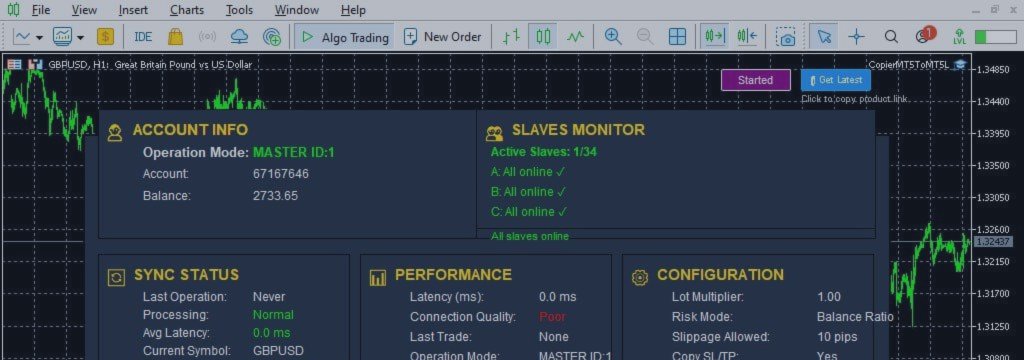
Slave Health Monitoring
Advanced monitoring systems track:
- Online status
- Offline status
- Reconnection events
- Synchronization activity
- Latency measurements
Some professional solutions even provide:
- Offline timers
- Disable controls
- Instant pop-up alerts
- Performance statistics
This ensures that every connected account remains visible at all times.
Benefits of Monitoring
A monitoring dashboard provides:
- Operational transparency
- Faster troubleshooting
- Better risk control
- Improved account management
- Reduced synchronization failures
For traders managing large account networks, monitoring can be just as important as execution speed itself.
Frequently Asked Questions (FAQ)
One of the most effective ways to understand lot management and trade replication is by addressing the questions that traders most frequently encounter when managing multiple accounts. The following FAQ section covers some of the most common concerns related to lot sizing, risk management, account synchronization, and professional trade copier operation.
Can a Slave Account use a larger lot size than the Master?
Yes. Most professional trade copiers allow Slave accounts to trade with larger or smaller volumes than the Master account through the use of a Lot Multiplier. For example, if the Master trades 1.00 Lot and the Slave Multiplier is 2.0, the Slave will trade 2.00 Lots. This feature is commonly used when traders intentionally want higher exposure on specific accounts. However, increasing lot size also increases risk and drawdown potential.
Is balance-based scaling better than fixed lots?
In most professional environments, yes. Balance-based scaling maintains proportional risk across accounts regardless of account size. Benefits include:
- Consistent risk exposure
- Better portfolio synchronization
- Improved capital efficiency
- More meaningful performance comparisons
Fixed lots may still be useful for strategy testing, demo environments, signal verification, or controlled risk experiments. For long-term portfolio management, proportional scaling is generally preferred.
What happens if the calculated lot exceeds broker limits?
Professional trade copiers automatically validate volume before execution. If the calculated lot exceeds maximum allowed volume, minimum volume, or volume step requirements, the system adjusts the value accordingly. This helps prevent trade rejection and improves synchronization reliability.
Can different Slave accounts use different multipliers?
Absolutely. Each Slave account can have its own independent configuration. For example:
- Slave A: Multiplier = 0.5
- Slave B: Multiplier = 1.0
- Slave C: Multiplier = 2.0
All accounts receive the same trade signal, but exposure levels differ according to individual risk preferences. This flexibility is one of the reasons why professional account managers rely on advanced trade copiers.
Does lot scaling affect trade replication speed?
No. Lot calculations require only a fraction of a second. Modern trade copiers perform volume calculations instantly before order execution. As a result, properly implemented lot scaling has virtually no noticeable impact on synchronization speed.
What happens if Master and Slave accounts use different leverage?
Different leverage settings can influence margin requirements. For example, if the Master uses 1:500 leverage and the Slave uses 1:50 leverage, the Slave account may require significantly more margin to execute the same trade. If sufficient margin is not available, the trade may be rejected. Professional trade copiers therefore combine lot management with margin validation mechanisms to reduce execution failures.
Does lot management differ between Netting and Hedging accounts?
Yes. This is one of the most important technical considerations in MetaTrader 5 environments.
Hedging Accounts: In a Hedging account, multiple positions can coexist independently. For example, Buy 1.00 Lot EURUSD and Sell 1.00 Lot EURUSD can both remain open simultaneously. The trade copier manages each position separately. This model is often preferred by traders who use grid strategies, hedging strategies, recovery systems, or multi-position management techniques.
Netting Accounts: In a Netting account, positions on the same symbol are merged into a single net position. For example, Trade 1: Buy 1.00 Lot EURUSD, Trade 2: Sell 0.50 Lot EURUSD results in a Net Position of Buy 0.50 Lot. The platform automatically combines positions. As a result, trade copiers must account for net volume calculations rather than managing each trade independently. Understanding this distinction is essential when deploying a trade copier across different broker environments.
Is it better to calculate lots using Balance or Equity?
Many traders ask whether lot sizing should be based on Account Balance or Account Equity.
Balance-Based Calculation: Reflects only closed profits and losses.
- Advantages: Stable calculations, simpler implementation, less fluctuation in position size.
- Disadvantages: Ignores floating profit and loss, may underestimate actual risk during drawdowns.
Equity-Based Calculation: Includes Account Balance, Floating Profit, and Floating Loss.
- Advantages: More realistic risk measurement, better adaptation to current account conditions, improved drawdown control.
- Disadvantages: Position size may fluctuate more frequently.
For professional risk management, many traders prefer Equity-based calculations because they reflect the account's actual financial condition at the moment of execution.
Can balance-based scaling be used on prop firm accounts?
Yes. In fact, balance-based scaling is often one of the most suitable methods for funded-account environments. Prop firms typically impose daily drawdown limits, maximum drawdown rules, and risk consistency requirements. Balance-based lot sizing helps maintain proportional exposure and reduces the likelihood of unintentionally exceeding risk limits as account balances change.
What happens if a Slave terminal goes offline?
Professional trade copiers usually include health-monitoring systems capable of detecting terminal crashes, internet interruptions, VPS failures, platform freezes, and manual terminal closures. Advanced dashboards may display online status, offline warnings, offline duration timers, and reconnection notifications. This allows traders to quickly identify and resolve synchronization issues.
Best Practices for Professional Lot Management
Proper lot management is not simply about calculating position size. It is about maintaining consistency, stability, and reliability throughout the entire trade replication process. The following best practices are widely used by professional traders and account managers.
Use balance-based scaling whenever possible.
For accounts with different balances, balance-based scaling generally provides the most consistent risk distribution. Benefits include:
- Better synchronization
- Improved risk alignment
- Consistent portfolio behavior
This approach is particularly effective when managing multiple investor accounts or funded accounts.
Apply lot multipliers carefully.
A larger multiplier increases both potential profits and potential losses. Many traders focus only on the profit side of the equation. Professional risk managers always evaluate the impact on drawdown before increasing exposure.
Monitor drawdown alongside profit.
Profit alone does not provide a complete picture of strategy performance. Two accounts may generate identical returns while experiencing vastly different drawdowns. Always evaluate:
- Maximum Drawdown
- Recovery Factor
- Sharpe Ratio
- Risk-to-Reward Profile
before modifying lot settings.
Set reasonable maximum lot limits.
Unexpected account growth or incorrect calculations can sometimes produce excessively large position sizes. A maximum lot limit acts as a safety mechanism. Professional trade copiers often include MaxLotSize, Volume Caps, and Risk Limits to prevent overexposure.
Use a maximum safety lot.
Regardless of how sophisticated a lot calculation model may be, every professional trade copier should include a Maximum Safety Lot limit. Unexpected conditions can occasionally generate abnormally large position sizes due to:
- Incorrect configuration
- Data corruption
- Calculation errors
- Extreme market volatility
- Unexpected account balance changes
Example: MaxSafetyLot = 50.0;
Even if calculations suggest a larger volume, the system should never exceed this predefined safety threshold. This simple protection mechanism can prevent catastrophic overexposure and significantly improve system reliability.
Validate margin before execution.
A trade may appear valid from a volume perspective but still fail due to insufficient margin. Before executing trades:
- Check free margin
- Validate account leverage
- Consider existing positions
This reduces synchronization failures and improves execution reliability.
Always use NormalizeDouble().
Floating-point precision issues can occasionally generate invalid lot values. For example, expected 0.10 but calculated 0.100000000001. Although the difference appears insignificant, some brokers may reject the order. Using NormalizeDouble() ensures that volume values conform to broker specifications.
double lot = NormalizeDouble(calculatedLot, 2);
This simple step significantly reduces volume-related execution errors.
Use OrderCheck before sending orders.
One of the most valuable validation functions available in MQL5 is OrderCheck() . Before submitting an order, OrderCheck() can verify:
- Margin requirements
- Volume validity
- Symbol permissions
- Stop-loss validity
- Take-profit validity
MqlTradeCheckResult result; if(OrderCheck(request, result)) { // Safe to proceed }
Validating trades before execution improves system stability and reduces unnecessary order rejections.
Test configurations on demo accounts first.
Even experienced traders should test lot-management settings before deploying them on live accounts. Demo testing helps verify:
- Symbol mapping
- Volume calculations
- Margin requirements
- Synchronization accuracy
- Risk scaling behavior
A small amount of testing can prevent costly mistakes later.
Monitor Slave health continuously.
Trade replication is only effective if all connected accounts remain operational. Professional monitoring systems should provide visibility into:
- Active Slaves
- Offline Slaves
- Synchronization status
- Execution latency
- Connection quality
Real-time monitoring allows traders to react quickly when problems occur.
Final Thoughts
Lot management is one of the most critical components of any professional multi-account trade replication system. While trade copying itself may appear straightforward, maintaining consistent risk exposure across multiple accounts requires far more than simply duplicating orders. Differences in account balance, leverage, broker specifications, and risk preferences can all influence how copied trades behave over time.
Without proper lot management, even a profitable strategy may produce inconsistent results, misleading performance statistics, and unnecessary drawdowns. Modern MT5 Trade Copiers address these challenges through advanced features such as:
- Balance-Based Lot Scaling
- Dynamic Lot Recalculation
- Fixed Lot Mode
- Lot Multipliers
- Maximum Lot Restrictions
- Symbol Mapping
- Contract Size Normalization
- Margin Validation
- Error Handling
- Real-Time Monitoring
When combined with robust synchronization technology, these tools allow traders to maintain consistent exposure and preserve the intended risk structure across an entire network of Master and Slave accounts.
Effective trade replication is not simply about copying orders from one account to another. The true challenge lies in preserving risk consistency across accounts with different balances, brokers, leverage settings, and trading conditions. Professional lot management transforms a basic copier into a complete risk-management infrastructure capable of supporting funded accounts, investor portfolios, signal distribution networks, and large-scale multi-account trading operations.
Ultimately, the difference between an amateur trader and a professional trader is not found in trade entries alone. Professionals understand that lot management is not merely a technical feature—it is a philosophy of survival in financial markets.
Copying trades is relatively easy. Copying risk correctly is the true art of professional trading.
PRODUCT ACCESS LINK ON MQL5 MARKET:
- Copier MT5 To MT5
https://www.mql5.com/en/ market/product/191385 - Copier MT4 To MT4
https://www.mql5.com/en/market/product/150647