
Introduction
The Descent Blade Indicator is a non-repainting trend reversal signal system for MetaTrader 4 and MetaTrader 5. It combines a Wilder Parabolic SAR with a one-bar lagging variant for entry detection and a Bill Williams Fractal layer for take profit and re-entry signals. Every signal is calculated on a confirmed bar close — historical signals never move, change, or disappear.
Key Features:
- Lagging PSAR Cross Entries: BUY and SELL signals fire on confirmed cross of the bar's high or low through the lagging PSAR line
- BW Fractal TP Engine: Take Profit signals appear at fractal-confirmed structural exhaustion points along the trend
- RE (Re-Entry) Signals: Optional counter-direction scale-in signals for grid and pyramid management
- Non-Repainting: All signals fire on bar close only and remain permanent
- Direction Filter: Buy & Sell, Buy Only, or Sell Only modes
- 8 Alert Events: Enter-Buy, Enter-Sell, Exit-Buy, Exit-Sell, TP-Buy, TP-Sell, RE-Buy, RE-Sell with popup, push, email, and sound delivery
- Symbol-Agnostic: Works on Forex, indices, commodities, equities, and cryptocurrencies on any timeframe
Download the indicator:
- MetaTrader 5: Descent Blade MT5
- MetaTrader 4: Descent Blade MT4
TIP: This indicator suits traders who want a structured rules-based approach to trend reversal trading. It works on any symbol and any timeframe available in MetaTrader.
Understanding Lagging PSAR Cross Signals
The Descent Blade Indicator uses a Wilder Parabolic SAR with a custom lagging variant. The standard SAR computes a bar-by-bar trailing dot using an acceleration factor; the lagging SAR is the standard SAR shifted by one bar. At any bar t , the lagging value equals the standard SAR at bar t-1 .
This formulation has a clean property: a cross of the bar's high above the lagging line corresponds exactly to a standard SAR flip from above-price to below-price (a bullish reversal). A cross of the bar's low below the lagging line corresponds to a SAR flip from below-price to above-price (a bearish reversal).
Visual rendering:
- Yellow line (Lagging PSAR Up): drawn when the lagging value sits below the bar's low — typically during an uptrend
- Magenta line (Lagging PSAR Down): drawn when the lagging value sits above the bar's low — typically during a downtrend
- Lime/red dotted segments (Standard PSAR): hidden by default; enable via InpShowPsar = true if you want both lines visible
How signals fire:
- The indicator monitors the bar's high vs. the lagging PSAR for a BUY cross and the bar's low vs. the lagging PSAR for a SELL cross
- A BUY signal fires when high[current] > lagging[current] AND high[previous] <= lagging[previous]
- A SELL signal fires when low[current] < lagging[current] AND low[previous] >= lagging[previous]
- The cross is evaluated only on confirmed (closed) bars to ensure non-repainting
NOTE: The cross detection is mathematically identical to the standard SAR flip detection. The benefit is the lagging line provides a stable visual reference on the chart that traders can use as a structural pivot.
Installation Guide
The Descent Blade Indicator is distributed through the MQL5.com Market. Installation is automatic.
Steps:
- Purchase the indicator from the MQL5 Market product page
- The indicator installs automatically into your MetaTrader terminal
- Open MetaTrader and press Ctrl+N to open the Navigator panel
- Expand Indicators > Market
- Locate Descent Blade Indicator in the list
- Drag the indicator onto any chart, or double-click its name
- The settings dialog appears — adjust parameters as needed (see sections below)
- Click OK to apply
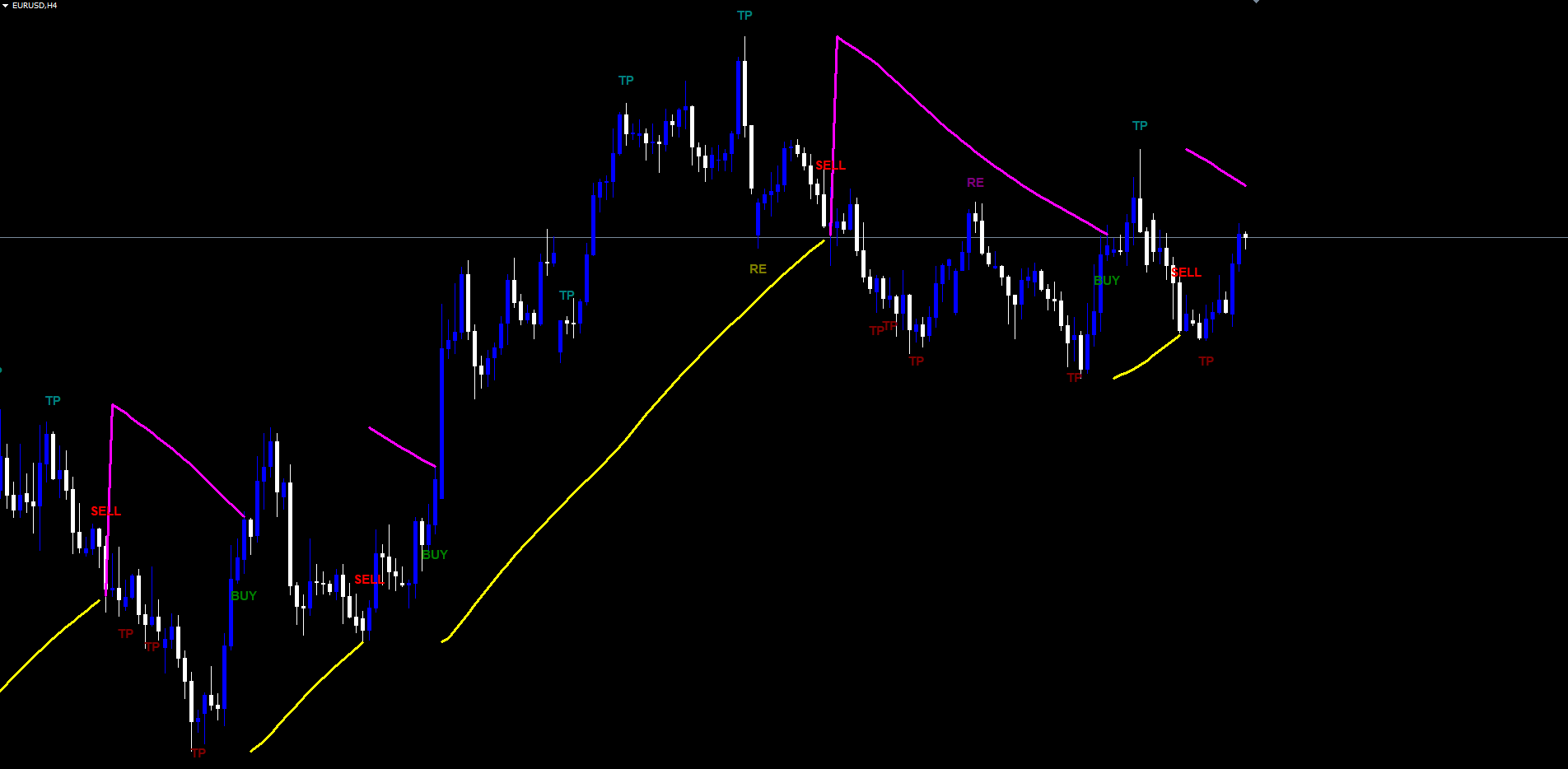
After loading, you will see:
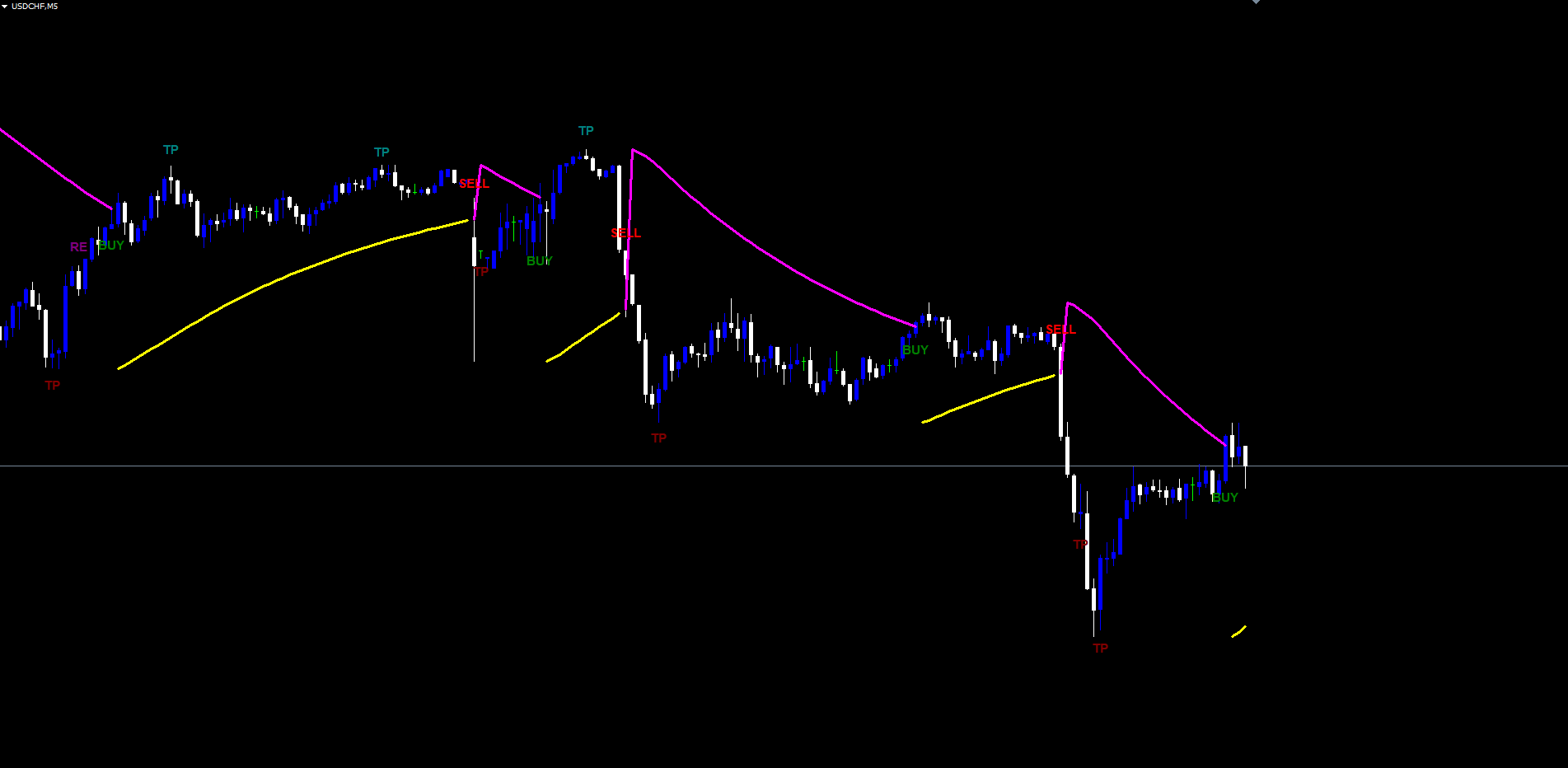
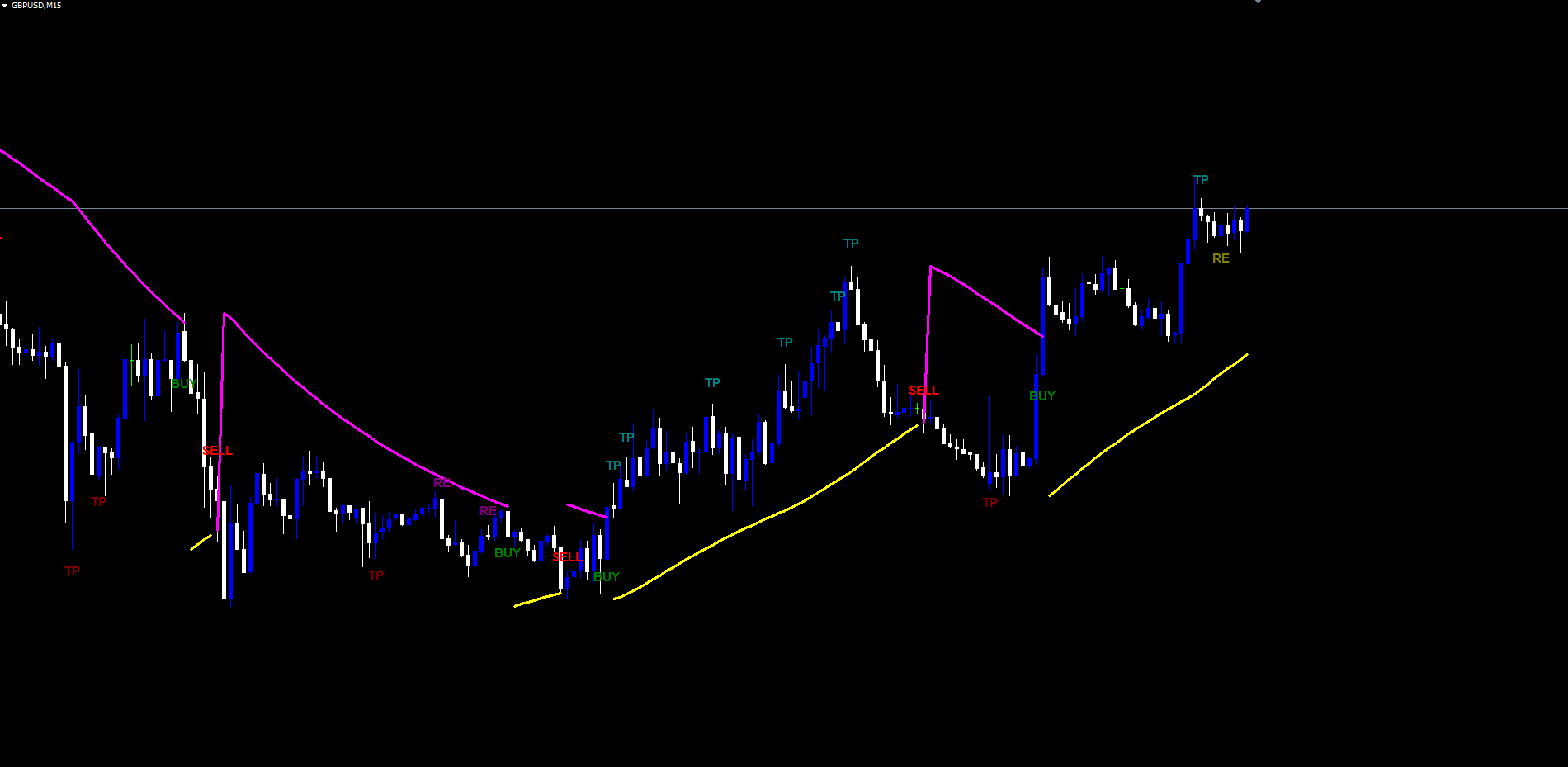
- Lagging PSAR line drawn across the chart in yellow (uptrend) or magenta (downtrend)
- BUY entry labels in green below the bar at upward cross points
- SELL entry labels in red above the bar at downward cross points
- TP labels in teal (BUY trade) or maroon (SELL trade) at fractal-confirmed take profit moments
- RE labels in olive (BUY-side) or purple (SELL-side) at fractal-confirmed re-entry moments
IMPORTANT: Do not manually copy files to the data folder. The MQL5 Market handles all file placement and updates automatically.
Signal System Overview
Each signal consists of a single text label drawn at the closed signal bar.
1. Entry Signals (BUY / SELL)
- BUY entry: green label with the text BUY placed below the bar at the upward lagging cross
- SELL entry: red label with the text SELL placed above the bar at the downward lagging cross
- The internal position state transitions from NONE to BUY or SELL on entry
- The recorded entry price is the lagging PSAR value at the cross bar
2. Exit Signals (EXIT BUY / EXIT SELL)
- EXIT BUY: green label with text EXIT BUY below the bar when an opposite cross occurs while in BUY state
- EXIT SELL: red label with text EXIT SELL above the bar when an opposite cross occurs while in SELL state
- Disabled by default ( InpShowExitBuy = false , InpShowExitSell = false ) because the next opposite entry communicates the same information
- When a flip occurs, both the EXIT label for the closing trade and the new entry label can appear on the same bar
3. TP Signals (Take Profit)
- BUY trade: teal label with text TP above the bar
- SELL trade: maroon label with text TP below the bar
- TP fires when a candle direction reversal occurs at a fractal-confirmed swing pivot, with current close beyond the entry price
- Multiple TPs can fire during one trade as price moves through successive fractals
4. RE Signals (Re-Entry / Scale-In)
- BUY-side scale-in (during SELL trade): olive label with text RE below the bar
- SELL-side scale-in (during BUY trade): purple label with text RE above the bar
- RE fires only after at least one TP has occurred in the trade (unless InpReBuyNoTp or InpReSellNoTp is enabled)
- Subject to a minimum proximity-to-lagging-PSAR ratio configurable via InpReMinProximity
Non-Repainting Confirmation:
- The state machine processes only confirmed bars (shift >= 1, never the live forming bar at shift 0)
- Once a signal label appears, it is permanent and never moves
- The historical scan on indicator load is silent — alerts are suppressed until the scan completes
- What you see in the chart history is exactly what would have appeared in real time at bar close
Position Direction Filter
The Direction input controls which entry side the indicator generates.
| Parameter | Default | Description |
|---|---|---|
| InpDirection | Buy & Sell | Buy & Sell / Buy Only / Sell Only |
- Buy & Sell: Both BUY entries and SELL entries are generated. Standard mode.
- Buy Only: Only BUY entries fire on upward lagging crosses. Downward crosses are ignored.
- Sell Only: Only SELL entries fire on downward lagging crosses. Upward crosses are ignored.
The TP and RE logic respects the active position regardless of the Direction filter — once a trade is open, all corresponding TP and RE signals fire normally.
TIP: Use Buy Only mode on instruments showing strong long-term bullish bias (e.g. major equity indices) to avoid counter-trend SELL signals. Use Sell Only sparingly — it is best suited for instruments in confirmed multi-month downtrends.
Show Signals Configuration
These toggles control which signal types are visualized on the chart. They do not affect the internal state machine — alerts continue to fire regardless of visibility settings.
| Parameter | Default | Description |
|---|---|---|
| InpShowEntryBuy | true | Show BUY entry labels |
| InpShowTpBuy | true | Show TP labels during BUY trades |
| InpShowReBuy | true | Show RE labels during SELL trades (BUY-side scale-in) |
| InpShowExitBuy | false | Show EXIT BUY labels |
| InpShowEntrySell | true | Show SELL entry labels |
| InpShowTpSell | true | Show TP labels during SELL trades |
| InpShowReSell | true | Show RE labels during BUY trades (SELL-side scale-in) |
| InpShowExitSell | false | Show EXIT SELL labels |
TIP: Disable RE labels ( InpShowReBuy = false , InpShowReSell = false ) for a cleaner chart if you don't use grid/pyramid management. Enable EXIT labels only if you trade hard exits separate from the next opposite entry.
PSAR Configuration
The standard Wilder PSAR parameters control the speed and aggressiveness of the lagging line.
| Parameter | Default | Description |
|---|---|---|
| InpPsarStart | 0.02 | Initial Acceleration Factor |
| InpPsarIncrement | 0.02 | AF increment per new extreme point |
| InpPsarMax | 0.025 | Maximum AF cap |
Logic: The standard SAR uses these values directly. The lagging variant is the standard SAR shifted by one bar. Higher Max values (e.g. 0.05, 0.1) produce a faster-trailing SAR that flips more often. Lower values (e.g. 0.01) produce a slower SAR with fewer flips. The defaults match the original Trend Trader-Remastered Pine Script source.
TIP: Most traders should leave these at their defaults. Modify only if you have a clear backtest justification. The default 0.025 maximum is intentionally conservative to keep the lagging cross meaningful rather than reactive.
BW Fractal Configuration
The Bill Williams Fractal layer drives the TP and RE signal logic.
| Parameter | Default | Description |
|---|---|---|
| InpFracHighSrc | High | Price source for high fractal detection |
| InpFracLowSrc | Low | Price source for low fractal detection |
| InpFracLbHigh | 2 | Lookback bars for high fractal confirmation |
| InpFracLbLow | 2 | Lookback bars for low fractal confirmation |
Available price sources for InpFracHighSrc and InpFracLowSrc :
- High: the bar's high (default for high fractal source)
- Low: the bar's low (default for low fractal source)
- Close: the bar's close
- Open: the bar's open
- Median: (High + Low) / 2
- Typical: (High + Low + Close) / 3
- Weighted: (High + Low + Close + Close) / 4
Logic: A high fractal forms at a bar whose source value exceeds the source values of InpFracLbHigh bars on each side. A low fractal forms at a bar whose source value is below the surrounding lows within the same window. With the default lookback of 2, fractals confirm 2 bars after they form.
When subsequent price action causes a close above a high fractal's price, the fractal is marked as broken out. The TP and RE engines reference these breakouts as their structural anchors.
TIP: Increasing the fractal lookback (e.g. to 3 or 4) filters out very minor swing pivots and produces fewer but more significant TP and RE signals. Reducing the lookback to 1 produces a denser signal stream — useful on lower timeframes but generally too noisy on H1+.
Re-Entry Tuning
These inputs control when RE (re-entry / scale-in) signals are allowed to fire.
| Parameter | Default | Description |
|---|---|---|
| InpReMinProximity | 0.0 | Minimum proximity ratio (%) of close to lagging PSAR |
| InpReBuyNoTp | false | Allow RE-Buy signals without a prior TP in the trade |
| InpReSellNoTp | false | Allow RE-Sell signals without a prior TP in the trade |
Proximity ratio formula: proximity = |close - lagging| / |lagging| × 100 (rounded to 2 decimals).
Logic:
- The proximity ratio gates RE signals to bars where price has moved away from the lagging line by at least the configured percentage. The default of 0.0 means the gate is disabled (any proximity is acceptable).
- The "NoTp" toggles control whether a prior TP must have occurred in the trade before any RE can fire. The default behavior (both false) requires a TP first, which means RE signals only appear after the trade has already shown some profit.
Practical settings:
- For instruments with frequent small swings (M5, M15 Forex), set InpReMinProximity = 0.5 to require at least a 0.5% distance from the lagging line before RE fires.
- For traders who want RE signals as soon as a counter-direction pivot forms, set InpReBuyNoTp = true and InpReSellNoTp = true .
- For traders who don't use re-entry scale-ins at all, simply disable the RE display via InpShowReBuy = false and InpShowReSell = false .
Visual Settings
| Parameter | Default | Description |
|---|---|---|
| InpShowPsar | false | Show the standard PSAR line |
| InpShowPsarLagging | true | Show the lagging PSAR line |
| InpShowPosEntry | false | Show a horizontal entry-price line during open trades |
Standard PSAR line: drawn in lime when the SAR sits below price (uptrend) and red when above (downtrend). Width 3 pixels. Hidden by default to keep the chart clean — most traders find the lagging line alone sufficient.
Lagging PSAR line: drawn in yellow when below the bar's low (uptrend) and magenta when above (downtrend). Width 3 pixels. The primary visual reference, enabled by default.
Position Entry line: white horizontal segment at the entry price, persisting from the entry bar through the duration of the open trade. Width 2 pixels. Hidden by default.
Signal Style
| Parameter | Default | Description |
|---|---|---|
| InpFontSize | 11 | Font size for signal labels (range 5–24) |
| InpFontName | Arial Bold | Font face for signal labels |
| InpColEntryBuy | clrGreen | Color for BUY entry and EXIT BUY |
| InpColEntrySell | clrRed | Color for SELL entry and EXIT SELL |
| InpColTpBuy | clrTeal | Color for TP labels during BUY trades |
| InpColTpSell | clrMaroon | Color for TP labels during SELL trades |
| InpColReBuy | clrOlive | Color for RE labels during SELL trades |
| InpColReSell | clrPurple | Color for RE labels during BUY trades |
Signal labels are placed at a vertical offset from the bar's high or low equal to 30% of the current 14-period ATR. This adaptive offset keeps labels visually clear regardless of instrument volatility.
Complete Parameter Reference
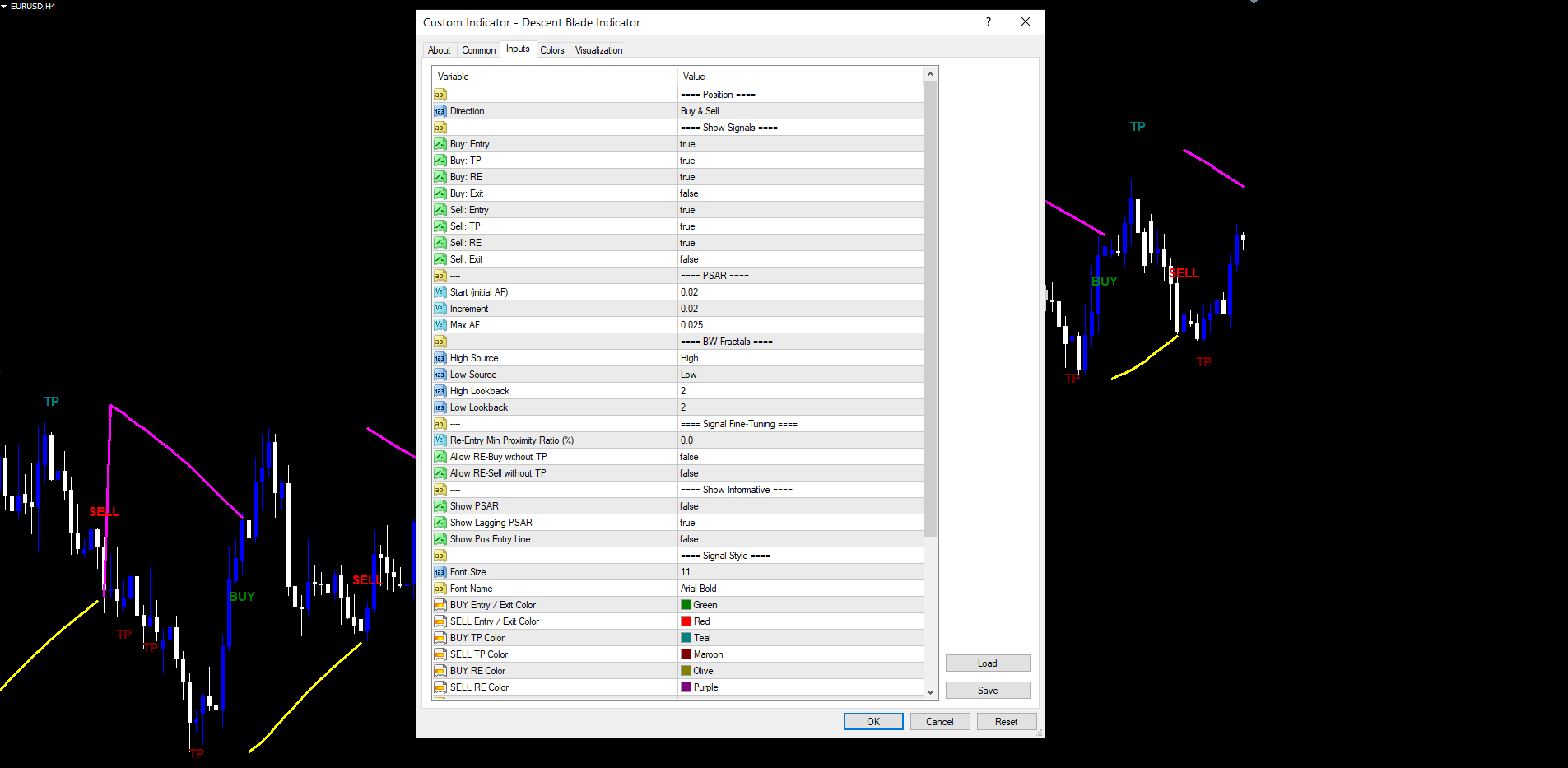
The following table lists every input parameter in the order it appears in the indicator settings dialog.
| # | Parameter | Type | Default | Group |
|---|---|---|---|---|
| 1 | InpDirection | enum | DBI_BUY_AND_SELL | Position |
| 2 | InpShowEntryBuy | bool | true | Show Signals |
| 3 | InpShowTpBuy | bool | true | Show Signals |
| 4 | InpShowReBuy | bool | true | Show Signals |
| 5 | InpShowExitBuy | bool | false | Show Signals |
| 6 | InpShowEntrySell | bool | true | Show Signals |
| 7 | InpShowTpSell | bool | true | Show Signals |
| 8 | InpShowReSell | bool | true | Show Signals |
| 9 | InpShowExitSell | bool | false | Show Signals |
| 10 | InpPsarStart | double | 0.02 | PSAR |
| 11 | InpPsarIncrement | double | 0.02 | PSAR |
| 12 | InpPsarMax | double | 0.025 | PSAR |
| 13 | InpFracHighSrc | enum | DBI_PRICE_HIGH | BW Fractals |
| 14 | InpFracLowSrc | enum | DBI_PRICE_LOW | BW Fractals |
| 15 | InpFracLbHigh | int | 2 | BW Fractals |
| 16 | InpFracLbLow | int | 2 | BW Fractals |
| 17 | InpReMinProximity | double | 0.0 | Signal Fine-Tuning |
| 18 | InpReBuyNoTp | bool | false | Signal Fine-Tuning |
| 19 | InpReSellNoTp | bool | false | Signal Fine-Tuning |
| 20 | InpShowPsar | bool | false | Show Informative |
| 21 | InpShowPsarLagging | bool | true | Show Informative |
| 22 | InpShowPosEntry | bool | false | Show Informative |
| 23 | InpFontSize | int | 11 | Signal Style |
| 24 | InpFontName | string | "Arial Bold" | Signal Style |
| 25 | InpColEntryBuy | color | clrGreen | Signal Style |
| 26 | InpColEntrySell | color | clrRed | Signal Style |
| 27 | InpColTpBuy | color | clrTeal | Signal Style |
| 28 | InpColTpSell | color | clrMaroon | Signal Style |
| 29 | InpColReBuy | color | clrOlive | Signal Style |
| 30 | InpColReSell | color | clrPurple | Signal Style |
| 31 | InpAlertPopup | bool | true | Alerts |
| 32 | InpAlertPush | bool | false | Alerts |
| 33 | InpAlertEmail | bool | false | Alerts |
| 34 | InpAlertSound | bool | true | Alerts |
| 35 | InpAlertSoundFile | string | "alert.wav" | Alerts |
| 36 | InpAlertEntry | bool | true | Alerts |
| 37 | InpAlertExit | bool | true | Alerts |
| 38 | InpAlertTP | bool | true | Alerts |
| 39 | InpAlertRE | bool | true | Alerts |
| 40 | InpObjPrefix | string | "DBI_" | Advanced |
Alert Configuration
The Descent Blade Indicator supports four alert delivery channels and eight distinct alert events.
Alert Channels
| Parameter | Default | Description |
|---|---|---|
| InpAlertPopup | true | Show on-screen popup dialog |
| InpAlertPush | false | Send push notification to the MetaTrader mobile app |
| InpAlertEmail | false | Send email notification |
| InpAlertSound | true | Play the sound file specified by InpAlertSoundFile |
| InpAlertSoundFile | alert.wav | Filename of sound to play |
Alert Categories
Alert categories let you mute groups of events without changing channel settings:
| Parameter | Default | Controls |
|---|---|---|
| InpAlertEntry | true | Enter-Buy, Enter-Sell |
| InpAlertExit | true | Exit-Buy, Exit-Sell |
| InpAlertTP | true | TP-Buy, TP-Sell |
| InpAlertRE | true | RE-Buy, RE-Sell |
Alert Events and Message Format
The indicator fires alerts for eight events. Each message uses the pipe-delimited format:
DBI|<Event>|<Symbol>|<Broker>|<Timeframe>|<Time>|<Price>
| Alert Event | When It Fires | Reference Price |
|---|---|---|
| Enter-Buy | BUY entry on upward lagging cross | Lagging PSAR at cross bar |
| Enter-Sell | SELL entry on downward lagging cross | Lagging PSAR at cross bar |
| Exit-Buy | Opposite cross during BUY trade | Lagging PSAR at cross bar |
| Exit-Sell | Opposite cross during SELL trade | Lagging PSAR at cross bar |
| TP-Buy | TP signal during BUY trade | Current bar close |
| TP-Sell | TP signal during SELL trade | Current bar close |
| RE-Buy | RE signal (BUY-side scale-in during SELL trade) | Current bar close |
| RE-Sell | RE signal (SELL-side scale-in during BUY trade) | Current bar close |
Example messages:
DBI|Enter-Buy|EURUSD|MetaQuotes-Demo|H1|2026.05.01 14:00:00|1.10523
DBI|TP-Sell|GBPJPY|MetaQuotes-Demo|H4|2026.05.01 16:00:00|193.250
DBI|Exit-Buy|XAUUSD|MetaQuotes-Demo|D1|2026.05.02 00:00:00|2387.50
Critical: Alerts are suppressed during the historical scan. When the indicator first loads on a chart, it walks the full visible history and prints all historical signals as chart labels. During this scan, no alerts fire — only newly closed bars after the indicator has fully initialized produce notifications. This prevents the alert flood that some chart-rendered indicators cause when first applied.
Enabling Push Notifications
- Install the MetaTrader mobile app on your phone (iOS or Android)
- Open the app and navigate to Settings > Messages
- Copy your MetaQuotes ID
- In the desktop MetaTrader, go to Tools > Options > Notifications
- Enter your MetaQuotes ID and enable notifications
- Set InpAlertPush = true in the indicator settings
Enabling Email Notifications
- In MetaTrader, go to Tools > Options > Email
- Check Enable
- Enter your SMTP server, port, login, password, and destination email address
- Click Test to verify the configuration works
- Set InpAlertEmail = true in the indicator settings
Trading Strategies
The following three approaches demonstrate different ways to use the Descent Blade Indicator. All strategies assume default settings unless stated otherwise.
WARNING: Trading involves significant risk of loss. These strategies are provided for educational purposes only. Always test on a demo account first and never trade with money you cannot afford to lose.
Strategy A: Pure Trend Reversal (H1 - H4)
Goal: Capture trend reversals at the lagging PSAR cross with no scale-ins.
Recommended settings:
- All defaults
- InpShowReBuy = false , InpShowReSell = false (hide RE labels)
- InpAlertRE = false (disable RE alerts)
Trade management:
- Wait for a BUY or SELL entry label
- Enter at the open of the next bar
- Hold position until the next opposite entry label appears
- Use TP labels as discretionary partial-exit cues — close 50% on the first TP, hold the remainder until next opposite entry
Strategy B: Multi-Target Scale-Out (H1 - D1)
Goal: Use successive TP signals as scale-out levels.
Recommended settings:
- All defaults
- Optionally increase InpFracLbHigh and InpFracLbLow to 3 to reduce TP density
Trade management:
- Enter on the entry signal at the open of the next bar
- Close one-third of the position on the first TP signal
- Move stop loss to entry breakeven after the first TP
- Close another third on the second TP signal
- Hold the final third until the next opposite entry or a discretionary exit
Strategy C: Grid Scale-In with RE Signals (Advanced)
Goal: Add to position counter-direction at fractal-confirmed pullbacks.
Recommended settings:
- All defaults
- InpReMinProximity = 0.5 (require some distance from lagging PSAR before RE fires)
Trade management:
- Enter on the entry signal
- Take partial profit on the first TP
- If a RE signal fires (counter-direction pullback to a fractal), add a small scale-in position
- The RE position is intended as a temporary hedge or profit-recovery layer
- Close all positions on the next opposite entry
WARNING: Strategy C requires careful position management and a broker that supports hedging or simultaneous opposite-direction positions. It is not appropriate for all account types or risk profiles.
Tuning Presets
The following presets are starting points. Adjust based on your symbol, broker conditions, and personal preference.
Scalping Preset (M5 - M15)
| Parameter | Scalping Value |
|---|---|
| InpFracLbHigh | 1 |
| InpFracLbLow | 1 |
| InpReMinProximity | 0.0 |
| InpShowExitBuy | true |
| InpShowExitSell | true |
| InpFontSize | 9 |
Swing Trading Preset (H1 - H4)
| Parameter | Swing Value |
|---|---|
| InpFracLbHigh | 2 |
| InpFracLbLow | 2 |
| InpReMinProximity | 0.0 |
| InpShowExitBuy | false |
| InpShowExitSell | false |
| InpFontSize | 11 |
Position Trading Preset (H4 - D1)
| Parameter | Position Value |
|---|---|
| InpFracLbHigh | 4 |
| InpFracLbLow | 4 |
| InpReMinProximity | 1.0 |
| InpShowReBuy | false |
| InpShowReSell | false |
| InpFontSize | 12 |
TIP: Start with the Swing Trading preset and adjust one parameter at a time to observe its effect on signal frequency and quality.
Troubleshooting
No Signals Appearing on the Chart
Possible causes:
- Insufficient history. The indicator requires at least 2 * max(InpFracLbHigh, InpFracLbLow) + 5 bars to begin processing. Scroll back to load more history or increase Max Bars in Chart in MetaTrader's Options.
- Direction filter restricting signals. Confirm InpDirection = DBI_BUY_AND_SELL if you expect both BUY and SELL signals.
- Lagging cross not occurring in visible range. Zoom out — the indicator may have signals further back in history or further forward as new bars form.
Lagging PSAR Line Not Visible
- Verify InpShowPsarLagging = true
- Check that the chart timeframe has enough bars for the SAR to develop (10+ bars after the chart's earliest visible point)
- Increase line width via #property indicator_width3 and indicator_width4 if recompiling — defaults are width 3
TP or RE Signals Not Firing
- Verify the corresponding show toggle ( InpShowTpBuy , InpShowTpSell , etc.) is true
- TP requires a candle direction reversal AND a fractal breakout above (or below) the entry price during the trade
- RE requires a TP to have occurred first (unless InpReBuyNoTp or InpReSellNoTp is true )
- The proximity gate ( InpReMinProximity ) may be filtering RE signals — try setting it to 0.0
Alerts Not Firing
- Confirm at least one of InpAlertPopup , InpAlertPush , InpAlertEmail , InpAlertSound is true
- Confirm the relevant category ( InpAlertEntry , InpAlertExit , InpAlertTP , InpAlertRE ) is true
- Alerts are silent during the historical scan on indicator load — they only fire for bars that close after the indicator has been applied
- For push notifications: verify your MetaQuotes ID in Tools > Options > Notifications
- For email: verify SMTP settings in Tools > Options > Email
Different Results Between MT4 and MT5
- The MT4 and MT5 implementations share identical logic and produce identical signals on the same bars. Visual differences (anti-aliasing, font rendering) are platform-specific.
- Both versions process bars chronologically with the same Wilder PSAR formula, the same lagging shift, the same fractal detection, and the same state machine.
- If you observe a difference, verify that both versions are at the same input parameter values and that both charts have the same loaded history.
Indicator Loaded but Chart Appears Empty
- Verify InpShowPsarLagging = true (the primary visible plot)
- Verify InpShowEntryBuy = true and InpShowEntrySell = true
- Confirm there is enough history loaded — at least 100 bars recommended for stable initial signals
Support and Contact
If you need assistance with the Descent Blade Indicator:
| Contact Method | Details |
|---|---|
| support@forexobroker.com | |
| Website | www.forexobroker.com |
| MQL5 Market | Use the Comments section on the product page |
When contacting support, please include:
- Your MetaTrader version (MT4 or MT5)
- Broker name and symbol format
- A description of the issue
- Screenshots of the chart and the indicator settings dialog
- The exact parameter values you are using
Download the indicator:
- MetaTrader 5: Descent Blade MT5
- MetaTrader 4: Descent Blade MT4
CONTACT & SUPPORT
- Email: info@forexobroker.com
- Questions: Use the Comments section on the product page or send a private message
- Bug Reports: Please include your broker name, account type, and a screenshot
-
✅ All MQL Tools: https://www.mql5.com/en/users/forexobroker/ ✅
--------------------------------------------------------------------------------------------------------------
🏦 **Broker I use**: https://icmarkets.com/?camp=55869
🏦 **Broker For EU Traders I use 1**: https://www.ictrading.com?camp=91414
🏦 **Broker I use 2**: https://one.exnessonelink.com/boarding/sign-up/a/c_thuv62ocfq
💻 **VPS**: https://chocoping.com/processing/aff.php?aff=738
💼 **Companies I use for getting funded**:
Fundednext: https://fundednext.com/?fpr=kestutis39
The5ers: https://www.the5ers.com/?afmc=16kl
FTMO: https://trader.ftmo.com/?affiliates=nRAyOhmFRnEnFdOpdLeh
Risk Disclaimer
Trading foreign exchange and CFDs on margin carries a high level of risk and may not be suitable for all investors. You may sustain a loss exceeding your initial investment. Trend Quorum is a technical analysis tool and does not guarantee profitable trades. Past performance is not indicative of future results. The authors accept no liability for any loss arising from use of the indicator. By using Trend Quorum you acknowledge sole responsibility for your trading decisions.