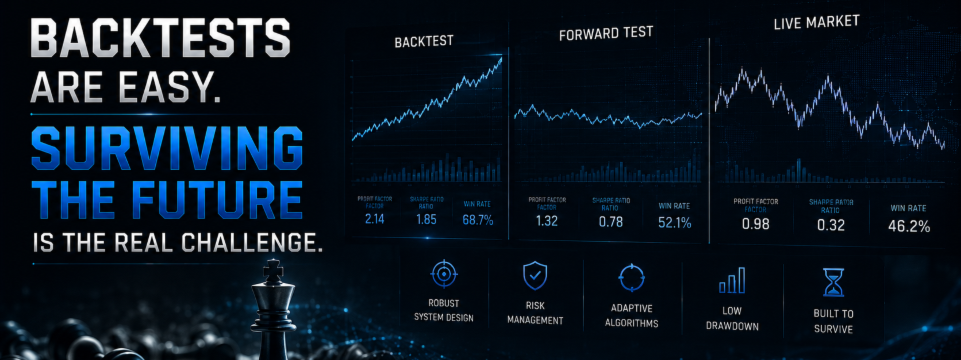
Backtests Are Easy. Surviving the Future Is the Real Challenge.

Backtests Are Easy. Surviving the Future Is the Real Challenge.
Anyone can optimize a strategy for yesterday. The real question is whether it can survive tomorrow, and tomorrow is a genuinely different test than the one most trading education ever prepares a trader to actually pass. This is a long, deliberately exhaustive investigation into the three genuinely distinct stages any strategy must survive, backtesting, forward testing, and live trading, why each one tests something the others cannot, and why the development philosophy behind ICONIC BTC AI+ and the flagship ICONIC KYBERNETIC AI+ was built around all three simultaneously rather than optimizing for the easiest one alone.
Part One: Why Three Stages Exist, Not One
Most retail trading discourse treats validation as a single event, run a backtest, look at the resulting curve, decide whether to trust it. This collapses three genuinely distinct tests into one, and the collapse is precisely where most trading systems quietly fail before a trader ever realizes three separate questions were actually being asked. Backtesting asks whether a strategy would have performed well against a specific, already known historical path. Forward testing asks whether that same strategy performs consistently against genuinely new data it has never touched, observed without real capital at risk. Live trading asks the final, only fully honest question, whether the strategy survives real capital, real execution conditions, and real psychological pressure, all simultaneously. Passing the first test proves almost nothing about the other two.
Part Two: Stage One, What Backtesting Can and Cannot Prove
A backtest tests a strategy against one, already completed historical path, the specific sequence of prices that actually occurred. This is genuinely useful for eliminating strategies that fail even against their own most favorable historical conditions, but it structurally cannot prove anything about how a strategy behaves against a future that has not happened yet, since a future path, by definition, cannot have been included in any historical test performed before it occurred. A sufficiently flexible model can fit not only genuine, repeatable structure inside historical data, but also the specific noise unique to that exact historical window, and a backtest has no mechanism whatsoever to distinguish between these two outcomes on its own.
Part Three, Stage Two: Forward Testing, the Genuinely Underused Middle Stage
This is the stage most retail traders skip entirely, moving directly from an impressive backtest to real, live capital, and it deserves considerably more attention than it typically receives. Forward testing means observing a strategy's behavior against genuinely new data as it actually occurs, in real time, without real capital at risk, a genuinely different test than backtesting because the data being evaluated did not exist at the time the strategy was originally developed and could not have influenced its calibration in any way. This is the first genuine, honest test of whether a strategy's apparent historical edge reflects real, repeatable structure or merely memorized noise specific to whatever historical window it was built against.
Forward testing occupies a genuinely useful middle position between the other two stages. It shares backtesting's freedom from real capital risk, allowing genuine, unpressured observation over an extended period, while sharing live trading's exposure to genuinely unseen, forward moving data the strategy's own development process never touched. A strategy that performs well in backtesting but degrades noticeably during forward testing has revealed, honestly and relatively cheaply, precisely the overfitting risk covered in depth throughout the next section, before that risk had the chance to consume real, deployed capital.
Part Four, Stage Three: Live Trading, the Only Fully Honest Test
Live trading introduces two genuinely new variables neither backtesting nor forward testing can fully replicate. Real execution conditions, actual spread, actual slippage, actual fill quality under genuinely live market pressure, differ meaningfully from the idealized fills a backtest or even a careful forward test typically assumes. And real capital introduces genuine psychological pressure no simulated environment can fully reproduce, the specific discomfort of watching an actual account balance move, a pressure covered in exhaustive depth elsewhere in this broader series regarding why emotional deviation quietly converts a validated system's true expectancy into something considerably less favorable. This is why live trading remains the only fully honest test among the three stages, the first environment where every variable that will ultimately determine real, durable results is simultaneously present and simultaneously at stake.
Part Five: Why Overfitting Survives Stage One but Rarely Survives Stage Two or Three
Overfitting deserves precise treatment specifically through the three stage lens this article has established, because the mechanism explains exactly why this specific failure mode is so consistently invisible until it is genuinely too late. A model with enough flexibility relative to available data can fit not only genuine market structure but the specific, unique noise of its exact historical training window, and both genuine structure and memorized noise produce an equally impressive looking curve during Stage One, since the backtest cannot distinguish between them. Stage Two begins revealing the difference, since genuinely new, forward moving data was never available for the model to memorize in advance, meaning memorized noise, having no reason to repeat in a genuinely new period, produces meaningfully degraded results while genuine structure continues performing consistently. Stage Three confirms this distinction under the additional pressure of real execution and real psychology, the final, unavoidable test any strategy that merely looked impressive during Stage One alone was never actually built to survive.
Part Six: Why Market Conditions Change Underneath Every Strategy, Regardless of How It Was Built
Even a strategy that genuinely passes all three stages faces a further, ongoing challenge this article's three stage framework alone does not fully capture, the market itself continues evolving after deployment, a phenomenon covered in exhaustive depth elsewhere in this broader series regarding genuine edge decay. Competitive erosion as more participants discover similar patterns, structural market evolution as participant composition and infrastructure genuinely shift, and changing cost structures all continue operating well after a strategy has successfully cleared backtesting, forward testing, and early live deployment, meaning surviving the future is not a single hurdle cleared once and then permanently behind a trader. It is an ongoing condition requiring continuous, honest reassessment for as long as a strategy remains deployed, not a box checked once during initial validation and never revisited afterward.
Part Seven: Why Robustness, Drawdown and Risk Control Are What Actually Determine Survival
This is the deepest point this entire article has been building toward. A strategy's ability to clear all three stages, and to keep surviving the ongoing market evolution covered in Part Six, ultimately depends less on how impressive its returns look and more on how disciplined its risk architecture genuinely is. A fifty percent drawdown requires a full one hundred percent gain simply to recover, and a strategy that survives each of the three stages with genuinely controlled drawdown carries a structurally different risk profile than one that happened to clear each stage while carrying undisciplined, oversized risk that has simply not yet produced a catastrophic outcome. Robustness is not a separate consideration from surviving the future, it is the actual mechanism through which survival becomes possible at all, since a strategy that cannot survive its own worst realistic drawdown never gets the chance to keep compounding through whatever genuine edge it may actually possess.
Part Eight: The Development Philosophy Behind ICONIC BTC AI+, Built for All Three Stages From the Start
ICONIC BTC AI+ was engineered around exactly the three stage philosophy covered throughout this article, not optimized purely to produce an impressive Stage One curve. Its trend linearity gating and ATR based risk calibration were built to generalize against genuinely new conditions rather than fit narrowly to one specific historical window, directly addressing the Stage Two forward testing standard this article has argued deserves far more attention than it typically receives. Its differentiable plasticity ensures the system continues genuinely adapting throughout Stage Three and beyond, addressing the ongoing market evolution covered in Part Six directly, rather than treating validation as a single event completed once before deployment and never revisited afterward. Its categorical, verified rejection of grid and martingale, combined with ATR adaptive position sizing, reflects the Part Seven standard directly, robustness and drawdown discipline built into the architecture from its very first design decision rather than added as an afterthought once a strategy already existed in some other, less disciplined form.
Part Nine: The Development Philosophy Behind ICONIC KYBERNETIC AI+, Extending This Standard to Portfolio Survival
The flagship ICONIC KYBERNETIC AI+ extends this same three stage philosophy to the portfolio level entirely. Its Adaptive Conformal Inference confidence gate is, in effect, a permanent, ongoing Stage Two discipline built directly into live operation, continuously checking whether the system's stated confidence genuinely tracks realized accuracy rather than trusting a single calibration performed once and never revisited, precisely the honest, continuous forward validation this article has argued matters considerably more than a single impressive historical curve. Its Physics Informed margin axiom and three tier portfolio drawdown framework embody the Part Seven robustness standard as unbreakable structural law, ensuring that even a strategy which has genuinely, honestly survived all three stages remains protected against the specific kind of catastrophic, account ending event no amount of validation elsewhere in this article's framework can ever fully rule out.
Part Ten: A Complete Worked Example, Watching a Strategy Fail Specifically at Stage Two
Walk through a realistic, composite scenario illustrating exactly why the middle stage covered in Part Three deserves genuine attention rather than being skipped entirely. A developer builds a strategy, iterating repeatedly against several years of historical data until the resulting Stage One backtest produces a genuinely impressive curve, each round of adjustment, however well intentioned, nudging the strategy incrementally further toward fitting the specific noise of that exact historical window rather than genuine, repeatable structure, precisely the mechanism covered in Part Five.
Rather than deploying directly to live capital, this strategy instead enters a genuine Stage Two forward test, observed against several months of entirely new data as it actually occurs, with no real capital at risk. Performance during this period diverges meaningfully from the Stage One backtest, not catastrophically, but honestly, revealing exactly the gap between memorized historical noise and genuine, repeatable structure this article has argued Stage Two exists specifically to expose. The developer, observing this divergence during a genuinely low stakes forward test rather than during live deployment, revises the strategy's design, removing the specific parameters most responsible for the original overfitting rather than adding further complexity in an attempt to force the original, impressive backtest curve back into existence. This is precisely what Stage Two is for, catching exactly this specific failure mode while the cost of doing so remains observational rather than financial.
Part Eleven: A Second Worked Example, Two Strategies That Both Cleared Stage One and Stage Two Identically
Consider a second, distinct illustration focused specifically on Part Seven's robustness argument. Two strategies, System I and System J, produce genuinely comparable results across both Stage One backtesting and Stage Two forward testing, both appearing to demonstrate genuine, real structure rather than memorized noise. System I applies disciplined, ATR based position sizing and hard, structurally enforced stop losses. System J applies fixed, undisciplined sizing with no equivalent structural risk enforcement, an unglamorous, invisible difference that neither the Stage One backtest nor the Stage Two forward test necessarily reveals dramatically on its own, since both stages can pass with either risk approach given a sufficiently favorable observed period.
The genuine difference between these two systems only becomes fully, unavoidably apparent during Stage Three, live deployment, once a genuinely adverse sequence of trades eventually occurs, an inevitability covered in exhaustive statistical depth elsewhere in this broader series. System I's disciplined risk architecture absorbs this adverse sequence and continues operating, keeping the compounding process intact. System J's undisciplined sizing risks converting the exact same statistically ordinary adverse sequence into a genuinely catastrophic, account threatening drawdown, despite both systems having appeared functionally identical throughout the first two stages of validation. This is precisely why robustness deserves equal weight alongside genuine statistical validation rather than being treated as a secondary concern only worth addressing after a strategy has already cleared the earlier, more visible stages of testing.
Part Twelve: Why Marketing That Skips Directly From Backtest to Sale Should Raise Immediate Suspicion
Be direct with yourself about this the next time a product's marketing moves straight from an impressive Stage One backtest curve to a purchase button, with no genuine discussion of Stage Two forward testing or honest, disclosed live deployment history. This specific pattern, skipping the middle stage entirely, is precisely the shortcut this article has argued deserves the most scrutiny, since Stage Two is exactly where the overfitting risk covered in Part Five becomes honestly visible before real capital is ever put at stake. A vendor genuinely confident in their strategy's real, repeatable structure has every reason to disclose genuine forward testing results, since those results, if the underlying edge is genuinely real, only strengthen the case being made. A vendor who skips directly from an impressive backtest to a sale is, whether deliberately or through simple oversight, denying you access to precisely the evidence that would most directly reveal whether their strategy's apparent edge is genuine or merely memorized historical noise.
Part Thirteen: The Specific Warning Signs That a Strategy Was Never Actually Built to Survive the Future
- An unnaturally smooth Stage One backtest with minimal drawdown. Genuine market exposure produces genuine volatility in results, and a curve too clean to be true across a meaningful historical window usually reflects overfitting rather than genuine edge.
- No disclosed Stage Two forward testing results whatsoever. The absence of this specific evidence, when a vendor could easily provide it if it existed and was favorable, is itself informative about how confident that vendor genuinely is in their strategy's ability to survive genuinely new data.
- Extreme sensitivity to small changes in the backtest window. A strategy whose results shift dramatically when the historical test period moves by even a few weeks was very likely tuned to that specific sequence rather than to durable, repeatable structure that would transfer to Stage Two and Stage Three.
- No visible risk enforcement discipline independent of the strategy's entry logic. A strategy that only ever discusses its entry technique, with no genuine, separate discussion of position sizing discipline or structural drawdown protection, has not addressed the Part Seven robustness standard this article has argued determines actual survival more than any other single factor.
Part Fourteen: A Practical Framework for Testing Any Strategy Across All Three Stages Yourself
Given everything covered throughout this article, a genuinely actionable validation framework emerges directly, one you can apply to any strategy, including the systems covered throughout this article, before trusting it with real capital. Begin with genuine Stage One backtesting against a meaningful historical window, but treat any resulting curve with appropriate skepticism rather than immediate confidence, remembering that Stage One alone cannot distinguish genuine structure from memorized noise. Proceed to genuine Stage Two forward testing, observing the strategy against real, newly arriving data for a meaningful period without real capital at risk, specifically watching for the kind of honest divergence covered in Part Ten that reveals overfitting before it can consume genuine deployed capital. Only after genuinely clearing both of these stages, and only with position sizing and risk enforcement disciplined enough to survive the Part Seven standard regardless of how the strategy's underlying edge ultimately performs, does Stage Three, real live deployment, become a reasonable next step rather than a premature leap directly from an impressive but fundamentally unproven historical curve.
Part Fifteen: Why Continuous Online Learning Functions as a Permanent, Ongoing Stage Two
This deserves direct, explicit attention, because it represents a genuinely deeper interpretation of the three stage framework this article has established. Most systems, having cleared Stage One and Stage Two, deploy to Stage Three and effectively stop testing entirely, trusting their original validation indefinitely regardless of how much genuine, new evidence accumulates afterward. ICONIC BTC AI+ and ICONIC KYBERNETIC AI+ both reject this static interpretation of validation. Continuous online learning, differentiable plasticity in the former, Adaptive Conformal Inference and regime bucket tracking in the latter, means Stage Two style forward testing against genuinely new data never actually stops, even after live deployment formally begins. The system continues checking its own assumptions against fresh evidence indefinitely, precisely the ongoing discipline covered in Part Six as necessary for surviving continued market evolution well beyond initial deployment.
Part Sixteen: A Third Worked Example, Watching Portfolio Level Robustness Absorb an Asymmetric Shock
Consider a third, distinct illustration specifically demonstrating the portfolio level robustness covered in Part Nine. Suppose a strategy genuinely clears all three stages of validation for Bitcoin specifically, and separately clears all three stages for Gold, both appearing genuinely sound in isolation. A single asset system deployed purely to Bitcoin, however well validated individually, concentrates its entire risk exposure on that one specific front, with no structural mechanism for absorbing a genuinely severe, asymmetric shock striking that front specifically while Gold conditions remain comparatively unaffected.
ICONIC KYBERNETIC AI+ experiences this same asymmetric event with a genuinely different structural response, its Stochastic Tunneling capital allocation continuously reassessing the balance between fronts as real, current conditions on each evolve independently, capable of shifting relative emphasis away from a specifically deteriorating front rather than remaining permanently locked into whatever allocation happened to be calibrated at the moment of initial deployment. This is not a claim that portfolio coordination eliminates the shock entirely, genuine market uncertainty remains real regardless of architecture. It is a claim that this specific structural capability, verified directly in working code, provides a genuine, additional layer of robustness a single asset deployment, however individually well validated across all three stages, structurally cannot access on its own.
Part Seventeen: Why This Three Stage Standard Deserves to Become Your Permanent Evaluation Lens
Carry this three stage framework forward into every future evaluation of any trading system you ever encounter, not merely the ones covered throughout this article. Ask directly whether genuine, disclosed evidence exists for all three stages, a meaningful Stage One backtest, honest Stage Two forward testing against genuinely new data, and either genuine live track record or, at minimum, architecture explicitly built to continue validating itself against fresh evidence throughout Stage Three rather than trusting a single, frozen calibration indefinitely. Most products in this category can speak confidently about Stage One alone. Considerably fewer can speak with genuine specificity about Stage Two, and fewer still can demonstrate the kind of ongoing, continuous validation covered in Part Fifteen that treats Stage Three not as a finish line but as an indefinitely continuing test the strategy must keep passing for as long as it remains deployed.
Part Eighteen: Why Retail Trading Culture Rewards Stage One Optimization at the Direct Expense of Stages Two and Three
There is a specific, structural reason so much of retail trading culture concentrates almost entirely on producing an impressive Stage One backtest rather than genuinely investing in Stage Two and Stage Three discipline. A backtest is fast, cheap, and immediately gratifying to produce, a developer can iterate dozens of variations within a single afternoon, watching the resulting curve improve with each adjustment. Genuine Stage Two forward testing requires actual, elapsed calendar time, weeks or months of patiently observing a strategy against data that has not yet occurred, offering none of the immediate, iterative gratification Stage One provides. This asymmetry in effort and immediate reward explains a great deal about why so much retail trading content optimizes almost exclusively for the easiest, fastest stage to demonstrate impressively, while the two stages that actually determine whether a strategy survives contact with the genuine future receive comparatively little serious attention or genuine patience.
Part Nineteen: The Honest Limits of Even a Strategy That Genuinely Clears All Three Stages
Intellectual honesty requires acknowledging directly what even genuinely successful completion of all three stages covered throughout this article does not promise. Clearing Stage One, Stage Two, and Stage Three does not guarantee any individual future trade's outcome, nor does it guarantee the strategy's genuine edge will never eventually decay, a phenomenon covered in exhaustive depth elsewhere in this broader series regarding why even properly validated edges erode over time due to competitive and structural forces beyond any single strategy's control. What genuine completion of all three stages does provide, honestly and defensibly, is meaningfully stronger evidence that a strategy's apparent edge reflects real, repeatable structure rather than an illusion that would have inevitably collapsed the moment real, forward moving, capital bearing conditions were finally applied to it.
Frequently Asked Questions
What are the three genuinely distinct stages a trading strategy must survive? Backtesting against already completed historical data, forward testing against genuinely new data without real capital at risk, and live trading with real capital, real execution conditions, and real psychological pressure all simultaneously present.
Why is a backtest alone not sufficient proof that a strategy genuinely works? A backtest tests against one already known historical path and cannot distinguish between genuine, repeatable structure and noise specific to that exact historical window, since both produce an equally impressive looking curve during this single stage alone.
What does forward testing actually reveal that backtesting cannot? Whether a strategy's apparent edge holds against genuinely new data it never touched during development, exposing overfitting honestly before real capital has been put at risk, since memorized historical noise has no reason to repeat during a genuinely new period.
Why does live trading remain the only fully honest test among the three stages? It introduces real execution conditions and real psychological pressure from actual capital at stake, variables neither backtesting nor forward testing can fully replicate, making it the first environment where every factor determining real results is simultaneously present.
Why does robustness matter as much as a strategy's apparent statistical edge? Two strategies can appear functionally identical through both backtesting and forward testing while carrying very different risk architecture, a difference that often remains invisible until a genuinely adverse sequence during live trading reveals whether the underlying risk discipline can actually survive it.
How does ICONIC BTC AI+ address all three validation stages in its own architecture? Through trend linearity gating and ATR based calibration built for genuine generalization rather than narrow historical fit, continuous plasticity based adaptation extending validation indefinitely into live deployment, and hard, structurally enforced risk boundaries addressing robustness directly.
What additional robustness does ICONIC KYBERNETIC AI+ provide at the portfolio level? Continuous, self calibrating confidence tracking functioning as an ongoing forward test even after deployment, and Stochastic Tunneling capital allocation capable of absorbing asymmetric shocks striking one coordinated market front more severely than the other.
Yesterday Was Easy. Tomorrow Is the Only Test That Actually Matters.
Anyone can optimize a strategy for a market that has already happened, iterating a backtest until its curve looks genuinely impressive. Surviving a market that has not happened yet, through honest forward testing, through real live deployment, and through the ongoing, never ending challenge of genuine market evolution covered throughout this article, is where almost every trading system that has ever been quietly abandoned actually failed, regardless of how impressive its original Stage One curve once looked.
ICONIC BTC AI+ and the flagship ICONIC KYBERNETIC AI+ were engineered around exactly this three stage philosophy from their very first design decisions, verified throughout this article against real, working mechanisms rather than a single, isolated backtest presented as complete proof. Deploy systems built to survive the only test that has ever actually mattered, the one that has not happened yet.
Risk Disclaimer. Trading foreign exchange, cryptocurrencies, commodities and other leveraged financial instruments carries a high level of risk and may not be suitable for all investors. The high degree of leverage can work against you as well as for you. Past performance is not indicative of future results. Automated trading systems and Expert Advisors do not guarantee profits and can produce losses. Backtests and simulated results have inherent limitations and do not represent actual trading. ICONIC.FX provides software tools only and does not provide investment advice, portfolio management or financial recommendations. You are solely responsible for your own trading decisions. Seek advice from an independent licensed financial advisor if you have any doubts.
Part Twenty: Why This Three Stage Discipline Mirrors Validation Standards in Other Genuinely Rigorous Fields
The three stage framework covered throughout this article is not a trading specific invention, and recognizing its presence elsewhere lends genuine, cross domain credibility to the standard this article has argued for. Pharmaceutical development follows a directly comparable structure, laboratory results roughly analogous to Stage One, controlled clinical trials against genuinely new subject populations roughly analogous to Stage Two, and post market surveillance once a treatment reaches real, uncontrolled patient populations roughly analogous to Stage Three, each stage catching failure modes the earlier stages structurally cannot reveal. Aerospace engineering follows a similar progression, computational modeling, controlled testing, and finally genuine operational deployment, each stage exposing a different category of potential failure. Trading strategies deserve, and rarely receive, this same rigorous, multi stage discipline, and recognizing that the three stage standard this article has argued for already exists as established practice across other genuinely high stakes, high consequence fields makes the case for applying it to trading considerably harder to dismiss as an arbitrary, trading specific preference.
Part Twenty One: A Fourth Worked Example, The Specific Danger of Declaring Victory Too Early
Consider a final, distinct illustration demonstrating a specific trap even disciplined traders occasionally fall into. A strategy clears Stage One convincingly, and clears the first several weeks of genuine Stage Two forward testing with results broadly consistent with the original backtest, leading a reasonably careful trader to conclude the strategy has genuinely proven itself and is ready for Stage Three deployment. This conclusion, while understandable, risks a specific, statistically grounded error covered in exhaustive depth elsewhere in this broader series, several weeks of forward testing frequently represents too small a sample for the law of large numbers to have meaningfully separated genuine signal from ordinary statistical variance, meaning an early, favorable stretch of Stage Two results provides considerably weaker evidence than it intuitively feels like it should. A genuinely disciplined validation process extends Stage Two testing across a meaningfully longer period specifically to guard against exactly this premature declaration of victory, allowing enough genuine, accumulated evidence to actually distinguish real, repeatable structure from a sample too small to reveal whether that structure genuinely exists at all.
Part Twenty Two: Why This Discipline Compounds Into a Genuine, Durable Advantage Over Time
Traders who genuinely internalize the three stage discipline covered throughout this article, rather than treating validation as a single event completed once during Stage One and never revisited, gain a durable advantage that compounds directly with everything covered in exhaustive detail elsewhere in this broader series regarding genuine statistical discipline as itself a form of edge. This discipline does not erode through competitive diffusion the way a specific technical pattern eventually does, since it is not a discoverable trading technique to be copied, it is a rigorous evaluation standard that remains genuinely valuable regardless of which specific strategy or which specific market it is eventually applied to, precisely the durable, transferable knowledge this article has been building toward across every section rather than a narrower, more perishable claim about any single strategy's specific historical performance.
Part Twenty Three: Why This Framework Extends Directly to Evaluating Your Own Discretionary Trading, Not Just Automated Systems
Everything covered throughout this article applies with equal force to a trader's own discretionary process, not merely to automated systems being evaluated for purchase. A discretionary trader who has only ever reviewed their own historical trades, essentially their own personal Stage One, without genuinely tracking forward, real time performance against a defined set of rules before scaling into meaningful size, is skipping precisely the same Stage Two discipline this article has argued matters considerably more than most traders assume. Applying this three stage framework to your own process, not merely to products you consider purchasing, offers a genuinely useful, humbling exercise, honestly asking whether your own trading approach has ever been forward tested with the same rigor this article has argued any serious strategy deserves, or whether it has simply been trusted based on a favorable historical review that may reflect the exact same overfitting risk covered throughout this article applied to a human's own pattern recognition rather than an algorithm's.
Part Twenty Four: The Specific Role Confidence Calibration Plays in Genuinely Continuous Stage Two Testing
It is worth returning to the mechanism covered in Part Fifteen with additional technical precision, because the specific way genuine confidence calibration operates deserves to be understood in real depth rather than merely asserted. Adaptive Conformal Inference inside ICONIC KYBERNETIC AI+ does not simply track whether the system's predictions are correct in some vague, aggregate sense. It continuously compares the system's own stated confidence level against its actual, realized accuracy at that specific confidence level, adjusting its internal threshold when these two figures genuinely diverge. This is a mathematically rigorous, ongoing form of exactly the honest self assessment Stage Two testing is designed to provide, except continuing indefinitely rather than concluding once deployment begins, meaning the system is, in a genuine, technical sense, perpetually forward testing its own assumptions against fresh evidence for as long as it continues operating.
Part Twenty Five: Bringing Every Stage of This Framework Together, One Final Synthesis
Step back across everything covered throughout this extensive investigation and the complete picture becomes unmistakable. Backtesting alone proves almost nothing about genuine future survival, since it structurally cannot distinguish real, repeatable structure from noise unique to whatever historical window happened to be tested against. Forward testing provides the first genuinely honest evidence of that distinction, exposing overfitting before real capital has been placed at risk, yet remains among the most consistently skipped stages across the broader retail trading population. Live trading introduces the final, unavoidable variables neither earlier stage can fully replicate, genuine execution conditions and genuine psychological pressure from real capital genuinely at stake. And robustness, drawdown discipline, and structurally enforced risk boundaries determine, ultimately, whether a strategy that has genuinely cleared all three stages actually survives the inevitable adverse sequences every genuine strategy eventually encounters, regardless of how sound its underlying edge honestly is.
ICONIC BTC AI+ and the flagship ICONIC KYBERNETIC AI+ were built around this complete, three stage philosophy from their very first design decisions, continuing to validate themselves against fresh, live evidence indefinitely rather than treating deployment as the finish line validation was working toward. Backtests are genuinely easy. Surviving a future that has not happened yet, honestly, repeatedly, and with disciplined risk enforcement throughout, is where almost every trading system that has ever quietly disappeared actually failed.
Part Twenty Six: The Final Question Worth Asking Before Deploying Real Capital
Carry one final, direct question forward from everything covered throughout this extensive investigation. Before deploying real capital behind any strategy again, ask honestly which of the three stages covered throughout this article you have genuinely, rigorously completed, and which you may have quietly skipped because it felt less immediately gratifying than an impressive backtest. Most traders, being genuinely honest with themselves, have spent the overwhelming majority of their validation effort on Stage One alone, precisely the stage this entire article has argued proves the least about genuine future survival. The traders and systems that actually endure are the ones honest enough to demand evidence across all three stages, and disciplined enough to enforce the robustness standard covered throughout this article regardless of how strong that evidence ultimately turns out to be.