

Automating Trading Strategies in MQL5 (Part 51): The Bread and Butter Judas Swing Model with Premium and Discount
 2 124
2 124
 0
0

Introduction
Traders who focus on session opens are often trapped by the first move after a kill zone begins. Price pushes out of the opening range, sweeps the session high or low, and then reverses sharply. This early false push (the Judas swing) is designed to take out stops from traders who chase the initial move. Without a structured way to read direction, judge whether price is expensive or cheap relative to the session range, and confirm a sweep before structure turns, these reversals are hard to trade consistently. This article is for MetaQuotes Language 5 (MQL5) developers and algorithmic traders who want to automate a session-based reversal approach grounded in smart money concepts.
In our previous article (Part 50), we automated a Turtle Soup liquidity sweep strategy. In this article, we build the Bread and Butter Judas Swing program. It combines a higher-timeframe daily bias with kill zones defined in New York time and premium and discount zones derived from each session's range. It arms a setup only after a sweep of the session extreme into the correct zone, then waits for a market structure shift before entering in the direction of the bias. We will cover the following topics:
Understanding the Bread and Butter Judas Swing Model
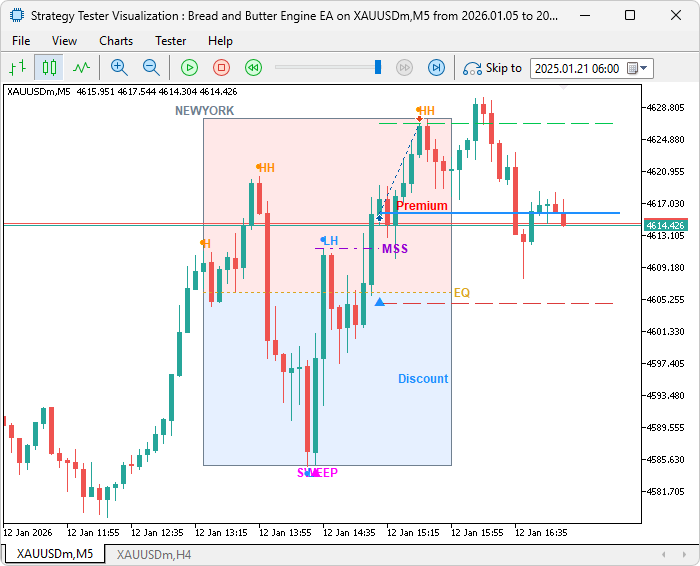
The Bread and Butter Judas Swing model rests on one idea: the first aggressive move after a session opens is often a trap, not a trend. The stops resting beyond the recent session high or low are the liquidity large participants need to fill orders, so price is driven into them and then reverses. We fade that false push rather than follow it, but only with a directional filter behind us. That filter is the daily bias read from a higher timeframe, where a confirmed close beyond the last swing high or low sets the bias bullish or bearish and decides which side of the reversal we are allowed to take.
Timing and location complete the setup. We restrict activity to defined kill zones (London, New York, and Asia), using New York time. Within each kill zone, we build a range from the running high and low and split it at the midpoint into premium (above) and discount (below). Premium favors selling; discount favors buying. A bearish bias then asks for a sweep of the session high into premium, and a bullish bias for a sweep of the session low into discount. The sweep is preparation, not the entry. We wait for a market structure shift: a close back through the last minor swing level in the bias direction. Then we enter, place the stop beyond the swept extreme, and target a fixed reward-to-risk. In a nutshell, here is a representation of our objectives.
Implementation in MQL5
We begin by setting the foundation: the version banner, the trade library, the enumerations that expose our options to the user, the full input set, and the global state the program carries between bars.
//+------------------------------------------------------------------+
//|                                   Bread and Butter Engine EA.mq5 |
//|                           Copyright 2026, Allan Munene Mutiiria. |
//|                                   https://t.me/Forex_Algo_Trader |
//+------------------------------------------------------------------+
#property copyright "Copyright 2026, Allan Munene Mutiiria."
#property link      "https://t.me/Forex_Algo_Trader"
#property version   "1.00"

//--- Define the EA version string shown in the startup log
#define EA_VERSION "1.00"

//--- Include the standard library for order execution
#include <Trade\Trade.mqh>

//+------------------------------------------------------------------+
//| Enumerations                                                     |
//+------------------------------------------------------------------+
enum TradeDirection
  {
   TRADE_BOTH,        // Both directions
   TRADE_BUYS_ONLY,   // Bullish setups only (buys)
   TRADE_SELLS_ONLY   // Bearish setups only (sells)
  };

enum LotSizingMode
  {
   LOTS_FIXED,        // Fixed lot size
   LOTS_RISK_PERCENT  // Risk percent of balance (auto lot)
  };

enum StopLossMode
  {
   SL_AUTO,           // Structural: beyond the swept extreme + buffer
   SL_MANUAL          // Fixed distance from entry (points)
  };

//+------------------------------------------------------------------+
//| Inputs                                                           |
//+------------------------------------------------------------------+
input group "GENERAL"
input long           InpMagicNumber        = 1107;              // Magic number
input LotSizingMode  InpLotSizingMode      = LOTS_RISK_PERCENT; // Lot sizing mode
input double         InpFixedLots          = 0.01;              // Fixed lot (Fixed mode)
input double         InpRiskPercent        = 0.5;               // Risk per trade, percent of balance (Risk mode)
input TradeDirection InpTradeDirection     = TRADE_BOTH;        // Allowed trade direction
input bool           InpAllowMultiple      = false;             // Allow several open trades at once
input string         InpOrderComment       = "BB";              // Order comment

input group "STOP LOSS"
input StopLossMode   InpStopLossMode       = SL_AUTO;           // Stop-loss mode
input int            InpStopBufferPoints   = 50;                // Auto SL: buffer beyond the swept extreme (points)
input int            InpManualStopPoints   = 11000;             // Manual SL: fixed distance from entry (points; symbol-specific)

input group "TAKE PROFIT"
input double         InpRewardRiskRatio    = 1.0;               // Reward-to-risk ratio (TP = R:R x stop distance)

input group "TRAILING STOP"
input bool           InpUseTrailingStop    = false;             // Use trailing stop
input int            InpMinProfitPoints    = 1000;              // Minimum profit points to activate trailing
input int            InpTrailPoints        = 300;               // Trailing stop points

input group "PARTIAL CLOSE (OPTIONAL)"
input bool           InpUsePartialClose    = false;             // Bank a partial at the first target
input double         InpPartialAtRR        = 1.0;               // Partial target in R
input double         InpPartialPercent     = 50.0;              // Percent of the position to close at the partial

input group "DAILY BIAS (HIGHER-TIMEFRAME STRUCTURE)"
input ENUM_TIMEFRAMES InpBiasTimeframe     = PERIOD_H4;         // Higher-timeframe bias chart
input int            InpBiasSwingLookback  = 5;                 // Bias swing pivot lookback (bars each side)

input group "KILL ZONES (NEW YORK TIME)"
input int            InpBrokerGmtOffset    = 0;                 // Broker/server GMT offset (hours). New York EST/EDT handled automatically.
input bool           InpUseLondon          = true;              // Trade the London kill zone
input string         InpLondonStart        = "02:00";           // London start (NY time HH:MM)
input string         InpLondonEnd          = "05:00";           // London end (NY time HH:MM)
input bool           InpUseNewYork         = true;              // Trade the New York kill zone
input string         InpNewYorkStart       = "08:20";           // New York start (NY time HH:MM)
input string         InpNewYorkEnd         = "11:00";           // New York end (NY time HH:MM)
input bool           InpUseAsia            = false;             // Trade the Asia kill zone
input string         InpAsiaStart          = "19:00";           // Asia start (NY time HH:MM)
input string         InpAsiaEnd            = "22:00";           // Asia end (NY time HH:MM)

input group "SETUP (JUDAS SWEEP INTO PREMIUM / DISCOUNT)"
input bool           InpRequireSweep       = true;              // Require a liquidity sweep of the recent extreme
input int            InpSweepLookback      = 20;                // Bars (entry TF) for the swept high/low
input int            InpMinSessionBars     = 3;                 // Entry-TF bars into the session before a range is valid

input group "ENTRY (MARKET STRUCTURE SHIFT)"
input ENUM_TIMEFRAMES InpEntryTimeframe    = PERIOD_CURRENT;    // Entry / trigger timeframe (current chart TF)
input int            InpMssSwingLookback   = 3;                 // Entry swing pivot lookback (bars each side)
input int            InpMaxWaitBars        = 24;                // Max entry-TF bars to wait for the MSS, then disarm

input group "LOGGING"
input bool           InpShowLogs           = true;              // Print log messages to the Journal
input string         InpLogPrefix          = "BB> ";            // Log prefix

input group "VISUALS (CHART ONLY)"
input bool           InpDrawVisuals        = true;              // Draw setup structure on the chart
input bool           InpShowSwingMarkers   = true;              // Draw entry-TF swing markers
input int            InpMarkerSize         = 10;                // Sweep / BOS / entry marker size (Wingdings 3)
input color          InpBullColor          = clrDodgerBlue;     // Bullish setup color
input color          InpBearColor          = clrRed;            // Bearish setup color
input color          InpSessionColor       = clrSlateGray;      // Kill-zone box color
input color          InpEqColor            = clrGoldenrod;      // Equilibrium line color
input color          InpSweepColor         = clrMagenta;        // Liquidity-sweep marker color
input color          InpMssColor           = clrDarkViolet;     // MSS line color
input color          InpSwingHighColor     = clrDarkOrange;     // Swing-high marker color
input color          InpSwingLowColor      = clrDodgerBlue;     // Swing-low marker color
input color          InpBiasHighColor      = clrForestGreen;    // Bias swing-high level (break = bullish)
input color          InpBiasLowColor       = clrOrangeRed;      // Bias swing-low level (break = bearish)
input color          InpPremiumColor       = C'255,232,232';    // Premium zone tint (very light)
input color          InpDiscountColor      = C'230,240,255';    // Discount zone tint (very light)

//+------------------------------------------------------------------+
//| Per-ticket trade record for partial and trailing management      |
//+------------------------------------------------------------------+
struct TradeRecord
  {
   ulong  ticket;       // Store the position ticket
   bool   isBull;       // Mark true for a buy position
   double entryPrice;   // Store the fill price
   double initialStop;  // Store the initial stop price
   double riskDistance; // Store the entry-to-initial-stop distance
   bool   partialTaken; // Mark true once the partial is banked
  };

//+------------------------------------------------------------------+
//| Global Variables                                                 |
//+------------------------------------------------------------------+
CTrade   Trade;                        // Trade execution object
int      SymDigits;                    // Cached symbol digits
double   SymPoint;                     // Cached symbol point size

datetime g_lastEntryBar = 0;           // Last processed entry-TF bar time
datetime g_lastBiasBar  = 0;           // Last processed bias-TF bar time
int      g_bias         = 0;           // Current daily bias: +1 bull, -1 bear, 0 flat

//--- Bias-TF structure tracking
double   g_biasSwingHigh     = 0.0;    // Last confirmed bias-TF swing high
datetime g_biasSwingHighTime = 0;      // Time of the last bias swing high
double   g_biasSwingLow      = 0.0;    // Last confirmed bias-TF swing low
datetime g_biasSwingLowTime  = 0;      // Time of the last bias swing low

//--- Session (kill-zone) state
string   g_activeSession   = "";       // Active kill-zone name ("" when none)
datetime g_sessionStart    = 0;        // Server time the session became active
double   g_sessionHigh     = 0.0;      // Running session high
double   g_sessionLow      = 0.0;      // Running session low
int      g_sessionBarCount = 0;        // Entry-TF bars counted this session
bool     g_sessionTraded   = false;    // Flag a setup already fired this session

//--- Cached kill-zone windows in minutes since NY midnight (parsed once)
int      g_londonStart = 0, g_londonEnd = 0;   // London window bounds
int      g_nyStart     = 0, g_nyEnd     = 0;   // New York window bounds
int      g_asiaStart   = 0, g_asiaEnd   = 0;   // Asia window bounds

//--- Cached New York DST offset (recomputed once per day)
int      g_nyOffset    = -5;           // Current NY GMT offset in hours
int      g_nyOffsetDay = -1;           // Day-of-year the offset was resolved

//--- Entry-TF swing tracking for the MSS trigger
double   g_lastSwingHigh     = 0.0;    // Last confirmed entry-TF swing high
datetime g_lastSwingHighTime = 0;      // Time of the last entry swing high
double   g_lastSwingLow      = 0.0;    // Last confirmed entry-TF swing low
datetime g_lastSwingLowTime  = 0;      // Time of the last entry swing low

//--- Armed setup state
bool     g_armed        = false;       // True while waiting for the MSS trigger
int      g_setupDir     = 0;           // Armed direction: +1 buy, -1 sell
double   g_setupExtreme = 0.0;         // Swept extreme used as the stop anchor
double   g_mssLevel     = 0.0;         // Structure level whose break confirms entry
datetime g_armBarTime   = 0;           // Entry-TF bar time the setup was armed

TradeRecord g_trades[];                // Per-ticket trade records
We establish the foundation here. We define the "EA_VERSION" banner macro and include "Trade.mqh" for order execution, then declare three enumerations — "TradeDirection", "LotSizingMode", and "StopLossMode" — that turn our configuration into readable dropdowns. We expose the inputs in groups: the general settings, stop-loss, reward-to-risk ratio, trailing, optional partial close, daily bias, kill zones in New York time, sweep setup, entry trigger, logging, and chart visuals. We declare the "TradeRecord" structure to store each position's ticket, direction, entry, initial stop, and original risk distance, so we always measure trailing and partials against the risk taken at entry rather than a stop that may have moved. Finally, we hold the global state between bars — the bias, the active session and its range, the confirmed swings, and the armed setup — with the "g_trades" array holding one record per open position.
Time and Session Foundations
Before any setup logic can run, the program needs to know when a new bar has opened and which kill zone is active. We build a small group of time helpers that handle new-bar detection, parse the session windows, resolve New York daylight saving time (DST), and name the active session.
//+------------------------------------------------------------------+
//| Detect the open of a new entry-TF bar                            |
//+------------------------------------------------------------------+
bool IsNewEntryBar()
  {
//--- Read the current entry-TF bar time
   datetime t = iTime(_Symbol, InpEntryTimeframe, 0);
//--- Report a new bar and store its time when it changes
   if(t != g_lastEntryBar) { g_lastEntryBar = t; return true; }
//--- Report no new bar
   return false;
  }

//+------------------------------------------------------------------+
//| Convert an HH:MM string to minutes since midnight                |
//+------------------------------------------------------------------+
int ParseHHMM(string hhmm)
  {
//--- Split the text on the colon separator
   string parts[];
   int n = StringSplit(hhmm, (ushort)':', parts);
//--- Fall back to zero on a malformed value
   if(n < 2) return 0;
//--- Parse the hour and minute components
   int hh = (int)StringToInteger(parts[0]);
   int mm = (int)StringToInteger(parts[1]);
//--- Combine into total minutes since midnight
   return (hh * 60 + mm);
  }

//+------------------------------------------------------------------+
//| Compute UTC time of the Nth Sunday of a month at a given hour    |
//+------------------------------------------------------------------+
datetime NthSundayUtc(int year, int month, int nth, int atHourUtc)
  {
//--- Build the first day of the month
   MqlDateTime t;
   t.year = year; t.mon = month; t.day = 1; t.hour = 0; t.min = 0; t.sec = 0;
   datetime first = StructToTime(t);
//--- Resolve the weekday of that first day
   TimeToStruct(first, t);
//--- Find the day-of-month of the first Sunday (0 = Sunday)
   int firstSunday = 1 + ((7 - t.day_of_week) % 7);
//--- Step forward to the requested Nth Sunday
   int day = firstSunday + (nth - 1) * 7;
//--- Build the final timestamp at the requested UTC hour
   MqlDateTime r;
   r.year = year; r.mon = month; r.day = day; r.hour = atHourUtc; r.min = 0; r.sec = 0;
   return StructToTime(r);
  }

//+------------------------------------------------------------------+
//| Resolve the New York GMT offset for a given UTC moment           |
//+------------------------------------------------------------------+
int NyGmtOffset(datetime utc)
  {
//--- Break the UTC moment into calendar fields
   MqlDateTime t; TimeToStruct(utc, t);
//--- Bound US DST: 2nd Sunday of March to 1st Sunday of November
   datetime dstStart = NthSundayUtc(t.year, 3, 2, 7);
   datetime dstEnd   = NthSundayUtc(t.year, 11, 1, 6);
//--- Return EDT inside the DST window
   if(utc >= dstStart && utc < dstEnd) return -4;
//--- Return EST outside the DST window
   return -5;
  }

//+------------------------------------------------------------------+
//| Get the current New York time as minutes since midnight          |
//+------------------------------------------------------------------+
int NyMinutesNow()
  {
//--- Convert server time to UTC using the broker offset
   datetime utc = TimeCurrent() - InpBrokerGmtOffset * 3600;
//--- Break UTC into fields to detect a day change
   MqlDateTime u; TimeToStruct(utc, u);
//--- Recompute the NY DST offset only once per day
   if(u.day_of_year != g_nyOffsetDay)
     {
      //--- Cache the day and its resolved offset
      g_nyOffsetDay = u.day_of_year;
      g_nyOffset    = NyGmtOffset(utc);
     }
//--- Shift UTC into New York time and return minutes of day
   MqlDateTime t; TimeToStruct(utc + g_nyOffset * 3600, t);
   return t.hour * 60 + t.min;
  }

//+------------------------------------------------------------------+
//| Test whether a minute-of-day sits inside a window                |
//+------------------------------------------------------------------+
bool InWindow(int now, int start, int end)
  {
//--- Handle a normal same-day window
   if(start <= end) return (now >= start && now < end);
//--- Handle a window that wraps past midnight
   return (now >= start || now < end);
  }

//+------------------------------------------------------------------+
//| Resolve the active kill zone for the current New York time       |
//+------------------------------------------------------------------+
string GetActiveSession()
  {
//--- Read the current New York minute of day
   int now = NyMinutesNow();
//--- Return London when enabled and inside its window
   if(InpUseLondon  && InWindow(now, g_londonStart, g_londonEnd)) return "LONDON";
//--- Return New York when enabled and inside its window
   if(InpUseNewYork && InWindow(now, g_nyStart,     g_nyEnd))     return "NEWYORK";
//--- Return Asia when enabled and inside its window
   if(InpUseAsia    && InWindow(now, g_asiaStart,   g_asiaEnd))   return "ASIA";
//--- Report no active kill zone
   return "";
  }
We build time helpers that run the strategy once per bar and resolve the active kill zone. With "IsNewEntryBar", we report the first tick of each entry-timeframe bar so the heavy logic runs once per bar. With "ParseHHMM", we convert each session input into minutes since midnight, run once at startup so no string parsing touches the live path. We handle New York time across daylight saving in two steps: "NthSundayUtc" and "NyGmtOffset" let us bound the DST window (second Sunday of March to first Sunday of November), where we return an offset of minus four inside it and minus five outside, and with "NyMinutesNow" we report the current New York minute of day, recomputing that offset only when the day changes. Finally, with "InWindow" we test a start-to-end window including wraps past midnight, and with "GetActiveSession" we return the first enabled kill zone we fall inside, or an empty string when none is active.
Pivots, Sizing, and Trade Bookkeeping
With the timing in place, the program needs a set of workers that the setup and entry logic will lean on: a swing pivot detector, direction and lot-sizing helpers, the bookkeeping that keeps our trade records in step with live positions, and the sweep test that confirms liquidity was taken.
//+------------------------------------------------------------------+
//| Scan for the latest confirmed swing pivot on a timeframe         |
//+------------------------------------------------------------------+
bool ScanPivot(ENUM_TIMEFRAMES tf, int lookback, bool &isHigh, bool &isLow,
               double &hiPrice, double &loPrice, datetime &pivotTime)
  {
//--- Assume no pivot until proven
   isHigh = false; isLow = false;
//--- Clamp the lookback to at least one bar each side
   int lb = MathMax(1, lookback);
//--- Require enough history to test both sides
   if(iBars(_Symbol, tf) < lb * 2 + 2) return false;
//--- Center on the candidate bar with lb closed bars to its right
   int shift = lb + 1;
   pivotTime = iTime(_Symbol, tf, shift);
   hiPrice   = iHigh(_Symbol, tf, shift);
   loPrice   = iLow(_Symbol, tf, shift);
//--- Assume both a high and a low pivot until a neighbor breaks it
   bool hh = true, ll = true;
//--- Compare the candidate against lb bars on each side
   for(int j = 1; j <= lb; j++)
     {
      //--- Reject the high if any neighbor is at least as high
      if(iHigh(_Symbol, tf, shift - j) >= hiPrice || iHigh(_Symbol, tf, shift + j) >= hiPrice) hh = false;
      //--- Reject the low if any neighbor is at least as low
      if(iLow(_Symbol, tf, shift - j)  <= loPrice || iLow(_Symbol, tf, shift + j)  <= loPrice) ll = false;
     }
//--- Publish the pivot classification
   isHigh = hh; isLow = ll;
//--- Report whether either a high or low pivot formed
   return (hh || ll);
  }

//+------------------------------------------------------------------+
//| Check whether a trade direction is permitted                     |
//+------------------------------------------------------------------+
bool IsDirectionAllowed(bool isBull)
  {
//--- Allow everything when both directions are enabled
   if(InpTradeDirection == TRADE_BOTH) return true;
//--- Allow only buys in buys-only mode
   if(InpTradeDirection == TRADE_BUYS_ONLY) return isBull;
//--- Otherwise allow only sells
   return !isBull;
  }

//+------------------------------------------------------------------+
//| Convert risk percent and stop distance into a lot size           |
//+------------------------------------------------------------------+
double CalcLotsByRisk(double entry, double stop)
  {
//--- Derive the money to risk from the account balance
   double riskMoney = AccountInfoDouble(ACCOUNT_BALANCE) * InpRiskPercent / 100.0;
//--- Measure the stop distance in points
   double stopPoints = MathAbs(entry - stop) / SymPoint;
//--- Abort on a zero stop distance
   if(stopPoints <= 0) return 0;
//--- Read the tick value and tick size for the symbol
   double tickValue = SymbolInfoDouble(_Symbol, SYMBOL_TRADE_TICK_VALUE);
   double tickSize  = SymbolInfoDouble(_Symbol, SYMBOL_TRADE_TICK_SIZE);
//--- Abort on invalid tick metrics
   if(tickValue <= 0 || tickSize <= 0) return 0;
//--- Convert tick value into money per point
   double valuePerPoint = tickValue / tickSize * SymPoint;
//--- Abort on an invalid per-point value
   if(valuePerPoint <= 0) return 0;
//--- Size the position so the stop loss equals the risk money
   double lots = riskMoney / (stopPoints * valuePerPoint);
//--- Read the broker volume constraints
   double volMin  = SymbolInfoDouble(_Symbol, SYMBOL_VOLUME_MIN);
   double volMax  = SymbolInfoDouble(_Symbol, SYMBOL_VOLUME_MAX);
   double volStep = SymbolInfoDouble(_Symbol, SYMBOL_VOLUME_STEP);
//--- Snap the lot size down to the volume step
   if(volStep > 0) lots = MathFloor(lots / volStep) * volStep;
//--- Clamp within limits and normalize to two decimals
   return NormalizeDouble(MathMax(volMin, MathMin(volMax, lots)), 2);
  }

//+------------------------------------------------------------------+
//| Resolve the lot size for a trade by the selected mode            |
//+------------------------------------------------------------------+
double ResolveLots(double entry, double stop)
  {
//--- Pick fixed lots or risk-based lots by the sizing mode
   double lots = (InpLotSizingMode == LOTS_FIXED) ? InpFixedLots : CalcLotsByRisk(entry, stop);
//--- Read the broker volume constraints
   double volMin  = SymbolInfoDouble(_Symbol, SYMBOL_VOLUME_MIN);
   double volMax  = SymbolInfoDouble(_Symbol, SYMBOL_VOLUME_MAX);
   double volStep = SymbolInfoDouble(_Symbol, SYMBOL_VOLUME_STEP);
//--- Snap the lot size down to the volume step
   if(volStep > 0) lots = MathFloor(lots / volStep) * volStep;
//--- Clamp within the allowed range
   lots = MathMax(volMin, MathMin(volMax, lots));
//--- Normalize to two decimals
   return NormalizeDouble(lots, 2);
  }

//+------------------------------------------------------------------+
//| Find a trade record index by ticket                              |
//+------------------------------------------------------------------+
int FindTradeRecord(ulong ticket)
  {
//--- Scan the records for a matching ticket
   for(int i = 0; i < ArraySize(g_trades); i++)
      if(g_trades[i].ticket == ticket) return i;
//--- Report not found
   return -1;
  }

//+------------------------------------------------------------------+
//| Count this EA's open positions on the current symbol             |
//+------------------------------------------------------------------+
int CountOurPositions()
  {
//--- Start the running count at zero
   int count = 0;
//--- Walk every open position from last to first
   for(int i = PositionsTotal() - 1; i >= 0; i--)
     {
      //--- Select the position by its ticket
      ulong ticket = PositionGetTicket(i);
      if(ticket == 0 || !PositionSelectByTicket(ticket)) continue;
      //--- Skip positions from another EA
      if(PositionGetInteger(POSITION_MAGIC) != InpMagicNumber) continue;
      //--- Skip positions on another symbol
      if(PositionGetString(POSITION_SYMBOL) != _Symbol) continue;
      //--- Count this position as ours
      count++;
     }
//--- Return the total owned positions
   return count;
  }

//+------------------------------------------------------------------+
//| Append a new trade record for a freshly opened position          |
//+------------------------------------------------------------------+
void AddTradeRecord(ulong ticket, bool isBull, double entry, double stop)
  {
//--- Ignore an invalid or already-tracked ticket
   if(ticket == 0 || FindTradeRecord(ticket) >= 0) return;
//--- Grow the record array by one slot
   int n = ArraySize(g_trades);
   ArrayResize(g_trades, n + 1);
//--- Populate the new record from the fill details
   g_trades[n].ticket       = ticket;
   g_trades[n].isBull       = isBull;
   g_trades[n].entryPrice   = entry;
   g_trades[n].initialStop  = stop;
   g_trades[n].riskDistance = MathAbs(entry - stop);
   g_trades[n].partialTaken = false;
  }

//+------------------------------------------------------------------+
//| Drop records whose positions have closed                         |
//+------------------------------------------------------------------+
void PruneTradeRecords()
  {
//--- Walk records backward so removals stay safe
   for(int i = ArraySize(g_trades) - 1; i >= 0; i--)
      //--- Remove the record once its position no longer exists
      if(!PositionSelectByTicket(g_trades[i].ticket))
        {
         //--- Shift later records down over the gap
         for(int j = i; j < ArraySize(g_trades) - 1; j++) g_trades[j] = g_trades[j + 1];
         //--- Shrink the array by one slot
         ArrayResize(g_trades, ArraySize(g_trades) - 1);
        }
  }

//+------------------------------------------------------------------+
//| Adopt any of our open positions missing a record                 |
//+------------------------------------------------------------------+
void SyncTradeRecords()
  {
//--- Walk every open position from last to first
   for(int i = PositionsTotal() - 1; i >= 0; i--)
     {
      //--- Select the position by its ticket
      ulong ticket = PositionGetTicket(i);
      if(ticket == 0 || !PositionSelectByTicket(ticket)) continue;
      //--- Skip positions from another EA
      if(PositionGetInteger(POSITION_MAGIC) != InpMagicNumber) continue;
      //--- Skip positions on another symbol
      if(PositionGetString(POSITION_SYMBOL) != _Symbol) continue;
      //--- Skip positions already tracked
      if(FindTradeRecord(ticket) >= 0) continue;
      //--- Grow the record array by one slot
      int n = ArraySize(g_trades);
      ArrayResize(g_trades, n + 1);
      //--- Rebuild the record from live position data
      g_trades[n].ticket       = ticket;
      g_trades[n].isBull       = (PositionGetInteger(POSITION_TYPE) == POSITION_TYPE_BUY);
      g_trades[n].entryPrice   = PositionGetDouble(POSITION_PRICE_OPEN);
      g_trades[n].initialStop  = PositionGetDouble(POSITION_SL);
      g_trades[n].riskDistance = MathAbs(g_trades[n].entryPrice - g_trades[n].initialStop);
      //--- Mark adopted positions as already partialed to avoid a surprise scale-out
      g_trades[n].partialTaken = true;
     }
  }

//+------------------------------------------------------------------+
//| Test whether a fresh liquidity sweep of the extreme occurred     |
//+------------------------------------------------------------------+
bool SweepDone(bool forSell)
  {
//--- Treat the sweep as satisfied when the filter is off
   if(!InpRequireSweep) return true;
//--- Clamp the lookback to at least two bars
   int n = MathMax(2, InpSweepLookback);
//--- Require enough history for the lookback plus buffer
   if(iBars(_Symbol, InpEntryTimeframe) < n + 3) return false;
//--- For a sell, test a take-out of the prior N-bar high
   if(forSell)
     {
      //--- Locate the highest high across the prior window
      int idx = iHighest(_Symbol, InpEntryTimeframe, MODE_HIGH, n, 2);
      if(idx < 0) return false;
      //--- Confirm the last closed bar pushed above it
      return (iHigh(_Symbol, InpEntryTimeframe, 1) > iHigh(_Symbol, InpEntryTimeframe, idx));
     }
//--- For a buy, locate the lowest low across the prior window
   int idx2 = iLowest(_Symbol, InpEntryTimeframe, MODE_LOW, n, 2);
   if(idx2 < 0) return false;
//--- Confirm the last closed bar pushed below it
   return (iLow(_Symbol, InpEntryTimeframe, 1) < iLow(_Symbol, InpEntryTimeframe, idx2));
  }

//+------------------------------------------------------------------+
//| Reset the armed setup state                                      |
//+------------------------------------------------------------------+
void Disarm(string reason)
  {
//--- Do nothing when no setup is armed
   if(!g_armed) return;
//--- Clear the armed flag
   g_armed = false;
//--- Log the disarm with its direction and reason
   Log((g_setupDir > 0 ? "Bullish" : "Bearish") + " setup disarmed: " + reason + ".");
  }
We build the workers that back the setup and entry logic. With "ScanPivot", we detect the most recent confirmed swing on a timeframe by centering on a candidate bar with the lookback number of closed bars on each side and rejecting it if any neighbor is equally or more extreme — the fractal pivot both the bias and the entry structure depend on. With "IsDirectionAllowed", we enforce the allowed-direction setting, and with "CalcLotsByRisk" and "ResolveLots", we size the position so the stop equals the risk money, snapped to the broker volume step and clamped to its limits. We keep our picture aligned with the terminal through a group of record helpers: with "CountOurPositions" we enforce the single-trade limit, with "AddTradeRecord" we store a fresh fill's original risk, with "PruneTradeRecords" we drop closed positions, and with "SyncTradeRecords" we adopt any position lacking a record, marking it as already partialed so a restart never triggers a surprise scale-out. Finally, with "SweepDone" we confirm a fresh liquidity grab of the prior N-bar extreme, and with "Disarm" we reset the armed state with a logged reason.
Drawing a Horizontal Level
Before the setup and bias logic can show anything on the chart, we need a reliable way to draw a horizontal line between two times at a fixed price. We define the "DrawHLevel" function as that building block, used for every level line in the program.
//+------------------------------------------------------------------+
//| Draw or update a horizontal trend-line level                     |
//+------------------------------------------------------------------+
void DrawHLevel(string name, datetime t1, datetime t2, double price, color clr, ENUM_LINE_STYLE style, int width)
  {
//--- Create the object on first use, otherwise move both anchors
   if(ObjectFind(0, name) < 0)
      ObjectCreate(0, name, OBJ_TREND, 0, t1, price, t2, price);
   else
     {
      //--- Move the left anchor
      ObjectMove(0, name, 0, t1, price);
      //--- Move the right anchor
      ObjectMove(0, name, 1, t2, price);
     }
//--- Apply the line color, style and width
   ObjectSetInteger(0, name, OBJPROP_COLOR, clr);
   ObjectSetInteger(0, name, OBJPROP_STYLE, style);
   ObjectSetInteger(0, name, OBJPROP_WIDTH, width);
//--- Keep the line as a segment, not a ray
   ObjectSetInteger(0, name, OBJPROP_RAY_RIGHT, false);
//--- Make the object non-interactive and hidden from the list
   ObjectSetInteger(0, name, OBJPROP_SELECTABLE, false);
   ObjectSetInteger(0, name, OBJPROP_HIDDEN, true);
//--- Draw the line in the foreground
   ObjectSetInteger(0, name, OBJPROP_BACK, false);
  }
We define the "DrawHLevel" function to draw or refresh a horizontal trend-line level from a name, two anchor times, a price, and a color, style, and width. We create the object on first use and simply move both anchors on later calls, so we redraw the same level every bar without piling up duplicates, keeping it a segment rather than a ray and non-interactive. This reuse-or-create pattern is the building block used for every level line, and we follow the same approach for the remaining box, label, and marker helpers.
Drawing the Session, Bias, and Setup Visuals
Here, we build the functions that render the whole setup on the chart: the kill-zone box with its premium and discount zones, the higher-timeframe bias levels, the pending trigger line, the entry and target levels, and the swing markers.
//+------------------------------------------------------------------+
//| Draw or refresh the active kill-zone box and equilibrium         |
//+------------------------------------------------------------------+
void DrawSessionBox()
  {
//--- Skip when visuals are off or no session is active
   if(!VisualsAllowed() || g_activeSession == "" || g_sessionStart == 0) return;
//--- Build a per-session id so the box persists across bars
   string id  = IntegerToString((int)g_sessionStart);
//--- Extend the right edge to the current time
   datetime t2 = TimeCurrent();
//--- Compute the equilibrium at the range midpoint
   double eq = (g_sessionHigh + g_sessionLow) / 2.0;
//--- Fill the premium (sell) zone above equilibrium
   DrawRectFill("BB_Prem_" + id, g_sessionStart, g_sessionHigh, t2, eq, InpPremiumColor);
//--- Fill the discount (buy) zone below equilibrium
   DrawRectFill("BB_Disc_" + id, g_sessionStart, eq, t2, g_sessionLow, InpDiscountColor);
//--- Outline the full session range
   DrawRect("BB_Sess_" + id, g_sessionStart, g_sessionHigh, t2, g_sessionLow, InpSessionColor);
//--- Label the session by name
   DrawText("BB_SessTxt_" + id, g_sessionStart, g_sessionHigh, " " + g_activeSession, InpSessionColor, ANCHOR_LOWER);
//--- Draw the dotted equilibrium line
   DrawHLevel("BB_EQ_" + id, g_sessionStart, t2, eq, InpEqColor, STYLE_DOT, 1);
//--- Label the equilibrium line
   DrawText("BB_EQTxt_" + id, t2, eq, " EQ", InpEqColor, ANCHOR_LEFT);
//--- Label the premium half
   DrawText("BB_PremTxt_" + id, t2, (g_sessionHigh + eq) / 2.0, "Premium ", InpBearColor, ANCHOR_RIGHT);
//--- Label the discount half
   DrawText("BB_DiscTxt_" + id, t2, (g_sessionLow + eq) / 2.0, "Discount ", InpBullColor, ANCHOR_RIGHT);
  }

//+------------------------------------------------------------------+
//| Draw the active higher-timeframe bias structure levels           |
//+------------------------------------------------------------------+
void DrawBiasStructure()
  {
//--- Skip when visuals are disabled
   if(!VisualsAllowed()) return;
//--- Anchor the level lines to the current entry-TF bar
   datetime now = iTime(_Symbol, InpEntryTimeframe, 0);
//--- Draw the bias high whose break turns order flow bullish
   if(g_biasSwingHigh > 0 && g_biasSwingHighTime > 0)
     {
      //--- Draw the bias-high line
      DrawHLevel("BB_BiasHigh", g_biasSwingHighTime, now, g_biasSwingHigh, InpBiasHighColor, STYLE_SOLID, 1);
      //--- Label the bias-high line
      DrawText("BB_BiasHighTxt", now, g_biasSwingHigh, " Bias High", InpBiasHighColor, ANCHOR_LEFT);
     }
//--- Draw the bias low whose break turns order flow bearish
   if(g_biasSwingLow > 0 && g_biasSwingLowTime > 0)
     {
      //--- Draw the bias-low line
      DrawHLevel("BB_BiasLow", g_biasSwingLowTime, now, g_biasSwingLow, InpBiasLowColor, STYLE_SOLID, 1);
      //--- Label the bias-low line
      DrawText("BB_BiasLowTxt", now, g_biasSwingLow, " Bias Low", InpBiasLowColor, ANCHOR_LEFT);
     }
  }

//+------------------------------------------------------------------+
//| Draw or extend the MSS trigger line for the armed setup          |
//+------------------------------------------------------------------+
void DrawMssLine()
  {
//--- Skip when visuals are off or no setup is armed
   if(!VisualsAllowed() || !g_armed || g_mssLevel <= 0) return;
//--- Build a per-setup id from the arm bar time
   string id = IntegerToString((int)g_armBarTime);
//--- Extend the line to the current entry-TF bar
   datetime now = iTime(_Symbol, InpEntryTimeframe, 0);
//--- Draw the dash-dot MSS trigger line
   DrawHLevel("BB_MSS_" + id, g_armBarTime, now, g_mssLevel, InpMssColor, STYLE_DASHDOT, 1);
//--- Label the MSS line
   DrawText("BB_MSSTxt_" + id, now, g_mssLevel, " MSS", InpMssColor, ANCHOR_LEFT);
  }

//+------------------------------------------------------------------+
//| Draw the entry, stop and target levels with an entry arrow       |
//+------------------------------------------------------------------+
void DrawEntryLevels(bool isBull, datetime t, double entry, double stop, double takeProfit)
  {
//--- Skip when visuals are disabled
   if(!VisualsAllowed()) return;
//--- Build a per-entry id from the entry time
   string id = "BB_Ent_" + IntegerToString((int)t);
//--- Span the level lines a fixed number of bars to the right
   datetime t2 = t + (datetime)(PeriodSeconds(InpEntryTimeframe) * 30);
//--- Draw the entry line
   DrawHLevel(id + "_e",  t, t2, entry,      clrDodgerBlue, STYLE_SOLID, 2);
//--- Draw the stop-loss line
   DrawHLevel(id + "_sl", t, t2, stop,       C'220,60,60',  STYLE_DASH,  1);
//--- Draw the take-profit line
   DrawHLevel(id + "_tp", t, t2, takeProfit, C'0,200,80',   STYLE_DASH,  1);
//--- Read the trigger bar high and low for arrow placement
   double barHigh = iHigh(_Symbol, InpEntryTimeframe, 1);
   double barLow  = iLow(_Symbol, InpEntryTimeframe, 1);
//--- Draw the direction arrow at the trigger bar extreme
   DrawMarker(id + "_a", t, isBull ? barLow : barHigh, isBull,
              isBull ? InpBullColor : InpBearColor, isBull ? ANCHOR_UPPER : ANCHOR_LOWER);
  }

//+------------------------------------------------------------------+
//| Draw an entry-TF swing marker with its label                     |
//+------------------------------------------------------------------+
void DrawSwingMarker(bool isHigh, datetime t, double price, string label, color clr)
  {
//--- Skip when visuals or swing markers are disabled
   if(!VisualsAllowed() || !InpShowSwingMarkers) return;
//--- Build a unique tag for a high or low marker
   string tag = (isHigh ? "BB_SWH_" : "BB_SWL_") + IntegerToString((int)t);
//--- Place a dot on the pivot, above a high or below a low
   int dotAnchor = isHigh ? ANCHOR_BOTTOM : ANCHOR_TOP;
   DrawArrow(tag, t, price, 159, clr, dotAnchor);
//--- Anchor the label text opposite the dot side
   ENUM_ANCHOR_POINT txtAnchor = ANCHOR_LEFT_UPPER;
   if(isHigh) txtAnchor = ANCHOR_LEFT_LOWER;
//--- Draw the H/HH/LH or L/LL/HL label beside the dot
   DrawText(tag + "_t", t, price, label, clr, txtAnchor);
  }
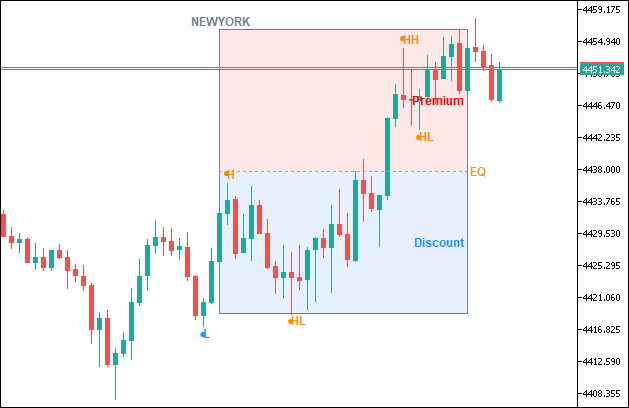
We render the whole setup on the chart here, routing everything through "DrawHLevel" and its sibling box, text, and marker helpers. With "DrawSessionBox", we fill the premium half above equilibrium and the discount half below it, outline the range, and label the zones — this is where we make the abstract idea of expensive and cheap price visible. With "DrawBiasStructure", we draw the bias high and low whose breaks flip order flow; with "DrawMssLine", we extend the dash-dot trigger line while a setup is armed; with "DrawEntryLevels", we lay down the entry, stop, and target lines with a direction arrow; and with "DrawSwingMarker", we label each confirmed pivot as H/HH/LH or L/LL/HL. Together, these give us a chart where the bias, session zones, pending trigger, and trade are all legible at a glance, as shown below.
Establishing the Bias and Tracking Structure
Now we reach the logic that gives the program its direction. We define two functions here: one that reads the higher-timeframe bias from market structure, and one that tracks the entry-timeframe swings that feed the trigger.
//+------------------------------------------------------------------+
//| Update the higher-timeframe bias from market structure           |
//+------------------------------------------------------------------+
void UpdateBias()
  {
//--- Only recompute on a fresh bias-TF bar
   datetime bt = iTime(_Symbol, InpBiasTimeframe, 0);
   if(bt == g_lastBiasBar) return;
   g_lastBiasBar = bt;
//--- Refresh the latest bias-TF swing points
   bool isHigh, isLow; double hi, lo; datetime t;
   if(ScanPivot(InpBiasTimeframe, InpBiasSwingLookback, isHigh, isLow, hi, lo, t))
     {
      //--- Store a new swing high when found
      if(isHigh && t != g_biasSwingHighTime) { g_biasSwingHigh = hi; g_biasSwingHighTime = t; }
      //--- Store a new swing low when found
      if(isLow  && t != g_biasSwingLowTime)  { g_biasSwingLow  = lo; g_biasSwingLowTime  = t; }
     }
//--- Remember the prior bias to detect a change
   int prevBias = g_bias;
//--- Read the last closed bias-TF close
   double c1 = iClose(_Symbol, InpBiasTimeframe, 1);
//--- Turn bullish on a close above the last swing high
   if(g_biasSwingHigh > 0 && c1 > g_biasSwingHigh)      g_bias = 1;
//--- Turn bearish on a close below the last swing low
   else if(g_biasSwingLow > 0 && c1 < g_biasSwingLow)   g_bias = -1;
//--- Act only when the bias actually flips
   if(g_bias != prevBias)
     {
      //--- Log the new directional bias
      Log("Bias -> " + (g_bias > 0 ? "BULLISH" : (g_bias < 0 ? "BEARISH" : "NEUTRAL")));
      //--- Mark the break of structure on its broken swing level
      if(g_bias != 0 && VisualsAllowed())
        {
         //--- Select the broken level for the new bias
         bool bull = (g_bias > 0);
         double brokenLevel = bull ? g_biasSwingHigh : g_biasSwingLow;
         //--- Anchor the marker to the bar that broke structure
         datetime bosBar = iTime(_Symbol, InpBiasTimeframe, 1);
         string nm = "BB_BOS_" + IntegerToString((int)bosBar);
         color clr = bull ? InpBiasHighColor : InpBiasLowColor;
         //--- Draw the break-of-structure marker on its line
         DrawMarker(nm, bosBar, brokenLevel, bull, clr, bull ? ANCHOR_UPPER : ANCHOR_LOWER);
         //--- Anchor the label above a bullish break or below a bearish one
         ENUM_ANCHOR_POINT a = ANCHOR_LEFT_LOWER;
         if(bull) a = ANCHOR_LEFT_UPPER;
         //--- Label the break of structure
         DrawText(nm + "_t", bosBar, brokenLevel, bull ? " BULLISH BOS" : " BEARISH BOS", clr, a);
        }
     }
  }

//+------------------------------------------------------------------+
//| Detect the latest confirmed entry-TF swing high and low          |
//+------------------------------------------------------------------+
void DetectEntrySwings()
  {
//--- Scan for a fresh entry-TF pivot, else bail out
   bool isHigh, isLow; double hi, lo; datetime t;
   if(!ScanPivot(InpEntryTimeframe, InpMssSwingLookback, isHigh, isLow, hi, lo, t)) return;
//--- Handle a fresh swing high
   if(isHigh && t != g_lastSwingHighTime)
     {
      //--- Label it H, HH or LH against the previous high
      string label; color clr = InpSwingHighColor;
      if(g_lastSwingHigh <= 0)      label = "H";
      else if(hi > g_lastSwingHigh) label = "HH";
      else                        { label = "LH"; clr = InpSwingLowColor; }
      //--- Draw the swing-high marker
      DrawSwingMarker(true, t, hi, label, clr);
      //--- Store the new swing high
      g_lastSwingHigh = hi; g_lastSwingHighTime = t;
     }
//--- Handle a fresh swing low
   if(isLow && t != g_lastSwingLowTime)
     {
      //--- Label it L, LL or HL against the previous low
      string label; color clr = InpSwingLowColor;
      if(g_lastSwingLow <= 0)      label = "L";
      else if(lo < g_lastSwingLow)  label = "LL";
      else                       { label = "HL"; clr = InpSwingHighColor; }
      //--- Draw the swing-low marker
      DrawSwingMarker(false, t, lo, label, clr);
      //--- Store the new swing low
      g_lastSwingLow = lo; g_lastSwingLowTime = t;
     }
  }
We define the "UpdateBias" function to set the daily direction. We run it once per bias-timeframe bar, refresh the latest swing high and low through "ScanPivot", and turn the bias bullish on a close above the last swing high or bearish on a close below the last swing low. We act only when the bias flips, logging the change and marking the break of structure on the broken level — this is the filter that decides which side of a sweep we are willing to trade. We then define the "DetectEntrySwings" function to maintain the lower-timeframe picture, classifying each fresh pivot as an H/HH/LH or L/LL/HL and storing it, since these stored levels become the market structure shift trigger once a setup is armed.
Managing the Session Lifecycle
The setup logic only makes sense inside a live kill zone, so we define the "UpdateSessionState" function to manage that lifecycle: opening a fresh session, closing an old one, and growing the range as the session unfolds.
//+------------------------------------------------------------------+
//| Handle the day rollover and active-session lifecycle             |
//+------------------------------------------------------------------+
void UpdateSessionState()
  {
//--- Resolve which kill zone is active now
   string active = GetActiveSession();
//--- Track whether a new session just opened this bar
   bool justStarted = false;
//--- React only when the active session changes
   if(active != g_activeSession)
     {
      //--- Initialize state when entering a new session
      if(active != "")
        {
         //--- Stamp the session start time
         g_sessionStart      = TimeCurrent();
         //--- Seed the range with the first session bar
         g_sessionHigh       = iHigh(_Symbol, InpEntryTimeframe, 0);
         g_sessionLow        = iLow(_Symbol, InpEntryTimeframe, 0);
         //--- Reset the session counters and flags
         g_sessionBarCount   = 0;
         g_sessionTraded     = false;
         //--- Clear entry swings for a fresh session
         g_lastSwingHigh     = 0.0; g_lastSwingHighTime = 0;
         g_lastSwingLow      = 0.0; g_lastSwingLowTime  = 0;
         //--- Flag the fresh start and log it
         justStarted         = true;
         Log("Entered kill zone: " + active);
        }
      //--- Disarm any pending setup when the session ends
      else if(g_armed) Disarm("kill zone ended");
      //--- Store the new active session name
      g_activeSession = active;
     }
//--- Extend the range with the just-closed in-session bar
   if(g_activeSession != "" && !justStarted)
     {
      //--- Read the last closed bar range
      double hi = iHigh(_Symbol, InpEntryTimeframe, 1);
      double lo = iLow(_Symbol, InpEntryTimeframe, 1);
      //--- Push the session high up when exceeded
      if(hi > g_sessionHigh) g_sessionHigh = hi;
      //--- Push the session low down when exceeded
      if(lo < g_sessionLow)  g_sessionLow  = lo;
     }
  }
We define the "UpdateSessionState" function to manage the kill-zone lifecycle. When we enter a session, we stamp the start time, seed the range with the current bar, and reset the counters, traded flag, and entry swings for a clean slate; when we leave a session, we disarm any pending setup, since a trigger that never fired is invalid once the window closes. While the session stays active, we extend the range with each just-closed bar — pushing the high up or the low down — which keeps the premium and discount zones and their equilibrium current, and we skip only the opening bar we already seeded.
Wiring the Event Handlers
Everything so far has been building blocks; now we place them inside the event handlers that the terminal calls for us. We add our startup work to the OnInit event handler, our cleanup to the OnDeinit event handler, and our per-bar sequencing to the OnTick event handler.
//+------------------------------------------------------------------+
//| Expert initialization function                                   |
//+------------------------------------------------------------------+
int OnInit()
  {
//--- Cache the symbol digits and point size
   SymDigits = (int)SymbolInfoInteger(_Symbol, SYMBOL_DIGITS);
   SymPoint  = _Point;
//--- Configure the trade object magic number and slippage
   Trade.SetExpertMagicNumber(InpMagicNumber);
   Trade.SetDeviationInPoints(20);
//--- Parse the kill-zone windows once to avoid per-bar work
   g_londonStart = ParseHHMM(InpLondonStart);  g_londonEnd = ParseHHMM(InpLondonEnd);
   g_nyStart     = ParseHHMM(InpNewYorkStart); g_nyEnd     = ParseHHMM(InpNewYorkEnd);
   g_asiaStart   = ParseHHMM(InpAsiaStart);    g_asiaEnd   = ParseHHMM(InpAsiaEnd);
//--- Force a DST offset recompute on first use
   g_nyOffsetDay = -1;
//--- Reset the trade records and setup state
   ArrayResize(g_trades, 0);
   g_armed         = false;
   g_activeSession = "";
//--- Adopt any of our positions already open
   SyncTradeRecords();
//--- Seed the bar-time guards
   g_lastEntryBar = iTime(_Symbol, InpEntryTimeframe, 0);
   g_lastBiasBar  = 0;
//--- Log a ready banner with the key settings
   Log("Bread & Butter Engine EA v" + EA_VERSION + " ready on " + _Symbol +
       " | entry " + EnumToString(InpEntryTimeframe) + " | bias " + EnumToString(InpBiasTimeframe) +
       " | Magic " + IntegerToString(InpMagicNumber));
//--- Report successful initialization
   return INIT_SUCCEEDED;
  }

//+------------------------------------------------------------------+
//| Expert deinitialization function                                 |
//+------------------------------------------------------------------+
void OnDeinit(const int reason)
  {
//--- Delete our chart objects on a real removal or chart close
   if(reason == REASON_REMOVE || reason == REASON_CHARTCLOSE || reason == REASON_CLOSE)
      ObjectsDeleteAll(0, "BB_");
//--- Clear any chart comment
   Comment("");
  }

//+------------------------------------------------------------------+
//| Expert tick function                                             |
//+------------------------------------------------------------------+
void OnTick()
  {
//--- Run per-bar logic only on a new entry-TF bar
   if(IsNewEntryBar())
     {
      //--- Update the kill-zone session lifecycle
      UpdateSessionState();
      //--- Update the higher-timeframe bias (self-gates to bias bars)
      UpdateBias();
      //--- Do setup work only inside an active kill zone
      if(g_activeSession != "")
        {
         //--- Count another in-session bar
         g_sessionBarCount++;
         //--- Detect the latest entry-TF swings
         DetectEntrySwings();
        }
     }
  }
We begin with the OnInit event handler, where we prepare everything the program needs before the first tick. We cache the symbol digits and point size to avoid repeated lookups, then configure the trade object with our magic number and a small deviation allowance. We parse each kill-zone window once with the "ParseHHMM" function so those strings never touch the live path, and we force a daylight saving recompute on first use by invalidating the cached day. We clear the trade records and setup state, adopt any of our positions that are already open, and seed the bar-time guards so the first bar is recognized correctly. A ready banner then prints the key settings, and we return INIT_SUCCEEDED to confirm the program is good to run.
We add the cleanup to the OnDeinit event handler, which the terminal calls when the program is removed or the chart closes. We delete only our own chart objects by their shared name prefix, and only on a genuine removal or chart close rather than a routine recompile, so a parameter change does not wipe the visuals unnecessarily. Clearing the chart comment leaves the chart clean behind us.
Finally, we add our per-bar sequence to the OnTick event handler. The whole block is gated by the "IsNewEntryBar" function so the logic runs once per bar rather than on every tick. On a fresh bar, we update the session lifecycle, refresh the higher-timeframe bias, and then, only inside an active kill zone, count the in-session bar and detect the latest entry-timeframe swings. When the program runs, we see the following.
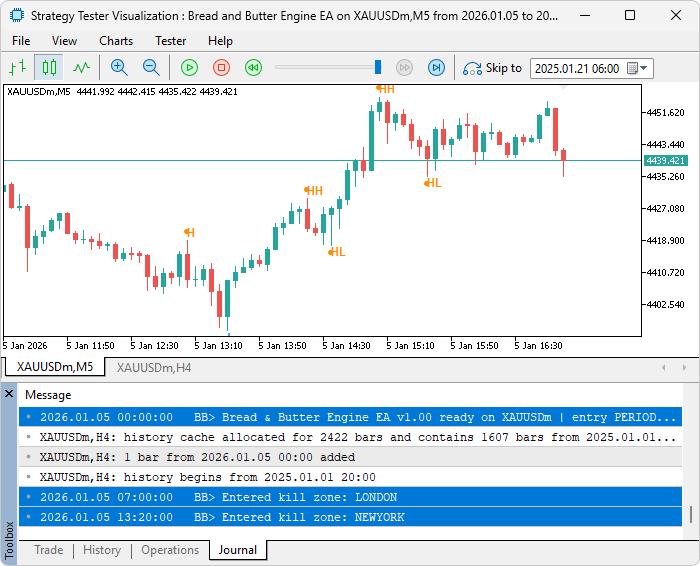
We can see that the program initialized and built the sessions, confirming the partial wiring works. Next, we add the arming, entry, and trade-management calls, beginning with the arming logic.
Arming a Setup
This is where the model's conditions come together. We define the "TryArm" function to watch the active session and latch a pending setup once a sweep into premium or discount lines up with the bias.
//+------------------------------------------------------------------+
//| Try to arm a setup inside the active kill zone                   |
//+------------------------------------------------------------------+
void TryArm()
  {
//--- Require an active session, a bias, and no existing armed setup
   if(g_activeSession == "" || g_bias == 0 || g_armed || g_sessionTraded) return;
//--- Respect the single-trade limit unless multiples are allowed
   if(!InpAllowMultiple && CountOurPositions() > 0) return;
//--- Require enough session bars for a valid range
   if(g_sessionBarCount < InpMinSessionBars) return;
//--- Require a non-degenerate session range
   if(g_sessionHigh <= g_sessionLow) return;
//--- Compute the equilibrium and read the current bid
   double eq    = (g_sessionHigh + g_sessionLow) / 2.0;
   double price = SymbolInfoDouble(_Symbol, SYMBOL_BID);
//--- Bearish flow: fade a push into premium after a high sweep
   if(g_bias < 0 && IsDirectionAllowed(false))
     {
      //--- Arm only above equilibrium with a completed sweep
      if(price >= eq && SweepDone(true))
        {
         //--- Latch the armed bearish setup, MSS on a break below the last swing low
         g_armed        = true;
         g_setupDir     = -1;
         g_setupExtreme = g_sessionHigh;
         g_mssLevel     = g_lastSwingLow;
         g_armBarTime   = iTime(_Symbol, InpEntryTimeframe, 0);
         //--- Log the armed bearish setup
         Log("Bearish setup ARMED in " + g_activeSession + " | premium sweep done, waiting for MSS below " + DoubleToString(g_mssLevel, SymDigits));
         //--- Mark the swept high
         DrawMarker("BB_Sweep_" + IntegerToString((int)g_armBarTime), g_armBarTime, g_setupExtreme, false, InpSweepColor, ANCHOR_LOWER);
         //--- Label the swept high
         DrawText("BB_SweepTxt_" + IntegerToString((int)g_armBarTime), g_armBarTime, g_setupExtreme, " SWEEP", InpSweepColor, ANCHOR_LOWER);
         //--- Draw the pending MSS trigger line
         DrawMssLine();
        }
     }
//--- Bullish flow: fade a push into discount after a low sweep
   else if(g_bias > 0 && IsDirectionAllowed(true))
     {
      //--- Arm only below equilibrium with a completed sweep
      if(price <= eq && SweepDone(false))
        {
         //--- Latch the armed bullish setup, MSS on a break above the last swing high
         g_armed        = true;
         g_setupDir     = 1;
         g_setupExtreme = g_sessionLow;
         g_mssLevel     = g_lastSwingHigh;
         g_armBarTime   = iTime(_Symbol, InpEntryTimeframe, 0);
         //--- Log the armed bullish setup
         Log("Bullish setup ARMED in " + g_activeSession + " | discount sweep done, waiting for MSS above " + DoubleToString(g_mssLevel, SymDigits));
         //--- Mark the swept low
         DrawMarker("BB_Sweep_" + IntegerToString((int)g_armBarTime), g_armBarTime, g_setupExtreme, true, InpSweepColor, ANCHOR_UPPER);
         //--- Label the swept low
         DrawText("BB_SweepTxt_" + IntegerToString((int)g_armBarTime), g_armBarTime, g_setupExtreme, " SWEEP", InpSweepColor, ANCHOR_UPPER);
         //--- Draw the pending MSS trigger line
         DrawMssLine();
        }
     }
  }
We define the "TryArm" function to decide whether the pieces are in place to prepare a trade. We first clear our gates — an active session, a resolved bias, no setup already armed, no trade taken this session, the single-trade limit respected, enough session bars for a valid range, and a range where the high sits above the low — then compute equilibrium and read the current bid. In bearish flow, when price is at or above equilibrium with a completed sweep of the recent high, we latch a bearish setup: we anchor the stop on the swept high and set the trigger at the last swing low. We mirror this in bullish flow below equilibrium with a swept low. We then call it in the tick handler as below.
//+------------------------------------------------------------------+
//| Expert tick function                                             |
//+------------------------------------------------------------------+
void OnTick()
  {
//--- Run per-bar logic only on a new entry-TF bar
   if(IsNewEntryBar())
     {
      //--- Update the kill-zone session lifecycle
      UpdateSessionState();
      //--- Update the higher-timeframe bias (self-gates to bias bars)
      UpdateBias();
      //--- Do setup work only inside an active kill zone
      if(g_activeSession != "")
        {
         //--- Count another in-session bar
         g_sessionBarCount++;
         //--- Detect the latest entry-TF swings
         DetectEntrySwings();
         //--- Try to arm a setup on a sweep
         TryArm();
        }
      //--- Reconcile records only when positions may exist
      if(ArraySize(g_trades) > 0 || PositionsTotal() > 0)
        {
         //--- Drop closed positions then adopt untracked ones
         PruneTradeRecords();
         SyncTradeRecords();
        }
      //--- Draw only when visuals are shown
      if(VisualsAllowed())
        {
         //--- Draw the bias structure levels
         DrawBiasStructure();
         //--- Draw the session box while a session is active
         if(g_activeSession != "") DrawSessionBox();
         //--- Flush the chart updates
         ChartRedraw(0);
        }
     }
  }
After compiling, we get the following result.
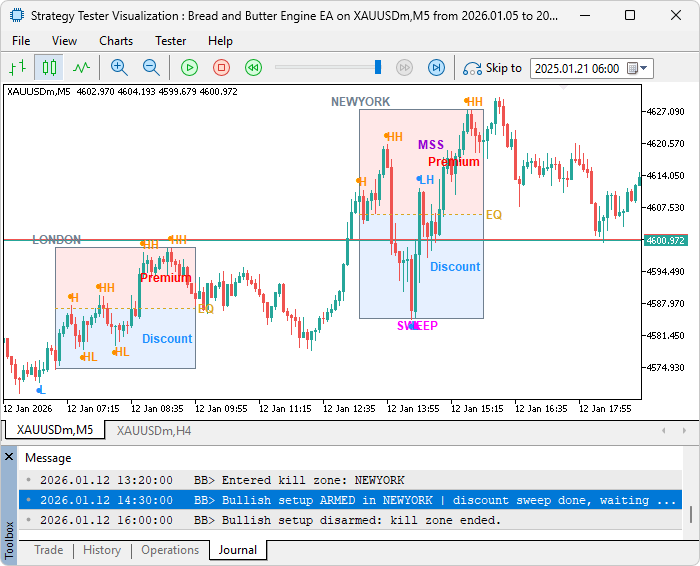
The key point is that arming is not entering: we have only recognized that liquidity was taken while price sits on the correct side of equilibrium for our bias. We now wait for structure to shift, and that trigger check is what we build next.
Confirming the Shift and Opening the Trade
With a setup armed, we now build the two functions that turn it into a live position: one that watches for the market structure shift and one that sizes, protects, and sends the order.
//+------------------------------------------------------------------+
//| Size, build SL and TP, and open the trade                        |
//+------------------------------------------------------------------+
void OpenTrade(bool isBull)
  {
//--- Respect the single-trade limit unless multiples are allowed
   if(!InpAllowMultiple && CountOurPositions() > 0) return;
//--- Enter at the market on the correct side
   double entry = isBull ? NormalizeDouble(SymbolInfoDouble(_Symbol, SYMBOL_ASK), SymDigits)
                         : NormalizeDouble(SymbolInfoDouble(_Symbol, SYMBOL_BID), SymDigits);
//--- Build the stop loss by the selected mode
   double stop;
   if(InpStopLossMode == SL_MANUAL)
     {
      //--- Manual: fixed point distance from entry
      double slDist = InpManualStopPoints * SymPoint;
      stop = isBull ? entry - slDist : entry + slDist;
     }
   else
     {
      //--- Auto: beyond the swept extreme by the buffer
      double buffer = InpStopBufferPoints * SymPoint;
      stop = isBull ? g_setupExtreme - buffer : g_setupExtreme + buffer;
     }
//--- Normalize the stop and measure the risk distance
   stop = NormalizeDouble(stop, SymDigits);
   double riskDistance = MathAbs(entry - stop);
//--- Abort on an invalid risk distance
   if(riskDistance <= 0) { Disarm("invalid risk distance"); return; }
//--- Set the take profit at the reward-to-risk multiple of the stop
   double takeProfit = NormalizeDouble(isBull ? entry + InpRewardRiskRatio * riskDistance
                                              : entry - InpRewardRiskRatio * riskDistance, SymDigits);
//--- Resolve the lot size for this trade
   double lots = ResolveLots(entry, stop);
//--- Abort on a lot sizing error
   if(lots <= 0) { Disarm("lot calc error"); return; }
//--- Send the market order on the correct side
   bool ok = isBull ? Trade.Buy(lots, _Symbol, entry, stop, takeProfit, InpOrderComment)
                    : Trade.Sell(lots, _Symbol, entry, stop, takeProfit, InpOrderComment);
//--- Record and annotate a successful fill
   if(ok)
     {
      //--- Track the new position for later management
      ulong ticket = Trade.ResultOrder();
      AddTradeRecord(ticket, isBull, entry, stop);
      //--- Lock the session to one trade
      g_sessionTraded = true;
      //--- Draw the entry, stop and target levels
      datetime now = iTime(_Symbol, InpEntryTimeframe, 0);
      DrawEntryLevels(isBull, now, entry, stop, takeProfit);
      //--- Log the fill with its resulting reward-to-risk
      double rr = MathAbs(takeProfit - entry) / riskDistance;
      Log((isBull ? "BUY" : "SELL") + " filled @ " + DoubleToString(entry, SymDigits) +
          "  SL=" + DoubleToString(stop, SymDigits) + "  TP=" + DoubleToString(takeProfit, SymDigits) +
          "  lots=" + DoubleToString(lots, 2) + "  (R:R " + DoubleToString(rr, 2) + ")");
     }
   else
      //--- Log the failure reason
      Log("Open failed: " + Trade.ResultRetcodeDescription());
//--- Clear the armed flag after the attempt
   g_armed = false;
  }

//+------------------------------------------------------------------+
//| While armed, update the trigger and check for the MSS entry      |
//+------------------------------------------------------------------+
void CheckArmedForEntry()
  {
//--- Do nothing when no setup is armed
   if(!g_armed) return;
//--- Disarm if the bearish bias no longer holds
   if(g_setupDir < 0 && g_bias >= 0) { Disarm("bias no longer bearish"); return; }
//--- Disarm if the bullish bias no longer holds
   if(g_setupDir > 0 && g_bias <= 0) { Disarm("bias no longer bullish"); return; }
//--- Disarm once the kill zone has ended
   if(g_activeSession == "")         { Disarm("kill zone ended"); return; }
//--- Disarm if the setup waited too long without a trigger
   int barsElapsed = iBarShift(_Symbol, InpEntryTimeframe, g_armBarTime);
   if(barsElapsed > InpMaxWaitBars) { Disarm("no MSS in time"); return; }
//--- Read the last closed entry-TF close
   double priorClose = iClose(_Symbol, InpEntryTimeframe, 1);
//--- Handle the armed bearish setup
   if(g_setupDir < 0)
     {
      //--- Track the swept high and refresh the MSS level
      g_setupExtreme = MathMax(g_setupExtreme, iHigh(_Symbol, InpEntryTimeframe, 1));
      if(g_lastSwingLow > 0) g_mssLevel = g_lastSwingLow;
      //--- Extend the MSS line
      DrawMssLine();
      //--- Enter short on a close below the structure level
      if(g_mssLevel > 0 && priorClose < g_mssLevel) OpenTrade(false);
     }
   else
     {
      //--- Track the swept low and refresh the MSS level
      g_setupExtreme = MathMin(g_setupExtreme, iLow(_Symbol, InpEntryTimeframe, 1));
      if(g_lastSwingHigh > 0) g_mssLevel = g_lastSwingHigh;
      //--- Extend the MSS line
      DrawMssLine();
      //--- Enter long on a close above the structure level
      if(g_mssLevel > 0 && priorClose > g_mssLevel) OpenTrade(true);
     }
  }
We define the "CheckArmedForEntry" function to supervise an armed setup until it triggers or is invalidated. We disarm when the bias flips against the setup, the kill zone ends, or too many bars pass; otherwise we keep the swept extreme and trigger level current and fire when the last closed bar closes through that structure level — the market structure shift. We then define the "OpenTrade" function to execute: we enter at market, build the stop either at a fixed distance or beyond the swept extreme by a buffer, set the take-profit at the reward-to-risk multiple, resolve the lot size, and abort cleanly on an invalid risk or lot. On a fill, we record the position, lock the session to one trade, draw the levels, and log the result.
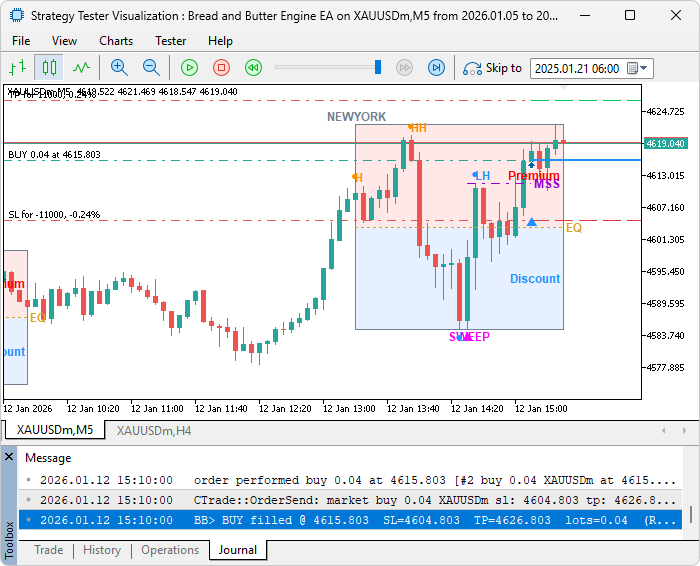
With the setup armed, confirmed, and triggered, what remains is managing the positions, and here is the logic we use to achieve that.
Managing the Open Position
Once a trade is live, we manage it with two optional tools: banking a partial at the first target and trailing the stop as the price runs. We define the "ManageOneTrade" function to handle a single position and the "ManageOpenTrades" function to walk them all.
//+------------------------------------------------------------------+
//| Manage one open trade with optional partial and trailing         |
//+------------------------------------------------------------------+
void ManageOneTrade(ulong ticket)
  {
//--- Select the position and confirm it is ours on this symbol
   if(!PositionSelectByTicket(ticket)) return;
   if(PositionGetInteger(POSITION_MAGIC) != InpMagicNumber) return;
   if(PositionGetString(POSITION_SYMBOL) != _Symbol) return;
//--- Read the core position fields
   bool   isBull      = (PositionGetInteger(POSITION_TYPE) == POSITION_TYPE_BUY);
   double entry       = PositionGetDouble(POSITION_PRICE_OPEN);
   double currentStop = PositionGetDouble(POSITION_SL);
   double currentTP   = PositionGetDouble(POSITION_TP);
   double volume      = PositionGetDouble(POSITION_VOLUME);
//--- Recover the original risk distance from the record when available
   int    recIdx       = FindTradeRecord(ticket);
   double riskDistance = (recIdx >= 0 && g_trades[recIdx].riskDistance > 0)
                          ? g_trades[recIdx].riskDistance : MathAbs(entry - currentStop);
//--- Abort on a zero risk distance
   if(riskDistance <= 0) return;
//--- Read the current bid and ask
   double bid = SymbolInfoDouble(_Symbol, SYMBOL_BID);
   double ask = SymbolInfoDouble(_Symbol, SYMBOL_ASK);
//--- Express open profit in R multiples
   double profitR = isBull ? (bid - entry) / riskDistance : (entry - ask) / riskDistance;
//--- Bank a one-time partial once the first R target is reached
   if(InpUsePartialClose && recIdx >= 0 && !g_trades[recIdx].partialTaken && profitR >= InpPartialAtRR)
     {
      //--- Read the volume constraints for the partial
      double volMin   = SymbolInfoDouble(_Symbol, SYMBOL_VOLUME_MIN);
      double volStep  = SymbolInfoDouble(_Symbol, SYMBOL_VOLUME_STEP);
      //--- Compute the closable volume snapped to the step
      double closeVol = MathFloor((volume * InpPartialPercent / 100.0) / volStep) * volStep;
      closeVol = NormalizeDouble(closeVol, 2);
      //--- Close the partial only if both sides stay above the minimum
      if(closeVol >= volMin && (volume - closeVol) >= volMin)
         if(Trade.PositionClosePartial(ticket, closeVol))
            Log("Partial close " + DoubleToString(closeVol, 2) + " @ " + DoubleToString(profitR, 2) + "R");
      //--- Mark the partial as taken regardless of outcome
      g_trades[recIdx].partialTaken = true;
     }
//--- Trail the stop once past the minimum profit plus trail distance
   if(InpUseTrailingStop)
     {
      //--- Measure open profit in points
      double profitPoints = isBull ? (bid - entry) / SymPoint : (entry - ask) / SymPoint;
      //--- Activate trailing past the activation threshold
      if(profitPoints >= InpMinProfitPoints + InpTrailPoints)
        {
         //--- Compute the trailed stop behind price
         double newStop = isBull ? bid - InpTrailPoints * SymPoint : ask + InpTrailPoints * SymPoint;
         newStop = NormalizeDouble(newStop, SymDigits);
         //--- Move the stop only when it improves protection
         bool improves = isBull ? (newStop > currentStop) : (currentStop == 0 || newStop < currentStop);
         if(improves) Trade.PositionModify(ticket, newStop, currentTP);
        }
     }
  }

//+------------------------------------------------------------------+
//| Manage every tracked open trade                                  |
//+------------------------------------------------------------------+
void ManageOpenTrades()
  {
//--- Walk the records backward and manage each position
   for(int i = ArraySize(g_trades) - 1; i >= 0; i--)
      ManageOneTrade(g_trades[i].ticket);
  }
We define the "ManageOneTrade" function to handle a position after it opens. We recover the original risk distance from our stored record rather than the live stop — critical once trailing moves the stop — and express open profit as a multiple of R. When it is enabled and profit reaches the R target, we bank a one-time partial of our chosen percentage, snapped to the volume step and closed only if both slices stay above the minimum. We then advance the trailing stop behind price once profit clears its activation threshold, applying it only when it improves protection. Above this, we define the "ManageOpenTrades" function as a thin loop over our records, which lets the scheme scale when multiple positions are allowed. What remains is testing, covered next.
Backtesting
We compile the program and run it in the MetaTrader 5 strategy tester in visual mode, which lets us watch each session build and each setup arm bar by bar. The result is shown below as a Graphics Interchange Format (GIF).
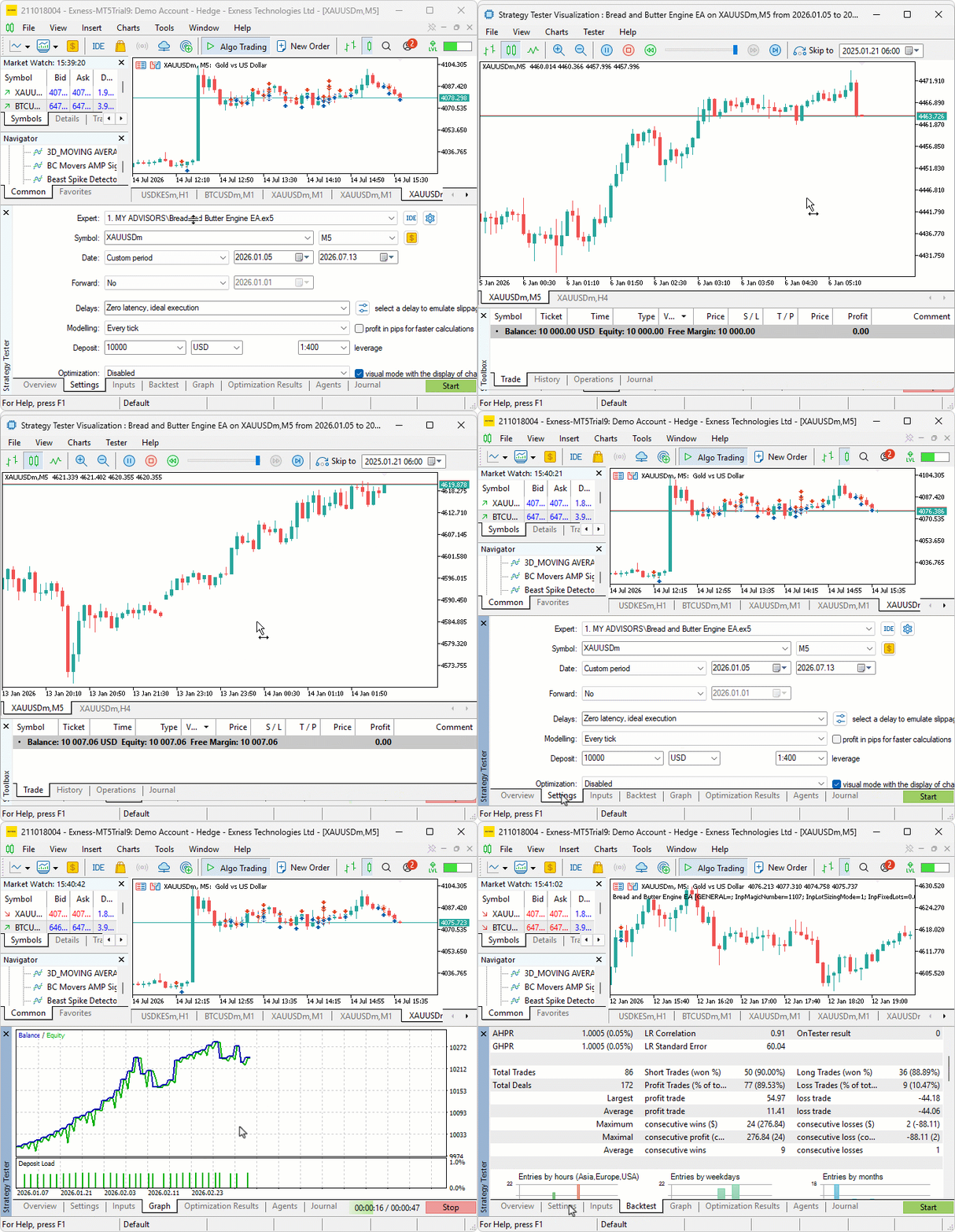
The test confirmed each stage worked as we designed it: the bias filter kept our trades in the higher-timeframe direction, setups armed only after a sweep of the session extreme into premium or discount, entries fired only on a close back through structure, and the optional trailing stop advanced once profit cleared its activation threshold.
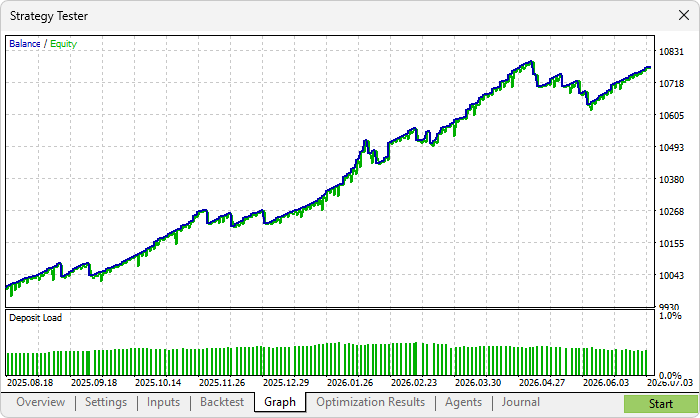
Backtest graph:
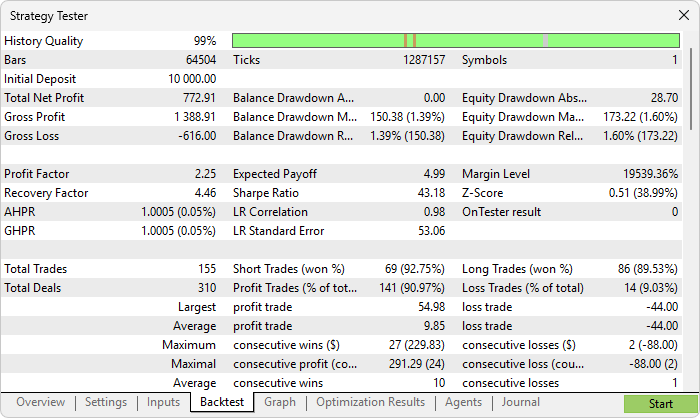
Backtest report:
Conclusion
In conclusion, we built the Bread and Butter Judas Swing program in MQL5: a session-based reversal model that fades liquidity sweeps into premium and discount, but only in the direction of a higher-timeframe bias. We read the daily bias from structure, restrict activity to New York kill zones with daylight saving resolved automatically, arm a setup after a sweep into the correct zone, wait for a market structure shift to confirm, and then manage the trade with fixed or risk-based sizing, a structural or manual stop, and optional partial and trailing exits. Instead of chasing the Judas swing, we wait for the trap to be set and structure to turn before committing.
Disclaimer: This article is for educational purposes only. Trading carries significant financial risks, and past performance during backtesting does not guarantee future results. Thorough backtesting and careful risk management are essential before deploying this program in live markets.
After reading this article, you will be able to:
- Arm a session reversal only when a higher-timeframe bias, a kill-zone window, and a sweep into premium or discount all align.
- Confirm entries on a market structure shift and manage them with structural stops and optional partial and trailing exits.
We kept the model to one trade per session, but the same structure extends to multi-session tracking and setup grading.
Warning: All rights to these materials are reserved by MetaQuotes Ltd. Copying or reprinting of these materials in whole or in part is prohibited.
This article was written by a user of the site and reflects their personal views. MetaQuotes Ltd is not responsible for the accuracy of the information presented, nor for any consequences resulting from the use of the solutions, strategies or recommendations described.

 Building a Modular Fair Value Gap (FVG) Detection Engine in MQL5
 MCMC Sampling Methods — The Metropolis-Hastings Algorithm
 Mathematical Models in Grid Strategies
 Neural Networks in Trading: Effective Feature Extraction for Accurate Classification (Final Part)

- Free trading apps
- Over 8,000 signals for copying
- Economic news for exploring financial markets
You agree to website policy and terms of use