Value Area Confluence
- Эксперты
-
Alex Amuyunzu Raymond
 I’m an experienced MQL5 developer and software engineer specializing in building robust, high-performance algorithmic trading systems for MetaTrader 5. My work goes beyond standard EA development — I design intelligent, scalable solutions that combine market logic, automation, and external
 - Версия: 1.12
- Активации: 5
VALUE AREA CONFLUENCE
A Multi-Symbol Price Action & Volume Profile Confluence Engine
The Idea Behind It
Most Expert Advisors pick a side. Some are pure price action — they read swings, patterns, and structure but have no idea where the real money traded. Others are pure volume tools — they show you the POC and Value Area but never tell you when to pull the trigger. Almost none of them do both, and virtually none do both across multiple symbols at once while scoring every setup objectively.
Value Area Confluence was built to close that gap.
It is a complete multi-symbol trading engine that fuses classical price action structure with native Volume Profile analysis, then reduces everything into a single, objective confluence score. When enough independent signals agree — structure, pattern, level, trendline, and volume node — the EA acts. When they don't, it stays quiet.
No guessing. No repainting. No discretionary "looks good to me." Just measured confluence, executed with institutional-grade risk control.
What Makes It Different
1. Fractal Swing Structure Engine
The EA reads the market the way a structural trader does. Using a configurable fractal wing, it identifies true swing highs and swing lows, filters out noise, and cleans the sequence into a readable pivot map. From that map it classifies the market into three states:
-
Uptrend — confirmed by higher highs and higher lows
-
Downtrend — confirmed by lower highs and lower lows
-
Range — anything that doesn't qualify
This trend classification is not based on a moving average crossover. It's based on the actual geometry of price — the same logic a discretionary swing trader uses, but applied consistently across every symbol, every bar, without emotion.
2. ATR-Normalized Candlestick Pattern Recognition
The engine detects and scores the classic high-probability reversal and continuation candles:
-
Bullish / Bearish Engulfing
-
Bullish / Bearish Pin Bars (hammer / shooting star)
-
Bullish / Bearish Outside Bars
-
Morning Star / Evening Star
-
Inside Bars and Doji (context markers)
Every pattern is normalized by ATR — meaning a pin bar on a quiet pair and a pin bar on a volatile pair are scored on equal footing. A pattern is only counted when its body, wick, and range meet real proportional thresholds, not fixed pip values that break across symbols.
3. Auto-Clustered Support & Resistance
Rather than drawing arbitrary horizontal lines, the EA takes every swing point from the structure engine, clusters them by ATR-based proximity, and builds touch-weighted S/R levels. A level touched five times is stronger than one touched once — and the EA knows it. These levels are then used both as confluence factors and as visual references on the chart.
4. Dynamic Trendlines from Swing Pivots
The EA fits linear regressions through the most recent swing lows (for support) and swing highs (for resistance). These are not hand-drawn lines — they are mathematically derived, and they update as new pivots form. When price approaches a computed trendline within an ATR-scaled tolerance, it counts toward confluence.
5. Chart Pattern Geometry — Double Top & Double Bottom
The engine measures the two most recent swing highs and two most recent swing lows. When they align within a fraction of ATR, a Double Top or Double Bottom is confirmed and drawn. These classical reversal formations are integrated directly into the confluence score.
6. Native Volume Profile — POC, VAH, VAL
This is the feature that separates it from every other price action EA on the market.
The EA builds a true Volume Profile for every symbol on the structure timeframe. It distributes each bar's volume across the price range it covered, bins it into configurable rows, and computes:
-
POC — the Point of Control, the single price where the most volume traded
-
VAH — the Value Area High, the upper boundary of the 70% volume zone
-
VAL — the Value Area Low, the lower boundary
These three prices are the market's true memory. They show where buyers and sellers actually agreed. The EA then measures how close current price is to these levels (using an ATR-scaled proximity) and awards confluence when a setup forms at a volume node — not in the middle of nowhere.
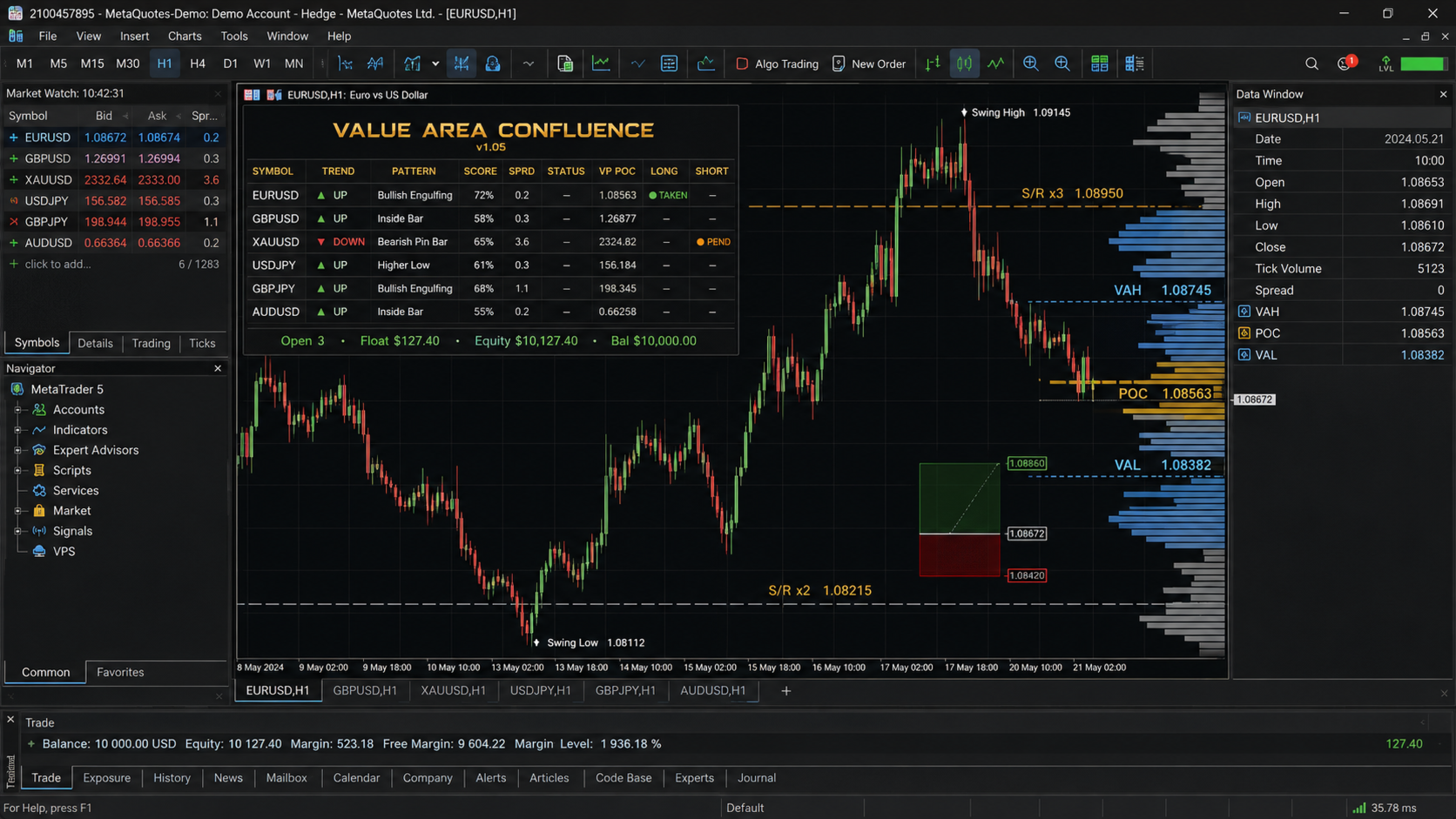
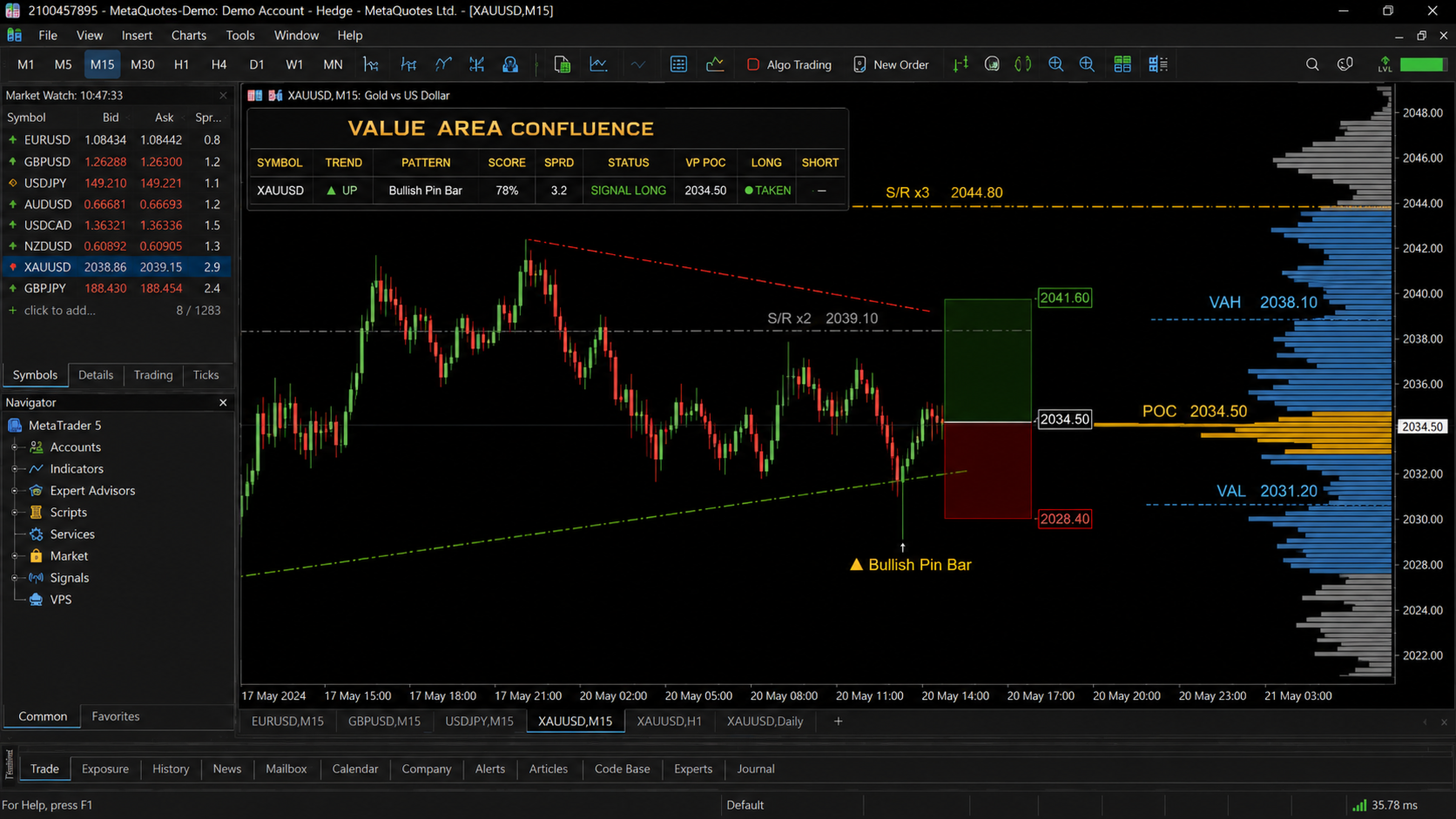
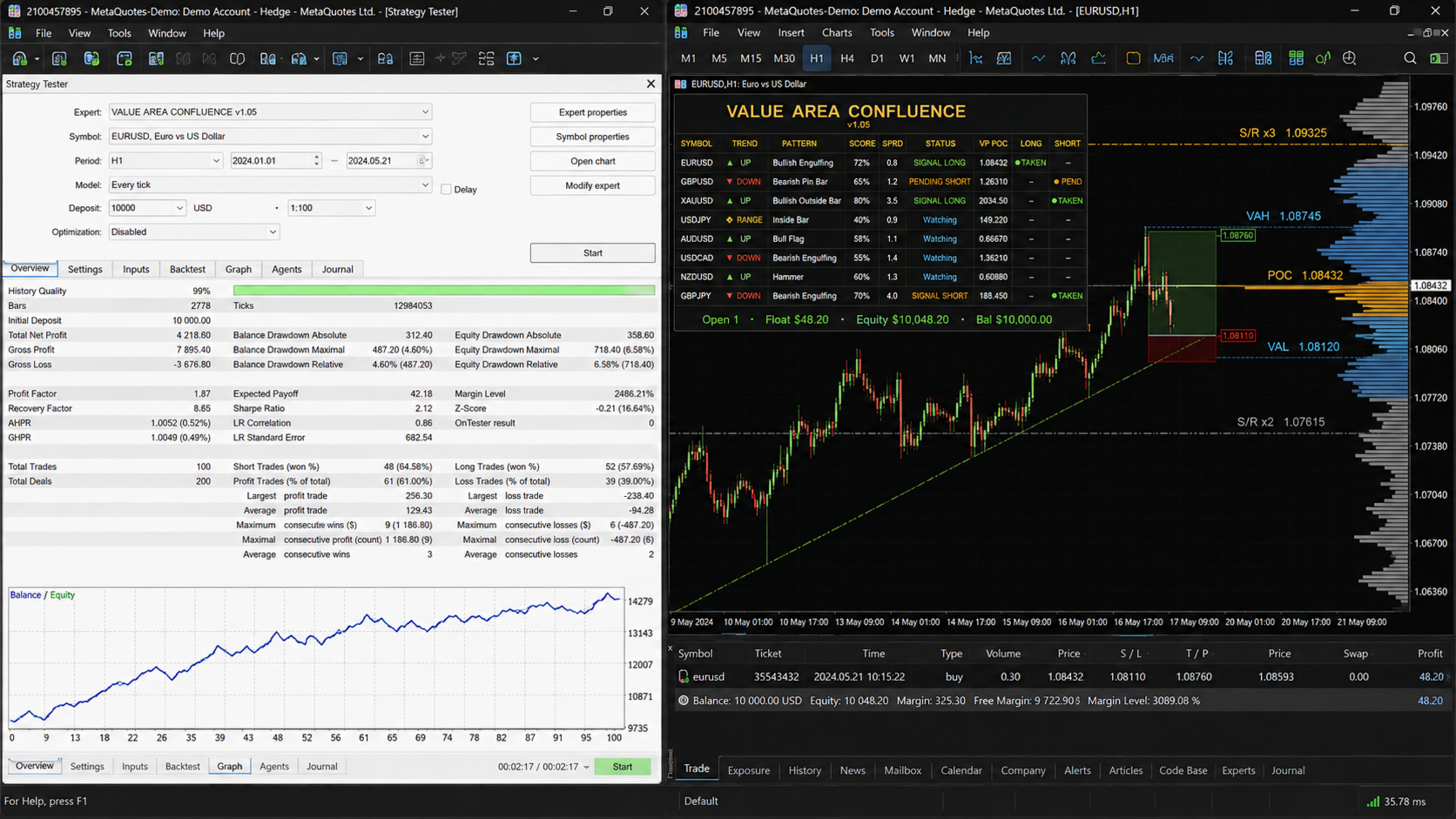
On the active chart, the full histogram is drawn natively — every bin, every row, color-coded by POC, Value Area, and outside range — with POC/VAH/VAL lines labeled. It looks like a professional volume profile tool because it is one.
7. The Confluence Scoring Engine
Here's the heart of the system. Every potential trade must accumulate a minimum confluence score before the EA will act. Each of the following adds to the score:
| Confluence Factor | Contribution |
|---|---|
| Valid candle pattern (ATR-qualified) | +1 |
| Trend alignment with structure | +1 |
| Price at a touch-weighted S/R level | +1 |
| Price at a computed trendline | +1 |
| Chart pattern confirmation (Double Top/Bottom) | +1 |
| Price at POC / VAH / VAL | +1 |
The default minimum is 3. You can raise it to demand only the highest-probability setups, or lower it for more frequency. The score is not a black box — every contributing reason is logged, alerted, and shown in the Telegram message and dashboard.
This is the difference between "the EA entered" and "the EA entered because six independent things agreed."
Multi-Symbol Architecture
Value Area Confluence is not a single-chart EA. It monitors up to 10 symbols simultaneously from one chart — reading structure, building S/R, fitting trendlines, computing Volume Profiles, and evaluating confluence for each one independently. The dashboard shows every symbol side by side, so you see the whole market at a glance.
Symbols, suffix handling, and timeframes are fully configurable.
Risk Management — Built Like an Institution
This is where the EA stops being a scanner and becomes a complete trading system.
Position Sizing
-
Risk is defined as a percentage of equity, not fixed lots.
-
Lot size is calculated from the actual SL distance in ticks.
-
Lots are normalized to broker volume step, min, and max.
Two-Order Partial Take Profit
-
Every signal places two positions with the same SL but different TPs.
-
TP1 at a configurable R-multiple (default 2R).
-
TP2 at a further R-multiple (default 3.5R).
-
The lot is split 50/50, locking partial profit while letting the runner breathe.
Breakeven Protection
-
Once price reaches a configurable R threshold (default 1.2R), SL is moved to breakeven plus a lock buffer.
-
Broker stop level and freeze level are respected before every modification.
Adaptive Trailing Stop
-
After breakeven, an ATR-based trail engages.
-
A Profit Lock Ladder can be enabled: for every R gained, a portion is locked in. The trail can never move against the position.
Hedge Guard
-
If a LONG is open on a symbol, the EA will not open a SHORT on the same symbol (and vice versa), and it will not place a pending order in the opposite direction.
-
This prevents accidental netting and double-risk exposure.
Order Expiry Management
-
Pending orders carry an expiration. When it fires, the order is deleted and the symbol status is updated to MISSED.
Account Protection Suite
Because real accounts need more than just good entries:
-
Max Open Positions — cap total exposure across all symbols (0 = unlimited).
-
Max Signals Per Day — throttle the EA on quiet or choppy days.
-
Equity Drawdown Circuit Breaker — halt all entries if equity falls a configurable percentage below its peak.
-
Max Daily Loss % — stop trading for the day once a loss threshold is hit.
-
Max Consecutive Losses — pause after a defined losing streak.
-
Time-Stop — close trades held longer than N bars, freeing capital from dead setups.
-
Friday No-Entry Cutoff — stop opening new positions late Friday.
-
Friday Close — close all EA positions before the weekend gap.
Every protection can be toggled independently. Every action is logged and (optionally) sent to Telegram.
Filters — Precision Without Overfitting
-
Higher-Timeframe EMA Filter — optional requirement that price is on the correct side of an HTF EMA before entry.
-
Minimum ATR Filter — skip dead, low-volatility markets entirely.
-
Spread Filter — reject signals when spread exceeds a configurable cap.
-
Session Filter — trade only London, only New York, both, or neither, with fully custom server-time hours.
-
Trend Alignment Requirement — optionally enforce that trades only fire in the direction of the structure trend.
Every filter is optional. Every filter is honest about what it does.
Telegram Notifications — Ticket-Aware, Not Spammy
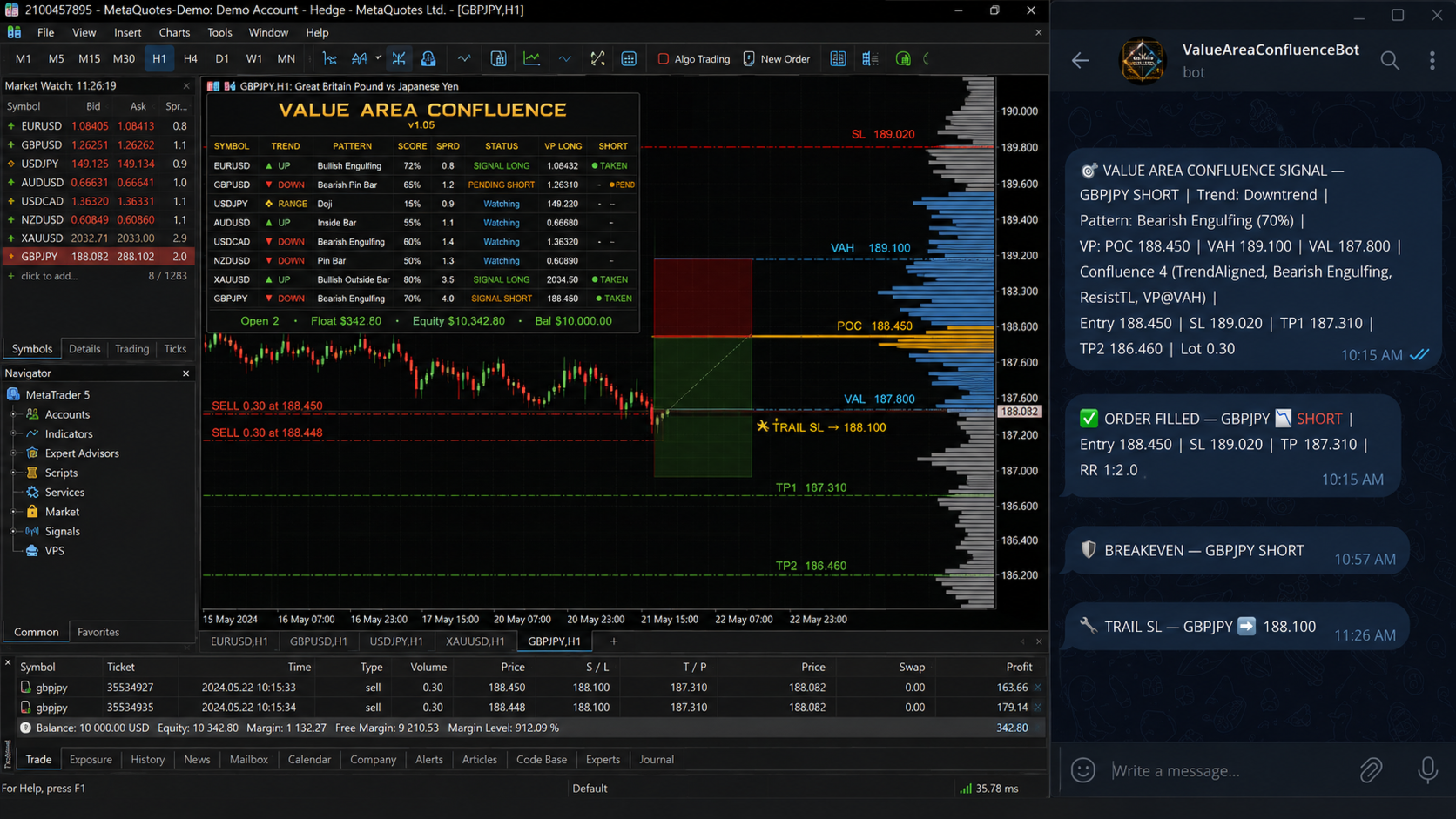
The EA sends structured Telegram alerts for:
-
Signals (with full context: trend, pattern, VP levels, confluence score, entry, SL, TP1, TP2, lot)
-
Order fills
-
Breakeven moves
-
Trail updates
-
Position closures (with realized P&L and daily P&L)
-
Order expirations
-
Weekend close
-
Time-stop closures
-
Trading pause events
Notifications are ticket-deduplicated — no duplicate "filled" messages, no repeated alerts for the same position. Credentials are configured via inputs (never hardcoded), and Telegram is automatically disabled in the Strategy Tester.
The Dashboard
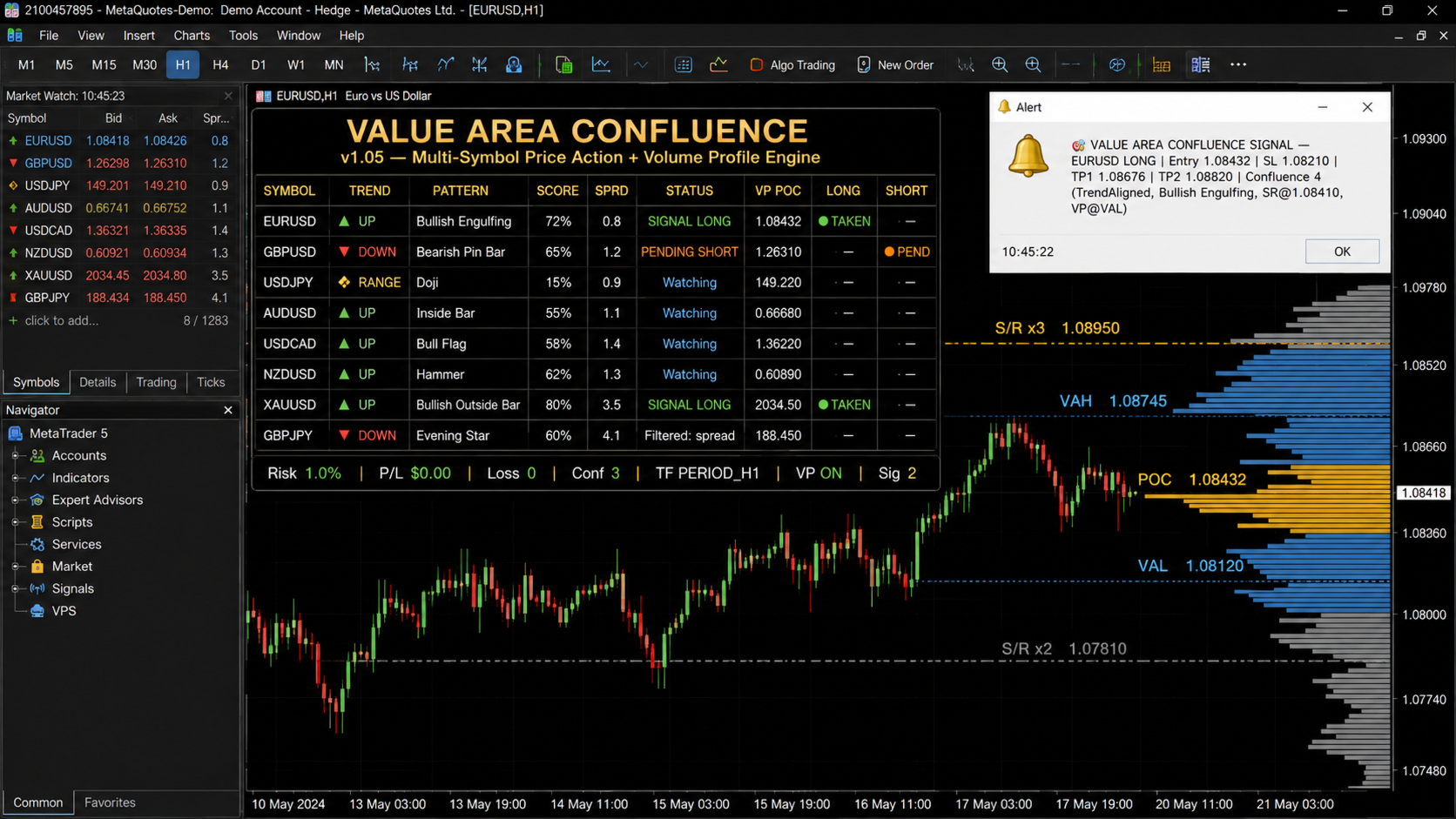
A professional dark/gold dashboard sits on the chart and shows, per symbol:
-
Symbol name
-
Trend state (▲ UP / ▼ DOWN / ◆ RANGE)
-
Last detected pattern with its score
-
Spread
-
Current status (signal, filtered, pending, taken, paused)
-
Volume Profile POC
-
LONG and SHORT trade status indicators
Below it: open positions, floating P&L, equity, and balance — all live. A compact / full view toggle lets you switch between a tight 10-symbol table and an expanded detailed layout with a single click.
The dashboard is not decoration. It is the operator's console.
What It Is Not
-
It is not a martingale.
-
It is not a grid.
-
It is not a hedging system.
-
It is not a "set and forget, 10,000% in a month" fantasy.
-
It does not repaint. It does not use future data.
-
It does not hide its logic behind a black box.
It is a structured, disciplined, confluence-based system for traders who understand that edge comes from agreement between independent signals, not from a single magic indicator.
Who It's For
-
Swing and intraday traders who already respect structure and volume.
-
Traders managing multiple pairs who want one console instead of ten charts.
-
Discretionary traders who want their logic automated, scored, and executed consistently.
-
Anyone who wants institutional-style risk control wrapped around a price-action core.
Recommended Setup
-
Structure TF: H1 or H4
-
Signal TF: M15 or M30
-
Min Confluence: 3 (default) — raise to 4 for fewer, higher-quality trades
-
Risk %: 0.5 – 1.0
-
Symbols: 4–8 liquid pairs (majors + one or two crosses)
-
Use HTF Filter: ON for trending markets, OFF for ranging
-
Use Session Filter: ON for London/NY overlap focus
The Bottom Line
Value Area Confluence does not try to predict the market. It waits for the market to agree with itself — across structure, pattern, level, geometry, and volume — and only then does it act.
That is the entire philosophy, encoded into one Expert Advisor.
If you trade value, you already understand why this works.
If you trade structure, you already understand why this works.
If you trade both, you already know you need this.
Value Area Confluence
Where Price Meets Value — And Value Meets Structure.