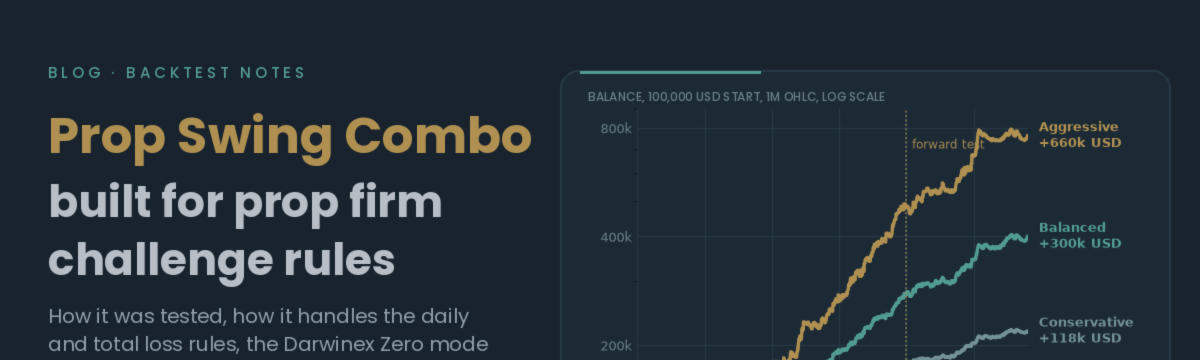
Prop Swing Combo: New Prop Presets, a Darwinex Zero Mode and Where the Loss Limits Stop the Profit (Backtest 2021-2026)

This post is about Prop Swing Combo, a swing trading Expert Advisor for prop firm style challenges and funded accounts. It covers the risk presets, a separate Darwinex Zero mode and five set files. I also want to answer one question openly: how far can the profit go before the usual loss limits stop it? Everything below is a backtest in the MetaTrader 5 Strategy Tester. It is simulated, not live trading. It does not guarantee that you pass a challenge, get funded or get an allocation, and Prop Swing Combo is not affiliated with any prop firm, with Darwinex or with Darwinex Zero.
[Product link: https://www.mql5.com/en/market/product/205286]
How the risk is managed
- Risk follows the balance. In the three presets the risk per trade is a percent of the current balance, not of the starting balance, so the lot grows after profits and shrinks after losses.
- Risk is cut in a drawdown. When the balance is more than 2% below its peak, the risk goes down step by step, to 40% of normal at 6% below the peak, and comes back as the balance recovers.
- Each preset has its own portfolio settings. Fewer open positions at the same time (3 or 4 instead of 7), which made more room for a higher risk per trade at the same drawdown.
- A second total loss line. Because the lot grows with the balance, the guard also closes everything and stops at 9% below the highest balance, not only at 9% below the start.
- Darwinex Zero mode. A separate account mode without the prop loss guards, built for a stable risk. Details below.
- Aggressive Max set file. The highest profit I found inside a 10% limit, for experienced users only, with a clear warning.
The trading logic is unchanged: seven symbols (EURUSD, GBPUSD, USDJPY, AUDUSD, EURJPY, XAUUSD, XAGUSD), three modules (trend pullback, trend breakout, mean reversion), closed bars of H1 and higher, one position per symbol, a stop loss on every trade. No martingale, no grid, no hedging, no averaging down.
The test setup
- Data: MetaQuotes-Demo history in the MT5 Strategy Tester, not prop firm server data.
- Period: 1 January 2021 to 23 October 2026. The optimiser only saw 2021 to 2024; 2025 to 23 October 2026 is the forward part.
- Account: 100,000 USD start, leverage 1:100 (Darwinex Zero mode 1:30), 1 minute OHLC model, with a real-tick check of the forward part.
- Costs: spread and swap from the data. No commission was added in the tester. My estimate (5 USD per lot round turn for currencies, 0.0007% of the traded value per side for metals) is shown for every preset.
Step 1: more strategies? No
The first idea for more profit was more strategies: other module settings and extra symbols found by the optimiser. I picked 54 single-module candidates using 2021 to 2024 only and checked them on 2025 to 2026. Most of them lost their edge in the forward part: a mix that had a profit factor of 1.59 on 2021 to 2024 fell to 1.16 afterwards, and its largest drawdown came in the forward part. I also ran the pick rule as a walk-forward test (pick on 2021 to 2022, check on 2023 to 2024) and it failed there too. So no new strategies went into the product. The extra profit comes from how the risk is managed, not from more optimisation.
Step 2: compounding, fewer positions and drawdown scaling
Three levers moved the result: risk based on the current balance, a smaller maximum number of open positions, and cutting the risk in a drawdown. Every candidate was run as a full 2021 to 2026 test. The table shows the frontier for the aggressive end, sorted by risk. Max drawdown is peak to trough of equity including open trades. Lowest equity is the deepest point below the 100,000 start, which is what a static 10% maximum loss rule looks at.
| Run | Risk | Max positions | Pause/resume | Risk cut from/to | Net profit | Max drawdown | Worst day | Lowest equity | Commission est. |
|---|---|---|---|---|---|---|---|---|---|
| A9 | 0.9% | 3 | off | 2 to 6% | +592,508 | 8.35% | 2.80% | -7.18% | 19,697 |
| A1 | 0.8% | 4 | off | 2 to 6% | +627,350 | 8.04% | 2.58% | -7.00% | 21,649 |
| A4 | 1.0% | 3 | off | 2 to 6% | +713,415 | 8.97% | 3.03% | -7.68% | 23,457 |
| A8 | 0.9% | 4 | off | 2 to 6% | +780,667 | 8.70% | 2.77% | -7.54% | 26,705 |
| A10 | 0.9% | 5 | off | 2 to 6% | +764,744 | 9.46% | 2.76% | -7.54% | 26,593 |
| A2 (Aggressive Max set file) | 1.0% | 4 | off | 2 to 6% | +948,484 | 9.31% | 2.95% | -8.03% | 32,374 |
| A5 | 1.0% | 5 | off | 2 to 6% | +940,229 | 10.16% | 2.94% | -8.03% | 32,619 |
| A11 | 0.9% | 4 | off | 3 to 8% | +978,218 | 9.79% | 3.08% | -8.64% | 33,837 |
| A7 | 1.0% | 4 | off | 3 to 8% | +1,179,012 | 9.87% | 3.33% | -8.59% | 41,402 |
| A3 | 1.2% | 4 | off | 2 to 6% | +1,276,455 | 10.11% | 3.20% | -8.48% | 43,698 |
| A16 | 0.9% | 4 | on | 2 to 6% | +556,698 | 8.21% | 2.67% | -3.77% | 19,917 |
| A15 | 1.0% | 3 | on | 2 to 6% | +565,253 | 8.62% | 3.03% | -4.38% | 18,521 |
| A6 (Aggressive preset) | 1.0% | 4 | on | 2 to 6% | +660,175 | 8.77% | 2.97% | -3.85% | 23,653 |
| A14 | 1.0% | 5 | on | 2 to 6% | +740,592 | 10.17% | 2.97% | -3.85% | 25,661 |
| A12 | 1.1% | 4 | on | 2 to 6% | +754,394 | 9.38% | 3.26% | -3.95% | 27,194 |
| A13 | 1.2% | 4 | on | 2 to 6% | +854,678 | 9.74% | 3.55% | -4.05% | 31,089 |
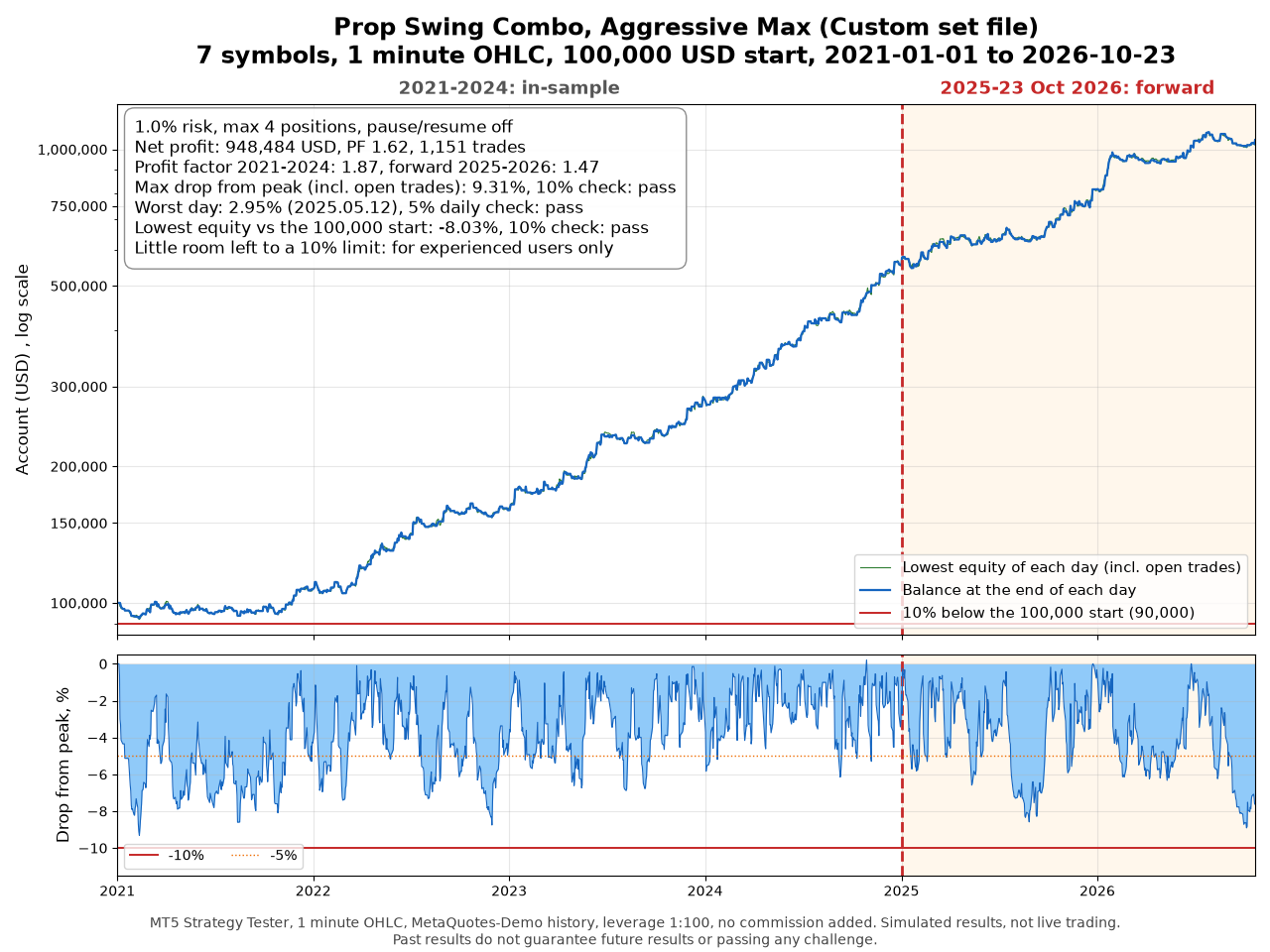
The honest answer to the 1 million question. On a 100,000 account, about 1 million USD of profit in six years is right at the edge of a 10% loss limit in this test, not inside it with room to spare. The runs above 1 million either broke 10% (A3 at 1.2% risk: 10.11%) or came within 0.13% of it (A7: 1,179,012 USD at 9.87%, while the next steps up in risk or positions, A3 and A5, broke 10%). A result that sits that close to the line on old data will cross it on new data sooner or later, so I did not use it. The highest result that kept some room was A2 with 948,484 USD at 9.31%, which becomes the Aggressive Max set file. Commission would take about 32,000 USD from it. Its equity was also 8.03% below the start in February 2021, so on a new challenge it was less than 2% away from failing in its first weeks.
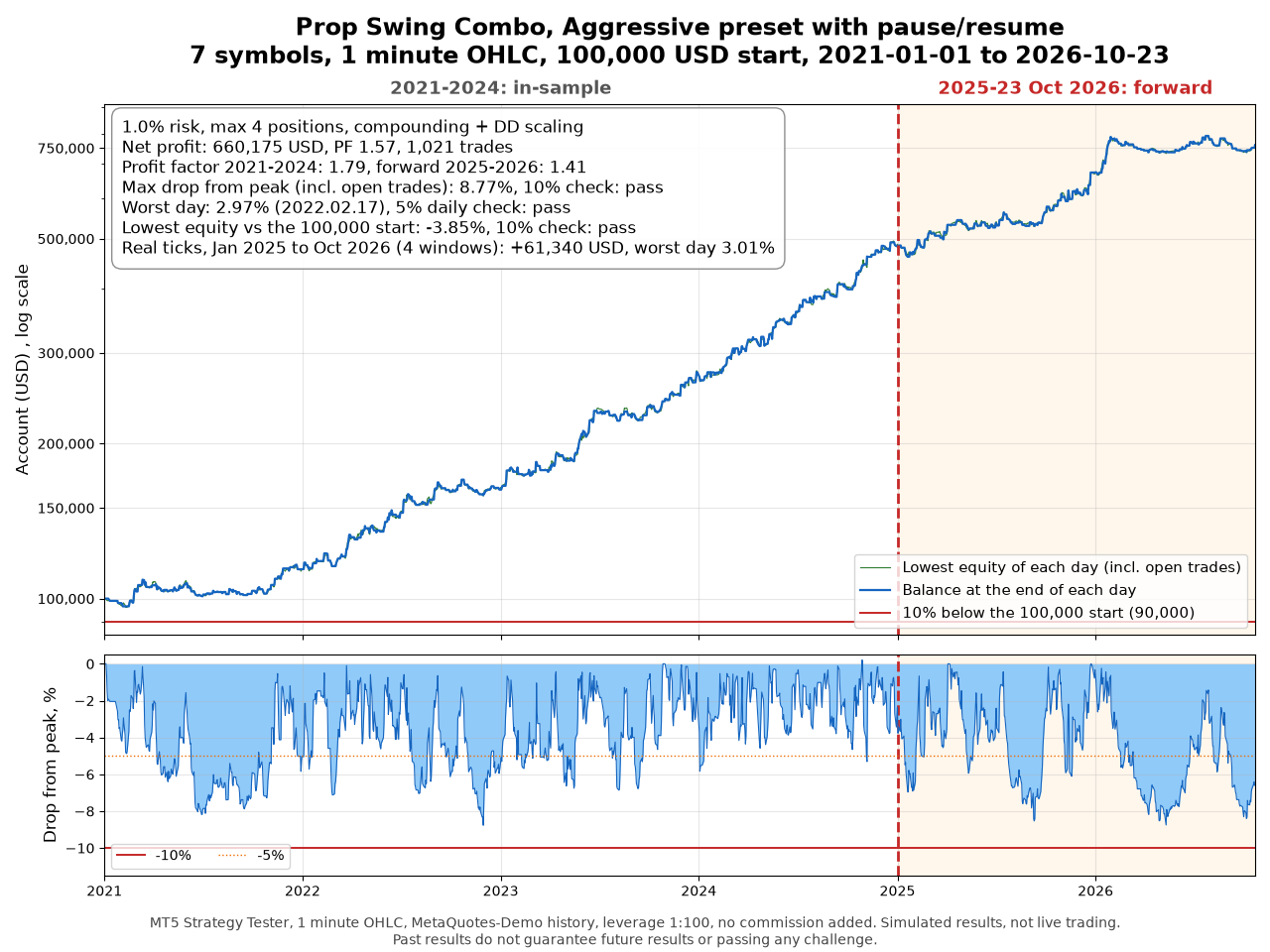
Pause and resume changes the picture for a challenge. At the same risk (A6 against A2) it earns less, 660,175 against 948,484 USD, with a similar peak drawdown, but the equity never went more than 3.85% below the start, against 8.03%. For a challenge, the distance to the static loss line in the first weeks matters more than the final profit, so A6 became the Aggressive preset.
One more point about these totals: they compound one account for six years. A funded account normally pays out its profits, so a real account will not grow like this. Please read the drawdown and the worst day as the risk level of a preset, and not the final profit as a forecast.
The presets
| Preset | Settings | Net profit | PF in-sample / forward | Max drawdown | Worst day | Lowest equity | Trades | Commission est. |
|---|---|---|---|---|---|---|---|---|
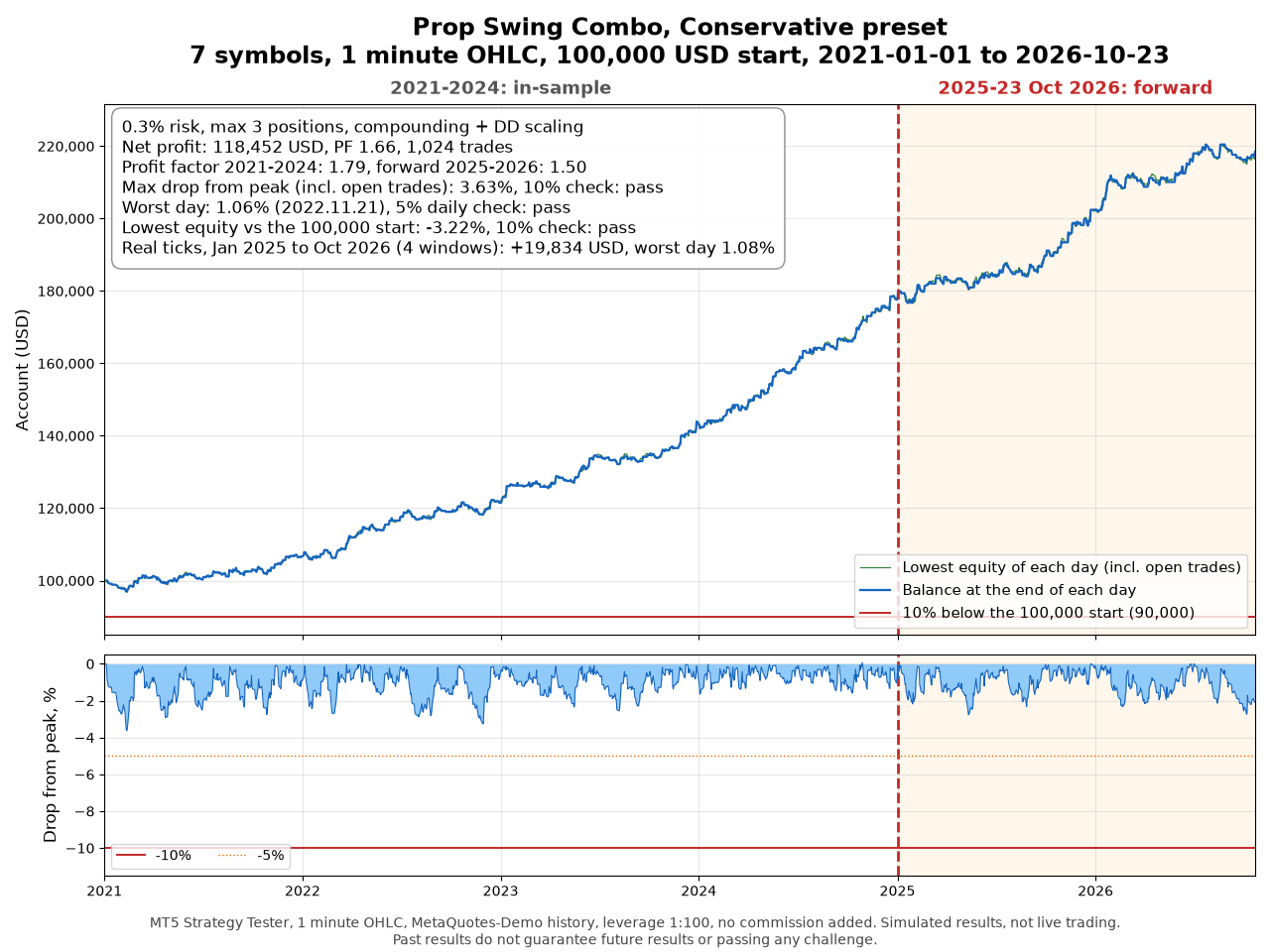
| Conservative | 0.3% risk, max 3 positions | +118,452 | 1.79 / 1.50 | 3.63% | 1.06% | -3.22% | 1,024 | 3,868 |
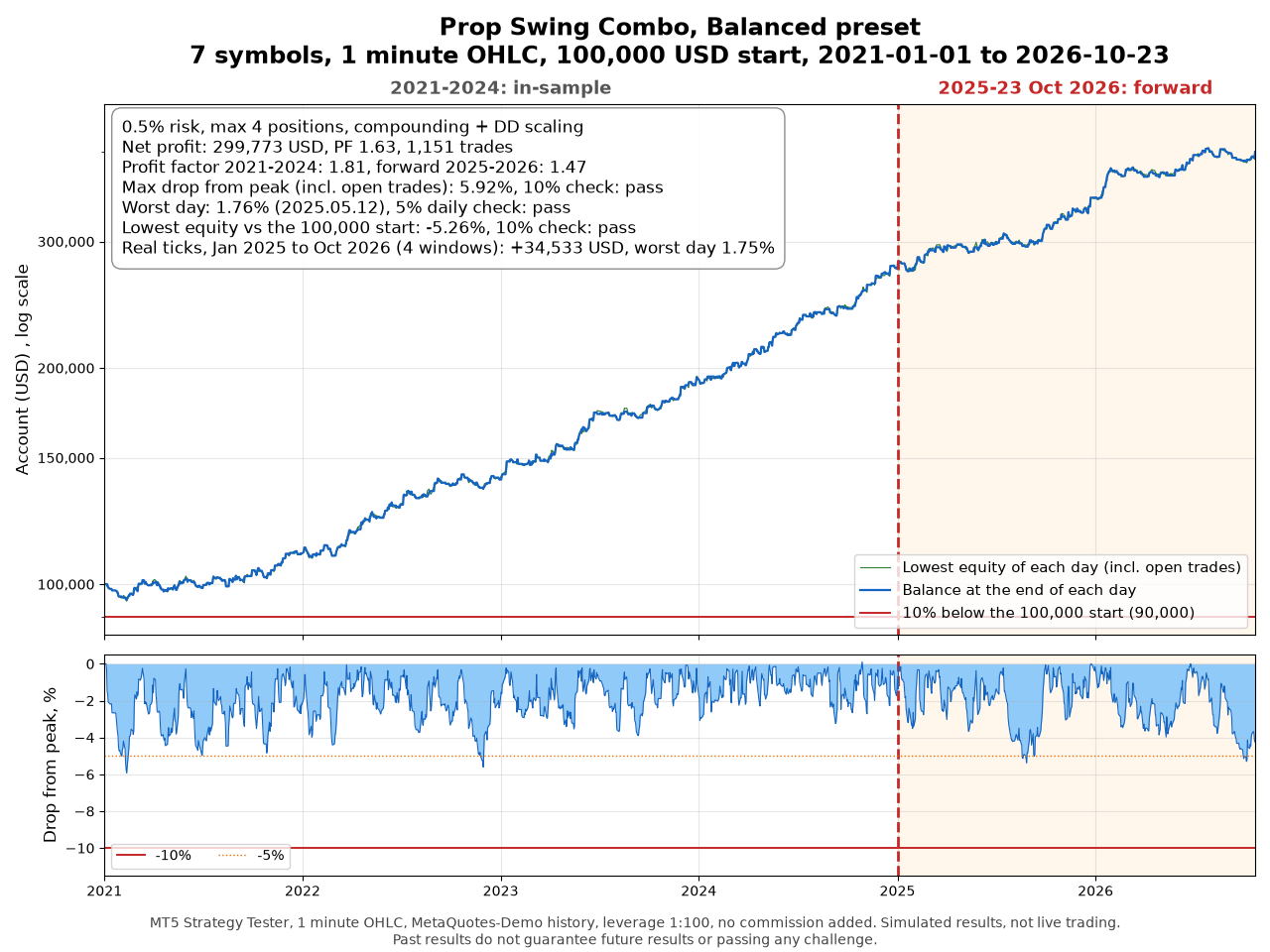
| Balanced | 0.5% risk, max 4 positions | +299,773 | 1.81 / 1.47 | 5.92% | 1.76% | -5.26% | 1,151 | 10,093 |
| Aggressive + pause/resume | 1.0% risk, max 4 positions | +660,175 | 1.79 / 1.41 | 8.77% | 2.97% | -3.85% | 1,021 | 23,653 |
| Aggressive Max (Custom set file) | 1.0% risk, max 4 positions, pause/resume off | +948,484 | 1.87 / 1.47 | 9.31% | 2.95% | -8.03% | 1,151 | 32,374 |
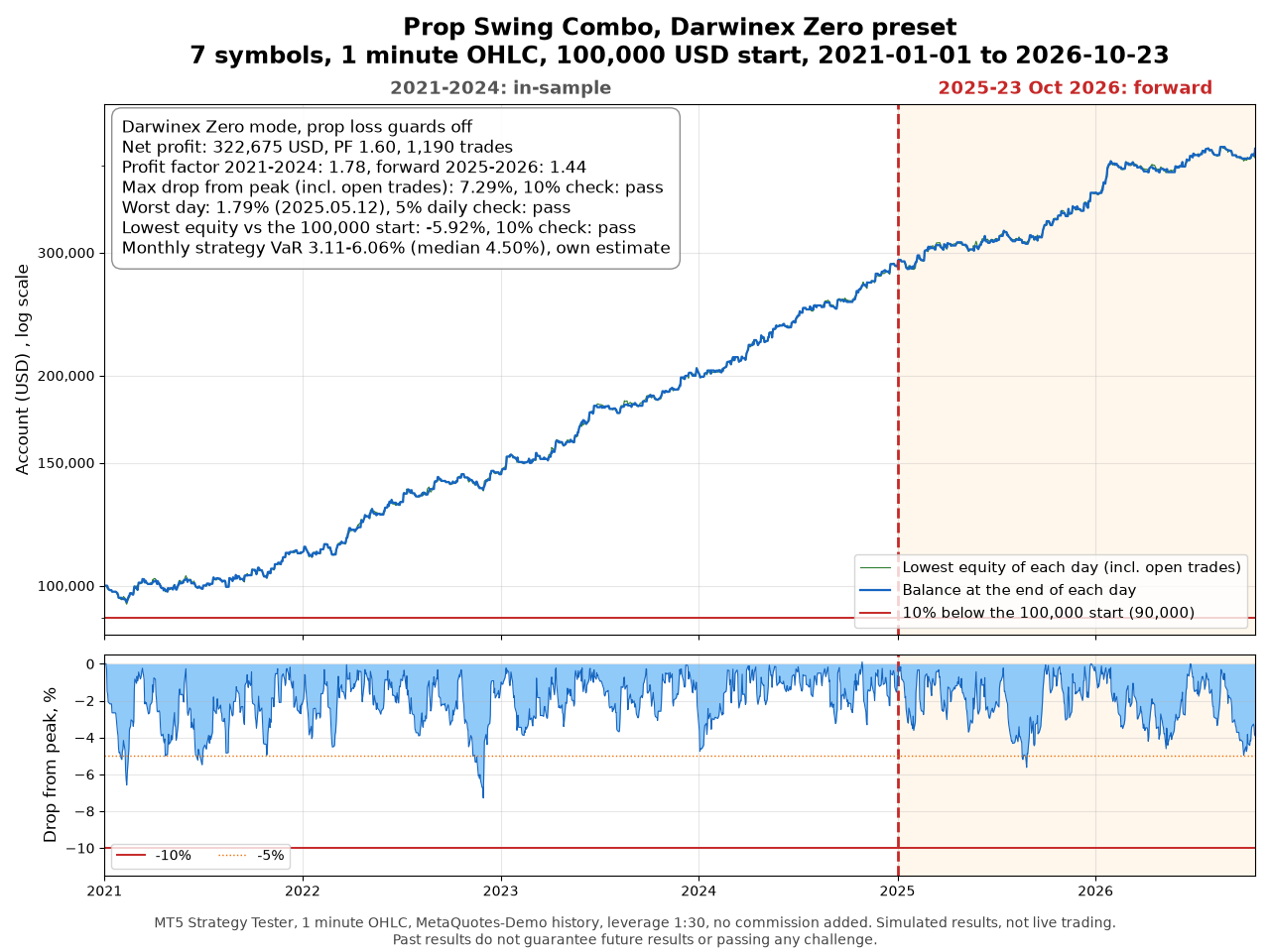
| Darwinex Zero | 0.5% risk, max 6 positions, leverage 1:30 | +322,675 | 1.78 / 1.44 | 7.29% | 1.79% | -5.92% | 1,190 | 11,127 |
For comparison, the earlier settings with a fixed risk based on the starting balance made 57,139 USD (Conservative), 87,267 USD (Balanced) and 143,144 USD (Aggressive) in the same test, with a maximum drawdown of 2.98%, 4.52% and 6.96%. The current presets carry more risk, and the drawdowns are higher too, so please pick the preset for the room your account has.
Net profit per calendar year in USD (2026 until 23 October):
| Preset | 2021 | 2022 | 2023 | 2024 | 2025 | 2026 |
|---|---|---|---|---|---|---|
| Conservative | +6,645 | +14,837 | +22,465 | +33,698 | +24,767 | +15,601 |
| Balanced | +10,368 | +29,469 | +54,195 | +81,197 | +70,040 | +49,708 |
| Aggressive + pause/resume | +14,019 | +48,769 | +112,579 | +208,536 | +188,474 | +84,204 |
| Aggressive Max | +7,090 | +52,981 | +123,714 | +271,801 | +260,451 | +218,803 |
| Darwinex Zero | +11,561 | +32,838 | +59,422 | +83,008 | +78,609 | +50,540 |
Every year was positive for every preset. The forward years have a lower profit factor than the in-sample years, which is what you would expect after an optimisation.
Real-tick check of the forward period
1 minute OHLC can be too kind to a strategy, so I ran 1 January 2025 to 23 October 2026 again with "Every tick based on real ticks", in four windows. Each window started fresh from 100,000 USD, like a new account, so the compounding and the pause and resume history start again in every window.
| Window | Conservative, real ticks (1m OHLC) | Balanced, real ticks (1m OHLC) | Aggressive, real ticks (1m OHLC) | Aggressive worst day | Aggressive lowest equity |
|---|---|---|---|---|---|
| Jan to May 2025 | +2,622 (+2,500) | +6,726 (+6,526) | +10,481 (+11,178) | 2.26% | -5.18% |
| Jun to Oct 2025 | +6,152 (+4,629) | +11,443 (+9,898) | +19,291 (+15,329) | 3.01% | -0.99% |
| Nov 2025 to Mar 2026 | +8,107 (+8,194) | +9,903 (+12,391) | +22,081 (+22,453) | 1.99% | -2.53% |
| Apr to Oct 2026 | +2,953 (+3,029) | +6,461 (+6,557) | +9,487 (+8,978) | 1.96% | -2.32% |
| Total | +19,834 (+18,352) | +34,533 (+35,372) | +61,340 (+57,938) | max 3.01% | min -5.18% |
Real ticks came out close to 1 minute OHLC. Every window of the three presets stayed inside a 5% daily and a 10% maximum loss rule. The first window was the hardest for Aggressive: equity went 5.18% below the window start, because a fresh start has no pause and resume history yet and the drawdown cut only begins 2% below the peak.
How long does a target take?
I took the daily equity of each run and simulated a new challenge on the first trading day of every month. A start failed if equity dropped 10% below it or one day lost 5% of it, and passed when equity reached the target.
| Preset | +5%: median / slowest | +8%: median / slowest | +10%: median / slowest | +10% within 30 / 60 days | Failed starts (of 65) |
|---|---|---|---|---|---|
| Conservative | 103 / 319 days | 191 / 369 days | 223 / 445 days | 0 / 0 | 0 |
| Balanced | 57 / 271 days | 92 / 327 days | 115 / 334 days | 0 / 5 | 0 |
| Aggressive + pause/resume | 38 / 260 days | 52 / 268 days | 67 / 318 days | 9 / 28 | 0 |
| Darwinex Zero (for comparison) | 55 / 271 days | 88 / 319 days | 113 / 332 days | 1 / 5 | 0 |
Days are calendar days, and starts too late in the data to reach the target are left out. Each start continues the running account, so the lot size and the pause and resume state are those of that moment, which is a little kinder than a brand new account. Even with Aggressive most starts needed more than a month for +10%. These presets suit challenges without a short time limit better than fast challenges, and the risk should not be raised just to reach a target sooner.
The Darwinex Zero mode
A Darwinex Zero account works differently from a prop challenge. There is no daily loss line to protect. Darwinex builds a DARWIN from the strategy and scales it to its own risk target, based on the monthly value at risk (VaR) of the strategy, so the investable result depends much more on how steady the risk is than on how high the return is. A strategy whose risk jumps around gets scaled up and down all the time, and that costs it. This is how I approached the mode, based on the public Darwinex Zero documentation:
- AccountMode = Darwinex Zero switches off the prop loss guards (DZUseDailyGuard can switch the daily guard back on).
- The risk per trade is a fixed percent of the current balance (DZMaxTradeRiskPct, 0.5% in the preset), without the drawdown cut, because the cut would make the risk less steady.
- At most 6 open positions (DZMaxPositions) and at most 6% total loss at the stops (DZMaxOpenRiskPct).
- An optional cap on the daily volatility of each position, D1 ATR in percent of the balance (DZVolPct, 2% in the preset, which only acts in very volatile markets).
- A safety stop that closes everything at a 20% drop from the balance peak (DZMaxDDPct).
- Plain Darwinex Zero symbol names and a leverage of 1:30 or less.
I expected sizing every trade by volatility to give the steadiest risk, and tested it at several levels. It did not win. The stops of the strategy are already based on volatility, so the extra sizing mostly made the positions smaller in a less useful way. To compare the variants I estimated the monthly strategy VaR from the daily equity (95%, last 45 days with exposure) and rebuilt a DARWIN-like curve that is scaled to a 6.5% VaR target. Over the full period:
| Variant | Net profit | Max drawdown | Median monthly VaR | VaR variation (CV) | Scaled curve: return per year | Scaled curve: max drawdown | Return / drawdown | Peak leverage |
|---|---|---|---|---|---|---|---|---|
| Volatility sizing 0.45% | +181,722 | 4.80% | 3.41% | 0.183 | 30.2% | 6.59% | 4.59 | 3.6 |
| Volatility 0.60%, stop risk cap 0.5% | +213,303 | 5.82% | 3.79% | 0.161 | 30.6% | 6.42% | 4.77 | 4.2 |
| Volatility 0.75%, stop risk cap 0.5% | +244,245 | 6.61% | 4.06% | 0.159 | 30.8% | 6.45% | 4.77 | 4.6 |
| Stop risk 0.5%, volatility cap 1.0% | +267,159 | 7.27% | 4.29% | 0.150 | 31.4% | 6.56% | 4.79 | 5.0 |
| Stop risk 0.4%, 8 positions | +217,408 | 5.92% | 3.59% | 0.147 | 33.7% | 6.08% | 5.55 | 4.9 |
| Stop risk 0.5%, 6 positions (preset) | +322,675 | 7.29% | 4.50% | 0.148 | 33.7% | 6.00% | 5.62 | 5.7 |
The plain version came out ahead: its VaR was as steady as the 0.4% version (variation 0.148 against 0.147) and steadier than all volatility sized versions, its return per drawdown after scaling was the highest (5.62), and its peak leverage was 5.7, far below the 1:30 limit. That became the Darwinex Zero preset.
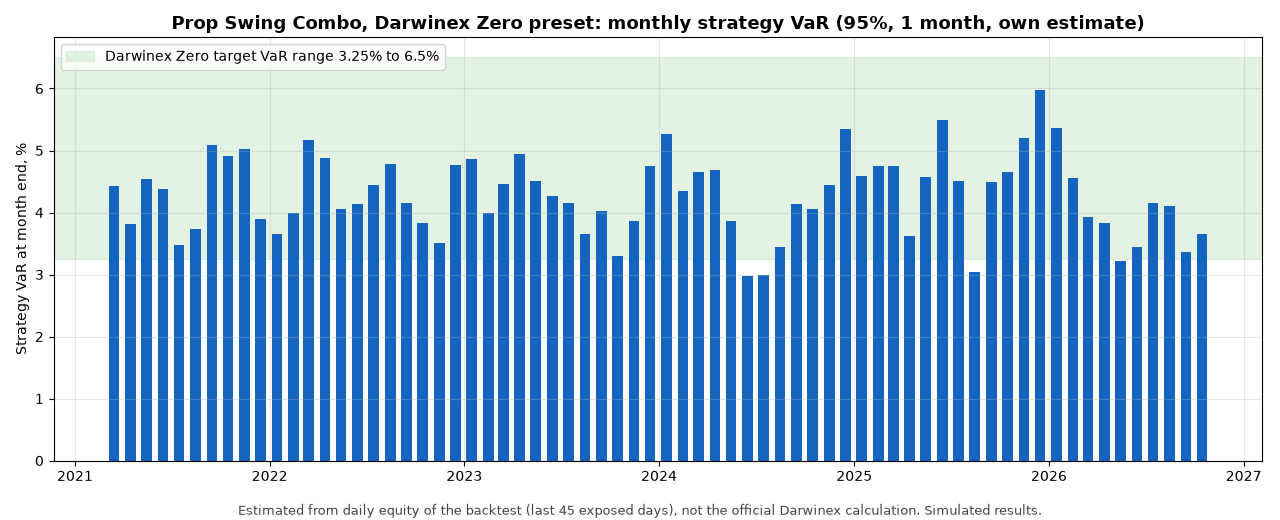
Month by month, the estimated strategy VaR of the preset stayed between 3.11% and 6.06%, with a median of 4.50%. At 67 of the 68 month ends it was inside the 3.25% to 6.5% range, and once it was just below (3.11%). The yearly medians ranged from 4.05% to 4.75%. Please keep in mind that this is my own estimate from the daily equity of a backtest, not the official Darwinex calculation. It says nothing about a future D-Score, about passing the calibration or about any allocation.
How to use the set files
- Download the .set file you want from the attachments at the end of this post.
- Open any one chart (symbol and timeframe do not matter) and attach Prop Swing Combo. Only one chart per account.
- In the inputs window click "Load" and pick the .set file. In the Strategy Tester it works the same way: Inputs tab, right click, Load.
- Set StartingBalance to your account size, for example 100000. If you leave it at 0, the EA uses the balance when it is first attached and remembers it. On a challenge that is already running, enter the original size, not today's balance.
- Check DayResetHour against the daily reset of your firm and your server time, and the guard levels against your rules. If your firm measures the daily loss from the higher of balance and equity, set DailyReference to that.
- For Darwinex Zero, load PropSwingCombo_DarwinexZero.set and use the leverage of your Darwinex Zero account (1:30 or less).
- Check the dashboard: all 7 symbols should be listed as found. If one is missing, add it in SymbolOverrides.
- Run it in the tester with your broker's data first, then on a demo account.
Caveats, please read these
- No guarantee of passing anything. These are backtests. A challenge is a live account with live spreads, slippage and gaps, and the past does not repeat exactly.
- Not prop firm data. All tests ran on MetaQuotes-Demo history. Spreads, swaps, commission and symbol specifications on your account will be different.
- The forward period is not fully blind. I looked at 2025 to 2026 when I chose the symbols and the risk levels. The strategy settings and the pause and resume rule were tuned on 2021 to 2024 only.
- Compounding makes the totals look large. The six-year totals assume that all profit stays in one account. That is not how funded accounts work.
- Aggressive Max has little room. Its equity went 8.03% below the start in the first weeks of the test. Use it only if you understand that.
- Only its own trades count. The guard sees the trades of this EA only. Manual trades or other EAs on the same account are not inside its limits.
- The guard needs a running terminal. If MT5 is offline, it cannot close anything. A VPS is recommended.
- A running challenge has less room. If your account is already 4% down, the 10% line is only 6% away, and the Aggressive presets are not a good idea there.
- Not affiliated. Prop Swing Combo is not connected to, endorsed by or approved by any prop firm, Darwinex or Darwinex Zero.
Files
Five .set files are attached below as separate files: PropSwingCombo_Conservative.set, PropSwingCombo_Balanced.set, PropSwingCombo_Aggressive_PauseResume.set, PropSwingCombo_AggressiveMax_Custom.set and PropSwingCombo_DarwinexZero.set. They set AllowMinLot to false, exactly as in the tests. Questions, or your own test results with your own data, are very welcome in the comments.